Japan
Emperor Taishō
Crown Prince (1889–1912), Emperor of Japan (1912–1926)
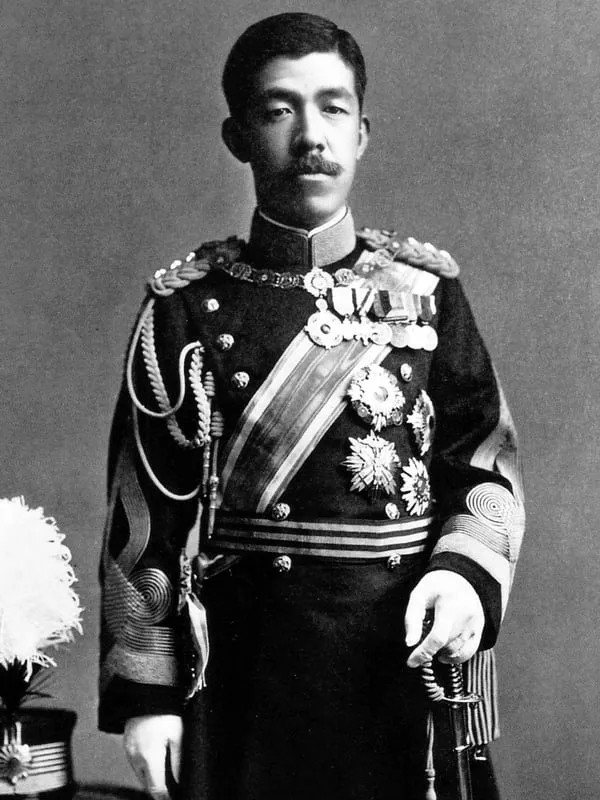
- Born:
- 31 August 1879, Tokyo (Aoyama Palace, Japan)
- Died:
- 25 December 1926, Hayama (Kanagawa Prefecture)
- Author:
- Łukasz
- Photo:
- 宮内省(Imperial Household Agency), domena publiczna, Wikimedia Commons

Yoshihito, known by his posthumous name as Emperor Taishō, reigned in Japan for fourteen years, between the great Emperor Meiji and his own son Hirohito, in whose name Japan went to war. He was the weakest of the three modern rulers: sickly from childhood and without political talent, from 1919 he was unable to perform any duties at all. In 1921 his son took over power as regent. Yet his reign was a turning point for Japan. The country sided with the victors in the First World War, joined the ranks of the great powers and built up its position in China, while at home power shifted from the old oligarchs to the political parties. This period, called “Taishō democracy”, ended a few years after his death. The emperor’s weakness, moreover, showed how much the constitutional power of the throne depended on the men who spoke in its name.
The sickly son of Emperor Meiji
He was born on 31 August 1879 in the Aoyama Palace in Tokyo, the third son of Emperor Meiji, Mutsuhito. His mother was a court concubine, Naruko Yanagiwara, but by custom the childless Empress Haruko (Shōken) was officially regarded as his mother. His two elder brothers died in infancy, and Yoshihito turned out to be the only son of the emperor to survive childhood. On 6 September he was given the name Yoshihito and the princely title Haru-no-miya. A few weeks after his birth he suffered a serious illness, diagnosed as meningitis, and for several months the doctors feared for his life. Like all imperial children, he was sent to be brought up in the household of a courtier, Marquis Tadayasu Nakayama, Emperor Meiji’s maternal grandfather. He did not begin to walk until he was three.
In 1885 he returned to court, where he was taught at a special school set up in the palace for him and a dozen or so children of his age, and from 1887 at the Gakushūin, the school for the aristocracy. On 31 August 1887, his eighth birthday, he was designated heir to the throne, and on 3 November 1889 he was formally proclaimed Crown Prince. He was often ill, had to repeat a year and struggled with subjects that required abstract thinking. After he was proclaimed Crown Prince, the military took charge of his upbringing. In 1891 General Yasukata Oku became the first head of his aides-de-camp. The harsh military regime damaged the boy’s health still further, and in 1894 it was decided that he would leave the Gakushūin after the first year of middle school. He continued to be taught privately in the Akasaka Palace: history, Japanese literature, Chinese poetry and French.
The turning point came in 1898. Prime Minister Hirobumi Itō persuaded the emperor that what the Crown Prince needed above all was health and experience, not cramming. Field Marshal Iwao Ōyama became head of the Crown Prince’s household, and his upbringing was entrusted to Prince Takehito Arisugawa, who put the emphasis on rest and travel. Yoshihito began to attend sittings of the House of Peers, received foreign diplomats and liked to slip French words into conversation, which irritated his father.
Crown Prince
On 10 May 1900 he married the fifteen-year-old Sadako Kujō of the aristocratic Kujō family, chosen after his earlier engagement to a princess of the Fushimi family had been broken off over suspicions of tuberculosis. The marriage proved fruitful. Hirohito was born in 1901, Yasuhito, later Prince Chichibu, in 1902, Nobuhito, Prince Takamatsu, in 1905, and Takahito, Prince Mikasa, in 1915. Yoshihito was the first emperor in centuries to have no concubines, although nothing formally prevented him. He was an affectionate father, but in keeping with custom his sons were brought up away from home.
After his marriage his health improved markedly. Between 1900 and 1912 he made many journeys around the country and visited every prefecture except Okinawa. The photographs of the Crown Prince and his family distributed on these occasions were a novelty that brought the court closer to its subjects. During the war with Russia he held the ranks of colonel in the army and captain in the navy and was attached to Imperial General Headquarters. At the end of 1904 the deputy chief of the General Staff, Gentarō Kodama, proposed making him head of the command of the forces on the continent, but Prime Minister Tarō Katsura and the Army Minister, Masatake Terauchi, blocked the idea.
In October 1907, on the initiative of the Resident-General in Korea, Hirobumi Itō, Yoshihito became the first Japanese crown prince to travel abroad. Accompanied by Admiral Heihachirō Tōgō, Katsura and Prince Arisugawa, he visited Seoul, where he was received by the new emperor, Sunjong, and at Itō’s residence he met Gojong, who had been forced to abdicate a few months earlier. The visit was meant to demonstrate the friendship of the two dynasties, but it took place in a country that had been a Japanese protectorate since 1905 and in which an uprising against the Japanese was under way. A few weeks later the young Korean crown prince, Yi Un, left for Tokyo to be educated – in practice as a hostage. Yoshihito grew fond of the boy and began to learn Korean, which he kept up even as emperor. Three years later Korea ceased to exist as a state when it was annexed by Japan.
Emperor Taishō
According to the official announcement Emperor Meiji died on 30 July 1912, and on the same day Yoshihito ascended the throne as the 123rd emperor. A new era was proclaimed: Taishō, “great righteousness”. At his very first audience after his accession the new ruler stumbled while reading his speech. The senior statesmen, the genrō, led by Field Marshal Aritomo Yamagata, had no faith in his abilities from the outset and tried to keep him under control. Yoshihito repaid Yamagata with dislike and avoided him as much as he could. He preferred men with whom he could talk freely, such as Shigenobu Ōkuma or Takashi Hara, the future prime minister, whose diary is one of the most important sources on the emperor.
The first months of the reign brought a political crisis that ushered in the Taishō era. In the autumn of 1912 the emperor offered Katsura the rank of field marshal, which would have excluded him from party politics. Katsura declined, became prime minister himself in December and began to use imperial rescripts in his battles with parliament, which outraged the opposition and the crowds in Tokyo. In February 1913 he was forced to resign. In later government crises, too, the emperor rashly expressed views on candidates for prime minister before the genrō had spoken, and Yamagata rebuked him several times. These episodes strengthened the conviction that the emperor could have no real influence on politics.
During his reign Japan entered the First World War. On 23 August 1914 it declared war on Germany in the emperor’s name; in November it captured the German fortress of Tsingtao in the Jiaozhou leased territory and occupied Germany’s Pacific islands, and in 1915 it imposed the Twenty-One Demands on China. Yoshihito’s enthronement ceremony, postponed because of mourning for the late Empress Dowager, took place in November 1915 at the Kyoto Imperial Palace with a pomp the emperor himself would have preferred to avoid. In 1918 the British made him an honorary field marshal of the British Army, and Japan sent troops to Siberia as part of the intervention against the Bolsheviks. When rice riots swept the country in the summer of 1918, the emperor donated 3 million yen from his own fortune to relieve the needy. The riots brought down the Terauchi cabinet, and the new prime minister was Hara, leader of the Rikken Seiyūkai and the first head of government who was not an aristocrat. In 1919 Japan took part in the Paris Peace Conference as one of the five great powers.
Illness and regency
After the enthronement the emperor’s condition began to deteriorate, and from 1918 he was no longer able to attend manoeuvres, military ceremonies or rituals. He spoke with increasing difficulty and was losing his balance and his memory. In December 1919 he tried for the last time to prepare for the opening of the parliamentary session, but could not master the speech from the throne. On 30 March 1920 the Imperial Household Ministry announced for the first time that the emperor was ill, while concealing his real symptoms. At the end of 1921, after Hirohito’s return from his journey to Europe, the Lord Keeper of the Privy Seal, Masayoshi Matsukata, and the Imperial Household Minister, Nobuaki Makino, brought about the establishment of a regency. On 25 November 1921, three weeks after the assassination of Prime Minister Hara, the Crown Prince became regent. According to witnesses Yoshihito surrendered the seal reluctantly, and as late as December he was assuring those around him that there was nothing wrong with him.
He spent the last years of his life at the imperial villas at Hayama, Numazu and Nikkō. He was there on 1 September 1923, when the Great Kantō earthquake destroyed Tokyo. He was absent from his son’s wedding in January 1924 and from the celebrations of his own silver wedding anniversary in May 1925. During this time Japan, ruled in his name by the regent, signed the Washington Naval Treaty, withdrew its troops from Siberia and, in 1925, after the convention with the USSR, from northern Sakhalin as well. In 1923 Poland awarded the emperor the Order of the White Eagle, which the regent had received a year earlier. In 1925 universal male suffrage was introduced, together with the Peace Preservation Law, aimed at the communists.
In the autumn of 1926 the emperor fell ill with pneumonia. He died at Hayama at 1.25 a.m. on 25 December 1926, aged 47. Hirohito ascended the throne, and the new era was named Shōwa. The late emperor was given the name Emperor Taishō, and after a night-time funeral in February 1927 he was buried in the Tama Mausoleum at Hachiōji. He was the first emperor to be buried in Tokyo rather than near Kyoto. His wife, Empress Teimei, died in 1951.
The man and the legend
Many rumours circulated about Emperor Taishō. The most famous held that at the opening of parliament he rolled up the text of his speech and peered at the deputies through it as if through a telescope. The story, already current in the first years of the Shōwa era and punishable as lèse-majesté, exists in various versions and with various dates, and its truth cannot be established. According to one courtier’s account, the emperor simply wanted to check that he had rolled up the document properly. Historians such as Takahisa Furukawa stress that the image of a deranged ruler is unjust. The surviving documents show a kindly, spontaneous and direct man who liked wine, cigars, billiards, riding and Western dress, and who on his travels would look into ordinary homes and bars. He wrote more than 1,300 poems in the Chinese style, more than any other Japanese emperor. The causes of his illness are uncertain. The court physicians linked it to the illness he had suffered in infancy, while modern researchers such as the neuropsychologist Morihiro Sugishita suggest a neurodegenerative brain disease that gradually robbed him of speech, memory and motor control.
Significance
Yoshihito’s reign coincided with the years in which Japan won the status of a great power and, at home, seemed for a moment to be moving towards parliamentary government. The emperor’s illness contributed to both processes, because real power lay in the hands of ministers, the genrō and the court. But it also exposed the weakness of a system in which every decision was sanctified by the throne and in which no one but the emperor stood formally above both the government and the military command. When Hirohito came to the throne, his entourage, including the last genrō, Kinmochi Saionji, and Makino, wanted to make him the opposite of his father: an able monarch surrounded by veneration. In the years that followed the cult of the emperor became one of the pillars of Japanese militarism, and the army invoked his will ever more often to act over the heads of the government. The Taishō era, as many historians put it, was a brief liberal interlude between the Meiji oligarchy and the wartime Japan of the Shōwa era, which occupied Manchuria in 1931, began the war with China in 1937 and attacked the United States in 1941. Yoshihito’s great-grandson is the present Emperor of Japan, Naruhito.