Japan
Masatake Terauchi
Army Minister (1902–1911), Resident-General and first Governor-General of Korea (1910–1916), Prime Minister of Japan (1916–1918), Field Marshal
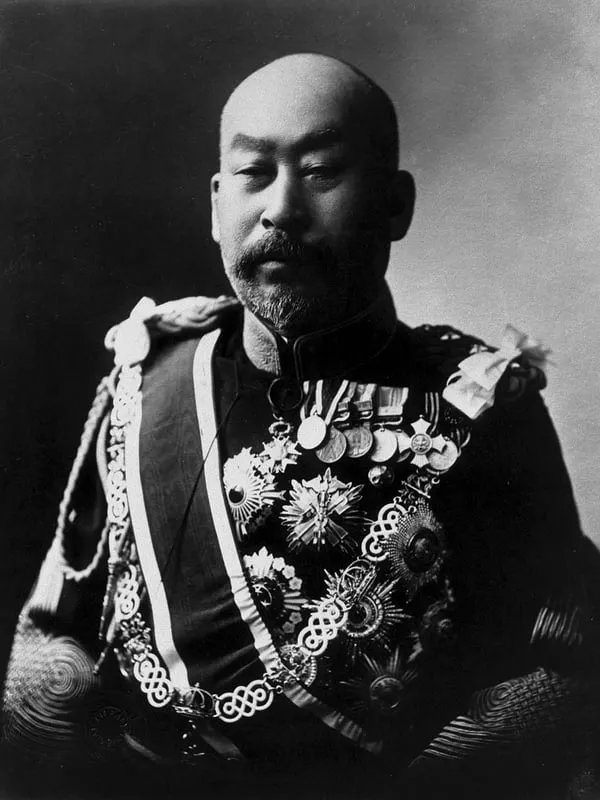
- Born:
- 25 March 1852, Hirai, Suō Province (today Yamaguchi, Japan)
- Died:
- 3 November 1919, Tokyo
- Author:
- Łukasz
- Photo:
- autor nieznany, domena publiczna, Wikimedia Commons

Masatake Terauchi was a soldier who scarcely ever commanded in the field and yet became one of the most powerful men in Japan in the Meiji and Taishō eras. For almost ten years, including the war with Russia, he ran the Army Ministry. In 1910 he carried out the annexation of Korea: it was he who on 22 August signed the treaty that abolished the Korean Empire, and he then governed the country for six years as its first Governor-General, basing his rule on the gendarmerie. As prime minister in 1916–1918 he extended Japanese influence in China and sent troops to Siberia. A protégé of Field Marshal Yamagata, he embodied an army that regarded Korea and Manchuria as Japan’s security zone. His “sabre rule” on the peninsula became a model for later Japanese administration on the Asian mainland.
A samurai from Chōshū
He was born on 25 March 1852 (by the old Japanese calendar the 5th day of the intercalary second month of the fifth year of the Kaei era; some sources wrongly give 5 February) in the village of Hirai in Suō Province, in the domain of Chōshū, as Jusaburō Utada, the third son of the samurai Masasuke Utada. He was adopted by his mother’s brother, Kan’emon Terauchi, whose surname he took. At twelve he joined one of the Chōshū volunteer units that fought against the shogunate, and at sixteen he campaigned through the Boshin War all the way to the Battle of Hakodate in 1869. He then studied soldiering in Kyoto under French instructors and joined the newly formed Imperial Army. In 1877, during the suppression of the Satsuma Rebellion, he was badly wounded at the Battle of Tabaruzaka and lost the use of his right arm. For the rest of his life he saluted with his left. He never again commanded troops in battle.
Instead he made a great career in military administration. From 1882 to 1886 he was in France, first as aide-de-camp to Prince Kan’in and then as military attaché. He served as commandant of the military academy, chief of staff of a division and head of the operations bureau of the General Staff. In the war with China of 1894–1895 he was responsible at Imperial General Headquarters for transport and communications, that is, for moving the troops to the mainland. In 1898 he became the first Inspector General of Military Training, and in 1900 Deputy Chief of the General Staff, supervising on the spot the operations of the Japanese contingent in China during the Boxer Rebellion. In the army he was regarded as a pedant, stern and meticulous; as commandant of the academy he was said to watch the cadets’ behaviour from his house through a telescope.
Army Minister
In 1902 he became Army Minister in the government of Tarō Katsura and held the post without a break, through three successive cabinets, until 1911. He was responsible for the mobilisation, reinforcement and supply of the army during the Russo-Japanese War, in which Japan put more than a million men into the field, and for reshaping the army after the victory. In 1906 he chaired the committee that founded the South Manchuria Railway Company, which ran the lines taken over from Russia under the Treaty of Portsmouth. In 1907 he was made a viscount. In the circle of Field Marshal Aritomo Yamagata, the army’s patron and leader of the faction rooted in Chōshū, he was regarded as his closest successor.
The annexation of Korea
After the assassination of Hirobumi Itō in Harbin in October 1909, Tokyo decided to speed up the absorption of Korea, which Japan had ruled as a protectorate since 1905. On 30 May 1910 Terauchi, while keeping the Army Ministry, became the third and last Resident-General in Korea, replacing the ailing Arasuke Sone. He arrived in Seoul on 23 July. Before he came, the Koreans had been made to hand over their police to the Japanese. Once there, he banned meetings, censored the press and ordered the preventive detention of suspects.
In mid-August he presented a draft treaty to the prime minister, Yi Wan-yong. He accepted Yi’s only significant demand, that the country keep the name Chosŏn and the monarch the title of king. On 18 August the Korean council of ministers approved the draft, and on 22 August, after a council held in the presence of Emperor Sunjong, who gave the prime minister full powers, Terauchi and Yi Wan-yong signed the treaty on the annexation of Korea in the Resident-General’s residence. That day the streets of Seoul were occupied by troops and gendarmes. The treaty was proclaimed on 29 August. According to one of his officials, on the evening after the signing Terauchi composed a poem asking how Kobayakawa, Katō and Konishi, the commanders of Toyotomi Hideyoshi’s invasion of Korea in the 16th century, would have looked at the moon that night. Koreans see it as proof that the annexation was viewed as the completion of an old conquest; some Japanese writers read it as a boast that it had been achieved without war.
The first Governor-General
On 1 October 1910 Terauchi took office as Governor-General of Chōsen, remaining Army Minister until August 1911. The Governor-General answered directly to the emperor, issued ordinances with the force of law, directed the administration and the courts, and could call on the army. Terauchi created a system in which police duties were performed by the military gendarmerie, supported by Korean auxiliaries. The gendarmes collected taxes, kept order and could impose floggings and fines without trial. Even officials and teachers wore uniforms and sabres. Koreans and historians call this period “sabre rule” (budan seiji).
In 1911 the authorities announced that they had uncovered a plot against the Governor-General’s life. Several hundred people were arrested, mostly Christians and members of the secret New People’s Association, and many were tortured. At first instance 105 defendants were convicted, which gave the case its name, but most were acquitted on appeal. For missionaries and the foreign press the trial became proof of the new regime’s brutality.
Terauchi built railways, roads, ports and schools, and his supporters praised his efficient administration and the growth in production. From 1910 to 1918 a great land survey was carried out. Land farmed without title deeds was taken over by the state and part of it then passed to Japanese companies and settlers. The Company Ordinance of 1910 required the Governor-General’s permission to set up a business, which held back Korean capital, and the Education Ordinance of 1911 subordinated the schools to the aim of raising “loyal subjects”. Korean political organisations were dissolved and newspapers closed. For the annexation Terauchi was made a count in 1911, and in June 1916 a field marshal.
The “Billiken” premier
In October 1916 Yamagata and the other genrō put him at the head of the government, passing over the candidate of the parliamentary majority. The Japanese nicknamed the cabinet of soldiers and bureaucrats the Billiken cabinet: the premier’s bald head recalled a fashionable doll, and the name sounded like hirikken, “unconstitutional”. Japan was then taking part in the First World War on the side of the Entente. Terauchi’s government sent destroyers to the Mediterranean in return for secret British, French and Russian promises that after the war Japan would keep the German rights it had seized in Shandong and the islands in the Pacific.
Terauchi’s most personal achievement was his China policy. His envoy Kamezō Nishihara, a businessman whom the premier knew from Korea, arranged loans in 1917–1918 for the government of Duan Qirui in Beijing, totalling some 145 million yen, in return for rights to railways, mines and forests in Manchuria and Shandong. In the autumn of 1917, in the Lansing–Ishii Agreement, the United States recognised Japan’s “special interests” in China. After the Bolshevik seizure of power, generals around Giichi Tanaka demanded an expedition to Siberia. Terauchi held back for a long time until he had Washington’s consent, but on 2 August 1918 he announced the Siberian Intervention. Contrary to what had been agreed, the army expanded it to more than 70,000 men. The announcement of the expedition coincided with a steep rise in the price of rice, and in the summer of 1918 rice riots swept the whole country. The government put them down with the army, but the premier, already ill, resigned on 21 September 1918. He was succeeded by Takashi Hara, Japan’s first fully party-based prime minister.
Last months and legacy
Terauchi suffered from heart disease and diabetes. He died in Tokyo on 3 November 1919, aged 67. A few months earlier, in March 1919, the Korea he had annexed rose against Japanese rule in the nationwide March First Movement, which was crushed by the army and the gendarmerie. His successors replaced the gendarmerie with an ordinary police force and proclaimed a milder “cultural rule”, without, however, changing the goal of assimilating the Koreans. Part of the Korean holdings of the library he founded in his native Yamaguchi was handed over to a university in South Korea at the end of the 20th century. His son Hisaichi Terauchi, also a field marshal, was Army Minister in 1936–1937 and during the Second World War commanded the Japanese forces in South-East Asia.
In the history of the road to the Second World War, Terauchi is the man who turned victory over Russia into lasting conquest. The model of Governor-General he created – a soldier ruling a colony independently of the government and parliament – entrenched in the army the conviction that the Asian mainland was its domain. It was from Korea that Japanese troops crossed the Yalu into Manchuria in 1931, and the policy of loans and special rights in Manchuria that he pursued as premier prepared the ground for conflict with Chinese nationalism.
Sources
Mentioned in battles
(01)Often appears with
People who appear in the same events.