Germany, United States
Wernher von Braun
Technical director of the Peenemünde centre (1937–1945), SS-Sturmbannführer (1943), Director of NASA’s Marshall Space Flight Center (1960–1970)
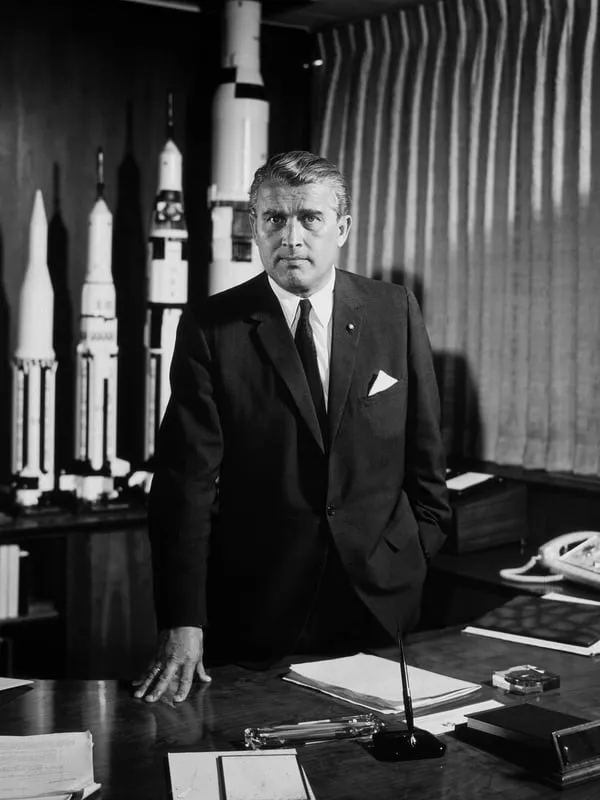
- Born:
- 23 March 1912, Wyrzysk (Province of Posen, Prussia)
- Died:
- 16 June 1977, Alexandria (Virginia, United States)
- Author:
- Łukasz
- Photo:
- NASA/MSFC, domena publiczna, Wikimedia Commons

Wernher von Braun was the most important rocket designer of the twentieth century and at the same time one of the most ambiguous figures of his age. As technical director of the military research centre at Peenemünde he led the development of the A4 rocket, the first long-range ballistic missile in history, which Germany fired at London and Antwerp in 1944–1945 as the V-2 “vengeance weapon”. He was a member of the Nazi Party (NSDAP) and an SS officer, and the rockets he designed were built in an underground factory by prisoners of the Mittelbau-Dora concentration camp, thousands of whom died there. After the war the Americans took him to the United States, where he built the first American ballistic missiles, put the first American satellite into orbit and created the Saturn V rocket that carried men to the Moon.
Childhood and youth
He was born on 23 March 1912 in Wyrzysk (German: Wirsitz) in the Prussian Province of Posen, the second of three sons of Magnus Freiherr von Braun, a Prussian civil servant and landowner, and Emmy, née von Quistorp. After the First World War Wyrzysk became part of Poland, and the family moved to Berlin. His father made a career in the civil service; in 1932–1933 he was Reich Minister of Agriculture in the conservative governments of Franz von Papen and Kurt von Schleicher.
His mother gave the boy a telescope and awakened his interest in astronomy. The real turning point was reading Hermann Oberth’s book on rockets as a means of travel into interplanetary space. A pupil weak at mathematics, he set about learning it so that he could build rockets. He took his school-leaving examination at a boarding school on the island of Spiekeroog, and from 1930 studied mechanical engineering at the technical university in Berlin-Charlottenburg, with one semester in Zurich. He belonged to the Berlin Society for Space Travel (Verein für Raumschiffahrt), whose members tested small liquid-fuel rockets at a suburban “rocket airfield” in Reinickendorf, and he assisted Oberth in his engine experiments.
In the army’s service
The amateurs’ experiments attracted the interest of the military. The Treaty of Versailles did not ban rockets, which could become a way of circumventing the restrictions imposed on German artillery. On 1 December 1932, even before Hitler came to power, the twenty-year-old von Braun became a civilian employee of the Army Ordnance Office and began work at the Kummersdorf proving ground near Berlin, under the then Captain Walter Dornberger. In 1934 he received a doctorate in physics from the University of Berlin; the public dissertation dealt with combustion tests, while the real one, describing the design of a liquid-fuel rocket, was classified and was published only in 1960. In December 1934 two of his A2 rockets were launched from the island of Borkum and climbed to more than 2 km.
When the Kummersdorf range proved too small, the army and the Luftwaffe built a joint research centre at Peenemünde on the island of Usedom. From 1937 the twenty-five-year-old von Braun was technical director of the army’s part of the site. He led a team that at its peak numbered thousands of engineers, technicians and workers, and directed work on the A3 and A5 rockets and, above all, the A4: a fourteen-metre missile with a range of about 300 km, carrying almost a tonne of explosive.
The Nazi Party and the SS
Von Braun was no ideologue, but nor did he stand aside from the regime. On 12 November 1937 he applied to join the Nazi Party and was admitted with membership backdated to 1 May 1937. On 1 May 1940 he joined the SS with the rank of Untersturmführer (second lieutenant); according to some researchers he had already belonged to an SS riding unit in Berlin in 1933–1934. He was promoted three times in the SS, the last time on 28 June 1943 to Sturmbannführer (major). After the war he claimed that he had joined the SS under pressure from Himmler, that his membership was a formality and that he had worn the uniform only once or twice. Historians, including his biographer Michael Neufeld, believe he was driven above all by ambition: membership of the party and the SS eased his career and helped him obtain resources for the programme, and von Braun was prepared to pay that price.
The A4 rocket and Hitler
On 3 October 1942 the first successful launch of an A4 rocket proved that the missile could fly nearly 200 km and climb to an altitude of more than 80 km. Adolf Hitler, however, long remained sceptical about rockets. He was won over only by a presentation at the Wolf’s Lair on 7 July 1943, when Dornberger and von Braun showed him a film of a successful launch. Hitler gave the programme the highest armaments priority and personally conferred the title of professor on the thirty-one-year-old designer.
That decision opened the way to mass production, and mass production meant slave labour. From June 1943 concentration camp prisoners worked at Peenemünde, and after the British air raid on the centre on the night of 17–18 August 1943 production was moved to the underground Mittelwerk factory in the Kohnstein hill near Nordhausen. The tunnels were dug and the rockets assembled by prisoners of the Mittelbau-Dora camp, which was run by the SS and directed on Himmler’s behalf by SS General Hans Kammler. Of the roughly 60,000 prisoners of the complex, an estimated 16,000 to 20,000 died. More people died building the rockets than were killed by the rockets themselves.
Von Braun’s role is well documented. He was not the camp commandant and was not responsible for the prisoners’ living conditions, but he knew what they were like. By his own account, he visited the Mittelwerk a dozen or more times. In August 1944 he personally selected skilled prisoners at Buchenwald to work for his team. He saw the emaciated men in the tunnels, and several former prisoners testified years later that he had been present at executions or punishments of prisoners; these accounts could not be conclusively confirmed. There is no trace of his ever having protested against any of it.
In March 1944, after he had refused Heinrich Himmler closer cooperation with the SS, the Gestapo arrested him together with his brother Magnus and two colleagues on charges of defeatism and of preparing to flee to England; the denunciation concerned conversations in which von Braun had said he would rather build spaceships than weapons. He was released after two weeks thanks to the intervention of Dornberger and the armaments minister Albert Speer, who convinced Hitler that without von Braun the programme would grind to a halt. After the war the arrest served him as proof of his distance from the regime.
The first operational A4s, christened the V-2 by Joseph Goebbels’s propaganda, were fired at Paris and London on 8 September 1944. By March 1945 the Germans had launched more than 3,000 rockets, mainly at London and Antwerp, killing some 5,000–9,000 people, most of them civilians. According to witnesses, when von Braun learned of the first hits on London he remarked that the rocket had worked perfectly, except for landing on the wrong planet. After the war the remark was often quoted as evidence of his indifference to the victims or, on the contrary, of his dreams of space; its authenticity is uncertain.
Surrender and Operation Paperclip
At the beginning of 1945, as the Red Army approached Peenemünde, von Braun and his closest colleagues decided to give themselves up to the Americans rather than the Russians. The team was moved first to Thuringia and then in April, on Kammler’s orders, to Bavaria; some of the documentation was hidden in an abandoned mine. On 2 May 1945, on the border between Bavaria and the Austrian Tyrol, near the Oberjoch Pass and the small town of Reutte, Wernher’s brother Magnus cycled up to a soldier of the American 44th Infantry Division and announced that his brother had invented the V-2 and that they wanted to surrender. Dornberger surrendered with them.
The Americans, who under Operation Overcast and then Operation Paperclip were trying to secure German specialists before they fell into Soviet hands, removed about a hundred sets of rocket components from the Mittelwerk. In September 1945 von Braun flew to the United States, and over the following months more than a hundred engineers from Peenemünde joined him. American officials knew of their past in the Nazi Party and the SS, but played it down: personnel files were “sanitised” so that the specialists could stay in the country. Dornberger spent two years as a British prisoner before he too went to the United States. Von Braun’s colleague Arthur Rudolph, production director at the Mittelwerk during the war, left the United States in 1984 and renounced his citizenship after the US Department of Justice accused him of complicity in the exploitation of Dora prisoners.
In the United States
Von Braun’s team worked first at Fort Bliss in Texas and launched captured V-2s at the White Sands proving ground in New Mexico. In 1947 von Braun married his cousin Maria von Quistorp; they had three children. In 1950 the team was moved to Huntsville, Alabama, where it built the Redstone ballistic missile, a development of the A4, first flown in 1953. On 15 April 1955 von Braun became an American citizen.
At the same time he became America’s best-known advocate of space flight. In 1952–1954 he co-authored a series of articles in the weekly Collier’s on orbital stations and expeditions to the Moon and Mars, and later appeared in Walt Disney’s television programmes. When the USSR launched Sputnik 1 on 4 October 1957 and the navy’s attempt with the Vanguard rocket ended in an explosion, the authorities turned to the Huntsville team. On 31 January 1958 a Jupiter-C rocket built by von Braun’s people put the first American satellite, Explorer 1, into orbit.
In 1960 the team transferred to NASA, and von Braun became the first director of the George C. Marshall Space Flight Center in Huntsville. In May 1961 a Redstone rocket carried Alan Shepard, the first American in space, on a suborbital flight. Von Braun’s greatest achievement, however, was the three-stage Saturn V, the largest and most powerful rocket built up to that time, first flown in 1967. In July 1969 it launched the crew of Apollo 11, the first to land on the Moon. It was one of history’s ironies that his greatest rival, the Soviet designer Sergei Korolev, had himself been a prisoner of Stalin’s labour camps and prison design bureaus from 1938 to 1944.
In 1970 von Braun moved to NASA headquarters in Washington, where he planned future programmes, including a mission to Mars, but budget cuts put an end to those plans. In 1972 he left the agency and became vice-president of the aerospace company Fairchild Industries. He suffered from cancer and died on 16 June 1977 in Alexandria near Washington, aged 65.
Memory and assessment
In his lifetime von Braun was a national hero in the United States, a recipient of the National Medal of Science (1975) and a symbol of America’s victory in the race to the Moon. His wartime past was no secret, but for a long time it remained in the background. The satirist Tom Lehrer mocked him in a 1965 song about an engineer who does not care where his rockets come down. A fuller picture emerged only from research in the 1980s and 1990s: declassified SS and Nazi Party files, documents from the Mittelwerk, the testimony of former Dora prisoners, the Rudolph case and the biography written by Michael Neufeld in 2007.
Today historians agree on the facts, though they differ in their assessment. Von Braun was a brilliant organiser of great technical projects and a visionary of space flight who, for the chance to build rockets, bound himself to the Nazi regime, accepted membership of the party and the SS, and acquiesced in the use of slave labour, knowing of the deaths of thousands of prisoners. For the history of the Second World War he is above all the creator of the V-2, a weapon that did not change the outcome of the war but ushered in the age of ballistic missiles. For the history of the twentieth century he is a man whose path from Peenemünde and Dora to the Saturn V and the Moon landing shows how readily the victors forgave the past of those whose knowledge they needed in the Cold War.
Sources
Often appears with
People who appear in the same events.