Poland
Witold Pilecki
Co-founder of the Secret Polish Army (1939), organiser of the resistance in KL Auschwitz (1940–1943), Kedyw officer of the AK High Command and Warsaw insurgent (1943–1944)
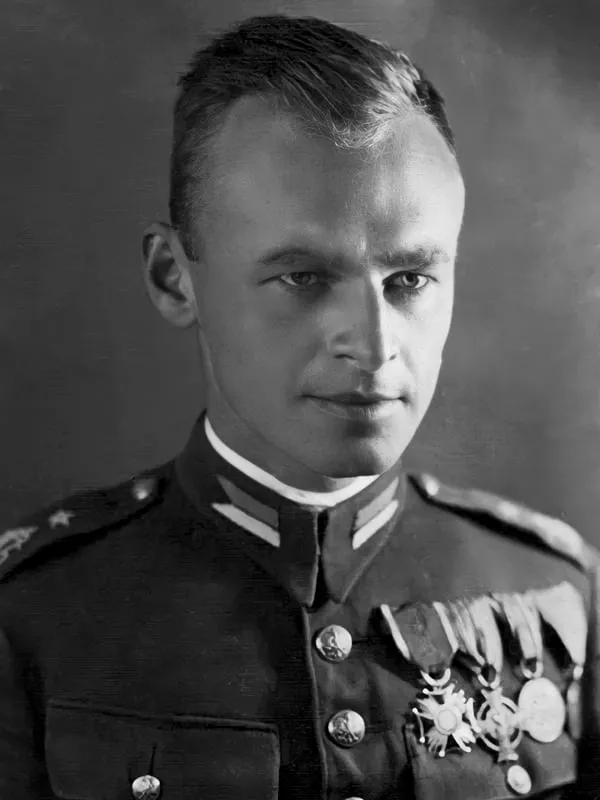
- Born:
- 13 May 1901, Olonets (Russian Empire)
- Died:
- 25 May 1948, Warsaw (Poland)
- Author:
- Łukasz
- Photo:
- autor nieznany, domena publiczna, Wikimedia Commons

Witold Pilecki was a landowner from the Kresy and a cavalry reserve officer who in wartime did something without precedent: in September 1940 he let himself be caught in a German round-up in order to enter the Auschwitz concentration camp, organise a resistance there and send out reports on the crimes of the SS. After almost two years and seven months he escaped from the camp, fought in the Warsaw Uprising, and after the war returned to Poland to run intelligence for the Polish army in the West. A communist court sentenced him to death and in May 1948 he was executed in the Mokotów prison. For decades his name was passed over in silence in the Polish People’s Republic; today he is one of the best-known figures of the Polish underground.
From Karelia to Wilno
He was born on 13 May 1901 in Olonets in Karelia, in northern Russia, into a noble family of the Leliwa coat of arms, whose ancestors had been exiled into the interior of the empire after the January Uprising. His father Julian was a forester; his mother Ludwika came from the Osiecimski family. In 1910 the family moved to Wilno, where Witold attended a commercial school and joined the Scouts, banned by the Russian authorities. During the First World War, while in Orel, he founded his own Scout troop; in spring 1918 the Scouts tried to make their way to the I Polish Corps of Gen. Józef Dowbor-Muśnicki, and although the plan failed, Pilecki managed to return to reborn Poland.
At the end of 1918 he took part in the self-defence of Wilno, and in the Polish-Soviet War he fought in cavalry units. In August 1920 he joined the 211th Uhlan Regiment (PL), with which he fought in the Battle of Warsaw, in the Rudnicka Forest and during Gen. Żeligowski’s action in Wilno. He was twice awarded the Cross of Valour. He passed his school-leaving examinations in 1921.
The landowner of Sukurcze
He did not complete his studies, in agriculture in Poznań and in art at the faculty of fine arts of Stefan Batory University. He settled on the estate of Sukurcze (PL) near Lida, recovered by his family, and farmed it until the war. He was a typical community activist of the Kresy: he ran the local fire brigade and chaired the dairy cooperative. In 1925 he became a cavalry reserve second lieutenant, and in the mid-1930s he was a reserve officer of the 26th Greater Poland Uhlan Regiment in Baranavichy. In 1931 he married Maria Ostrowska; their son Andrzej was born in 1932 and their daughter Zofia in 1933.
September 1939 and the Secret Polish Army
Mobilised in August 1939, in the September Campaign he commanded a divisional cavalry platoon of the 19th Infantry Division (PL) of Prusy Army, and after its destruction he fought as part of the 41st Infantry Division in the south-east of the country. On 17 October 1939 he disbanded his unit and made his way to Warsaw. There, on 9 November, together with Maj. Jan Włodarkiewicz (PL), he co-founded the Secret Polish Army (PL), an organisation of servicemen, Catholic activists and students, in which he was organisational inspector and later chief of staff.
When in August 1940 the Gestapo arrested several members of the TAP leadership and they were sent to Auschwitz, the organisation decided to send its own man into the camp. The task fell to Pilecki. Historians disagree on whether he himself originated the mission or received it from his superiors – according to some of them also in connection with internal disputes in the TAP, among other things over subordinating the organisation to the Union of Armed Struggle. On 19 September 1940, with papers in the name of Tomasz Serafiński, he let himself be detained in a round-up in Żoliborz.
Prisoner number 4859
On the night of 21 to 22 September 1940 he was brought to Auschwitz with the so-called second Warsaw transport. As Tomasz Serafiński he received the number 4859. Already in October he formed from prisoners the first “five” of the Union of Military Organisation (PL) and sent the first report, which reached Warsaw by way of a released prisoner and in March 1941 reached London. The ZOW was based on independent five-man cells; it obtained food, clothing and medicines for prisoners, passed on news and prepared units in case of a partisan attack on the camp. Its members included the sculptor Xawery Dunikowski (PL) and the skier Bronisław Czech. From autumn 1941 the organisation operated in a common structure with the camp network of the ZWZ, and its network eventually covered, by various estimates, several hundred and perhaps even about a thousand prisoners. In November 1941 Gen. Stefan Rowecki promoted Pilecki to lieutenant.
The ZOW reports, carried out by released prisoners, civilian workers and escapees, informed the underground about the terror against Poles, the murder of Soviet prisoners of war, and from 1942 the extermination of the Jews in the gas chambers of Birkenau. In spring 1943 the camp Gestapo began to get on the trail of the conspiracy, and “old” prisoners with low numbers were transported to other camps. On the night of 26 to 27 April 1943, at Easter, Pilecki escaped with Edward Ciesielski and Jan Redzej from the camp bakery, where they were working the night shift. They walked along the tracks to the Soła, crossed the Vistula by boat and, with the help of a priest in Alwernia, through the area of Wieliczka and the Niepołomice Forest, reached Bochnia and Nowy Wiśnicz (PL). There Pilecki found the real Tomasz Serafiński, who helped him make contact with the local Home Army. He had spent 947 days in the camp.
Kedyw and the Warsaw Uprising
Pilecki presented the AK command with a plan for an attack on the camp from outside, combined with an uprising of the prisoners. The High Command judged it unfeasible with the forces of the local underground. In autumn 1943 he wrote “Report W”, in which he replaced the prisoners’ names with numbers, and on 11 November 1943 he was promoted to captain of cavalry. He served in the Directorate of Diversion of the AK High Command, among other things as deputy commander of the clandestine intelligence organisation “Kameleon”-“Jeż”.
In the Warsaw Uprising he first fought, without revealing his rank, as a private rifleman in the “Warszawianka” company, and then commanded a unit in the Chrobry II Group (PL) in the area of Towarowa and Pańska streets. The strongpoint defended by his soldiers in the vicinity of Jerozolimskie Avenue was called “Witold’s Redoubt”; it was among those that the insurgents held to the end. After the capitulation Pilecki went into German captivity. He passed through the camp at Łambinowice (Stalag 344 Lamsdorf) and Oflag VII A Murnau in Bavaria, where in spring 1945 he lived to see liberation.
In Italy and back in Poland
After liberation he reported to the 2nd Polish Corps in Italy. There he wrote the most extensive of his reports (PL), an account of Auschwitz of over a hundred pages, handed to Gen. Tadeusz Pełczyński. In autumn 1945, with the knowledge and consent of Gen. Władysław Anders, he set out for Poland to run intelligence for the Polish army in the West; he reached Warsaw at the end of the year. He built an information network that collected news about Home Army and 2nd Corps soldiers imprisoned in NKVD camps or deported to the USSR, and about the work of the Ministry of Public Security, the army and diplomacy. When he later received an order to leave the country, he did not carry it out; he also considered revealing himself under the amnesty of 1947, but did not decide to do so.
Trial and execution
On 8 May 1947 he was arrested by the security police. The investigation in the prison on Rakowiecka Street, supervised in the MBP by Col. Józef Różański (PL), was conducted with the use of torture. The show trial of the so-called Witold group began on 3 March 1948 before the District Military Court in Warsaw. He was accused of spying for Anders, preparing an assassination of MBP officers, using false documents and illegal possession of weapons. He rejected the charge of preparing an assassination; he presented the gathering of information as service to the Polish army, not espionage. The court, presided over by Lt. Col. Jan Hryckowian, in a composition contrary to the law of the time, sentenced him to death on 15 March 1948. The Supreme Military Court confirmed the sentence on 3 May, and Bolesław Bierut did not use the right of clemency. Maria Szelągowska and Tadeusz Płużański (PL) were also sentenced to death; their sentences were commuted to life imprisonment.
On the evening of 25 May 1948 Pilecki was shot in the back of the head in the Mokotów prison; the sentence was carried out by Piotr Śmietański (PL). The authorities did not disclose the burial place. The body was most probably buried in secret in the so-called Łączka (PL) by the wall of the Powązki Military Cemetery, but the exhumations carried out there did not allow it to be identified.
Remembrance
In the Polish People’s Republic information about Pilecki was subject to censorship. In 1990 the Supreme Court acquitted him and his co-defendants, finding the sentences unjust (some studies date the annulment of the sentence to 1991). In 2002 a prosecutor of the IPN charged the prosecutor at the trial, Czesław Łapiński, but he died in 2004 before a verdict. In 1995 Pilecki was posthumously awarded the Commander’s Cross of the Order of Polonia Restituta, and in 2006 the Order of the White Eagle. The Pilecki Institute in Warsaw bears his name, and his Auschwitz reports, published in full in Poland only in 2000, have been translated into other languages. The fate of Pilecki, who volunteered for a German camp and died at the hands of the authorities imposed on Poland after the war, has become one of the symbols of the Polish experience of the Second World War and of the years that followed.
Sources
- dzieje.pl
- artsandculture.google.com · dQUhQpyPGgoA8A
- przystanekhistoria.pl · 80959,Pilecki ucieka z piekla
- ipn.gov.pl · 144328,Agnieszka Wygoda Wyrok na Witolda Pileckiego
- eng.ipn.gov.pl · 1165,70th anniversary of the death of captain witold pilecki
- instytutpileckiego.pl · patron
- Witold Pilecki · Wikipedia (pl)
- Tajna Armia Polska · Wikipedia (pl)
- Raporty Pileckiego · Wikipedia (pl)
Often appears with
People who appear in the same events.