Poland
Stefan Rowecki
Commander of the Union of Armed Struggle (1940–1942) and commander of the Home Army (1942–1943)
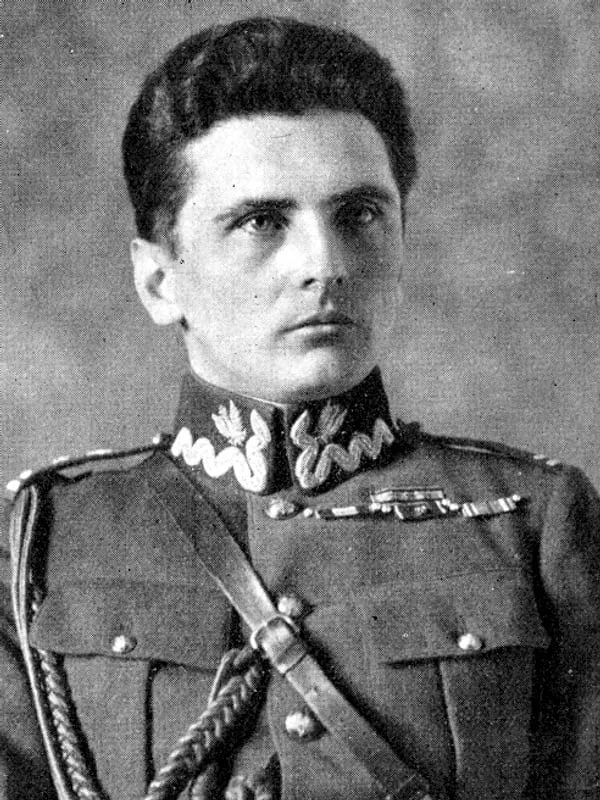
- Born:
- 25 December 1895, Piotrków Trybunalski (Congress Poland, Russian Empire)
- Died:
- 2 August 1944, KL Sachsenhausen (Third Reich)
- Author:
- Łukasz
- Photo:
- autor nieznany, domena publiczna, Wikimedia Commons

Stefan Rowecki, “Grot”, was the creator and first commander of the Home Army, the largest underground army of occupied Europe. A Legionnaire of Piłsudski, a staff officer and the author of manuals on street fighting and field fortification, in 1939 he commanded an improvised armoured-motorised brigade, and after the defeat of September he became one of the founders of the military underground. From June 1940 he led the Union of Armed Struggle, and from February 1942 the Home Army. On 30 June 1943 the Gestapo arrested him. After a year in prison at Sachsenhausen, in the first days of the Warsaw Uprising, he was murdered on Himmler’s orders.
Scout and Legionnaire
He was born on 25 December 1895 in Piotrków Trybunalski (PL), in the Russian partition, the son of Stefan and Zofia née Chrzanowska. From 1906 he attended a Polish gymnasium in his home town, from 1908 he belonged to the scouting movement, and in 1911 he co-founded and led the first secret scout patrol in Piotrków. In 1912 he began technical studies at the Wawelberg and Rotwand school in Warsaw, and a year later joined the Polish Riflemen’s Squads, where he used the pseudonym Stefan Radecki.
In August 1914 he joined the Polish Legions. He served in the 1st and from 1915 in the 5th Infantry Regiment of the I Brigade and went through its whole combat path – fighting, among other places, at Krzywopłoty, Łowczówek and Kostiuchnówka. He was wounded three times. After the oath crisis of 1917 the Germans interned him in the camp at Beniaminów (PL), from which he was released in January 1918. He then lectured on field fortifications at the cadet school in Ostrów Mazowiecka and published his first manuals on the subject.
An officer of the Second Polish Republic
In November 1918 he joined the Polish Army. During the Polish-Soviet War he worked in intelligence, in the Second Sections of front and army staffs; for the war he received the Silver Cross of the Virtuti Militari. In 1922 he completed a course at the Higher War School and became a General Staff officer. In 1923–1926 he headed the scientific department of the Military Scientific and Publishing Institute; he founded and edited the “Przegląd Wojskowy (PL)” (“Military Review”). He was one of the most prolific military authors of his generation – he wrote on fortification, on the Red Army and on propaganda, and in 1928 he published the manual “Walki uliczne” (“Street Fighting”). During the May Coup of 1926, although a Piłsudski loyalist, he did not side with the Marshal; sources differ as to whether he declared for the legal authorities or remained neutral.
In 1930–1935 he commanded the 55th Poznań Infantry Regiment (PL) in Leszno, and then the Podole Brigade of the Border Protection Corps (PL) on the border with the USSR. In summer 1938 he became commander of the divisional infantry of the 2nd Legions Infantry Division in Kielce. In June 1939 he was entrusted with forming the Warsaw Armoured-Motorised Brigade (PL), the second such unit in the Polish Army. The decision came too late for the brigade to be trained and welded together before the war.
September 1939 and the underground
In the September Campaign Rowecki’s brigade fought as part of the Lublin Army (PL) on the middle Vistula, and then in the first Battle of Tomaszów Lubelski. After the capitulation he avoided captivity and returned to Warsaw, where at the beginning of October 1939 he became deputy to Gen. Michał Karaszewicz-Tokarzewski, commander of the Service for Poland’s Victory. After the SZP was transformed into the Union of Armed Struggle he took command of the Warsaw area, and on 30 June 1940, after the defeat of France and the transfer of the decision-making centre to Poland, he became Commander of the ZWZ and commander of the armed forces in the country. From 3 May 1940 he was a brigadier general.
Building an underground army in a society embittered by defeat was not easy. In December 1941 Rowecki wrote that “this persistent burdening of us with responsibility for September” made it hard to create the atmosphere “that should surround the army in conspiracy”. Nevertheless he built a network of districts and sub-districts across the whole area of the pre-war Republic, together with extensive intelligence and propaganda. On his orders a cell “N” was created in the Bureau of Information and Propaganda, which conducted psychological warfare aimed at the Germans (Action N (PL)), and at the end of 1941 the sabotage organisation “Wachlarz” came into being. His most important aim was to merge the underground into a single non-party army.
Commander of the Home Army
On 14 February 1942 Gen. Władysław Sikorski renamed the ZWZ the Home Army, and Rowecki became its commander. Over the following months the National Military Organisation, among others, joined the AK, and the number of sworn soldiers grew from about 100,000 to several hundred thousand. From December 1942 Rowecki was also the Delegate of the Minister of National Defence in Poland. Under his command a plan for a general uprising was prepared for the moment of Germany’s collapse; in the version of March 1942 it was to be supported by Allied forces brought to Poland. He was opposed to cooperation with the communists of the Polish Workers’ Party, and regarded the Red Army’s entry onto Polish lands as one of the greatest threats the underground would face.
In November 1942 he recognised the Jewish Combat Organisation and ordered contact to be established with it; in December the AK handed the first weapons to the ghetto, and after the January self-defence of 1943, further consignments. His reports to London were one of the main channels through which the government in exile learned about the situation in Poland, including the extermination of the Jews. In 1942 he received the Gold Cross of the Virtuti Militari.
The Germans regarded him as “enemy number one”. He appeared first on their list of leaders of the Polish underground, and the Gestapo set up a special unit to capture him. Rowecki himself disliked the strict rules of conspiracy: he usually moved around Warsaw without protection, relying on his knowledge of the city, his altered appearance and well-forged documents.
Arrest and death
On the morning of 30 June 1943 the Gestapo detained him at a safe house at 14 Spiska Street in Ochota, shortly before a briefing of the High Command. The arrest is linked to a group of Gestapo agents who came from AK intelligence – Ludwik Kalkstein, Blanka Kaczorowska and Eugeniusz Świerczewski, who had known the general since 1920. The details of the betrayal remain disputed: some historians believe that “Grot” had been followed and betrayed, others that he fell into the trap largely by chance. Command of the AK was taken over by his deputy, Gen. Tadeusz Komorowski “Bór”.
Rowecki was flown to Berlin, where he firmly rejected a proposal of cooperation, including participation in an action against the USSR. In mid-July 1943 he was placed in a special prison block (Zellenbau) of the Sachsenhausen concentration camp, at first as an honorary prisoner; later, on orders from Berlin, he was cut off from all contact with other prisoners. On 14 March 1944 the Commander-in-Chief, Gen. Kazimierz Sosnkowski, promoted him to major general with seniority from 1 January 1944.
After the outbreak of the Warsaw Uprising Heinrich Himmler ordered him to be killed immediately. Historians long stated that he died on the night of 1 to 2 August 1944. An investigation by the investigative division of the IPN, discontinued in 2007 because the perpetrators were dead, established that he was murdered between 2 and 7 August, probably in the camp crematorium; the order to carry out the execution was given to the camp commandant Anton Kaindl (PL) and the Zellenbau commandant Kurt Eccarius (PL). No written order has been found, and the direct killers have not been identified. The IPN classified the killing as a crime against humanity. The general’s burial place remains unknown; his symbolic grave is in the Powązki Cemetery (PL).
Remembrance
In the Polish People’s Republic, especially in the Stalinist years, the assessment of Rowecki was one-sided: propaganda accused the AK command of collaboration with the Germans, and “Grot” was usually presented as a victim set against the “Sanacja” officers of the High Command. His first biographical entry appeared only in 1959; in time the memoirs of his collaborators appeared, along with a biography by Tomasz Szarota (1985). On 1 August 1980 a commemorative plaque was unveiled on the building at 14 Spiska Street, and in 1981 a new bridge over the Vistula in Warsaw (PL) received his name.
In 1995 he was posthumously awarded the Order of the White Eagle. The Sejm declared 2004 the Year of Stefan Rowecki; in 2005 a monument to him was erected at the junction of Ujazdowskie Avenue and Chopin Street in Warsaw, and in 2014 he was also commemorated on the site of the former Sachsenhausen camp. His name is borne today by, among others, the Agat military unit, and his pseudonym by the “Grot” carbine produced in Radom.
He was married twice; from his first marriage he had a daughter, Irena, who wrote down her memories of her father after the war. His younger brother Stanisław, a lawyer, was during the occupation a legal adviser to the High Command of the ZWZ-AK.
Sources
- Stefan Rowecki · Wikipedia (pl)
- dzieje.pl
- ipn.gov.pl · 220401,Pawel Popiel Wyrok na Eugeniusza Swierczewskiego
- ipn.gov.pl · 159062,Piotr Niwinski Powstanie Armii Krajowej
- dzieje.pl · pokazano dokumenty dot gen stefana roweckiego grota
- dzieje.pl · 82 lata temu powolano armie krajowa najwieksza armia podziemna europy
- Armia Krajowa · Wikipedia (pl)
Mentioned in battles
(01)Often appears with
People who appear in the same events.