Poland
Józef Dowbor-Muśnicki
Commander of the I Polish Corps in Russia (1917–1918), Commander-in-Chief of the Polish Armed Forces in the former Prussian partition (1919), Lieutenant General (generał broni)
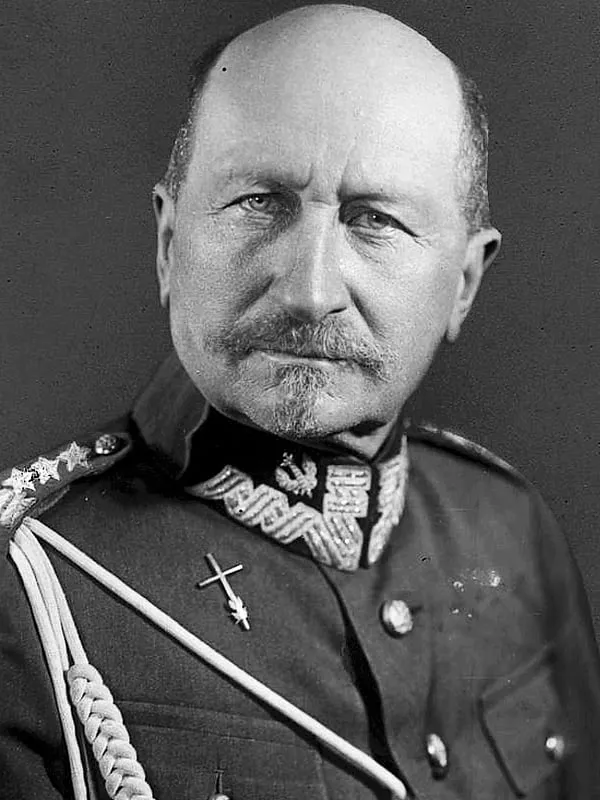
- Born:
- 25 October 1867, Garbów near Sandomierz (Russian Empire)
- Died:
- 26 October 1937, Batorowo near Poznań
- Author:
- Łukasz
- Photo:
- autor nieznany, domena publiczna, Wikimedia Commons

Józef Dowbor-Muśnicki was one of those Poles who made their entire professional careers in the Tsarist army and who in 1917, as Russia fell apart, set out to build a Polish army. As commander of the I Polish Corps in Russia he refused in January 1918 to disarm and took up arms against the Bolsheviks, and a year later, during the Greater Poland Uprising, he turned volunteer units within a few months into a regular army tens of thousands strong. He was a soldier of the old school, devoted to discipline and to an apolitical army, distrustful of revolution and of the camp of Józef Piłsudski, with whom he fought throughout the interwar years over the question of to whom Poland owed its army. He did not live to see the Second World War, but both his daughters were killed in 1940, one by the Soviets and the other by the Germans.
Youth and service in the Russian Army
He was born on 25 October 1867 on the Garbów estate near Sandomierz, in the Kingdom of Poland, into a landed family descended, according to family tradition, from the Lithuanian Dowbor clan, settled in the Sandomierz region since the seventeenth century. That is the date given by Polish biographies. Russian sources treat it as an Old Style (Julian calendar) date, which would correspond to 6 November. His elder brother Konstanty also became a general in the Russian Army. Józef attended grammar school in Radom, then the Cadet Corps in St Petersburg, from which he graduated in 1886, and the Konstantinovsky Military School. In 1888 he began his service as a second lieutenant in an infantry regiment in Kostroma.
It was not easy for a Pole and a Catholic to win promotion in the Russian Army, and especially to get into the General Staff Academy. According to his Polish biographers, Dowbor converted to Calvinism around 1890; according to others, the family had already belonged to the Evangelical Reformed Church. General Anton Denikin, who knew him from the Russian Army, recalled years later that for his first years of service Dowbor used only the shortened surname and passed for a Protestant, and that the full name “Dowbor-Muśnicki” appeared in orders only after he had completed his studies. In 1902 he graduated from the General Staff Academy in St Petersburg.
During the Russo-Japanese War he served in Manchuria as a staff officer of the I Siberian Army Corps. Denikin judged him an officer “of little talent, but brave”. After the war he held staff posts in Harbin, Irkutsk and Kharkiv, and from 1910 to 1914 he was chief of staff of an infantry division. In 1908 he became a colonel.
The Great War
From November 1914 he commanded the 14th Siberian Rifle Regiment. In early 1915 he fought in the battles of Przasnysz, where he was seriously wounded during the crossing of the Orzyc near the village of Stary Podoś. For bravery he received, among other awards, the Order of St George, 4th class, the Golden Weapon of St George and promotion to major general, and the British awarded him the Order of the Bath. In 1916–1917 he commanded in turn the 123rd and 38th Infantry Divisions, was briefly chief of staff of the 1st Army, and after the February Revolution, in April 1917, took command of the XXXVIII Army Corps. In May he was promoted to lieutenant general.
The revolution gave the Poles serving in the Russian Army – and there were several hundred thousand of them – the chance to form their own units. In June 1917 the Supreme Polish Military Committee (PL), known as the Naczpol, was set up in Petrograd, and in the summer it appointed Dowbor commander of the I Polish Corps. The corps headquarters was in Minsk, and its units, scattered over a vast area of Belarus, numbered about 29,000 men in January 1918. Dowbor built an army of a kind that hardly existed any longer in revolutionary Russia: without soldiers’ committees, mass meetings or commissars, with officers in command and the old discipline.
Against the Bolsheviks
After the October Revolution Dowbor announced that the corps would not take sides in Russia’s internal disputes. To the Bolsheviks, however, a disciplined, “counter-revolutionary” corps was a threat. The Commander-in-Chief, Nikolai Krylenko, demanded its “democratisation”, and when Dowbor refused, the Soviet authorities began to stop and disarm Polish transports. On 24 January 1918 the general sent the Bolshevik command an ultimatum: if the disarming did not stop, from noon on 25 January (12 January Old Style) he would consider that war had been declared on the Poles. The orders were not withdrawn. Latvian Riflemen and sailors under Jukums Vācietis moved against the corps. Some Polish regiments were broken up and disarmed, but on the night of 2–3 February the Poles captured the Bobruisk fortress with its great depots. In the Polish tradition this fighting marks the opening of the long war with Soviet Russia.
When the Germans advanced eastwards in the second half of February, Dowbor concluded an agreement with them at Bobruisk under which the corps was recognised as a neutral force and allowed to keep its weapons. The agreement was controversial from the outset. His opponents, especially on the left, accused him of collaborating with the occupier and of harshness towards Belarusian peasants. After the Treaty of Brest-Litovsk the Germans no longer needed the corps. In May 1918 they issued an ultimatum. On the night of 21–22 May conspirators from the circle of the Polish Military Organisation, among them Leopold Lis-Kula, tried to force the general to fight the Germans and held him for a few hours, but Dowbor judged resistance hopeless and signed the dissolution of the corps. The soldiers, known after him as “Dowborczycy” (Dowbor’s men), returned without their weapons to the Kingdom of Poland, and in the autumn many of them joined the reborn Polish Army. The general himself settled in Staszów. To the end of his life he defended this decision, arguing that he had saved the men for the future army, while his opponents in the Piłsudskiite camp accused him of surrendering his weapons without a fight.
The Greater Poland Uprising
After the outbreak of the Greater Poland Uprising, the Supreme People’s Council in Poznań was looking for an experienced general, since there were almost no senior officers among the Poles of the Prussian partition. On 6 January 1919 Dowbor received the summons, spoke in Warsaw with Piłsudski, who agreed to his appointment, and on 8 January arrived in Poznań. By a decree of the Supreme People’s Council of 11 January he became Commander-in-Chief of the Polish Armed Forces in the former Prussian partition, and on 16 January he took over from Major Stanisław Taczak. Many officers from the former Russian Army and the I Corps followed him.
In Greater Poland Dowbor did what he had done earlier in Belarus. He introduced conscription, which in time covered more than a dozen age groups; he formed rifle divisions, a cavalry brigade, artillery and an air arm based on aircraft captured at Ławica airfield; and he dissolved the soldiers’ councils. On 26 January, on Freedom Square (Plac Wolności) in Poznań, he took the army’s oath. His army repelled the German counter-offensive at the turn of January and February and, after the Armistice of Trier of 16 February, continued to grow. According to the Institute of National Remembrance, in June 1919 it numbered about 102,000 men. In March 1919 Dowbor was given the rank of generał broni (lieutenant general), at that time the highest in the Polish Army.
The general wanted the Greater Poland army to remain intact and under his command, and he opposed sending his units east to the Ukrainian and Bolshevik fronts. He dreamt of an offensive into Pomerania and Gdańsk, which the decisions of the peace conference made impossible. The army was gradually placed under the High Command in Warsaw, and in August 1919 it was formally incorporated into the Polish Army. Dowbor continued to command the Greater Poland Front.
On the sidelines
When open war with the Bolsheviks broke out, Dowbor placed himself at Piłsudski’s disposal but declined the posts he was offered, including command of an army and of the southern front. In the autumn of 1920 he was transferred to the reserve, and in 1924 retired. He settled on an estate near Poznań, first at Lusowo and then at Batorowo. He opposed the May Coup of 1926 and the Sanation regime, although he belonged to no party and called himself a nationalist. Around him gathered the veterans of the I Corps, organised in the Association of Dowborczycy, who formed a counterweight of sorts to the state cult of Piłsudski and the Legions. Dowbor published memoirs in which he settled scores sharply with his opponents, and he himself was attacked in the press as a “Russified” general who had given up his weapons without a fight in 1918. In his lifetime he received no Polish state decoration.
He died of heart failure on 26 October 1937 at Batorowo and was buried in the family vault at Lusowo.
The family and the war
The most tragic chapter in the Dowbor family’s history came after the general’s death. His elder daughter, Janina Lewandowska, a glider pilot and parachutist, was taken prisoner by the Soviets in September 1939 and murdered at Katyn in the spring of 1940. She was the only woman among the victims of the Katyn massacre. The younger daughter, Agnieszka Dowbor-Muśnicka, was active in the underground in occupied Warsaw. Arrested by the Gestapo in April 1940, she was held in Pawiak prison and shot at Palmiry in June 1940. The fate of the two sisters, murdered in the same year by the two occupiers, became after 1989 one of the symbols of Poland’s experience of the Second World War.
Legacy
Dowbor-Muśnicki was a commander who twice, in Minsk and in Poznań, built a Polish army from scratch and twice had to hand it over to someone else’s command. His role in the Greater Poland Uprising is beyond dispute: he turned a volunteer rising into an army that allowed the Poles to hold on to their gains until the Treaty of Versailles and then fought in the Polish–Soviet War. In the interwar years his achievements were overshadowed by the legend of the Legions, and the general himself, at odds with Piłsudski and the Sanation regime, remained on the margins. Recognition came later. Since 1996 a mechanised brigade in Międzyrzecz has borne his name, and in 2018, on the centenary of the outbreak of the uprising, he was posthumously awarded the Order of the White Eagle.
Sources
Commanded in battles
(01)Mentioned in battles
(01)Often appears with
People who appear in the same events.