1918–1921: Wars after the Great War
The Polish–Soviet War
- Dates:
- 14 February 1919 – 18 October 1920
- Front:
- Central and Eastern Europe
- Location:
- The lands between the Vistula, the Dnieper and the Dvina – Lithuania, Belarus, Volhynia, Podolia, Eastern Galicia and Right-Bank Ukraine with Kiev – and in the summer of 1920 also Podlasie and Masovia up to the approaches to Warsaw, Płock and ToruńOn the battle map →
- Sides:
- Poland (in 1920 allied with the Ukrainian People's Republic)Józef Piłsudski, Tadeusz Rozwadowski, Edward Rydz-Śmigły, Władysław Sikorski, Józef HallerSoviet Russia (with the Ukrainian and Byelorussian Soviet Socialist Republics)Sergei Kamenev, Mikhail Tukhachevsky, Alexander Yegorov, Semyon Budyonny
- Result:
- Polish victory. The Battle of Warsaw and the Battle of the Niemen halted the Red Army's advance west. The Treaty of Riga of 18 March 1921 divided Belarus and Ukraine between Poland and the Soviet republics.
- Author:
- Natalia
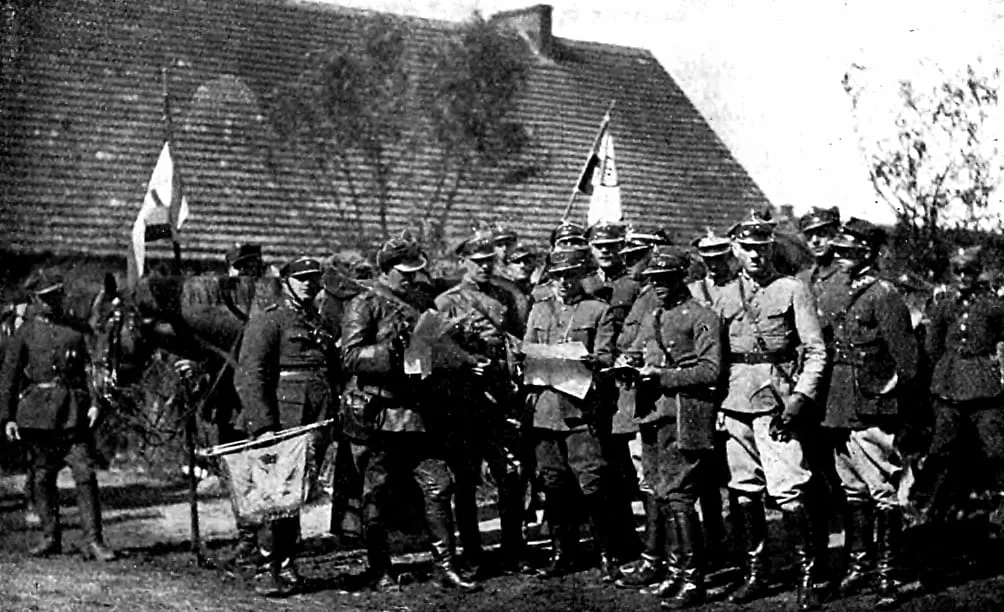
The Polish–Soviet War was the largest armed conflict in Europe between the end of the Great War and the outbreak of the Second World War. Reborn Poland and Soviet Russia fought over the lands of the old Polish–Lithuanian Commonwealth, which the German occupation army had evacuated after Germany’s defeat, and at the same time over whether the Bolshevik revolution would pass through Poland into Germany and on into western Europe. The war began in the winter of 1919 with skirmishes between advance detachments in Polesie and the Grodno region. In 1919 it brought the Poles Wilno (Vilnius) and Minsk, in the spring of 1920 the expedition to Kiev, and in the summer a Soviet counter-offensive that reached the gates of Warsaw. In August 1920 the Battle of Warsaw turned the tide, and in the autumn Polish troops drove the Red Army far back to the east. The peace concluded at Riga drew a border that the Soviet Union never truly accepted as final and that it tore up on 17 September 1939.
Name and dates
Polish historians most often call the conflict the Polish–Bolshevik War, but also the Polish–Soviet War or, following some historians, the Polish–Russian War of 1919–1920. For decades Soviet historiography treated it as one episode of the Civil War and foreign intervention – the “war against the White Poles”.
The war was never declared, so its starting point is a matter of convention. It is most often dated to 14 February 1919, when in Polesie and the Grodno region, at Bereza Kartuska and at Mosty on the Niemen, Polish detachments pushing forward in the wake of the retreating Germans clashed for the first time with regular units of the Red Army. Other historians begin it on 5 January 1919, when the Bolsheviks took Wilno after several days of fighting against the Polish self-defence forces, and others still only with the Polish offensive in Ukraine in April 1920. That is how Russian literature usually reckons it, seeing the war above all as an act of Polish aggression. The Soviet side had indeed been advancing westwards since November 1918, while the Poles had been pushing their forces east since the beginning of 1919, so both versions describe the same process from opposite sides.
Hostilities ended with an armistice signed in Riga on 12 October 1920 together with preliminary peace terms; it came into force on 18 October. Formally the state of war lasted until the peace treaty signed in Riga on 18 March 1921 and ratified in April, which is why many studies date the war to 1919–1921.
Background
In 1918 there was no recognised border between Poland and Russia. The partitions had pushed Russia far to the west, as far as Kalisz, and the Treaty of Brest-Litovsk of March 1918, concluded by the Bolsheviks with the Central Powers, had placed the lands from the Baltic to the Black Sea under German control. Lithuania and Belarus were ruled by the German military administration, Ober Ost. After the Armistice of Compiègne its troops began to return home, and on 13 November 1918 the government of Vladimir Lenin annulled the Treaty of Brest-Litovsk. A few days later the Western Army set off westwards, occupying one town after another as the Germans withdrew: Minsk in December, Wilno on 5 January 1919. The Bolsheviks hoped to reach Germany through Poland, where the revolution was then under way, and to join forces with the German proletariat. In Soviet documents the operation was called “Target Vistula”. In February 1919 the Lithuanian–Byelorussian Soviet Socialist Republic (Litbel) was set up in the occupied territory, and many communists of Polish origin sat in its government.
On the Polish side there was a dispute about where the eastern border should lie. The Chief of State, Józef Piłsudski, wanted to push Russia as far east as possible and create between it and Poland a belt of independent states – Lithuania, Belarus and Ukraine – bound to Poland by federation or alliance. Such a Poland would not have to fear another partition by two powerful neighbours. Roman Dmowski and the National Democrats, by contrast, wanted to annex directly those eastern lands they considered capable of being Polonised, and not to fight for the rest. The Western powers, which were deciding Europe’s borders in Paris, were still counting on a White victory in the Russian Civil War and looked unfavourably on Polish expansion to the east. The White leaders, Admiral Alexander Kolchak and General Anton Denikin, were prepared to recognise Poland at most within the borders of Congress Poland.
At the beginning of 1919 Poland was fighting on several fronts at once: against the Ukrainians for Lwów (Lviv) and Eastern Galicia in the Polish–Ukrainian War, against the Germans in Greater Poland, and in January also against Czechoslovakia over Cieszyn Silesia. The Polish Army was only just being formed out of legionnaires, soldiers of the three partitioning armies and volunteers. On 5 February 1919 in Białystok the Poles and Germans signed an agreement that allowed German units to withdraw through Poland by rail and in return opened the way east for Polish troops through Białystok and Grodno. The German–Soviet front turned into a Polish–Soviet one.
The course of the war in 1919
In mid-February the Polish groups of General Antoni Listowski in Polesie and General Wacław Iwaszkiewicz near Wołkowysk made contact with the forward units of the Red Army. After the skirmishes of 14 February and the following days at Bereza Kartuska and Mosty, the front stabilised. At the beginning of March the Poles took Słonim and Pińsk and came close to Lida. The Bolsheviks, busy fighting Kolchak in Siberia and helping the Hungarian Soviet Republic, treated this front as secondary.
On 16 April 1919 Piłsudski launched an offensive against Wilno. A cavalry group under Lieutenant Colonel Władysław Belina-Prażmowski outflanked the Soviet forces and burst into the city on the morning of 19 April, followed by the infantry of General Edward Rydz-Śmigły, which arrived by rail. After two days of street fighting Wilno was in Polish hands. In the same days the Poles took Lida, Nowogródek and Baranowicze, and on 28 April Grodno. On 22 April Piłsudski issued a proclamation “To the inhabitants of the former Grand Duchy of Lithuania”, promising them the freedom to decide their own fate. The National Democrats received it with indignation, and the Lithuanians, who regarded Wilno as their capital, with suspicion.
In the summer the Lithuanian–Belarusian Front of General Stanisław Szeptycki, reinforced by units from Greater Poland and by General Józef Haller’s army, which had arrived from France, moved further east. On 8 August 1919 the Poles took Minsk, at the end of August Bobruisk, and in September Borisov, reaching the Berezina and the Dvina. In the south, after defeating the Ukrainians in Eastern Galicia in July 1919, Polish troops stood on the Zbruch and in Volhynia. At the same time, in August 1919, the Polish radio intelligence service of Lieutenant Jan Kowalewski began breaking Soviet ciphers. For the next year the Polish command read a large proportion of the Red Army’s signals.
In the autumn of 1919 Piłsudski halted the offensive. Denikin’s Volunteer Army was then marching on Moscow, and Piłsudski considered a victory of the Whites, who would hear neither of an independent Ukraine nor of a Polish border east of the Bug, more dangerous than a victory of the Reds. Despite pressure from France and Britain he did not strike at the Bolsheviks. His envoy, Captain Ignacy Boerner, held secret talks at Mikashevichy in Polesie with the communist Julian Marchlewski and gave the Bolsheviks to understand that the Poles would not attack while the Red Army moved its forces against Denikin. The talks did not bring peace, but the de facto truce helped the Reds to crush the Whites. The only major operation of the winter was the capture of Dyneburg (Daugavpils), together with the Latvians, at the beginning of January 1920, under the command of Rydz-Śmigły. The city was handed over to Latvia.
The Kiev expedition
Around the turn of 1919 and 1920 Soviet Russia proposed peace to Poland several times, but neither side took these offers seriously. After defeating Kolchak and Denikin, the Red Army command, headed by Commander-in-Chief Sergei Kamenev, moved more and more divisions west, and Polish radio intelligence tracked their concentration in Belarus, in the so-called Smolensk Gate. Piłsudski, a Marshal of Poland from March 1920, decided to forestall the blow and to strike first, in Ukraine. On 21 April 1920 in Warsaw he concluded an alliance with Otaman Symon Petliura, leader of the Ukrainian People’s Republic. Poland recognised his government, and Petliura renounced Eastern Galicia and western Volhynia. Polish troops were to help him recover Kiev and establish an independent Ukrainian state there.
The Kiev expedition began on 25 April. Some 60,000 Polish and several thousand Ukrainian soldiers quickly took Zhytomyr, Berdychiv, Koziatyn and Vinnytsia. On 7 May 1920 units of Rydz-Śmigły’s 3rd Army entered Kiev almost without a fight, and on 9 May they paraded down the Khreshchatyk. The success, however, was illusory. The Soviet 12th and 14th Armies withdrew behind the Dnieper almost intact, and the Ukrainian population, weary of repeated changes of regime, did not support Petliura, whom many saw as a man brought in by the Poles. Only a few thousand volunteers joined his army. In Russia, on the other hand, the expedition set off a wave of patriotism. The Bolsheviks presented the war as the defence of the motherland against the Polish lords, and many former tsarist officers joined the Red Army in response to an appeal by General Aleksei Brusilov.
The Red Army’s counter-offensive
On 14 May Mikhail Tukhachevsky’s Western Front attacked in Belarus. The Poles repulsed this first offensive after several weeks, but had to commit their reserves to do so. In Ukraine, from the end of May, Semyon Budyonny’s 1st Cavalry Army, brought over from the Caucasus, went on the attack as part of the South-Western Front of Alexander Yegorov, whose political commissar was Joseph Stalin. On 5 June Budyonny broke through the front near Samhorodok and emerged in the rear of the Polish armies. His cavalry took Zhytomyr and Berdychiv, where, according to Polish accounts, it burned down a hospital together with several hundred wounded. On 10–13 June the Poles abandoned Kiev and began a long retreat to the west, and at the beginning of July Budyonny took Równe in Volhynia.
On 4 July Tukhachevsky struck again, this time with much larger forces. His order of 2 July ended with the words: “The fate of world revolution is being decided in the West. The road to a world-wide conflagration lies over the corpse of White Poland.” The right wing of the Western Front, with the cavalry corps of Gaya Gai (Hayk Bzhishkyan), repeatedly outflanked the Polish positions from the north. The front cracked, and in places the retreat turned into a rout. On 11 July the Poles abandoned Minsk; on 14 July the Red Army and Lithuanian troops took Wilno, which Soviet Russia had assigned to Lithuania in the treaty of 12 July; Grodno fell on 19 July, Białystok on 28 July and the fortress of Brześć (Brest) on 1 August. In the space of a month the Red Army advanced more than 400 kilometres, and at the beginning of August it stood on the Narew and the Bug, about 100 kilometres from Warsaw.
The defeat shook the state. On 1 July the Sejm set up the Council of National Defence, and on 7 July General Haller took command of the Volunteer Army, which tens of thousands of people joined, many of them schoolboys and students. Prime Minister Władysław Grabski went to the Spa Conference to ask the powers for help. The British Prime Minister, David Lloyd George, made it conditional on Poland accepting an armistice line along the Bug – later named the Curzon Line after the British Foreign Secretary – and on leaving the decision on Cieszyn Silesia, Wilno and Danzig (Gdańsk) to the powers. Grabski agreed, but Moscow rejected the British proposal. On 24 July a Government of National Defence was formed, with the Peasant Party leader Wincenty Witos as prime minister and the socialist Ignacy Daszyński as deputy prime minister. On 22 July General Tadeusz Rozwadowski became Chief of the General Staff. An Allied mission arrived in Warsaw that included Foch’s chief of staff, General Maxime Weygand, but the Poles did not hand command over to him and his role was limited to giving advice.
Moscow was euphoric. On 17 July a plenum of the Central Committee decided not to stop at the Curzon Line but to “help the proletariat of Poland” overthrow its government. Lenin later said that the Bolsheviks had decided to “probe with bayonets” whether Poland was ripe for revolution. Behind the front travelled, by train, the Provisional Polish Revolutionary Committee with Marchlewski, Felix Dzerzhinsky and Józef Unszlicht; at the end of July in Białystok it proclaimed the end of the “government of the gentry and bourgeoisie” and was to take power in a captured Warsaw. Most Poles, however, did not greet the Red Army as liberators. The invasion from the east united a country in which only a few weeks earlier many peasants and workers had been indifferent to the war.
The Battle of Warsaw
At the beginning of August Tukhachevsky had four armies and a cavalry corps advancing on Warsaw from the east and north-east. Instead of striking the capital head-on, he decided to go round it to the north, force the Vistula between Modlin and Toruń and attack the city from the west, as Field Marshal Paskevich had done in 1831. He left only part of his forces before Warsaw, and his left flank on the Wieprz was covered by the weak Mozyr Group. The South-Western Front, which according to the original plan was to support the attack on Warsaw, was meanwhile advancing on Lwów. On 11 and 13 August Commander-in-Chief Kamenev ordered the 1st Cavalry Army and the 12th Army to be placed under Tukhachevsky’s command, but Yegorov, Stalin and Budyonny delayed and went on assaulting Lwów. Budyonny’s cavalry left the city only on 20 August, when the battle for Warsaw had already been lost.
The Polish plan, set out in the order of 6 August 1920, provided for the defence of the Warsaw bridgehead and of the line of the Wkra north of Modlin, while at the same time concentrating on the Wieprz, south-east of Warsaw, a strike group that was to fall on the rear and flank of the Western Front. The authorship of the plan has been disputed for a hundred years. Piłsudski claimed it for himself; his opponents attributed it to Rozwadowski or to Weygand, who himself denied it. Most historians believe that Piłsudski formulated the general idea of the manoeuvre from the Wieprz, while Rozwadowski’s staff worked out the details and the orders. The Northern Front, which defended the capital, was commanded by General Haller, the 5th Army on the Wkra by General Władysław Sikorski, and the strike group by Piłsudski in person. On 12 August, the eve of the battle, Piłsudski handed Witos his resignation as Chief of State and Commander-in-Chief, which the prime minister put away in a drawer.
On 13 August two Soviet divisions broke through the defences at Radzymin, about 20 kilometres from Warsaw. For three days the town changed hands several times, until on 15 August reserve divisions finally recaptured it. At nearby Ossów the chaplain of the volunteers, Father Ignacy Skorupka, was killed on 14 August and became one of the symbols of the battle. On 14 August, at Haller’s request and earlier than planned, Sikorski attacked the Soviet 3rd and 15th Armies on the Wkra. After heavy fighting his troops broke through the front on 15 August and took Nasielsk on 16 August. On the far northern flank, meanwhile, Gai’s cavalry and the Soviet 4th Army reached Włocławek and Płock, where on 18 and 19 August the inhabitants and a small garrison beat off their assault.
On the morning of 16 August the strike group set off from the Wieprz. Five divisions, among them the 14th Greater Poland and the 16th Pomeranian, smashed the weak Mozyr Group and within two days reached the Warsaw–Brest highway, emerging in the rear of the Soviet forces before the capital. Tukhachevsky, who was directing operations from his headquarters in Minsk, several hundred kilometres away, did not know for two days what was happening, and his orders could not keep pace with events. On 18 August he ordered a regrouping, and on 19 August the retreat of the whole front. Polish troops set off in pursuit to the north-east. Parts of the Soviet 4th and 15th Armies and Gai’s corps, cut off from their lines of retreat, crossed the border of East Prussia around 24–26 August and were interned there by the Germans. On 25 August the Polish command halted the pursuit. In the Battle of Warsaw the Poles took tens of thousands of prisoners, about 45,000 Soviet soldiers were interned in East Prussia, and of the Western Front’s 22 divisions roughly half survived.
The name “Miracle on the Vistula” appeared while the battle was still going on. Piłsudski’s opponents used it to deny him the credit for the victory and attribute it to Providence, while in Catholic tradition the battle, whose decisive fighting coincided with the Feast of the Assumption on 15 August, became a miracle of the Virgin Mary. The British diplomat Edgar Vincent, Lord D’Abernon, a member of the Allied mission, called it the eighteenth decisive battle in the history of the world.
Lwów, Zamość and Komarów
In the south, at the same time, Budyonny was advancing on Lwów. On 17 August at Zadwórze a battalion of volunteers under Captain Bolesław Zajączkowski held up one of his divisions for an entire day. Of some 330 defenders only a dozen or so survived, and the action became known as the Polish Thermopylae. By the time the 1st Cavalry Army finally moved north, through Sokal towards Zamość and Lublin, it was too late. At Zamość a small garrison held out for several days, among them the Ukrainian 6th Sich Rifle Division of Marko Bezruchko. On 31 August 1920 at Komarów the Polish 1st Cavalry Division of Colonel Juliusz Rómmel defeated Budyonny’s army in what is often called the greatest cavalry battle of the 20th century. Budyonny barely managed to lead the remnants of his divisions back across the Bug. In September Polish forces under the overall command of Rozwadowski defeated all three armies of the South-Western Front and reached the Zbruch and the Sluch.
The Battle of the Niemen and the armistice
Tukhachevsky, meanwhile, had rebuilt his front on the Niemen and the Svislach and was preparing a new offensive. Piłsudski forestalled him. On 20 September the Polish offensive began that later became known as the Battle of the Niemen. On 26 September the Poles retook Grodno, and Rydz-Śmigły’s group, passing through Lithuanian territory, came out in the rear of the Soviet 3rd Army and took Lida. The Western Front collapsed for the second time, and by mid-October the pursuit had reached Minsk, which Polish units briefly entered.
Both sides were by now exhausted. Peace talks, begun in Minsk back in August, were moved to Riga on 21 September. Soviet Russia needed troops in the Crimea, where the White general Pyotr Wrangel was still fighting, and to put down peasant revolts. In Poland the Council of National Defence, against the wishes of Piłsudski, who wanted to fight on for a free Belarus and Ukraine, decided that the country could not bear another winter of war. On 12 October 1920 the delegations signed in Riga the preliminary peace terms and an armistice, which came into force on 18 October. That day Piłsudski issued his order “On the end of the war”. Three days before the armistice was signed, on 9 October, troops under General Lucjan Żeligowski, with Piłsudski’s tacit consent, took Wilno after staging a mutiny against their own command. The occupied Wilno region became Central Lithuania, which was incorporated into Poland in 1922. Petliura’s Ukrainians, Poland’s allies, and the Belarusian units of General Stanisław Bułak-Bałachowicz fought on alone for a few more weeks and were then interned in Poland.
The Treaty of Riga, signed on 18 March 1921 by Poland on the one side and by Soviet Russia and the Ukrainian Soviet Socialist Republic, also acting on behalf of Soviet Belarus, on the other, drew the border far east of the Curzon Line but well west of the line on which the armies had stood in October. Poland kept western Belarus with Grodno, Nowogródek and Pińsk, and most of Volhynia, while the Soviet side renounced its claims to Eastern Galicia. Poland recognised the Soviet republics of Ukraine and Belarus. Minsk and Kiev remained on the Soviet side. The Soviet side undertook to return to Poland the cultural property plundered since the 18th century and to pay 30 million gold roubles, obligations it never fully met. Piłsudski’s federal plan collapsed. Petliura and his soldiers remained in Poland as émigrés.
Losses
According to Polish military figures, the Polish Army lost about 47,000–48,000 killed and died of wounds, about 113,000 wounded and about 51,000 prisoners and missing. Soviet losses are less well known. Various estimates put them at several tens of thousands killed (a figure of about 60,000 is often given), more than 100,000 wounded and 80,000 to 110,000 taken prisoner by the Poles, not counting the soldiers interned in East Prussia. Civilian casualties are unknown. Both sides committed crimes against prisoners and civilians. Budyonny’s Cossacks murdered prisoners, wounded men and Jews. Polish and allied units, especially in 1919, carried out pogroms and killed prisoners, including political commissars.
The prisoners are a separate issue, and one still exploited politically today. According to a joint publication by Polish and Russian archivists in 2004, between 16,000 and 20,000 Soviet prisoners died in Polish camps such as Strzałkowo and Tuchola (Polish researchers tend to speak of 16,000–17,000, Russian ones of 18,000–20,000), mainly from epidemics of typhus, dysentery and cholera, from hunger and from appalling conditions. The Russian side often gives figures several times higher, and since the 1990s has used the issue as an “anti-Katyn” – a counterweight to the crime of 1940. The fate of Polish prisoners in Soviet captivity has been less thoroughly researched. According to estimates cited by the historian Andrzej Chwalba, as many as some 20,000 of them may have been killed or died.
Significance
The Battle of Warsaw stopped the Bolsheviks’ only attempt to carry the revolution into western Europe by the force of the Red Army. At a party conference in September 1920 Lenin spoke openly of a severe military defeat, and Soviet policy turned towards consolidating power at home, which Stalin later made into the slogan of “socialism in one country”. Poland defended its independence and for twenty years secured an eastern border that gave it Wilno, Lwów, Grodno and Pińsk, but also several million Ukrainians and Belarusians. As a result, the Second Polish Republic became a state in which about a third of the citizens were not Poles, and tensions with its minorities, especially the Ukrainian one, weighed on it to the end.
The war also shaped the thinking of the Polish military and of Polish politics for the next two decades. A victory won by manoeuvre and cavalry confirmed many commanders in the conviction that Russia was the main enemy and that a future war would be a war of movement in which cavalry would retain an important role. The men of 1920 ran Poland and its army throughout the interwar years: Piłsudski until his death in 1935, Rydz-Śmigły as Commander-in-Chief in September 1939, and Sikorski and Władysław Anders – in 1920 the commander of an uhlan regiment – as leaders of the Poles in exile and of the Polish Army in the West. The success of the radio intelligence service in 1919–1920 marked the beginning of the Polish school of cryptology, from which the breaking of Enigma grew.
On the Soviet side, the defeat at Warsaw left deep resentments. Tukhachevsky, Yegorov and Budyonny blamed one another, and the argument over who was at fault – Tukhachevsky, who had pushed too far, or Stalin and the command of the South-Western Front, who had not sent him troops – went on for years. In 1935 all three became Marshals of the Soviet Union, and in 1937–1939 Tukhachevsky and Yegorov perished in the Great Purge, which Budyonny survived as one of Stalin’s closest associates. In Moscow, 1920 was remembered as a humiliation and an unfinished march to the west. Soviet Russia and the Weimar Republic, united by hostility towards Poland and the Versailles order, drew closer while the war was still going on. The head of the German army, Hans von Seeckt, counted on Poland’s collapse, and in 1922 the Treaty of Rapallo opened the way to secret military cooperation between the two states.
The Riga border lasted until 17 September 1939, when the Red Army, in accordance with the secret protocol of the Molotov–Ribbentrop Pact, invaded Poland. The line that the USSR and Germany drew between themselves, and in 1945 the new Polish–Soviet border fixed by the powers at Yalta, both ran roughly along the Curzon Line of 1920. Some historians see the memory of 1920, and Stalin’s resentment of the Polish army and its officers, as one of the causes of the Katyn massacre, in which in the spring of 1940 the NKVD murdered more than 21,000 Polish prisoners of war and detainees, many of them veterans of the war against the Bolsheviks. This thesis is hard to prove, however, as the decision to commit the crime stemmed above all from the Soviet policy of destroying the Polish elites in the occupied territories.
Sources
- Polish–Soviet War · Wikipedia (en)
- Semyon Budyonny · Wikipedia (en)
- Каменев, Сергей Сергеевич · Wikipedia (ru)
- Егоров, Александр Ильич · Wikipedia (ru)
- Будённый, Семён Михайлович · Wikipedia (ru)
- Bitwa pod Komarowem · Wikipedia (pl)
- Konferencja w Spa · Wikipedia (pl)
- Bitwa pod Dyneburgiem (1920) · Wikipedia (pl)