- Category:
- Politics
- Front:
- Central and Eastern Europe
- Date:
- 15 October 1944
- Author:
- Łukasz
- Tags:
- Hungary, Third Reich, Miklós Horthy, Holocaust
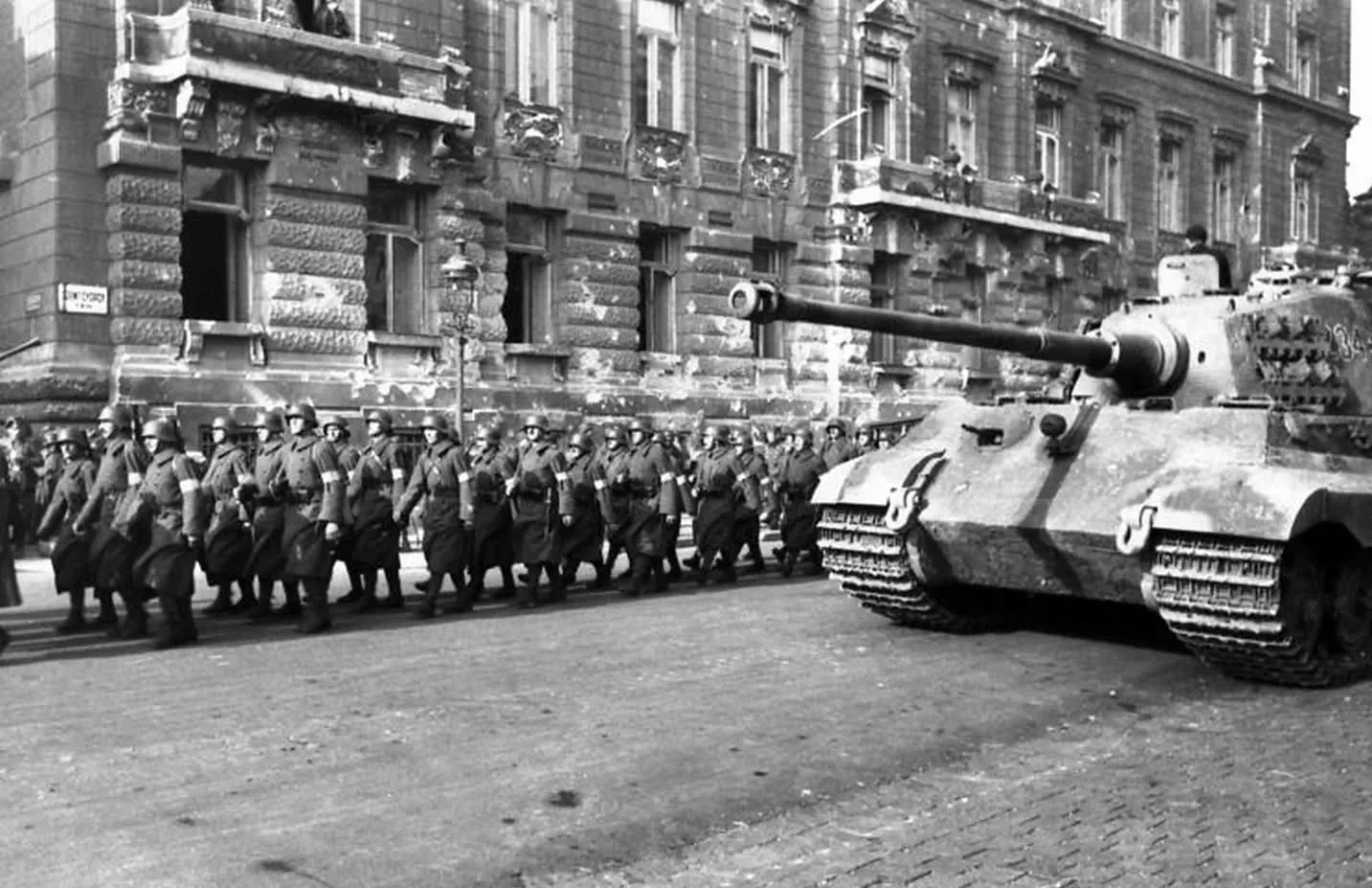
In the early afternoon of Sunday 15 October 1944 Radio Budapest interrupted its programme to broadcast a proclamation by the Regent, Miklós Horthy. The Regent declared that Germany had lost the war, that Hungary had been drawn into it against her interests, and that he had asked her adversaries for an armistice. A few hours later his authority no longer existed. The Germans, who had been preparing for weeks, abducted the Regent’s son, seized key points in the capital and surrounded Buda Castle, while the far-right Arrow Cross party took over the radio. By the next morning Horthy was in German hands, and under threat of his son’s death he signed a document withdrawing the proclamation, abdicating and entrusting power to the Arrow Cross leader, Ferenc Szálasi.
The statement that the Germans “overthrew” Horthy and “replaced” him with Szálasi captures the essence of what happened, but the events unfolded over two days. On 15 October Horthy announced his request for an armistice and was cut off from power. He signed his abdication and Szálasi’s government was appointed only on 16 October, and Szálasi assumed the office of “Leader of the Nation” at the beginning of November.
Background: an armistice negotiated in Moscow
Since the German occupation of 19 March 1944 Hungary had formally remained a sovereign ally of the Reich, but real power lay with the Reich plenipotentiary, Edmund Veesenmayer. After Romania changed sides in August, Horthy appointed a government under General Géza Lakatos and began looking for a way out of the war. The Western Allies replied that Hungary could surrender only to all three great powers, the USSR included. On 1 October a secret delegation under General Gábor Faraghó reached Moscow, and on 11 October it signed preliminary armistice terms. Hungary was to withdraw to her Trianon borders and declare war on Germany. In those same days Churchill and Stalin were discussing spheres of influence in the Balkans and Central Europe in Moscow, while in the east of the country the Battle of Debrecen was already under way, with Marshal Rodion Malinovsky’s 2nd Ukrainian Front pushing deep into the Great Hungarian Plain.
Horthy acted in secret from part of his own government, but not from the Germans. Veesenmayer had informers in the Lakatos cabinet, and German intelligence was watching people in the Regent’s circle. Adolf Hitler was determined not to allow a repetition of the Italian scenario of September 1943 or the Romanian one of August 1944. The lines of communication of the German forces withdrawing from the Balkans ran through Hungary, and the oilfields near Nagykanizsa were among the Reich’s last sources of oil. In case of “betrayal” a plan was prepared under the codename Panzerfaust.
Szálasi and the Arrow Cross
Ferenc Szálasi, born in 1897 in Kassa (Košice), a former General Staff officer, left the army in the mid-1930s and created his own ideology, which he called Hungarism (PL). It combined extreme nationalism, antisemitism and a mystical vision of a greater Hungary ruling the Carpathian Basin. His movement, known as the Arrow Cross after its emblem of arrows arranged in a cross, won several dozen seats in the 1939 election and was then the second force in parliament. Szálasi himself was jailed several times, and Horthy’s government regarded his party with distrust. During the war its popularity declined, but it kept its armed squads and its influence in parts of the officer corps and the gendarmerie. To the Germans Szálasi was not an ideal partner – they considered him a fantasist – but he was the only politician prepared to wage the war to the end.
Preparations proceeded on two tracks. Hitler’s emissaries arrived in Budapest, among them SS-Obersturmbannführer Otto Skorzeny, who a year earlier had freed Mussolini from the Gran Sasso, and SS-Obergruppenführer Erich von dem Bach-Zelewski, fresh from crushing the Warsaw Uprising. Armoured units and paratroops were brought up to the city, and on 11 October Veesenmayer instructed Szálasi to prepare his party to take power. Arrow Cross squads under the former general Emil Kovarcz were to seize the radio, government offices and police stations.
The abduction of the Regent’s son
On the morning of 15 October the Germans carried out the first part of the plan, referred to in accounts as Operation Mickey Mouse (Maus). The Regent’s son, Miklós Horthy Jr, had been conducting behind-the-scenes talks about leaving the war. German intelligence agents provocateurs lured him to a supposed meeting with emissaries of Tito’s Yugoslav Partisans in the office of the director of the Danube ports, Félix Bornemisza, in central Budapest. When he entered the building, Skorzeny’s men surrounded him. After a brief exchange of fire in which his bodyguards were killed and wounded, Horthy Jr was beaten, rolled up in a carpet, driven to the airfield and flown to Vienna, and from there sent to Mauthausen concentration camp. He survived there until the end of the war.
The Regent learned of the abduction at a meeting of the Crown Council. Despite Veesenmayer’s urging that he wait until he had spoken to the ambassador, Rudolf Rahn, he decided not to delay. In the early afternoon the radio broadcast his proclamation. Its text, toned down at the last moment by Prime Minister Lakatos, was vague: it spoke of asking for an armistice rather than concluding one, and it did not declare war on Germany. The order to the troops to cease fighting was in practice never delivered in an intelligible form.
The afternoon and night of 15 October
The Germans and the Arrow Cross reacted at once. Shortly after the proclamation Szálasi’s men, backed by the Germans, seized the broadcasting station. The Chief of the General Staff, General János Vörös, sent out a clarification to commanders that the Regent had not concluded an armistice but had merely opened negotiations, and that the fighting would continue. In the evening the radio broadcast an appeal by Szálasi, who proclaimed himself leader of the “fighting nation”, together with German marches. German units occupied the bridges over the Danube, the railway stations and government buildings, while in provincial towns the Arrow Cross took power.
The attitude of the army proved decisive. Contrary to Horthy’s belief that the officers would keep the oath they had sworn to the Regent, most of the officer corps declared for continuing the war or kept silent. The commander of the First Army in the Carpathians, General Béla Miklós, ordered a ceasefire and went over to the Soviet side, but most of his soldiers stayed in their positions. The commander of the Second Army, General Lajos Veress, was arrested by his own officers. By the evening the Regent could rely on practically no one but a few hundred men of the bodyguard in the Castle. Prime Minister Lakatos negotiated with Veesenmayer and Rahn all afternoon and finally agreed to the German demand for the Regent’s abdication in exchange for a promise of safety for him and his family.
16 October: the abdication
Early on 16 October Lakatos and Veesenmayer arrived at the Castle. According to Horthy’s account he was given a few minutes to decide: if he did not place himself under German protection, the Castle would be attacked. The Regent agreed and left with Veesenmayer for SS headquarters. At about the same time Skorzeny led a column of heavy Tiger II tanks and paratroops up Castle Hill. Some of the guardsmen, whom the order not to resist had not reached, held out briefly, and a few soldiers on both sides were killed in the clashes. Bach-Zelewski’s plan to shell the Castle with heavy artillery in the event of resistance proved unnecessary.
That same day Lakatos presented Horthy with a written statement in which the Regent annulled his proclamation, abdicated and entrusted Szálasi with forming a government. When Horthy asked Veesenmayer whether his son’s life depended on his signature, Veesenmayer is said to have confirmed it. Horthy signed. He later wrote that he had handed nothing over, but had merely “exchanged his signature for his son’s life”, and that a signature extracted under threat had no legal force. On 16 October Szálasi became prime minister of a government named the Government of National Unity, in which the Arrow Cross held half the portfolios. On 17 October Horthy and his family left by train for Germany, where until the end of the war he was held under SS guard at Hirschberg Castle in Bavaria. Despite the promises, his son was not released. At the beginning of November a rump parliament, whose sitting was attended by only some of its members, conferred on Szálasi the powers of head of state, and he took the oath as nemzetvezető – “Leader of the Nation”.
Terror against the Jews of Budapest
The coup had its most tragic consequences for the Jews. In the summer of 1944 the Hungarian gendarmerie, working with Adolf Eichmann’s SS unit, had deported more than 430,000 Jews from the provinces to Auschwitz-Birkenau. At the beginning of July Horthy halted the deportations, which saved most of the capital’s Jews – according to various estimates some 200,000–250,000 people, crowded into a few thousand “yellow-star houses”. As early as the night of 15–16 October and over the following days, Arrow Cross squads raided these houses, looting and murdering. Historians speak of several hundred killed in the first days after the coup. On 17 October Eichmann returned to Budapest, and the new government agreed to “lend” the Reich tens of thousands of Jews for forced labour.
From 8 November tens of thousands of Jews, women and the elderly among them, were driven on foot in death marches towards the Austrian border at Hegyeshalom, to build fortifications in front of Vienna and to the camps. In December the ghetto in Pest was sealed, and the Arrow Cross shot Jews on the banks of the Danube – an atrocity commemorated today by the memorial Shoes on the Danube Bank. According to the most frequently cited estimates, the Arrow Cross murdered some 10,000–15,000 people, most of them Jews, during their rule, and the total number of victims of their policies, including those who died on the marches and those deported, was many times higher. Some of those in danger were saved by diplomats of neutral states: the Swede Raoul Wallenberg, the Swiss consul Carl Lutz, the Italian Giorgio Perlasca and representatives of the nunciature, who issued protective passports and ran houses under the protection of their states.
Its place in the war
The coup of 15–16 October kept Hungary in the war on Germany’s side to the end. The Reich retained its last ally in Central Europe, Hungary’s resources and oil, and a rear base for the front. The price was a campaign that lasted until April 1945 and turned the country into a battlefield: the Red Army reached the outskirts of Budapest at the beginning of November, and the siege of Budapest, from the end of December to 13 February 1945, was among the bloodiest of the whole war. Meanwhile, in the territory taken by the Soviets, a Provisional National Assembly and a government under General Béla Miklós were set up in Debrecen in December; on 20 January 1945 that government signed an armistice with the Allies in Moscow.
Szálasi fled west before the Red Army. In May 1945 he fell into the hands of the Americans, who handed him over to Hungary. The People’s Tribunal in Budapest sentenced him to death, and on 12 March 1946 Szálasi was executed together with several members of his government. Horthy testified as a witness at Nuremberg, was never put on trial, and spent the rest of his life in exile in Portugal, where he died in 1957. After the war Skorzeny was acquitted of the charges against him by an American tribunal at Dachau and escaped from an internment camp. The rule of the Arrow Cross, brief and chaotic, has gone down in history above all as the last chapter of the Holocaust in Hungary.
Sources
Meanwhile
(04)Elsewhere, within a week.
- 12 October 1944 · Western FrontXXIII Corps in EuropeIn the autumn of 1944 the headquarters of the US XXIII Corps, formed in January 1944, reached Europe. It never saw battle – in 1945 it occupied the Rhineland.
- 12 October 1944 · PacificThe raids on FormosaOn 12–16 October 1944 Halsey's carriers crushed Japanese air power over Formosa. Tokyo announced 11 carriers sunk – in reality, not one.
- 12 October 1944 · BalkansThe liberation of AthensOn 12 October 1944 the Germans left Athens and EAM and ELAS took the streets; the British arrived on 14 October and Papandreou's government on 18 October.
- 18 October 1944 · MilitaryThe VolkssturmOn 18 October 1944 at Bartenstein in East Prussia Himmler announced the creation of the Volkssturm – a levy en masse of men aged 16 to 60.
Related events
(04)The same battle, people or subject.
- 29 December 1944 · Eastern FrontThe siege of Budapest beginsOn 29 December 1944 the Red Army sent envoys with an ultimatum into encircled Budapest. Both were killed, and the Soviets began their assault on Pest.
- 1 October 1944 · DiplomacyThe Hungarian delegation in MoscowOn 1 October 1944 a secret delegation sent by Regent Horthy and led by General Gábor Faraghó reached Moscow to negotiate a Hungarian–Soviet armistice.
- 19 March 1944 · Central and Eastern EuropeThe Germans occupy HungaryOn 19 March 1944 the Wehrmacht occupied Hungary in Operation Margarethe. Horthy remained regent, but real power passed to Veesenmayer and the SS.
- 29 March 1945 · Central and Eastern EuropeThe Deutsch Schützen massacreOn 29 March 1945 at Deutsch Schützen in Burgenland the SS shot at least 57 Hungarian Jews – forced labourers building fortifications.