- Category:
- Military operations
- Front:
- Eastern Front
- Date:
- 29 December 1944
- Author:
- Natalia
- Battle:
- Siege of Budapest
- Tags:
- Hungary, Red Army, Third Reich, Holocaust
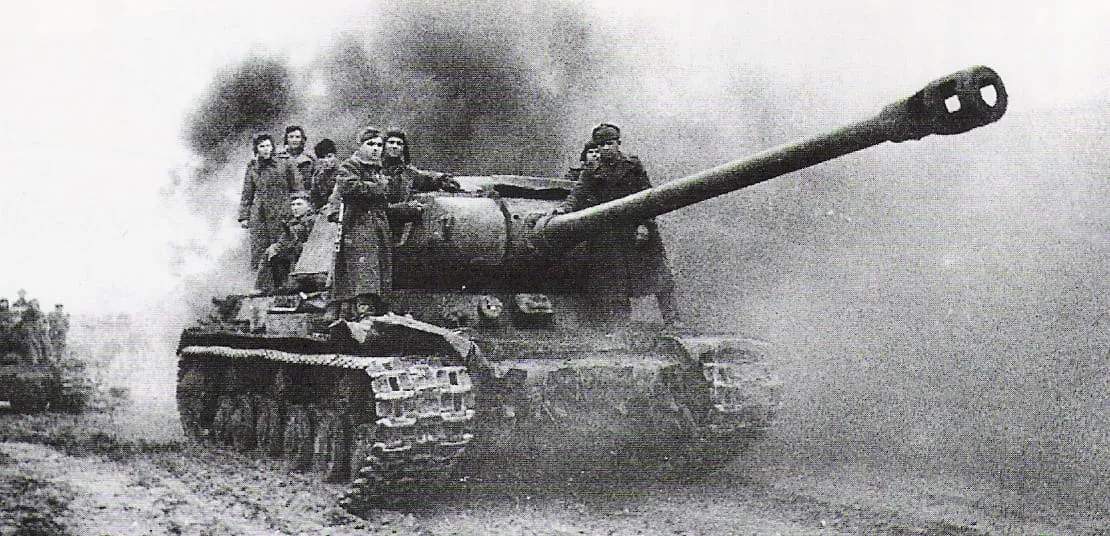
On Friday 29 December 1944, before noon, two officers carrying white flags set out from the Soviet lines outside Budapest. Captain Miklós Steinmetz, a Hungarian-born officer of the Red Army, drove in a car fitted with a loudspeaker towards the outskirts of Pest. Captain Ilya Ostapenko crossed the front line on foot in Buda, on the west bank of the Danube. Both carried the same ultimatum from the commanders of the 2nd and 3rd Ukrainian Fronts: the garrison of the encircled Hungarian capital was to surrender, in return for which the Soviets promised the soldiers their lives and care for the wounded. Neither envoy returned alive. The ultimatum was rejected, and the Red Army began its assault on a city in which, by historians’ estimates, some 800,000 civilians remained. So began a siege that lasted until 13 February 1945 and was among the longest and bloodiest battles for a major city in the whole war.
The statement that Soviet troops “began the siege of Budapest” on 29 December needs qualifying. The ring of encirclement had closed three days earlier, on 26 December, and fighting for the suburbs of Pest had been going on since November. The date of 29 December has become accepted as the start of the siege because on that day the Soviets delivered a formal ultimatum, and after its rejection and the deaths of the envoys they launched an organised assault on the city itself.
The road to Budapest
Hungary was the Reich’s last ally in Central Europe. When in October 1944 the regent, Miklós Horthy, tried to take the country out of the war, the Germans responded with the Arrow Cross coup, which handed power to Ferenc Szálasi. At the same time the Battle of Debrecen was being fought in eastern Hungary. Marshal Rodion Malinovsky’s 2nd Ukrainian Front suffered heavy losses in it, but by the end of October it had occupied the Great Hungarian Plain up to the Tisza and stood on the road to the capital.
Joseph Stalin pressed for Budapest to be taken quickly. As early as 29 October Malinovsky was ordered to attack the city straight off the march, although his troops were exhausted after the fighting on the plain. At the beginning of November the Soviet spearheads reached the south-eastern suburbs of Pest, but there they were halted. The Germans and Hungarians manned a semicircular belt of fortifications around the part of the city on the left bank, the so-called Attila Line, and throughout November beat off one attack after another. The frontal assault had failed, so the Soviet command decided to outflank the capital on both sides.
Closing the ring
The encircling manoeuvre was prepared throughout December. In the north, on the left bank of the Danube, troops of the 2nd Ukrainian Front broke through the hills north of the capital and reached the Danube opposite Esztergom. In the south, Marshal Fyodor Tolbukhin’s 3rd Ukrainian Front, which in November had crossed the Danube in Yugoslavia and southern Hungary, approached Lake Balaton. On 20 December both fronts struck simultaneously. Tolbukhin’s armies broke through the German defences between Lake Balaton and Lake Velence and advanced rapidly to the north-west, into the rear of Buda.
On Christmas Eve Soviet tanks appeared on the hills of Buda, in suburbs where trams were still running and residents were preparing for the holiday, unaware of how close the front was. On 26 December units of the 3rd Ukrainian Front reached Esztergom and linked up with Malinovsky’s troops on the Danube. Budapest was cut off from the west. The whole city was encircled, with both its halves: flat, densely built-up Pest on the left bank and hilly Buda, with Castle Hill, on the right.
The commanders of German Army Group South had earlier proposed shortening the front and withdrawing troops from the capital before the pocket closed. Adolf Hitler refused. Already at the turn of November and December he had declared Budapest a fortress (Festung) to be defended house by house, and on 22 December he dismissed the commander of Army Group South, Colonel General Johannes Frießner, blaming him for the defeats. Instead of allowing a breakout, Hitler announced a relief operation and sent SS General Herbert Otto Gille’s IV SS Panzer Corps to Hungary from the Warsaw area. For Hitler, Hungary also mattered economically: the oilfields near Lake Balaton were among the last sources of oil left to the Reich.
Defenders and besiegers
The defence of the city was commanded by SS-Obergruppenführer Karl Pfeffer-Wildenbruch, a police general who at the end of 1944 had taken command of the IX SS Mountain Corps. Trapped in the pocket were two SS cavalry divisions – the 8th SS Cavalry Division “Florian Geyer” and the 22nd SS Volunteer Cavalry Division “Maria Theresia” – together with the 13th Panzer Division, the Panzergrenadier Division “Feldherrnhalle” and the remnants of other units. The Hungarian side was represented by General Iván Hindy’s I Corps, with the remnants of an infantry division and an armoured division, assault-gun battalions, gendarmerie, police, volunteer units including students, and armed Arrow Cross militias. The Hungarian units were placed under German command, and Hindy had no real influence on decisions.
Figures for the size of the garrison vary. According to the Hungarian historian Krisztián Ungváry, author of the most comprehensive study of the siege, some 79,000 soldiers were trapped in the pocket, roughly half of them Hungarians. The Soviet side committed more than twice that strength to the fighting for the city itself, with a considerable superiority in artillery and aircraft. The Romanian VII Army Corps, which had been fighting on the Allied side since August, also took part in the assault on Pest. Further Soviet armies had at the same time to hold the outer ring of the encirclement against the expected German relief attempt.
The envoys of 29 December
Malinovsky and Tolbukhin hoped that the cut-off garrison would lay down its arms without a fight for every street. Their haste was understandable: Stalin expected Budapest to fall quickly, and the Soviet command wanted to send its troops on towards Vienna as soon as possible. On 29 December, therefore, the two front commanders sent envoys with an ultimatum, which had been announced in advance by radio and over loudspeakers along the front line.
Captain Miklós Steinmetz, a Hungarian who after the fall of the Hungarian Soviet Republic in 1919 had ended up in Soviet Russia and become an officer of the Red Army, drove in a car flying a white flag along the road from Vecsés towards Pest. Near what is now the district of Pestszentlőrinc the car was destroyed, and Steinmetz and the soldiers with him were killed. The circumstances of his death are disputed: according to some accounts the car was fired on by the defenders, according to others it ran over a mine. Captain Ilya Ostapenko crossed the front line in Buda, was led blindfolded to the German headquarters, where acceptance of the ultimatum was refused, and set off back. On the way to his own lines he was killed by an exploding shell.
From the following day Soviet propaganda proclaimed that the Germans had deliberately murdered both envoys, and for decades this version was official in communist Hungary, where monuments were erected at the places where they died. The Hungarian historians Krisztián Ungváry and József Meruk, however, pointed to documents from Russian military archives according to which Ostapenko was killed by a shell fired from the Soviet side. Steinmetz’s death remains unexplained. Whatever the circumstances, the rejection of the ultimatum settled the matter: from 30 December Soviet artillery and aircraft began a massive bombardment of the city, and infantry with tanks went into the attack on the suburbs of Pest, into which the Red Army and Romanian units now ground their way street by street.
Civilians in the pocket
Budapest had not been evacuated. Szálasi’s authorities – he had moved with his government to the west of the country at the beginning of December – prepared neither the removal of the inhabitants nor stocks for a long siege. By historians’ estimates, some 800,000 civilians remained in the city, including thousands of refugees from the provinces. When the ring closed, people went down into the cellars, where they were to spend the following weeks without electricity, gas or running water, with dwindling food supplies. Water was fetched from wells and from the Danube under fire, and the meat of dead horses became one of the staple foods. Air supply of the garrison by the Luftwaffe – first to the airfield, then by parachute drops and by gliders landing in the centre of Buda – was not enough even for the soldiers.
The Jews of Budapest under Arrow Cross rule
The Jews were the most endangered group of the city’s inhabitants. In the summer of 1944 the Hungarian gendarmerie and Adolf Eichmann’s SS unit had deported more than 430,000 Jews from the provinces to Auschwitz-Birkenau, but most of the capital’s Jews survived because Horthy halted the deportations. After the Arrow Cross coup their situation deteriorated sharply. In November tens of thousands of people were driven on death marches towards the Austrian border, and in December a ghetto was sealed off in Pest’s VII District, around the Great Synagogue on Dohány Street, into which some 70,000 people were crammed. Several tens of thousands more lived in the so-called international ghetto, in apartment buildings under the protection of neutral states.
As the front drew nearer and power in the city passed into the hands of armed militias, the Arrow Cross men increasingly dragged Jews out of houses, shelters and hospitals. The victims were led to the Danube, made to take off their shoes and shot on the embankment so that their bodies fell into the river. This is commemorated today by the Shoes on the Danube Bank memorial. The number killed by the river is given variously, most often in the thousands. According to estimates cited by historians, the Arrow Cross murdered some 10,000–15,000 Jews in Budapest between the autumn of 1944 and the arrival of the Red Army, and thousands more died in the ghetto from hunger, cold and disease.
For some of those in danger, the legations of neutral states offered salvation. The Swedish diplomat Raoul Wallenberg, who had arrived in Budapest in July 1944, issued Swedish protective passports and set up a network of protected houses. The Swiss vice-consul Carl Lutz, the papal nuncio Archbishop Angelo Rotta and the diplomats of Spain and Portugal acted in a similar way. The Italian Giorgio Perlasca, passing himself off as the deputy of the Spanish envoy after the latter’s departure, protected thousands of people in houses under the Spanish flag. Jews were also hidden by Catholic religious orders, including the sisters of Margit Slachta’s congregation. Protective documents often failed to stop the militias, but the constant presence of the diplomats, their interventions with the authorities and bribery made it possible to save many lives. Many of these people were later honoured with the title of Righteous Among the Nations.
Two governments, one besieged city
The siege began at a time when Hungary already had two governments. Szálasi, proclaimed “Leader of the Nation”, ruled from the western edge of the country under German protection. On the other side of the front, in Debrecen, taken in October during the Battle of Debrecen, a Provisional National Assembly met on 21 and 22 December and appointed a government headed by General Béla Miklós, the former commander of the First Army. This government, formed under Soviet supervision, was preparing to conclude an armistice with the Allies and to declare war on Germany. The struggle for Budapest was thus also a struggle over who would rule Hungary after the war.
Place in the war
The siege that began on 29 December lasted 50 days. In January 1945 the Germans tried three times to break through to the city in Operations Konrad I, Konrad II and Konrad III. The units that came closest got to within a dozen or so kilometres of Buda, but none of the attempts succeeded. On 18 January the Red Army took the whole of Pest, after the Germans had blown up all the bridges over the Danube. That same day the ghetto was liberated, and more than 100,000 Jews in the city lived to see the end of the occupation. The day before, Raoul Wallenberg had gone to the Soviet headquarters and been arrested. He died in a Soviet prison, and the circumstances of his death have still not been explained. The fighting for Buda and Castle Hill went on for more than three weeks. On 11 February the remnants of the garrison attempted to break out of the encirclement. Most of those taking part were killed or captured, and only a few hundred to a few thousand soldiers, according to various estimates, reached the German lines. On 13 February 1945 the fighting in the city ceased.
Budapest is sometimes compared with Stalingrad and with Warsaw as one of the most devastated cities of the war. According to Ungváry’s estimates, some 38,000 civilians died during the siege – some killed by bombs and shells, some by the Arrow Cross, and some by hunger and disease. The military losses of both sides are estimated at tens of thousands killed. The arrival of the Red Army was accompanied by mass rape of women, looting and the deportation of thousands of men, civilians among them, for forced labour in the USSR, as documented by witness accounts and historians’ research. For Hitler, the defence of the city was part of a wider game for Hungary. It tied down Soviet forces that might otherwise have moved on Vienna, and it weighed on the decision to send the 6th SS Panzer Army to Hungary after the failure in the Ardennes. After the fall of Budapest the fighting moved to Lake Balaton, where in March 1945 the Germans launched their last major offensive of the war. In April the Red Army drove them out of Hungary.
Sources
Meanwhile
(04)Elsewhere, within a week.
- 26 December 1944 · Western FrontThe relief of BastogneOn 26 December 1944 tanks of Patton’s 4th Armored Division broke through to encircled Bastogne, opening a narrow corridor to the 101st Airborne Division.
- 26 December 1944 · PacificThe race riot at AganaOn the night of 25/26 December 1944 on Guam white Marines fired on the camp of a black depot company. Three days of clashes ended in arrests and courts martial.
- 1 January 1945 · Western FrontOperation Nordwind beginsOn New Year's Eve the Germans struck the overstretched US Seventh Army in northern Alsace. Operation Nordwind was their last great offensive in the west.
- 1 January 1945 · Western FrontOperation BodenplatteOn 1 January 1945 the Luftwaffe hit Allied airfields in Belgium, the Netherlands and France, destroying hundreds of aircraft but losing 300 and over 200 pilots.
Related events
(04)The same battle, people or subject.
- 13 February 1945 · Eastern FrontThe end of the siege of BudapestOn 13 February 1945 the last units in Buda surrendered. Of 28,000 soldiers in the breakout of 11 February, only some 700 reached the German lines.
- 15 October 1944 · Central and Eastern EuropeThe Arrow Cross coup in HungaryOn 15 October 1944 Horthy broadcast a request for an armistice with the USSR. The Germans abducted his son, forced his abdication and installed Szálasi.
- 29 March 1945 · Central and Eastern EuropeThe Deutsch Schützen massacreOn 29 March 1945 at Deutsch Schützen in Burgenland the SS shot at least 57 Hungarian Jews – forced labourers building fortifications.
- 1 October 1944 · DiplomacyThe Hungarian delegation in MoscowOn 1 October 1944 a secret delegation sent by Regent Horthy and led by General Gábor Faraghó reached Moscow to negotiate a Hungarian–Soviet armistice.