Germany
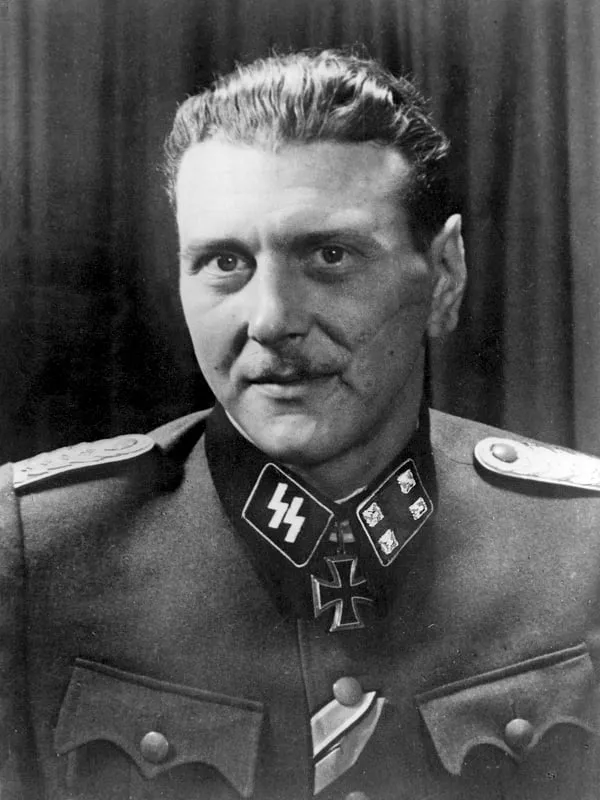
Otto Skorzeny
Head of the special operations department of SS foreign intelligence (1943–1945), commander of the SS-Jagdverbände (1944–1945), SS-Obersturmbannführer (1944)
- Born:
- 12 June 1908, Vienna (Austria-Hungary)
- Died:
- 5 July 1975, Madrid (Spain)
- Author:
- Łukasz
- Photo:
- autor nieznany, domena publiczna, Wikimedia Commons

Otto Skorzeny was an Austrian Nazi and SS officer who from 1943 commanded German special-operations units. He won fame for his part in the rescue of Benito Mussolini from the Gran Sasso in September 1943, when the propaganda of Joseph Goebbels and Heinrich Himmler gave him all the credit for an operation planned and carried out by Luftwaffe paratroopers. He later took part in the overthrow of the Regent of Hungary and commanded commandos disguised in American uniforms during the Ardennes offensive. Acquitted by an American tribunal after the war, he escaped from internment and settled in Franco’s Spain, where, as a businessman, military adviser and arms dealer, he built up the legend of “the most dangerous man in Europe”. Historians are now separating that legend from the facts piece by piece.
Vienna, the fraternity and the party
He was born on 12 June 1908 in Vienna into the middle-class family of the engineer Anton Skorzeny. The surname had Slavic roots: according to family tradition his ancestors came from Greater Poland. His childhood fell in the years of war and post-war poverty in a truncated Austria. While still at grammar school he was active in a nationalist pupils’ association, and from 1926 he studied mechanical engineering at the Vienna University of Technology. He joined the duelling fraternity Markomannia, to which he remained loyal until his death, and fought more than a dozen sabre duels. One of them left him with prominent scars on his left cheek, which later earned him the Allied nickname “Scarface”. He also belonged to the Academic Legion, a student formation linked to the Austrian Heimwehr movement.
He qualified as an engineer in 1931 and worked as a mechanic and then for a scaffolding firm whose owner became his father-in-law; in 1937 he took over the business. He joined the Austrian Nazi Party in May 1932 – impressed, he claimed, by a speech Goebbels gave in Vienna – and in February 1934 the SS, which was then illegal in Austria. He took no part in the July Putsch of 1934, in which Chancellor Engelbert Dollfuss was killed.
On 11 March 1938, the night of the Anschluss, he was among the SS men who entered the Federal Chancellery in Vienna. He then escorted President Wilhelm Miklas to his villa, and after the war presented himself as Miklas’s protector against Nazi violence. According to research by Austrian historians, during Kristallnacht in November 1938 his SS unit destroyed two Viennese synagogues, amid attacks on Jews.
The Waffen-SS
When the war broke out he volunteered for the Luftwaffe, but at over thirty he was too old for flying training. Instead he ended up in the armed SS units from which the Waffen-SS was formed. As a technical and transport officer in the division later named “Das Reich” he went through the Battle of France, the invasion of Yugoslavia and, from June 1941, the war against the Soviet Union. In the Battle of Moscow his division reached the approaches to the capital. In December 1941 Skorzeny was lightly wounded and, because of a gall-bladder illness, sent to the rear. He never returned to the front.
The turning point in his career came through his acquaintance with a Viennese party comrade, Ernst Kaltenbrunner, who took over the Reich Security Main Office (RSHA) in January 1943. In April 1943 Skorzeny was given a new special-tasks department within SS foreign intelligence, headed by Walter Schellenberg: it was to train saboteurs and carry out sabotage and commando operations. It was intended as the SS counterpart of the “Brandenburg” units under the military intelligence service of Admiral Wilhelm Canaris. From men of the SD, the police and the Waffen-SS he formed a special unit, stationed from June 1943 at Friedenthal near Berlin and known from 1944 as SS-Jäger-Bataillon 502.
Gran Sasso
At the end of July 1943, after the fall of Mussolini, Hitler ordered General Kurt Student to find and free the Italian dictator, and Skorzeny was attached to Student’s staff. According to Skorzeny’s memoirs, Hitler picked him personally from among several officers. The most important leads were obtained by the Rome SD station of SS-Obersturmbannführer Herbert Kappler, while Skorzeny flew reconnaissance over La Maddalena, where the Italians held Mussolini for part of August. On 12 September 1943, during the rescue of Mussolini, he landed by glider beside the Campo Imperatore hotel together with a dozen or so of his men and paratroopers from the training battalion of Major Harald Mors, who was in command of the whole operation. Skorzeny’s gliders reached the spot ahead of the group of the landing-force commander, he was the first to run into the hotel, and he then insisted on flying out with Mussolini in an overloaded Fieseler Storch, putting the success of the whole operation at risk.
Propaganda turned this into his personal triumph. Hitler immediately awarded him the Knight’s Cross and promoted him to SS-Sturmbannführer (major), and radio and newsreels presented him as the author and commander of the operation. The paratroopers, whose role was passed over in silence, protested in vain. In successive memoirs Skorzeny repeated the version in which he was in command and played down the Luftwaffe’s part. Historians working from documents and participants’ accounts, among them Marco Patricelli and German researchers, have shown that the operation was planned by Student’s staff and commanded by Mors. Skorzeny took part in it; he was not its author.
The Reich’s commando, 1944–1945
After the Gran Sasso Skorzeny became one of Hitler’s favourites and was given tasks in which publicity and loyalty to the regime counted most. In May 1944 he took part in planning the airborne raid on the headquarters of Josip Broz Tito at Drvar in Bosnia, but withdrew from it in the belief that its secret had leaked. The raid failed and Tito escaped. On the evening of 20 July 1944, after the failed attempt on Hitler’s life, Skorzeny arrived with a company of his men at the Bendlerblock in Berlin, the conspirators’ headquarters, and helped restore the regime’s control there. When the RSHA absorbed the Abwehr he took over its sabotage units, and in November 1944 he became head of the SS-Jagdverbände, the combined formations for sabotage and operations behind enemy lines.
In October 1944 he led the operation in which the Germans overthrew the Regent of Hungary, Miklós Horthy, when he tried to take his country out of the war. On 15 October Skorzeny’s men kidnapped the Regent’s son, Miklós Jr., in Budapest and took him to Mauthausen concentration camp, and the next day they seized Buda Castle. Blackmailed with his son’s fate, Horthy revoked the armistice he had announced the day before and resigned, and power passed to the leader of the Arrow Cross, Ferenc Szálasi. Skorzeny was promoted to SS-Obersturmbannführer (lieutenant colonel).
In December 1944, during the Ardennes offensive, his 150th Panzer Brigade was to seize the bridges over the Meuse as part of Operation Greif. Several dozen English-speaking soldiers in American uniforms and captured vehicles infiltrated the American lines, switched road signs and sowed confusion. Militarily the operation achieved little, but a rumour spread among the Americans that Skorzeny was heading for Paris to kill General Dwight Eisenhower, who had to spend Christmas under heavy guard. The disguised men who were captured were tried by American military courts, and more than a dozen were shot as spies.
At the end of January 1945 Himmler sent Skorzeny and his units to the Oder front to defend the bridgehead at Schwedt. There, as president of a summary court, he had the mayor of the small town of Königsberg in der Neumark (today Chojna) shot for leaving the town without orders. According to the Czechoslovak judicial authorities, in April 1945 an SS unit under his command burned several Moravian settlements, including Ploština, in an anti-partisan operation and murdered several dozen civilians. Skorzeny was also supposed to organise resistance in the alleged “Alpine Fortress”. On 16 May 1945 he surrendered to the Americans in Austria.
The Dachau trial and escape
The Americans interrogated him in an internment camp, and in 1947 put him on trial before one of the military tribunals at Dachau together with nine officers of his Ardennes brigade. The charges concerned the use of enemy uniforms in combat, as well as looting and the mistreatment of prisoners. The trial lasted from 18 August to 9 September 1947 and ended in the acquittal of all the defendants. The decisive evidence came from the British intelligence officer Forest Yeo-Thomas, who confirmed that Allied special forces had also operated in enemy uniform.
After the trial he was handed over to a German internment camp in Darmstadt to await denazification proceedings. On 27 July 1948 he escaped. According to his own version, he was driven out by former SS men disguised as American military policemen. Some historians argue that the escape was made possible by the tacit consent of American intelligence, which saw him as a useful man in the Cold War. He spent the following years under a false name, hiding in Bavaria among other places and writing his memoirs. In February 1950 he appeared in public in Paris, and a photograph of him in a café on the Champs-Élysées made the front pages.
Madrid
From 1950 he lived in Madrid under the protection of the Franco regime. He ran an engineering office, represented West German and Austrian companies in Spain, did property deals on the Costa del Sol and traded in arms. In 1952 a denazification tribunal in Hesse classified him in absentia as a “lesser offender”, which allowed him to travel. According to many accounts he advised the Argentine president Juan Perón, and according to American documents in the 1950s he led a team of German military instructors in the Egypt of Gamal Abdel Nasser. In 1959 he bought a farm in Ireland, but was not granted permanent residence there.
Many stories grew up around Skorzeny. Simon Wiesenthal and the press portrayed him as one of the leaders of the ODESSA network, which helped SS men escape abroad. Historians, however, doubt that ODESSA ever existed as a single, centralised organisation and have not confirmed that Skorzeny led it. What is certain is that he was the focal point of the community of former SS men in Spain, was a friend of Léon Degrelle, met Oswald Mosley and supported the far right for the rest of his life, including the Spanish neo-Nazi organisation CEDADE.
The most surprising thread of his post-war life came to light only long after his death. According to a former head of Mossad, Meir Amit, and to Israeli journalists and historians including Tom Segev and Danny Orbach, in the early 1960s Skorzeny worked with Israeli intelligence, helping it gather information on German scientists working on Egypt’s missile programme. In this way he is said to have secured himself against the fate of Adolf Eichmann. The details of this cooperation vary from account to account, and the journalist Ronen Bergman has dismissed reports that Skorzeny personally killed one of the scientists on Mossad’s behalf as untrue.
He died of cancer in Madrid on 5 July 1975. His ashes were buried in the family grave in Döbling cemetery in Vienna. At the funerals in Madrid and Vienna his old SS comrades bade him farewell with the Nazi salute. He never renounced Nazism.
Legend and reality
Skorzeny was to a large extent a creation of propaganda, which he then kept alive himself for thirty years. The Nazi media made him a hero at a moment when the Reich needed good news and the SS wanted to show that it could do whatever the army could. His memoirs, published in 1950 and reissued many times, and the uncritical biographies written in the 1950s and 1960s fixed the image of a brilliant commando and apolitical soldier. Only the research of recent decades, based on American, German and Italian records, has shown that at the Gran Sasso he was a participant in the paratroopers’ operation, not its commander; that the overthrow of Horthy was a police-style coup against a weakened ally; and that Greif was an operation with almost no military effect.
He was not, however, a marginal figure. He belonged to the men on whom the regime relied in the last years of the war: loyal to Hitler to the end, ready to crush revolt within their own camp, to kidnap allies and to subject their own citizens to summary justice. After the war, exploiting the divisions of the Cold War, he escaped punishment and for decades acted as a link between former Nazis, the intelligence services of several countries and the European far right.
Sources
Mentioned in battles
(03)Often appears with
People who appear in the same events.