- Category:
- Military operations
- Front:
- Atlantic
- Date:
- 13 December 1939
- Author:
- Łukasz
- Battle:
- Battle of the River Plate
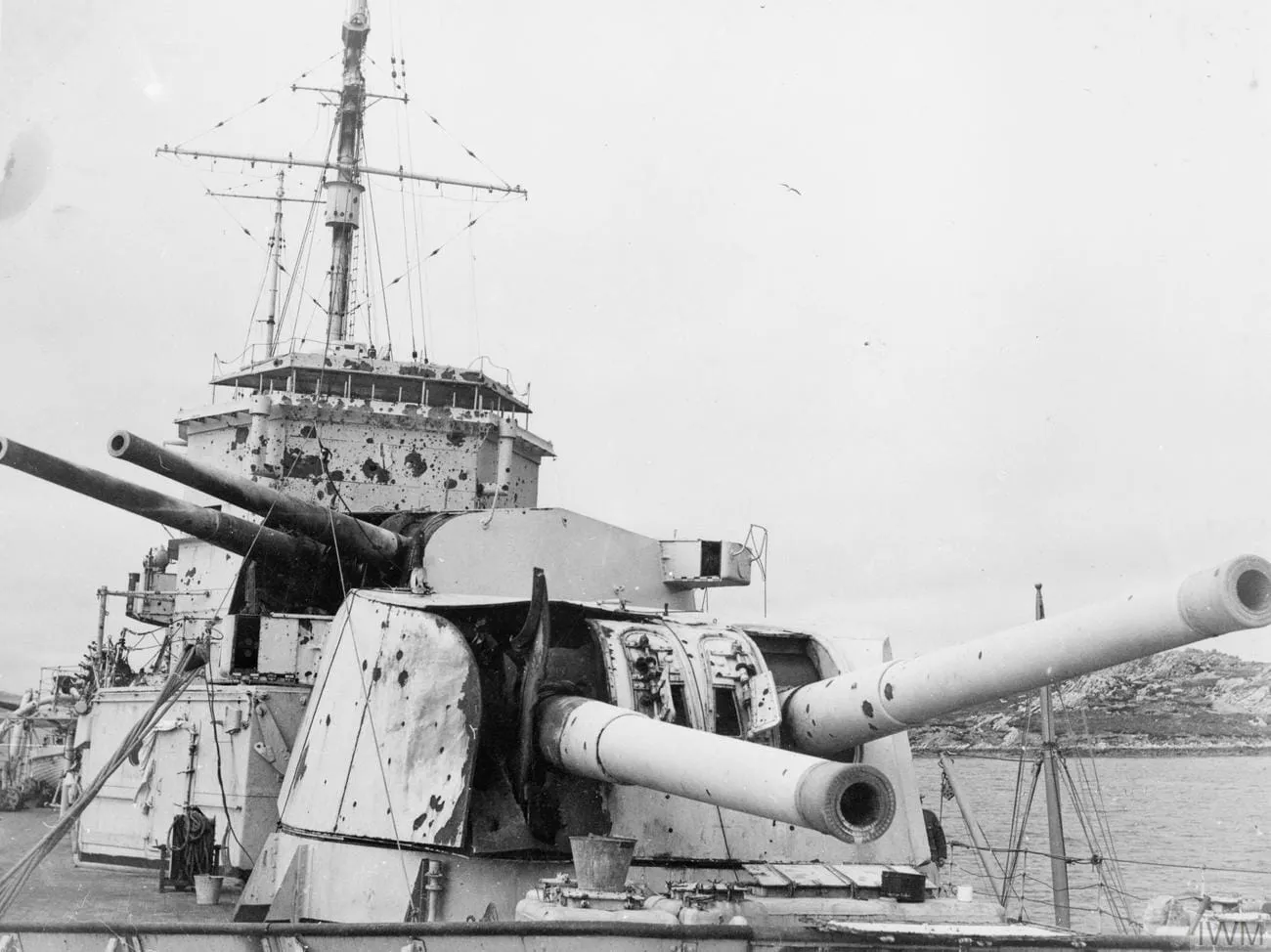
At dawn on 13 December 1939, in the South Atlantic a few hundred kilometres east of the estuary of the River Plate between Uruguay and Argentina, three British cruisers under Commodore Henry Harwood came upon the German “pocket battleship” Admiral Graf Spee, commanded by Captain Hans Langsdorff. The heavy cruiser Exeter and the light cruisers Ajax and Achilles were each clearly weaker than their opponent, yet they attacked at once. After an hour and a half of fighting the Exeter was wrecked and had to withdraw to the Falklands, and the Ajax had lost half her guns; but the Graf Spee too had suffered damage that ruled out a return to Germany. Langsdorff broke off the action and made for neutral Montevideo, with the two lighter cruisers shadowing him all day. Shortly after midnight on 13–14 December the German ship dropped anchor in the harbour of the Uruguayan capital. It was the first major clash between surface warships in the Second World War and the first naval battle of the war that the British could proclaim a victory.
It is often written that the battle was fought “off Montevideo” and that the German ship was attacked by “Hunting Group F”. Both points need correcting. Harwood’s squadron was designated Force G; Force F was a group of cruisers from the Halifax station operating in the North Atlantic. And the battle itself was fought far from the coast, on the open sea east of the entrance to the estuary; it moved into the vicinity of Montevideo only in the evening, during the pursuit.
Hunting the raider
The Admiral Graf Spee had left Wilhelmshaven before the war, on 21 August 1939, and from the end of September she had been destroying Allied shipping. On 30 September she sank her first ship, the British freighter Clement, off the coast of Brazil. By December she had sunk nine ships totalling some 50,000 gross register tons in the South Atlantic and the Indian Ocean. In doing so Langsdorff observed prize law: he stopped the ships, took their crews on board and only then sank them. Not one seaman from the ships he sank lost his life. He transferred most of his prisoners to his supply tanker Altmark, but kept some on board.
Against him and his sister ship Deutschland, operating in the North Atlantic, the British Admiralty and the French navy formed eight hunting groups at the beginning of October. Force G, which was to guard the coast of South America from Rio de Janeiro to the River Plate, was in essence the old South America Division, which Harwood had commanded since 1936. It comprised the heavy cruisers Exeter and Cumberland and the Leander-class light cruisers Ajax, in which Harwood flew his broad pennant, and Achilles. The latter belonged to the New Zealand Division of the Royal Navy, the forerunner of the Royal New Zealand Navy, and had a largely New Zealand crew.
For two months the raider eluded her pursuers. At the beginning of December she returned from the Indian Ocean to the Atlantic. On 2 December, in the eastern part of the South Atlantic a few hundred miles off the African coast, she sank the British ship Doric Star, whose wireless operator managed to send an attack signal and give her position, and on the following day the Tairoa. The commander of the South Atlantic station at Freetown thereupon moved his forces to the routes around the Cape of Good Hope. Harwood, some 3,000 nautical miles away, drew a different conclusion. He had long believed that sooner or later the raider would be tempted by the rich shipping lanes off the River Plate, along which ships carried Argentine meat and grain to Britain. He calculated that the Doric Star’s attacker could reach the area off Rio de Janeiro by 12 December and the River Plate a day later, and decided to concentrate his ships at the latter. The Exeter sailed from Port Stanley in the Falklands on 9 December, the Achilles a day later, and on the morning of 12 December the three cruisers met off the entrance to the estuary. The Cumberland remained in the Falklands, where her machinery was being overhauled.
On 7 December the Graf Spee sank her last victim, the Streonshalh, which was carrying grain from Argentina, and headed due west towards the River Plate. Langsdorff knew from a German naval staff report of 4 December that British cruisers were patrolling the area, but he counted on finding easy prey among the dense traffic.
Harwood’s plan
The disparity of forces was plain. The Graf Spee carried six 283 mm guns in two turrets and eight 150 mm guns, armour able to withstand cruiser shells at longer ranges and – something the British did not know – a primitive radar that helped with rangefinding. A shell from her main armament weighed about 300 kilograms. The Exeter had six 203 mm guns firing shells less than half as heavy; the Ajax and Achilles had eight 152 mm guns each. The combined broadside of the three cruisers weighed less than that of the German ship, and her guns outranged theirs. The British, on the other hand, had an advantage of a few knots in speed and in numbers.
Harwood had been preparing for just such an encounter for years. In the mid-1930s, as an instructor at the Royal Naval War College at Greenwich, he had worked out tactics for a cruiser squadron fighting a “pocket battleship”. On 12 December he issued his captains with a brief order: the three cruisers were to attack at once, by day or by night. By day they were to fight in two divisions, the Exeter on her own and the Ajax and Achilles together, so that the enemy would have either to split the fire of his two turrets or to leave one division unmolested. By night the ships were to keep together in loose formation and attack with torpedoes. Harwood accepted that he might lose his cruisers. The strategic arithmetic, however, favoured a fight: the Royal Navy could afford to lose a few cruisers, whereas the Kriegsmarine had nothing to replace a “pocket battleship” with. A damaged raider would have to abandon the war on trade and make for home through the North Sea, guarded by the British Home Fleet.
The first phase: the Exeter under fire
At about 6.10 a.m. on 13 December, by the time used in the British reports, smoke was sighted from the Ajax to the north-west. Harwood sent the Exeter to investigate. At 6.16 the cruiser signalled: “I think it is a pocket battleship.” The Germans had sighted the British ships’ masts earlier, but Langsdorff, who could not use his damaged reconnaissance seaplane, took them for a cruiser and two destroyers, perhaps escorting a convoy. Instead of keeping his distance and shelling the enemy from a range that only his guns could reach, he steamed at full speed towards them in order to catch the British before they had worked up to full speed. His orders from Berlin were to avoid action with warships. By the time he realised that he faced three cruisers, it was too late to withdraw without a fight.
The British carried out Harwood’s plan. The Exeter turned west to attack from the south, the Ajax and Achilles from the east. At 6.18 the Graf Spee opened fire on the Exeter at a range of about 17 kilometres. The Exeter replied two minutes later, the light cruisers a few minutes after that. The German fire was accurate from the start. The third salvo straddled the Exeter, and splinters from a shell that burst close alongside killed the crews of her torpedo tubes and wrecked the cruiser’s seaplane. At about 6.25 a 283 mm shell struck the Exeter’s B turret, the second of her forward turrets, and put it out of action. Splinters swept the bridge, killing or wounding almost everyone on it. Captain Frederick Bell, wounded in the face, moved to the after control position, and as communications had been destroyed, orders to the engine room and the steering were passed by a chain of messengers.
For a short time Langsdorff divided the fire of his two turrets between the Exeter and the light cruisers, but he soon went back to concentrating his main armament on the most dangerous opponent, engaging the Ajax and Achilles with his 150 mm guns. At about 6.40 two more hits wrecked the Exeter’s A turret and started a fire. The cruiser listed to starboard, took in water and fired only from her single after turret, directed by the gunnery officer from the turret roof. Twice she fired torpedoes, without result. At about 7.30 water flooded the electrical supply to the last turret and the Exeter fell silent. According to the most frequently cited figures she had been hit by seven 283 mm shells. Sixty-one of her men were killed and 23 wounded. Bell turned the ship to the south-east and later towards the Falklands, which she reached at a speed of a dozen or so knots, listing and down by the bow by more than a metre.
The Ajax and the Achilles
Before this, however, the Exeter had managed to strike the most important blow. One of her 203 mm shells pierced the Graf Spee’s decks and exploded near the funnel, destroying the fuel purification plant. Without it the ship’s diesel engines could run only on the stock of already purified fuel, enough by German calculations for only a dozen or so hours’ steaming. The British, however, did not yet know this.
The light cruisers, firing together under the direction of the Ajax, steadily closed the range. The Ajax launched a Fairey Seafox seaplane, which spotted the fall of shot. On the Achilles, meanwhile, splinters from a shell bursting alongside killed four men and wounded her captain, Edward Parry. At 7.16 the Graf Spee turned south, as if to finish off the Exeter. The two light cruisers then closed in and engaged her so effectively that Langsdorff gave up and switched his fire back to them. At 7.25 a 283 mm shell hit the Ajax and knocked out both her after turrets, and a few minutes later another brought down her mast. Seven men were killed in the cruiser. At about the same time Harwood received a report that the Ajax had only some 20 per cent of her ammunition left. According to participants’ accounts the report was exaggerated, but the commodore had no way of checking it. He judged that if he continued the fight in daylight he would lose both ships, while the enemy seemed almost undamaged. At 7.40 the British cruisers withdrew eastwards under cover of a smokescreen. Harwood intended to shadow the enemy until dark and attack him with torpedoes during the night.
To the surprise of the British, the Graf Spee did not pursue them. Nor did she finish off the retiring Exeter. The captain of the Achilles later wrote that to the end of his life he never understood why the German had not dealt with the two light cruisers once he had finished with the Exeter. Langsdorff set course westwards, for the River Plate.
Langsdorff’s decision
The German ship had taken about twenty hits in the battle, three of them 203 mm shells from the Exeter and the rest 152 mm shells. Her armour stopped most of them, but the damage was extensive: the fuel purification plant destroyed, a hole in the bow above the waterline that would have taken in water in the rough North Atlantic, the galley wrecked, the desalination plant damaged, along with some of the anti-aircraft guns and one of the secondary turrets. She had also used up more than half her main-armament ammunition. Thirty-six of her crew were killed and about 60 wounded. Langsdorff, who had commanded from an open position rather than from the armoured conning tower, was himself twice slightly wounded by splinters and, according to some accounts, briefly lost consciousness.
After conferring with his officers Langsdorff concluded that in her present state the ship could not fight her way across the Atlantic to Germany, and decided to put into port for temporary repairs. He chose Montevideo, the capital of neutral Uruguay. Many historians regard this choice as a mistake: Uruguay sympathised with the Allies and was under strong British influence, whereas Argentine ports such as Mar del Plata, or Buenos Aires on the far side of the estuary, might have received the German ship more kindly. During the battle several dozen British seamen from sunk merchant ships were on board the Graf Spee. None of them was killed.
The pursuit
All day the Ajax and Achilles followed the German ship on either side of her, at a distance of a dozen or more nautical miles. Whenever one of them came too close, the Graf Spee turned and fired a few salvoes, and the cruiser withdrew behind a smokescreen. At about 11 a.m. Langsdorff stopped the British ship Shakespeare on his way. He called the Ajax by radio, using the two ships’ pre-war call signs, asking her to pick up the boats with the ship’s crew. Only then was Harwood certain that he was fighting the Graf Spee and not the Admiral Scheer, as the British had believed until then. The Shakespeare’s crew, however, did not abandon their ship, and Langsdorff steamed on. At 9.46 a.m. Harwood had summoned the Cumberland from the Falklands, and the Admiralty ordered ships thousands of miles away towards the River Plate, among them the aircraft carrier Ark Royal and the battlecruiser Renown, which could not, however, arrive for several days.
In the evening it became clear that the German ship was entering the estuary. As it was shallow and full of sandbanks, Harwood ordered the Achilles to shadow the raider while the Ajax watched another channel through which the Graf Spee might try to slip away. After sunset, silhouetted against the western sky, the Achilles came under fire from the Graf Spee once more. Late in the evening Harwood called the Achilles off the pursuit. The Admiral Graf Spee dropped anchor in the Montevideo roads at about midnight – according to most sources a few minutes after midnight, and so already on 14 December. The wounded were taken to the local British hospital, and the Germans, in accordance with international law, released the 61 prisoners from the sunk ships once they entered port.
In the whole battle 108 men were killed: 36 Germans and 72 British and New Zealand sailors, 61 of them in the Exeter, 7 in the Ajax and 4 in the Achilles.
A first assessment
The balance of the day was not clear-cut. Tactically the Germans had the upper hand: they had badly damaged Harwood’s strongest cruiser and knocked out half the guns of a second, while losing far fewer men themselves. German propaganda announced that the Graf Spee had sunk a heavy cruiser and damaged two light ones, suffering only slight damage herself. Strategically, however, the British had achieved what they wanted: the raider had abandoned her war on trade and was sitting in a neutral port whose exits were watched by their cruisers. What happened next now depended in equal measure on international law, on diplomacy in Montevideo and on the imagination of Langsdorff, who believed that a far stronger fleet was waiting for him than was actually the case. For stopping the raider Harwood was promoted to rear admiral with seniority from 13 December 1939, and on 23 December his appointment to the Order of the Bath, with a knighthood, was announced. The captains of his three cruisers were also decorated.
Critics later reproached Harwood for not making full use of the advantage of having three ships: dividing his forces exposed the Exeter to the enemy’s concentrated fire, and the light cruisers could have closed the range sooner. Most historians nevertheless rate his decisions highly. He foresaw where the raider would appear, attacked her at once despite having weaker ships, and did not let her slip away when the battle proved indecisive.
Significance
The Battle of the River Plate ended the first challenge that the German surface fleet had thrown down to British shipping. The Deutschland had already returned home in November, and the Graf Spee was now immobilised. Four days later, on 17 December, she was scuttled by her own crew off the entrance to Montevideo harbour, and on 20 December Langsdorff took his own life in Buenos Aires. The Graf Spee’s cruise also showed how costly it was to fight a single ship: for two and a half months several dozen British and French warships had been searching for her, and stopping her had cost the lives of 72 British and New Zealand sailors.
In Britain the battle mattered above all for morale. In the first months of the war the Royal Navy had lost the aircraft carrier Courageous, the battleship Royal Oak and the armed merchant cruiser Rawalpindi, while on land the Phoney War dragged on. The victory of three small cruisers over a dangerous raider was the first success that could be shown to the public. The First Lord of the Admiralty, Winston Churchill, made the most of it. In February 1940 the crews of the Exeter and Ajax marched through the streets of London, and the damaged Exeter, which rumour said would remain in the Falklands until the end of the war, returned home at Churchill’s wish and spent more than a year being repaired and modernised. The Achilles was the first ship to fly the New Zealand flag in battle, and the town of Ajax in Ontario, Canada, built during the war beside a munitions factory, was named in honour of the Ajax.
For the Kriegsmarine the loss of the Graf Spee was a blow to the strategy of Admiral Erich Raeder, who wanted to scatter the British fleet by cruiser warfare on the oceans. Adolf Hitler regarded the course of the battle and its outcome as a disgrace, and was still repeating in December that the Exeter ought to have been sunk. German heavy ships later went out into the Atlantic with orders to fight to the last but to avoid engagements with an opponent of equal strength. Their raids in 1940–1941 were dangerous, but in May 1941 they ended with the sinking of the battleship Bismarck, after which the burden of the war on Allied trade passed almost entirely to the U-boats. The ships of the River Plate met different fates. The Ajax went on to fight in the Mediterranean and survived the war. The Exeter was sunk in March 1942 in the Battle of the Java Sea, and many of her crew died in Japanese captivity. The Achilles survived the war and, as the Indian cruiser Delhi, played herself in the 1956 British film The Battle of the River Plate, which fixed the battle in popular memory.
Sources
Meanwhile
(04)Elsewhere, within a week.
- 18 December 1939 · Western FrontCanadian and Indian troops reach EuropeOn 17 December 1939 the 1st Canadian Division’s first flight reached Greenock, as Churchill announced. Indian mule companies landed at Marseille on 26 December.
- 7 December 1939 · ScandinaviaThe Battle of Kollaa beginsOn 7 December 1939 the Soviet 56th Rifle Division attacked Finnish positions on the Kollaa river in Ladoga Karelia. The Finns held them to the end of the war.
- 7 December 1939 · ScandinaviaThe Battle of Suomussalmi beginsOn 7 December 1939 the Soviet 163rd Division reached Suomussalmi, burnt by the Finns. The Finnish command sent Colonel Hjalmar Siilasvuo's brigade there.
- 7 December 1939 · DiplomacyScandinavia, Italy and the Winter WarIn early December 1939 Norway and Denmark declared neutrality in the Winter War, Italy reaffirmed its “non-belligerence”, and Sweden declared no neutrality.
Related events
(04)The same battle, people or subject.
- 17 December 1939 · AtlanticThe scuttling of the Admiral Graf SpeeOn 17 December 1939 Langsdorff had the damaged Admiral Graf Spee blown up off Montevideo. Argentina interned her crew; on 20 December he shot himself.
- 5 October 1939 · AtlanticHunting groups against the raidersOn 5 October 1939 the Admiralty, together with the French, formed eight hunting groups of carriers and heavy ships to track down German surface raiders.
- 23 November 1939 · AtlanticThe sinking of HMS RawalpindiOn 23 November 1939 the battleships Scharnhorst and Gneisenau sank the armed merchant cruiser Rawalpindi between Iceland and the Faroes. About 265 men died.
- 14 October 1939 · AtlanticThe sinking of HMS Royal OakOn the night of 13–14 October 1939 Günther Prien’s U-47 slipped into Scapa Flow and sank the battleship Royal Oak. 833 or 835 men were killed.