United Kingdom
Henry Harwood
Commodore commanding the South America Division (1936–1940), Commander-in-Chief Mediterranean Fleet and Levant (1942–1943), Admiral
- Born:
- 19 January 1888, London (United Kingdom)
- Died:
- 9 June 1950, Goring-on-Thames (United Kingdom)
- Author:
- Łukasz
- Photo:
- Royal Navy official photographer, domena publiczna, Wikimedia Commons

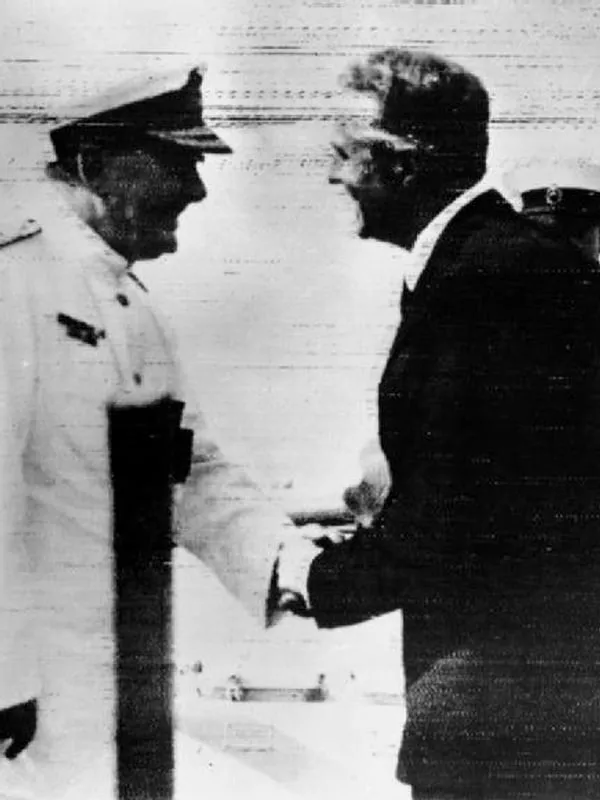
Sir Henry Harwood was a British naval officer whose name is linked above all with a single day: 13 December 1939. As a commodore in command of three cruisers, he foresaw where the German “pocket battleship” Admiral Graf Spee would appear, attacked her despite the enemy’s clear superiority in firepower and forced her to take refuge in Montevideo, where four days later she was scuttled by her own crew. The Battle of the River Plate was the Royal Navy’s first victory of the Second World War and made Harwood a national hero. His later career, crowned by command of the Mediterranean Fleet during the hardest period of the fighting in North Africa, brought him less glory. He was a staff officer and tactician, and his success at the River Plate grew out of years of thinking through the very problem he was eventually called upon to face.
Torpedo officer
Henry Harwood Harwood was born on 19 January 1888 in the Mayfair district of London, the son of Surtees Harwood Harwood, a barrister from Suffolk, and Mary Cecilia, née Ullathorne. The doubled name, in which the forename repeated the surname, was a family tradition. He was educated at Stubbington House in Hampshire, a school that prepared boys for a naval career, and in January 1903 he joined the training ship Britannia, the forerunner of Britannia Royal Naval College at Dartmouth, as a cadet. He became a midshipman in 1904 and a lieutenant in 1908.
In 1911 he completed the torpedo course and became a torpedo specialist. This specialisation, which at the time also covered ships’ electrical installations and communications, was one of the routes to the highest posts in the Royal Navy, one taken earlier by Dudley Pound, among others. Harwood served at sea throughout the First World War, but according to the available sources he took no part in any major battle. In 1916 he was promoted to lieutenant commander, and in 1919, while serving in the battleship Royal Sovereign, he was appointed an Officer of the Order of the British Empire (OBE).
Between the wars
Between the wars Harwood had the career typical of a capable staff officer. In 1921 he was promoted to commander; he worked in the Plans Division of the Admiralty, and in the mid-1920s he was torpedo officer of the 3rd Battle Squadron and of the Mediterranean Fleet. In 1924 he married Joan Chard, with whom he had two sons. In 1927–1928 he stood by the heavy cruiser Cumberland as she was completed, taking her over as her commanding officer – a ship whose fate would cross his again in 1939. At the end of 1928 he was promoted to captain and commanded the destroyer Warwick and a destroyer division of the Atlantic Fleet.
In 1931 he completed the course at the Imperial Defence College, which trained senior officers of all the armed services in strategy, and then in 1932–1934 he commanded the heavy cruiser London and served as chief of staff of the 1st Cruiser Squadron in the Mediterranean. He spent 1934–1936 as an instructor at the Royal Naval College, Greenwich. There he worked on a problem that troubled British planners in the 1930s: how to deal on the high seas with the new German Deutschland-class ships, known as “pocket battleships”, which were more powerful than any cruiser and faster than almost any battleship. Harwood concluded that a cruiser force should attack such a ship at once – by day split into two groups, to force the enemy to divide his fire, and by night together, using torpedoes.
In September 1936 Harwood became commodore commanding the South America Division of the America and West Indies Station, and at the same time captain of the heavy cruiser Exeter. For three years he sailed along the coasts of South America, getting to know its ports, politicians and diplomats. In January 1939 the crews of the Exeter and the Ajax brought aid to the victims of the Chillán earthquake in Chile, for which Harwood received Chilean decorations. At the end of August 1939, as war approached, he handed over command of the Exeter to Captain Frederick Bell and shifted his broad pennant to the light cruiser Ajax.
The River Plate
After the outbreak of war Harwood’s division intercepted German merchant ships trying to break out from South American ports for home. In October 1939 the Admiralty incorporated it into the hunting groups searching for German raiders as Force G, made up of the heavy cruisers Exeter and Cumberland and the light cruisers Ajax and Achilles. Their quarry was the Admiral Graf Spee under Kapitän zur See Hans Langsdorff, which had been sinking British ships since 30 September in the South Atlantic and the Indian Ocean.
At the beginning of December, when the raider sank the Doric Star far to the east in the South Atlantic, Harwood judged that the German would head for the rich shipping lanes off the coast of South America. He calculated that she could appear off the mouth of the River Plate on 13 December and concentrated his three available cruisers there. On 12 December he gave their captains his battle plan. On the morning of 13 December the Graf Spee did indeed steam straight towards the British force. In the Battle of the River Plate the Exeter was battered and had to withdraw, and the Ajax lost half her guns, but the German ship suffered damage that made it impossible for her to return to Germany, and she took refuge in neutral Montevideo. With his two light cruisers – and from the evening of 14 December also the Cumberland, summoned from the Falklands – Harwood guarded the exit from the estuary, while British diplomats prolonged the Germans’ stay in port and the Admiralty spread rumours of approaching heavy ships. On 17 December Langsdorff scuttled his ship off the harbour entrance, and Harwood’s cruisers steamed past the burning wreck.
Harwood was promoted to rear admiral with seniority from the day of the battle, and on 23 December 1939 his appointment as a Knight Commander of the Order of the Bath was announced. The First Lord of the Admiralty, Winston Churchill, made the battle a symbol of the Royal Navy’s spirit at a time when the Phoney War was dragging on on land, and from then on he took Harwood under his wing. The commodore’s handling of the battle was not, however, judged unanimously. Some critics felt that dividing his forces had exposed the Exeter to the concentrated fire of the German guns, and that the light cruisers could have closed the range sooner. Most historians, however, stress his accurate reading of the enemy’s movements, his determination in attacking a more powerful ship and the fact that he did not let the raider escape when the battle itself proved indecisive.
Harwood remained in South American waters until the middle of 1940, flying his flag at that time in the old cruiser Hawkins.
The Admiralty and the Mediterranean
In December 1940 Harwood joined the Board of Admiralty as a Lord Commissioner and Assistant Chief of the Naval Staff (Foreign), responsible among other things for cooperation with Allied navies. In April 1942, in a considerable leap in his career, he took over command of the Mediterranean Fleet at Alexandria with the acting rank of admiral, succeeding Admiral Andrew Cunningham, who had left for Washington. It was one of the most difficult posts in the entire Royal Navy. The fleet, weakened by its losses in 1941, no longer had any serviceable battleships or aircraft carriers in the Mediterranean, and Malta was starving under German and Italian air raids.
In June 1942 a convoy sent from Alexandria to Malta under his command in Operation Vigorous failed to get through. Under incessant air attack and faced with the threat from the Italian fleet, Harwood changed his orders several times and finally ordered the convoy to turn back. At the beginning of July, when Erwin Rommel’s forces reached El Alamein, less than a hundred kilometres from Alexandria, he took the fleet out of the threatened base to ports in Palestine, Lebanon and the Suez Canal, which caused a nervousness in the city that the British remembered as “the Flap”. After the Eighth Army’s victory at El Alamein in the autumn of 1942 and the Allied landings in North Africa the situation was reversed: in November a convoy from Alexandria broke the siege of Malta, and the fleet supported the advance of the land forces along the Libyan coast.
In February 1943 the Mediterranean command was divided. Cunningham again took over the Mediterranean Fleet in the western part of the sea, while Harwood became Commander-in-Chief Levant, responsible for the eastern part of the sea and for supplying by sea and covering the flank of General Bernard Montgomery’s Eighth Army. Montgomery, who after the capture of Tripoli in January 1943 was anxious to get the port, wrecked by the Germans, working again quickly, openly criticised the pace of seaborne supplies. According to his biographers, Churchill then lost confidence in Harwood, whose health was already failing. In the spring of 1943 Harwood gave up his command; the official reason was ill health.
Last years
After a long period of leave, Harwood commanded Orkney and Shetland from April 1944 to March 1945, with the Home Fleet’s base at Scapa Flow. It was a quiet post, far from the main theatres of war. In August 1945 a medical board found him unfit for further service, and he retired with the rank of admiral. He died on 9 June 1950 at his home in Goring-on-Thames in Oxfordshire, aged 62, and was buried in the parish churchyard there.
Memory
Harwood went down in history as the victor of the River Plate. In 1949, together with the former British minister to Uruguay, Eugen Millington-Drake, he presented the city of Montevideo with the Ajax’s bell, which was set up by the harbour. In the 1956 British film The Battle of the River Plate he was played by Anthony Quayle, and Langsdorff by Peter Finch. His name is borne by the main street of the Canadian town of Ajax in Ontario, named after the cruiser he commanded in the battle, and by the town’s sea cadet corps.
His significance for the history of the Second World War is greater than his modest later career would suggest. The Battle of the River Plate ended the German surface fleet’s first attempt to challenge British shipping and showed that sound analysis, tactics thought out in advance and a readiness to take risks could offset an enemy’s technical superiority. In the grim winter of 1939, after the defeat of Poland and losses at sea, it gave the British their first victory to celebrate. Harwood’s fortunes in the Mediterranean, on the other hand, showed that a talent for commanding a cruiser squadron was not always enough to direct an entire fleet in a war decided by air power, logistics and cooperation with the army.
Sources
Commanded in battles
(01)Mentioned in battles
(02)Often appears with
People who appear in the same events.