1939–1945: The Battle of the Atlantic
Battle of the River Plate
- Dates:
- 13–17 December 1939
- Front:
- Atlantic
- Location:
- The South Atlantic some 300–400 km east of the mouth of the River Plate, in the approaches to the coasts of Uruguay and Argentina, and the River Plate estuary with the port and roadstead of MontevideoOn the battle map →
- Sides:
- United KingdomHenry HarwoodNazi GermanyHans Langsdorff
- Result:
- British victory. The damaged Admiral Graf Spee took refuge in neutral Montevideo, and on 17 December 1939 her crew scuttled the ship at the mouth of the harbour.
- Author:
- Łukasz
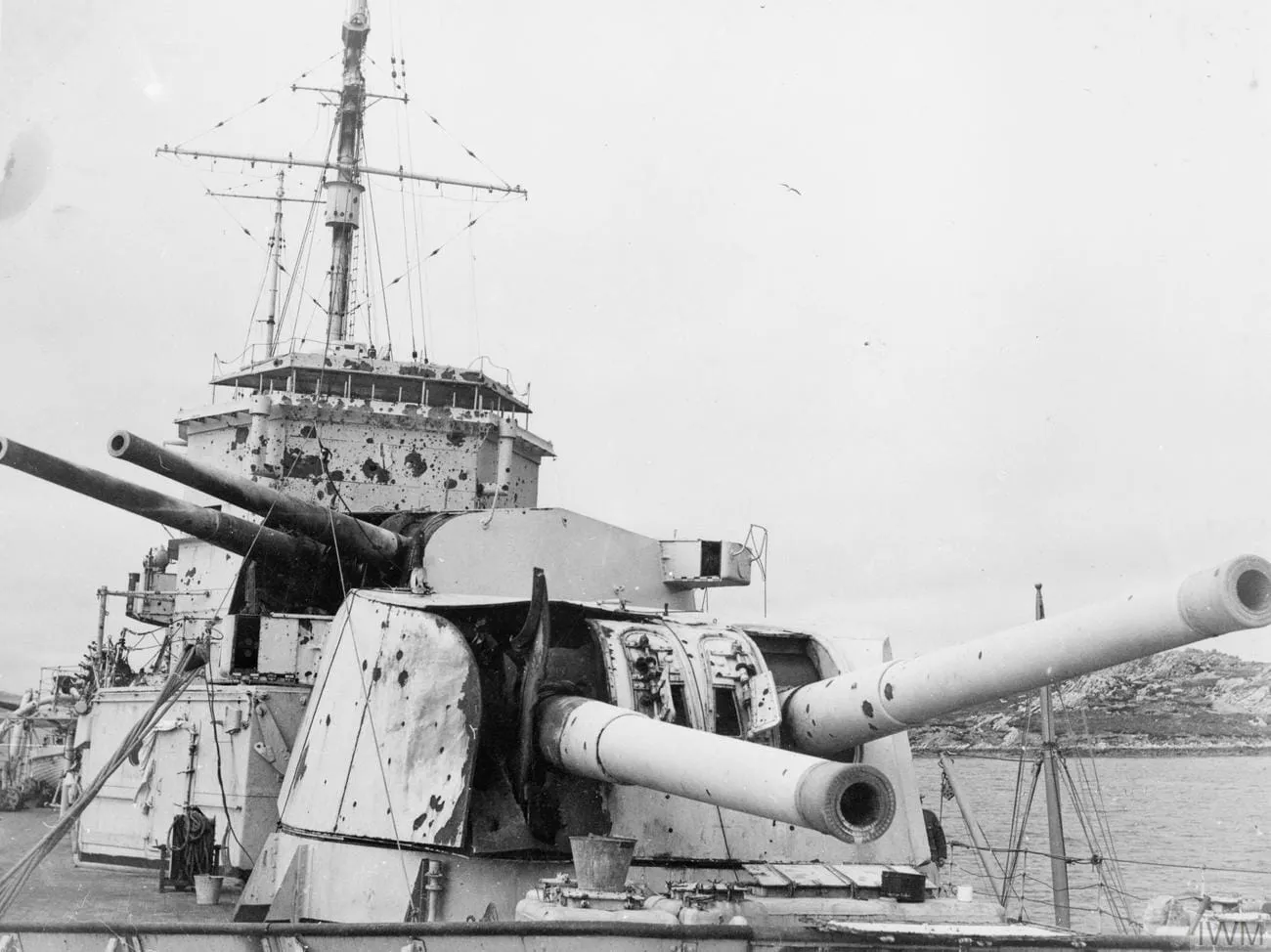
The Battle of the River Plate was the first great clash of surface warships in the Second World War and the only naval battle of 1939 to capture the attention of the whole world. On the morning of 13 December 1939 the German “pocket battleship” Admiral Graf Spee under Captain Hans Langsdorff, which for three months had been hunting Allied merchant ships in the South Atlantic and the Indian Ocean, ran into a British squadron under Commodore Henry Harwood east of the mouth of the River Plate: the heavy cruiser Exeter and two light cruisers, Ajax and the New Zealand ship Achilles. In an hour and a half of fighting the German ship badly damaged Exeter and hit Ajax, but she herself took about twenty hits, including one that destroyed her fuel-purification plant. Langsdorff broke off the action and, shadowed by the two light cruisers, entered neutral Montevideo shortly after midnight. For the next three days the fate of the ship was the subject of a game played by diplomats and intelligence services. Convinced that superior forces were waiting for him at the mouth of the estuary, on 17 December Langsdorff took his ship out into the roadstead and had her blown up.
Name and dates
The British call the action the Battle of the River Plate, the Germans the engagement or battle off the Río de la Plata (Gefecht vor dem Río de la Plata). The actual fighting took place on 13 December 1939: from the first salvoes just after six in the morning to the last shots in the evening, as Graf Spee was entering the estuary. The battle is nevertheless dated 13–17 December, because it was decided only when Langsdorff scuttled his ship off Montevideo. This is also how British and German studies describe it, treating the days in port as part of the same operation: throughout that time Harwood’s cruisers guarded the exit from the estuary, ready to resume the fight.
The times given in the literature differ by a quarter of an hour or so, and sometimes by an hour, because the British and the Germans kept their logs in different time zones. The times given below are approximate and follow the British report.
Background
A raider in the South Atlantic
Admiral Graf Spee was the third and newest ship of the Deutschland class, the first of which had been launched in 1931. These ships, which the British called “pocket battleships”, carried six 280 mm guns in two triple turrets and eight 150 mm guns, and their diesel engines gave them an enormous range. They were more powerful than any cruiser and faster than almost any battleship. Under Plan Z they were, in a war with Britain, to destroy her shipping on the distant oceans and scatter the forces of the Royal Navy.
The ship sailed from Wilhelmshaven on 21 August 1939, before the war broke out, and received the order to begin operations on 26 September. On 30 September, off the coast of Brazil, she sank her first ship, the British freighter Clement. By December she had sunk nine ships totalling about 50,000 GRT, in the South Atlantic and, in November, in the Indian Ocean. Langsdorff operated according to prize rules: he allowed the crews to leave their ships, took them on board or transferred them to his supply tanker Altmark, and in the whole course of the raid not a single seaman from the ships he sank lost his life. His orders required him to avoid action even with weaker warships, because a damaged ship had nowhere to be repaired.
On 5 October the Admiralty and the French navy formed eight hunting groups against the German raiders. Behind these decisions stood the First Lord of the Admiralty, Winston Churchill, and the First Sea Lord, Admiral Dudley Pound. The east coast of South America fell to Force G, Commodore Harwood’s South America Division. It consisted of the heavy cruisers Exeter and Cumberland and the light cruisers Ajax and Achilles. At the end of November the “pocket battleship” was still at large, and in the meantime German warships had also shown themselves in the north: on 23 November Scharnhorst and Gneisenau sank the armed merchant cruiser Rawalpindi.
Harwood’s calculation
On 2 December, between South Africa and the island of St Helena, Graf Spee sank the British ship Doric Star, whose wireless operator managed to send a raider-attack signal together with her position. The next day Tairoa was sunk, and she too managed to call for help. On 7 December, in the central Atlantic, Graf Spee sank her last ship, Streonshalh, on which the Germans found information about shipping movements off the coast of South America. Langsdorff decided to strike at the shipping off the mouth of the River Plate, where the routes from Buenos Aires and Montevideo converged, carrying Argentine meat and grain to Britain.
Harwood, who still believed that he was hunting Admiral Scheer, came to the same conclusion. He calculated that the raider, steaming from the position of Doric Star at about 15 knots, could be off the River Plate on 12 December, and he judged that the busiest stretch of the shipping routes would be the most tempting target for her. He drew his ships into the area: Ajax and Achilles met on 10 December, and Exeter joined them on 12 December. Cumberland was under repair at Stanley in the Falkland Islands. Harwood therefore concentrated three cruisers some 150 nautical miles east of the mouth of the river and rehearsed his plan of action with their captains.
The forces
The British forces were clearly the weaker. The flagship Ajax (Captain Charles Woodhouse) and Achilles (Captain Edward Parry) were Leander-class light cruisers armed with eight 152 mm guns. Achilles belonged to the New Zealand Division of the Royal Navy, the forerunner of the Royal New Zealand Navy, and her crew was largely from New Zealand. Exeter (Captain Frederick Bell) was a heavy cruiser with six 203 mm guns. The weight of Graf Spee’s broadside exceeded the combined broadside of the three cruisers, her guns outranged theirs and her armour was thicker. The British, on the other hand, had the advantage of a few knots of speed and of numbers: they could attack from two sides and force the enemy to divide her fire.
Harwood had worked out the tactics for fighting a “pocket battleship” himself, while lecturing at the Royal Naval War College at Greenwich in 1934–1936. They called for an immediate attack by day or by night, by day in two separate groups: Exeter on one side and the two light cruisers on the other. The calculation was simple. Each of the British cruisers was of relatively small value, whereas the lone Graf Spee was one of the Kriegsmarine’s few heavy ships. Even serious damage that could not be repaired thousands of miles from home would mean the end of her raid.
Course of the battle
The first salvoes
At dawn on 13 December the British cruisers were steaming north-east at 14 knots, some 390 nautical miles east of Montevideo. Graf Spee sighted them first. Her lookouts saw masts at around 5.30 a.m. German time, and Langsdorff, who no longer had a reconnaissance aircraft because his Arado Ar 196 had broken down the day before, took them for a convoy escort. When, a quarter of an hour or so later, Exeter was identified and the two smaller ships were taken for destroyers, Langsdorff decided, contrary to the orders forbidding him to fight, to close the enemy at full speed. He reckoned that he could attack before the British worked up to full speed and destroy the cruisers before they could call for reinforcements. By the time he realised that he was facing three cruisers, it was too late to change his mind.
The British spotted smoke to the north-west at around 6.10 a.m. Harwood sent Exeter to investigate and a few minutes later received the report: “I think it is a pocket battleship.” In accordance with the plan Exeter turned to the north-west, while Ajax and Achilles turned to the north-east. At about 6.18 a.m. Graf Spee opened fire at a range of some 17–18 kilometres, directing her main armament at Exeter and her secondary guns at the light cruisers. Exeter replied at 6.20 a.m., Achilles and Ajax a few minutes later. Until the end of the action the British ships believed that they were firing at Admiral Scheer.
Exeter under fire
The German gunnery was accurate. The third salvo straddled Exeter, and a shell that burst close alongside killed the torpedo-tube crews, cut communications and wrecked the Walrus seaplane that was ready for launch. At about 6.26 a.m. a 280 mm shell hit the second forward turret, “B”, and put it out of action, while splinters swept the bridge, killing or wounding almost everyone on it apart from Captain Bell and two other men. Communications with the after control position were also destroyed. For the rest of the action the ship was steered through a chain of messengers passing on orders, and her course was kept by a boat’s compass.
In the meantime Ajax and Achilles had closed the enemy, and their accurate fire forced Langsdorff to divide the fire of his main armament. At about 6.37 a.m. Ajax catapulted off a Seafox seaplane, which spotted the fall of shot for the British cruisers for the rest of the action. Exeter fired torpedoes twice but missed. At about 6.40 a.m. she received two more heavy hits: one knocked out the forward turret “A”, the other started a fire amidships and destroyed the fire-control circuits. The cruiser was shipping water, listing to starboard and firing only from her after turret, “Y”, directed by a gunnery officer from its roof.
Before Exeter lost her firepower, however, she dealt Graf Spee the most important blow of the battle. One of her 203 mm shells penetrated two decks and burst near the funnel, destroying the purification plant for the raw fuel that prepared diesel oil for the engines. The German engineers were unable to repair it at sea, and according to most accounts the ship had only enough fuel ready for use for a dozen or so hours of steaming. Langsdorff learned the full extent of this damage only after the action.
The light cruisers
At around seven o’clock Graf Spee shifted the fire of her heavy guns to the light cruisers, whose 152 mm shells could not penetrate her armour but did wreck her superstructure and anti-aircraft positions and kill men at exposed stations. The German ship laid a smokescreen and turned to the west. Captain Bell, whose ship was still firing from one turret, had to break off the action at about 7.30 a.m., when water from a near miss short-circuited the electrical system of the last turret. The badly damaged Exeter withdrew southwards, towards the Falklands. Langsdorff made no attempt to finish her off, because Ajax and Achilles were taking up all his attention.
Harwood closed the range to make the fire of the light cruisers more effective. At 7.25 a.m. Ajax fired torpedoes, which Graf Spee avoided, and almost at the same moment she was hit by a 280 mm shell that put both her after turrets, “X” and “Y”, out of action. Shortly afterwards another shell brought down the flagship’s mast. At about 7.40 a.m. Harwood received a report that Ajax had only about 20 per cent of her ammunition left. The report later proved to be inaccurate, but the commodore judged that continuing the fight at close range in daylight risked the loss of both cruisers. He decided to disengage under cover of smoke, shadow the enemy from a safe distance and renew the attack after dark, when he would be able to use torpedoes. The first phase of the battle had lasted about 80 minutes.
Langsdorff could then have resumed the fight with both light cruisers, but he did not do so. Captain Parry of Achilles later wrote that he still did not know why Graf Spee had not dealt with Ajax and Achilles once she had finished with Exeter. The German commander, himself slightly wounded by splinters because he had been directing the action from an open position, was at that time assessing the damage to his ship. The fuel-purification plant, the galley and the desalination plant had been destroyed, there was a gaping hole in the bow, and part of the secondary and anti-aircraft armament was out of action. All six main guns were still firing, but only about a third of their ammunition remained on board. Langsdorff concluded that in this state the ship would not survive the passage through the North Atlantic and the blockade in the North Sea, and decided to put into a neutral port to repair the damage.
The pursuit to Montevideo
For the rest of the day Ajax and Achilles followed the German ship at a distance of a dozen or so miles, one on each side. Harwood summoned Cumberland from the Falklands, and the Admiralty ordered to the South Atlantic every heavy ship that could get there in reasonable time. Several times Graf Spee turned and fired salvoes at cruisers that had come too close, and each time they withdrew behind smoke. At around 11 a.m. Langsdorff came upon the British ship Shakespeare and called on Ajax by radio to pick up her boats. From the call sign the British learned that their opponent was Graf Spee and not Admiral Scheer. The ship had not, however, been abandoned, and Langsdorff let her go.
By the evening it was clear that the German ship was entering the River Plate estuary. Because of the shoals, Harwood sent Achilles after her, while Ajax was to watch the other channel in case the enemy turned back. After sunset Graf Spee opened fire on Achilles once more. Shortly after midnight, in the first minutes of 14 December, she dropped anchor in the roadstead of Montevideo, the capital of neutral Uruguay. The British cruisers took up positions at the mouth of the estuary, outside territorial waters.
The choice of Montevideo turned out to be unfavourable for the Germans. Uruguay was neutral, but its government sympathised with Britain, to which the country was bound by strong economic ties. Argentina’s Mar del Plata or Buenos Aires, where the authorities were friendlier towards Germany, lay further away, and Buenos Aires was reached by a shallow, silted channel in which the ship risked clogging her condensers with muddy water. Langsdorff chose the nearest port.
The trap at Montevideo
The law of neutrality
The stay of warships in neutral ports was governed by the Thirteenth Hague Convention of 1907. A belligerent warship could remain in a neutral port for no more than 24 hours, unless damage prevented her from putting to sea. In that case she was allowed to repair only what was necessary to make her seaworthy, but not to increase her fighting power. A warship that did not leave port by the deadline set was liable to be interned until the end of the war. Another provision forbade a warship to leave port less than 24 hours after the departure of an enemy merchant ship.
On the morning of 14 December the Germans released 61 seamen from sunken ships whom Langsdorff had held on board during the battle. None of them had been hurt. The wounded were taken to hospitals in the city, and on 15 December the 36 German sailors killed in action were buried with military honours in the Northern Cemetery in Montevideo. Photographs of the funeral, showing Langsdorff giving a naval salute while the men around him raised their arms in the Nazi salute, later went round the world.
The German minister, Otto Langmann, asked the Uruguayan foreign minister, Alberto Guani, for two weeks to carry out repairs. The British minister, Eugen Millington-Drake, at first demanded that the ship, which had entered port under her own power and at high speed, should either leave at once or be interned. When word came from London, however, that there were no strong British warships anywhere nearby, the game was reversed: the British wanted to keep Graf Spee in port for as long as possible, while officially continuing to demand her departure. A Uruguayan technical commission inspected the ship, and the Uruguayan government granted her 72 hours, until 8 p.m. on Sunday 17 December. At the same time Millington-Drake made sure that British and French merchant ships left Montevideo at 24-hour intervals, which under the Hague Convention prevented the German ship from sailing immediately after them.
Disinformation
Meanwhile the British spread rumours that large forces were gathering off the mouth of the River Plate, led by the battlecruiser Renown and the aircraft carrier Ark Royal. The Admiralty sent signals on frequencies that it knew German intelligence was intercepting. British diplomats in Buenos Aires ordered fuel for these ships, knowing that the information would reach the Germans. The rumours were also believed by the world’s press, whose correspondents had descended on Montevideo. In reality Renown and Ark Royal were then some 2,500 nautical miles to the north and could not arrive before the deadline expired. Harwood was joined only by Cumberland, which covered more than a thousand miles from the Falklands in 34 hours and arrived on the evening of 14 December. Off the mouth of the river, therefore, there were three cruisers, two of them damaged and short of ammunition. Exeter had reached the Falklands.
The Germans were deceived. Graf Spee’s officers watched the horizon through their rangefinders and believed that they could see the silhouette of Renown. On 16 December Langsdorff reported to Berlin that Renown, Ark Royal, cruisers and destroyers were waiting for him at sea, that breaking out into the open sea and home was impossible, and proposed an attempt to force a passage to Buenos Aires and, should that fail, the scuttling of the ship. He asked whether internment in Uruguay or scuttling was preferred. Grand Admiral Erich Raeder put the matter to Hitler and, with his approval, replied: extend the stay in neutral waters by every possible means; an attempt to break through to Buenos Aires was approved; internment in Uruguay was ruled out; if the ship were scuttled, her destruction was to be made effective. A damaged ship, with what remained of her ammunition estimated to be enough for fifteen to twenty minutes of continuous fire, would have had little chance in the shallow, winding channel to Buenos Aires.
The scuttling
After consulting his officers, Langsdorff decided not to sacrifice the lives of more than a thousand of his men in a hopeless fight. On the morning of 17 December secret documents and equipment were destroyed on board, and explosive charges were placed in the most important compartments. Most of the crew transferred to the German merchant ship Tacoma, which was lying in the port. After 6 p.m. Graf Spee, with a few dozen men on board, weighed anchor and left the harbour. Thousands of people watched from the shore, according to some accounts tens of thousands, and American radio broadcast the event live, convinced that a new battle was about to begin. A few miles offshore the ship stopped in shallow water, and the last sailors went down into boats, which took them to Argentine tugs.
At dusk there were tremendous explosions (accounts give times from 7.52 p.m. to 8.55 p.m., depending on the time zone used). Graf Spee settled on the bottom of the estuary, burning, and the fires went on for another two days. The British cruisers, which were heading towards Montevideo in battle formation, saw the glow from afar. Harwood reported to the Admiralty that the German ship had scuttled herself. During the night Argentine tugs took the German sailors off Tacoma and carried them to Buenos Aires, where the Argentine authorities interned them for the duration of the war. During the night of 19–20 December Langsdorff, having written letters to his family and to the German ambassador, shot himself in his room in Buenos Aires.
Losses
On Exeter 61 seamen were killed and 23 wounded. According to British figures the ship took seven 280 mm hits, lost all her main turrets, shipped hundreds of tons of water and was listing several degrees to starboard. On Ajax seven men were killed, and both her after turrets were out of action. Achilles, which was struck only by splinters, lost four killed. In all, 72 British and New Zealand seamen lost their lives. Some studies give slightly different figures, because they include or omit those who later died of wounds.
On Graf Spee 36 men were killed and about 60 wounded, Langsdorff among them. The number of hits she took is given differently in the literature. According to some accounts she was hit by two or three 203 mm shells from Exeter and by between a dozen and more than twenty 152 mm shells from the light cruisers; according to others, which also count minor damage, about 70 times. Her armour protected the engine rooms and turrets, but the damage to her auxiliary machinery, above all to the fuel-purification plant, proved decisive. Scuttling by her own crew cost the Kriegsmarine one of its three “pocket battleships”. None of the prisoners and no member of the crew lost his life during the scuttling.
Significance
For the British the battle was the first great victory of the war, won at a time when on land the Phoney War dragged on and the news from the sea was mainly of losses, such as the sinking of Courageous and Royal Oak. Three weaker cruisers had forced a stronger ship to abandon her raid, and disinformation and diplomacy had completed the work. Harwood was promoted to rear admiral that same December and appointed to the Order of the Bath with a knighthood, and the captains of the cruisers also received the order. In February 1940 the crews of Exeter and Ajax marched through the streets of London, and Churchill said that in a dark, cold winter the battle had warmed the cockles of the British heart. On Achilles the flag of New Zealand flew in battle for the first time in history, and the battle became an important part of New Zealand’s national memory. Harwood was nevertheless also criticised for failing to exploit his numerical advantage after the first phase of the battle and for letting the enemy get away.
For Germany the scuttling of the ship without a fight was a humiliation that propaganda found hard to explain. Hitler was furious. Two days after Langsdorff’s death Raeder issued an order that a German warship was to fight to the last shell, and either win or go down with her flag flying. The battle showed the limits of a strategy of surface raiders: far from home, even slight damage put an end to a raid. In the years that followed it was mainly German armed merchant cruisers that operated on the distant oceans, while sorties by large warships, such as that of the battleship Bismarck in May 1941, ended in ever heavier losses. The burden of the Battle of the Atlantic passed to the U-boats.
The battle also had diplomatic consequences. It was fought within the security zone around the Americas that the American republics had proclaimed at Panama in the autumn of 1939. On 23 December 1939 they jointly protested to all the belligerents against the violation of the zone, but to no effect. The tanker Altmark, to which Langsdorff had earlier transferred nearly three hundred prisoners from the ships he had sunk, tried to slip through to Germany. On 16 February 1940 the British destroyer Cossack intercepted her in Norway’s Jøssingfjord and freed the prisoners, which heightened the tension over Norwegian neutrality. Most of Graf Spee’s sailors interned in Argentina spent the war in camps and small towns in the interior, and many of them settled in Argentina and Uruguay after the war.
After makeshift repairs at Stanley, Exeter returned home and, after a long refit, went back into service. She was sunk in March 1942 after the Battle of the Java Sea. The wreck of Graf Spee still lies in the shallow waters of the estuary. Soon after the scuttling the British examined the German gunnery radar on board, and in the 21st century a rangefinder and the bronze eagle from her stern were raised from the bottom; the fate of the eagle is the subject of a dispute in Uruguay. In 1956 the battle was brought to the screen in a British film in which Langsdorff was played by Peter Finch, which fixed the image of a gentlemen’s battle, as it indeed was when set against the increasingly ruthless war at sea that followed.