Germany
Hans Langsdorff
Commanding officer of Admiral Graf Spee (1938–1939), Kapitän zur See (Captain) in the Kriegsmarine
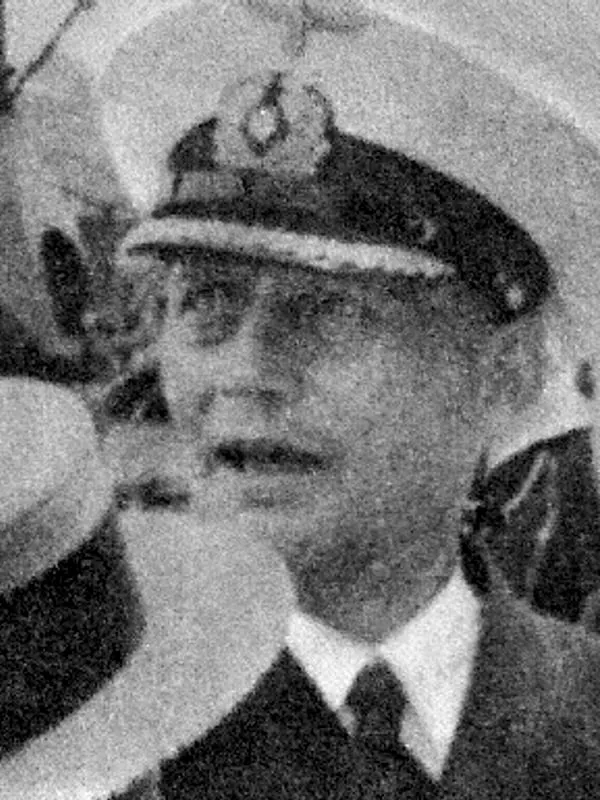
- Born:
- 20 March 1894, Bergen auf Rügen (German Empire)
- Died:
- 20 December 1939, Buenos Aires (Argentina)
- Author:
- Natalia
- Photo:
- autor nieznany, domena publiczna, Wikimedia Commons

Hans Langsdorff commanded the German pocket battleship Admiral Graf Spee in the first months of the Second World War. In the autumn of 1939 his ship sank nine British merchant ships in the South Atlantic and the Indian Ocean without killing a single member of their crews. On 13 December 1939 he fought a battle off the estuary of the River Plate against three British cruisers, and four days later, rather than take his damaged ship out to certain destruction, he had her scuttled at the mouth of the harbour of Montevideo, saving the lives of more than a thousand of his sailors. He shot himself in Buenos Aires on the night of 19–20 December. His British opponents remembered him as a chivalrous officer, and after the war he became one of the best-known figures of the war at sea. Historians today debate how much of this image is legend.
Youth and the First World War
Hans Wilhelm Langsdorff was born on 20 March 1894 in Bergen auf Rügen on the island of Rügen, into the well-to-do family of a lawyer, a judge of a higher court, with no naval traditions. In 1898 the family moved to Düsseldorf. According to his biographers, the Langsdorffs’ neighbour there was a naval officer, later Admiral Count Maximilian von Spee, and it was under his influence that the boy chose a naval career against his parents’ wishes. In February 1912 he passed his school-leaving examination in Düsseldorf, and in April he joined the Imperial German Navy, the Kaiserliche Marine, as a cadet.
During the First World War he served as a junior officer in the battleship Grosser Kurfürst and took part in the Battle of Jutland in 1916, for which he received the Iron Cross Second Class. Admiral von Spee had already been killed, together with both his sons, at the Battle of the Falkland Islands in December 1914. From 1917 Langsdorff commanded minesweepers in the North Sea and was awarded the Iron Cross First Class. During the revolution of November 1918, according to his biographer, he ordered the ensign and pennant to be lowered as he returned to port, to avoid a firefight with the revolutionaries. His biographer believes that it was from that moment that Langsdorff began to take an interest in politics. He went to meetings in civilian clothes in order to understand the new political landscape.
At the Reichswehr Ministry
After the war Langsdorff stayed on in the Reichsmarine, the navy of the Weimar Republic, cut down by the Treaty of Versailles. At first he cleared mines from the sea, then served in torpedo boats and commanded a half-flotilla. In 1924 he married Ruth Hager, with whom he had a son and a daughter.
In 1925 he was posted to the Reichswehr Ministry in Berlin, where, as a naval officer, he assisted Lieutenant Colonel Kurt von Schleicher, who ran the department responsible for the army’s contacts with politicians. After training as an Admiralty staff officer he returned to Schleicher in the early 1930s as his adjutant. He watched at close quarters the backstage politics of the republic’s last years: the fall of governments, the intrigues around President Paul von Hindenburg and the road that in January 1933 brought Hitler to power. His letters to his father, on which a 2020 biography is based, reveal an officer who read widely, including the liberal press. The correspondence broke off in 1934 on his father’s death, so it is not known what Langsdorff thought of the murder of Schleicher during the Night of the Long Knives. He spent his last years at the ministry in the Minister’s Office, headed by General Walter von Reichenau.
Spain and Admiral Graf Spee
In the autumn of 1935, now in the Kriegsmarine that Hitler was rebuilding, he returned to sea as first staff officer to the Commander of Reconnaissance Forces, with the rank of Fregattenkapitän (commander). From 1936 to 1938 he was first staff officer to Konteradmiral (Rear Admiral) Hermann Boehm, who commanded the German warships sent to Spanish waters during the Spanish Civil War. Officially these ships took part in the patrols enforcing the arms embargo; in practice they covered shipments to the Nationalists of General Francisco Franco. From 1 January 1937 Langsdorff held the rank of Kapitän zur See (captain).
In October 1938 he took command of Admiral Graf Spee, the third ship of the Deutschland class, named after the admiral he had admired as a boy. She was one of the most modern ships in the fleet and the first German warship fitted with radar. In March 1939 Graf Spee was part of the squadron that accompanied Hitler during the occupation of Klaipėda (Memel). In the spring of 1939 Langsdorff took her on a cruise in the Atlantic, with visits to Ceuta and Lisbon. His biographer, the retired naval officer Hans-Jürgen Kaack, points out that Langsdorff had spent most of his career in smaller ships and on staffs, and learned to command a large gunnery ship only on Graf Spee.
The Atlantic raid
On 21 August 1939 Graf Spee sailed from Wilhelmshaven for the South Atlantic, where in the event of war she was to destroy Allied merchant shipping. For the first weeks of the war she waited in hiding, because Hitler was hoping for an understanding with Britain and France. Only on 26 September did the ship receive permission to begin operations, and on 30 September she sank her first ship, the British freighter Clement, off the coast of Brazil.
By December Graf Spee had sunk nine ships totalling some 50,000 GRT in the South Atlantic and the Indian Ocean. Langsdorff acted in accordance with his orders and the prize rules: he stopped the ships, allowed their crews to abandon them, and took the men on board or transferred them to the supply tanker Altmark. Throughout the entire raid not one seaman from the sunken ships lost his life. The British captains held aboard his ship, among them Patrick Dove of Africa Shell, later described the commander as a courteous and honourable man. To throw off pursuit, Langsdorff kept shifting his area of operations and altering his ship’s silhouette, and in his distress calls on behalf of shipwrecked crews he used the call sign of her sister ship Admiral Scheer. Against him and against Deutschland, operating in the North Atlantic, the British and French deployed eight hunting groups.
The River Plate
On the morning of 13 December 1939, off the estuary of the River Plate, Graf Spee ran into the British squadron of Commodore Henry Harwood: the heavy cruiser Exeter and the two light cruisers Ajax and Achilles. Langsdorff, who under his orders should have avoided action, attacked, believing at first that he was facing a cruiser with destroyers. In the Battle of the River Plate he badly damaged Exeter, but his own ship took around seventy hits. Thirty-six of his sailors were killed, and Langsdorff himself, who directed the battle from an open position rather than from the armoured bridge, was twice slightly wounded by splinters. The fuel purification plant, the galley and the desalination equipment were damaged. Kaack believes that his wounds and concussion may have influenced the commander’s later decisions.
Langsdorff put into neutral Montevideo. The Uruguayan authorities gave him 72 hours in port. Meanwhile the British spread rumours that the aircraft carrier Ark Royal and the battlecruiser Renown were gathering off the river mouth, when in reality they were thousands of miles away. Langsdorff concluded that breaking out to the open sea was impossible and that an attempt to reach Buenos Aires in Argentina along the shallow channel was too risky. Berlin – more precisely Raeder, with Hitler’s consent – forbade internment of the ship in Uruguay and left the captain to choose between attempting a breakout and scuttling. On the evening of 17 December Graf Spee, with a skeleton crew, steamed out into the roads and was blown up before the eyes of crowds gathered on the shore. Almost the entire crew, more than a thousand men, transferred to Argentine tugs and were interned in Argentina.
Death
On the night of 19–20 December 1939 in Buenos Aires, Langsdorff wrote letters to his family and to the German ambassador and then shot himself, lying on an ensign. According to some accounts it was his ship’s ensign, according to others the old ensign of the Imperial Navy. In his letter he wrote that he had decided to scuttle the ship so as not to expose his men to a pointless death, that he alone bore responsibility for this, and that by his death he wished to prove that the armed forces of the Reich were ready to die for the honour of the flag. The letter ended with a declaration of faith in the nation’s future and in the “Führer”. He was buried with military honours in the German section of the Chacarita Cemetery in Buenos Aires. The funeral procession included sailors from his ship and also, according to contemporary reports, British seamen and captains who had been his prisoners.
To the Nazi leadership, scuttling the ship without a fight was a disgrace. Two days after Langsdorff’s death Raeder issued an order that a German warship was to fight “to the last shell” until she was victorious or went down with her flag flying. In the years that followed such orders meant death for thousands of sailors, among others in Bismarck in 1941 and Scharnhorst in 1943. Langsdorff’s son also served in the navy and, according to the available sources, was killed towards the end of the war as the pilot of a midget submarine.
Memory and the dispute over the legend
A legend soon grew up around Langsdorff. The 1956 British film The Battle of the River Plate, in which he was played by Peter Finch, showed him as a chivalrous adversary. In Argentina, where many of Graf Spee’s sailors settled after the war, flowers were laid on his grave every December. In the Canadian town of Ajax, named after the cruiser from the River Plate battle, a street was named after him, but it was renamed in 2021 after protests by residents. At his daughter’s request the swastika was removed from the cross on his grave. In the German Navy there is still a dispute over whether he can serve as a role model.
German historians today approach the legend with caution. Kaack’s 2020 biography, based on more than 150 previously unknown letters, shows Langsdorff as an officer respected by his subordinates and capable of independent thought, but also as a commander who, off the River Plate, accepted battle with a stronger squadron contrary to his orders. The military historian Michael Epkenhans, in a substantial article in 2021, challenged the myth of the “captain who defied Hitler”: Langsdorff was no opponent of the regime, and he took the decision to scuttle his ship in agreement with Berlin, which had left him free to choose. Whatever the outcome of these disputes, the fact remains that in a war in which shipwrecked crews were less and less often rescued at sea, he conducted his raid without loss of life among the crews of the ships he sank, and in December 1939 he put the lives of his sailors before a pointless fight.
Sources
Commanded in battles
(01)Mentioned in battles
(01)Often appears with
People who appear in the same events.