1941–1942: The Japanese offensive in the Pacific
Battle of Hong Kong
- Dates:
- 8–25 December 1941
- Front:
- Pacific
- Location:
- The British colony of Hong Kong: the New Territories and the Kowloon peninsula on the mainland, and Hong Kong Island with the city of Victoria; bordered to the north by the Japanese-occupied province of Guangdong (China)On the battle map →
- Sides:
- JapanTakashi SakaiUnited Kingdom, Canada and British IndiaMark Young, Christopher Maltby
- Result:
- Japanese victory. After five days of fighting on the mainland and a week on the island, Governor Mark Young and Major General Christopher Maltby surrendered on 25 December 1941. Nearly 11,000 soldiers were taken prisoner. According to Japanese figures, 675 Japanese were killed and 2,079 wounded. Depending on the tally, the defenders lost from about 1,500 to more than 2,100 killed and missing, including 290 Canadians. An occupation began that lasted until 1945.
- Author:
- Natalia
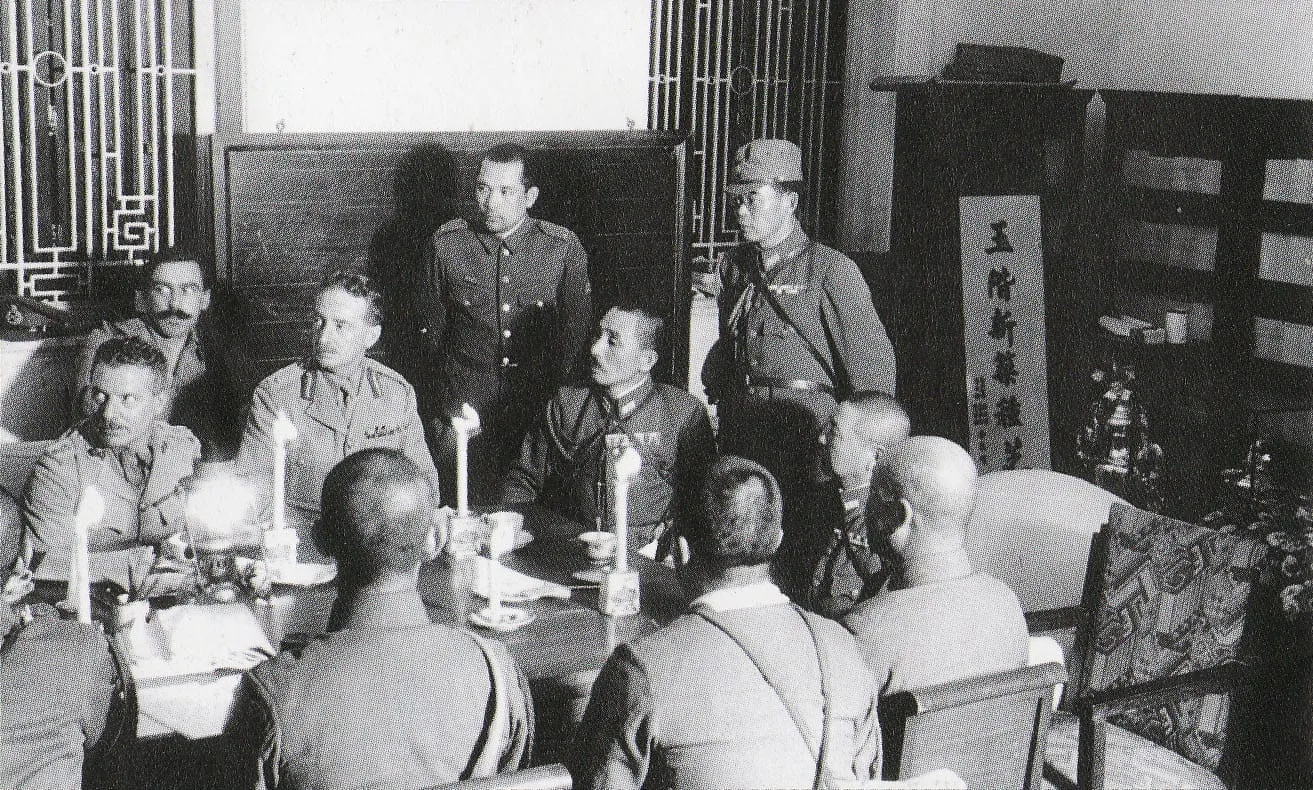
On the morning of 8 December 1941, Hong Kong time, a few hours after the attack on Pearl Harbor (which in Hawaii still fell on 7 December), Japanese aircraft bombed Kai Tak airfield in the British colony of Hong Kong, and soldiers of the 38th Division crossed the border river north of the New Territories. The garrison – two British battalions, two Indian, two Canadian and local volunteers – had no chance whatever of relief. Winston Churchill himself knew this: as late as January 1941 he had considered the colony impossible to hold. Even so, the defenders held out for eighteen days.
The Japanese broke the defensive line on the mainland on only the second day of fighting, and on 13 December the last British units left the Kowloon peninsula. On the evening of 18 December the Japanese crossed to Hong Kong Island, the next day they split the defence in two, and on Christmas Day the governor, Sir Mark Young, and the commander of the troops, Major General Christopher Maltby, surrendered. It was the first time in history that a British crown colony had surrendered to an invader. The people of Hong Kong call that day “Black Christmas”, for it marked the start of three years and eight months of Japanese occupation. The fighting was accompanied by war crimes: the killing of prisoners, the wounded and medical staff, and, on the last day, a massacre at the field hospital in St Stephen’s College at Stanley.
Name and dates
In Polish the established name is “the battle for Hong Kong”; English-language writing speaks of the Defence of Hong Kong or the Fall of Hong Kong. British accounts usually divide it into two phases: the fighting on the mainland (8–13 December) and the defence of the island (13–25 December), with the landing on the night of 18–19 December as the turning point.
The battle began on 8 December 1941, local time. Hong Kong lies west of the International Date Line, so when it was still the morning of 7 December in Hawaii, in Hong Kong it was already the night of 7–8 December. According to British and Canadian accounts, at about 4.45 a.m. Radio Tokyo broadcast that war was inevitable; at 5 a.m. sappers began blowing the bridges on the roads leading from the border; at dawn the Japanese crossed the border river; and at about 8 a.m. bombers appeared over Kai Tak. Japanese staffs expected to take the whole colony in roughly ten days.
The battle is taken to have ended on 25 December. At 3.15 p.m. that day Maltby reported to the governor that further effective resistance was impossible, white flags were hoisted, and in the evening Young and Maltby surrendered to Lieutenant General Takashi Sakai in the Japanese-occupied Peninsula Hotel in Kowloon. The last isolated posts laid down their arms only over the following days: Brigadier Cedric Wallis at Stanley surrendered on receiving a written order in the early hours of 26 December, and an ammunition magazine in the interior of the island on 27 December.
Background
Hong Kong had been British since the Opium War: China ceded the island, with the city of Victoria, in 1842 and the tip of the Kowloon peninsula in 1860, while in 1898 Britain leased the New Territories for 99 years. The colony was a port and a centre of trade with southern China, but not a fortress. After the Anglo-Japanese Alliance lapsed, British planners regarded Japan as their main potential enemy in the Far East, but the Washington Treaty of 1922 prohibited any expansion of the fortifications of Hong Kong. Only when Japan renounced the naval agreements and the ban expired at the end of 1936 did work begin, on the hills north of Kowloon, on a line of defences named after Gin Drinkers Bay – a chain of pillboxes, trenches and firing positions some 18 kilometres long, with the Shing Mun Redoubt as its key point. The press called it, with some exaggeration, the “Eastern Maginot Line”.
After the Marco Polo Bridge Incident and the outbreak of the Sino-Japanese War, Hong Kong became one of the main supply routes into China. In October 1938 the Japanese landed in Bias Bay and took Canton (Guangzhou), and their troops reached the colony’s border. From then on Hong Kong was surrounded on the landward side and – given the Japanese bases on Hainan, Taiwan and, from 1940 and 1941, in Indochina – from the sea as well. In July 1940 the authorities evacuated most British women and children to Australia.
The British Chiefs of Staff had long regarded the colony as an outpost that could not be held in a war with Japan. The garrison’s task was to defend the port for as long as possible and deny it to the enemy. On 7 January 1941 Churchill answered a request to reinforce the garrison with a minute to General Hastings Ismay: “If Japan goes to war with us there is not the slightest chance of holding Hong Kong or relieving it.” It would, he went on, be most unwise to increase the losses Britain would suffer there; rather than being reinforced, the garrison ought to be reduced to a symbolic scale.
By the summer of 1941 opinion in London had changed. The outgoing General Officer Commanding in China, Major General Arthur Grasett, a Canadian by birth, argued that two more battalions – preferably from Canada – would strengthen the defence and act as a deterrent to the Japanese. After the oil embargo, British policy in the Far East rested on deterrence; the dispatch of a squadron of capital ships to Singapore was meant to serve the same end. Reinforcing Hong Kong was also intended to convince Chiang Kai-shek that Britain would not abandon China. The Foreign Secretary, Anthony Eden, backed the idea in September, Churchill agreed, and on 19 September London asked Ottawa for two battalions. The government of William Lyon Mackenzie King consented. Canada had been at war since September 1939, but its army had not yet fought a single battle.
The two battalions chosen were considered not fully trained and earmarked for garrison duty: the Winnipeg Grenadiers, who had previously guarded Jamaica, and the Royal Rifles of Canada from Quebec, who had served in Newfoundland. With Brigadier John K. Lawson’s brigade headquarters, the so-called C Force numbered 1,975 men. On 27 October it embarked at Vancouver on the transport Awatea and the armed merchant cruiser HMCS Prince Robert, and on 16 November it landed in Hong Kong and moved into the Sham Shui Po barracks in Kowloon. Its vehicles, shipped separately on an American freighter, never arrived – after the outbreak of war the ship was diverted to Manila. After the defeat the Canadian government set up a royal commission under Chief Justice Lyman Duff, which in 1942 cleared the authorities of blame, although the preparation and dispatch of C Force remained a matter of controversy in Canada for decades.
The Japanese had been preparing the attack since the autumn. The war plan approved at the Imperial Conference of 5 November provided for a strike on Hong Kong at the same time as the landings in Malaya and the attack on Hawaii. The task went to Lieutenant General Takashi Sakai’s 23rd Army, stationed in Canton, whose chief of staff was Major General Tadamichi Kuribayashi. From the beginning of December its units concentrated behind the Sham Chun border river, opposite present-day Shenzhen. On 2 December signals sent to the army (“Hinode wa Yamagata”) and to the fleet (“Niitakayama nobore 1208”) confirmed the date of the attack.
Opposing forces
The General Officer Commanding British Troops in China, Major General Christopher Maltby, an officer of the Indian Army, had taken up his post in August 1941. Governor Mark Young arrived in the colony in September. Depending on the tally – and on whether volunteers, sailors and auxiliary services are included – the garrison numbered from about 11,000 to about 14,500 men. Its core was six infantry battalions: the British 2nd Battalion, Royal Scots, and 1st Battalion, Middlesex Regiment (the latter manning the pillboxes along the island’s shores); the 5/7th Rajputs and 2/14th Punjabis of the British Indian Army; and the two newly arrived Canadian battalions. In addition there were coast and anti-aircraft batteries, largely manned by Indian and Sikh gunners of the Hong Kong and Singapore Royal Artillery, sappers, some 40 Royal Marines, and the Hong Kong Volunteer Defence Corps (HKVDC) – about 2,000 local volunteers: British, Portuguese from Macau and Hong Kong, Chinese, Eurasians and Indians, many of them veterans of the First World War.
The coast artillery was designed to fight warships, not to support infantry. The Royal Navy had left in Hong Kong only three old destroyers, a few river gunboats and the 2nd Motor Torpedo Boat Flotilla. At Kai Tak the RAF had five obsolete aircraft: three Vickers Vildebeest torpedo bombers and two Supermarine Walrus amphibians. A request for a fighter squadron had been turned down; the nearest British fighters were in Malaya, some 2,200 kilometres away. The Chinese military mission in the colony was headed by the one-legged Rear Admiral Chan Chak (Andrew Chan), who worked with the police to break up networks of Japanese sympathisers.
On the Japanese side the main striking force was Lieutenant General Tadayoshi Sano’s 38th Division with three infantry regiments – the 228th (Colonel Teihichi Doi), the 229th (Colonel Ryōzaburō Tanaka) and the 230th (Colonel Toshishige Shōji) – reinforced with heavy and mountain artillery, mortars, engineers and river-crossing units. It was supported by the 23rd Army’s air arm, while the 2nd China Expeditionary Fleet blockaded the colony from the sea. Estimates of the Japanese strength vary: the British historian Tony Banham puts the forces used against Hong Kong at about 27,000 men, older Polish studies give about 20,000 front-line troops, and some English-language accounts considerably more when they count the whole of the 23rd Army’s rear echelon. Yet the Japanese advantage did not lie in numbers alone. They had complete command of the air, the experience of four years of war in China and excellent intelligence: for years they had been gathering information about the colony’s defences, and Japanese agents were at work in the city itself. The British, for their part, underestimated their enemy. At headquarters it was repeated that Japanese soldiers fought poorly at night and that Japanese airmen were bad pilots – a belief that was soon proved false.
The defence plan assumed that three battalions under Brigadier Wallis would delay the enemy on the mainland and that the Gin Drinkers Line would hold for at least a week, perhaps longer. In that time everything on the mainland that might be of use to the Japanese was to be destroyed; the troops would then withdraw to the island and defend it until relief arrived. But relief was a fiction: the British fleet could not come, and the Chinese armies in Guangdong were too weak to break through the Japanese positions around Canton. On the island the defence was divided between Brigadier Lawson’s West Brigade and Brigadier Wallis’s East Brigade.
The fighting on the mainland (8–13 December)
At about 8 a.m. on 8 December twelve Japanese bombers with a fighter escort attacked Kai Tak. Within minutes they had destroyed on the ground two of the three Vildebeests and both Walruses, most of the civil aircraft and the machines of the volunteer air arm, as well as the American Pan Am flying boat “Hong Kong Clipper”. From then on the defenders had no air force at all, and the RAF personnel fought as infantry. The Sham Shui Po barracks were also bombed. Meanwhile three Japanese regiments – the 230th in the west, the 229th in the centre and the 228th in the east – crossed the border river and advanced through the New Territories. A light covering force of the 2/14th Punjabis with Universal Carriers and the volunteers’ armoured cars delayed them by blowing up bridges and roads. The first serious clashes took place in the afternoon; near Tai Po the Punjabis inflicted losses on the Japanese, but in the evening, threatened with being outflanked, all the defenders fell back to the Gin Drinkers Line.
Between 8 and 10 December aircraft of the Chinese airline CNAC, flown by American and Chinese pilots, carried some 275 people out of Kai Tak by night to Chongqing and other airfields in unoccupied China, among them Sun Yat-sen’s widow, Soong Ching-ling, and the Chinese finance minister, H. H. Kung (Kong Xiangxi).
The Gin Drinkers Line was manned by only three battalions: the Royal Scots in the west, the Punjabis in the centre and the Rajputs in the east. On the western sector stood the Shing Mun Redoubt – a system of pillboxes and tunnels that could hold more than a hundred men, but which in December 1941 was garrisoned by about forty soldiers of A Company, Royal Scots. On 9 December Colonel Doi, reconnoitring the ground ahead of his regiment, noticed that the redoubt was weakly held and, without waiting for orders – although it lay outside his regiment’s sector of attack – decided to assault it. During the night of 9–10 December a storming party crossed the dam of the reservoir and approached the pillboxes undetected. At about 11 p.m. the defenders opened fire, but the Japanese seized the trenches and tunnels, blew up the pillboxes and forced the last men, shut in an observation post, to surrender. By morning the redoubt was lost; according to their own figures, the Japanese lost only a handful of men in the attack. The staff of the 38th Division was taken aback by Doi’s unauthorised action, but quickly exploited the breach.
The loss of the redoubt doomed the defence of the mainland. The commander of the Royal Scots refused to counter-attack, judging it hopeless. On the morning of 11 December the Japanese attacked Golden Hill; D Company, Royal Scots, briefly retook the hill, but at midday Maltby, convinced that Kowloon could not be held, ordered the evacuation of the mainland. Sappers destroyed docks, power stations and depots, looting spread through the city, and according to British accounts Japanese sympathisers and triad members fired on the withdrawing troops. The Royal Scots and most of the other units crossed to the island during the night of 11–12 December, and some of the Punjabis fought their way through Kowloon to the Star Ferry pier. The Rajputs still held the Devil’s Peak peninsula, covering the narrow Lei Yue Mun strait, and early on 13 December they were the last to be ferried to the island. A line that was supposed to hold for a week or more had fallen in less than three days, and the whole of the mainland in five.
The siege of the island (13–18 December)
On the morning of 13 December a launch carrying Japanese envoys crossed the harbour and, in General Sakai’s name, demanded surrender. Governor Young refused. Japanese artillery, emplaced on the hills of Kowloon, began shelling the island, destroying coast batteries, the pillboxes along the north shore and the fuel tanks, while aircraft bombed the city and the defenders’ positions. Fires, cuts in water and electricity supplies, and panic among a population of about one and a half million, many of them refugees from China, hampered the defence. According to British accounts a “fifth column” was at work, and the police had difficulty keeping order.
On 17 December the Japanese again offered terms of surrender and were again refused. That same night their scouts reconnoitred the shore around the Taikoo dockyard. Maltby expected the landing most probably to come directly across the harbour onto Victoria or from the south, and spread his forces along the whole coastline. The entire garrison was now defending the island, but without reserves, without aircraft and without hope of help from outside.
The landing on the island and the fighting for the Wong Nai Chung Gap (18–22 December)
On 18 December the Japanese intensified their bombardment of the island’s north-east shore, setting the oil tanks ablaze. In the evening, under cover of smoke, darkness and rain, the first battalions of the 228th and 230th Regiments crossed by boat from Kowloon to the area of North Point and the Taikoo dockyard, and two battalions of the 229th Regiment crossed from Devil’s Peak to the area of Sai Wan and Aldrich Bay. Searchlights and the Rajputs’ fire inflicted losses on them, and both commanders of the first-wave battalions were wounded, but by midnight six Japanese battalions were ashore. The Rajputs, who bore the whole weight of the landing, were shattered; according to Maltby’s report, the battalion lost all its British officers and most of its Indian ones. At the North Point power station a detachment of older HKVDC volunteers, reinforced by a small group of Free French, held out until morning.
The Japanese did not waste time capturing the shore defences. They bypassed the pillboxes and pushed inland by night onto the hills of Mount Parker, Mount Butler and Jardine’s Lookout, towards the Wong Nai Chung Gap – the only convenient passage between the north and south shores, where West Brigade had its headquarters. For a long time Maltby believed the landing to be a diversion and sent reinforcements in small groups. Canadian companies – the Royal Rifles in the east and the Winnipeg Grenadiers in the centre of the island – were thrown into night counter-attacks over unfamiliar ground, often without maps or communications.
On the morning of 19 December the Japanese surrounded Brigadier Lawson’s headquarters in the gap. At about 10 a.m. Lawson reported by radio that he was going outside to fight his way out, and he was killed together with most of his staff – the highest-ranking Canadian officer to die in the battle. The same day A Company of the Winnipeg Grenadiers fought on the slopes of Jardine’s Lookout and Mount Butler. Company Sergeant Major John Robert Osborn threw back several Japanese grenades, and when he could not throw one back in time he covered it with his own body, saving his men. He was awarded a posthumous Victoria Cross – the first to a Canadian in the Second World War. The Royal Rifles’ Newfoundland dog, Gander, was killed when he seized a grenade and ran with it towards the Japanese; in 2000 he was posthumously awarded the Dickin Medal. On the morning of 19 December the motor torpedo boats attacked Japanese landing craft in the harbour and sank several of them, but suffered losses themselves.
The counter-attacks on the gap on 19 and 20 December – by the Royal Scots, the Winnipeg Grenadiers, the Punjabis and gunners fighting as infantry – failed. The island was cut in two: Brigadier Wallis’s East Brigade withdrew to the Stanley peninsula in the south, while the remnants of West Brigade, under Colonel Henry Rose of the HKVDC, defended the western part of the island with the city of Victoria. On 21 December Churchill telegraphed the governor that there could be no question of surrender, that every part of the island must be fought for with the utmost stubbornness, and that every day of resistance helped the Allied cause throughout the world. That day Wallis made one more attempt to break out from Stanley northwards towards the gap, but his column, although it briefly took Bridge Hill and Red Hill, had to turn back.
On 22 December the Japanese took the hotel above Repulse Bay, where civilians were sheltering, and pushed Wallis’s troops deeper into the Stanley peninsula. In the west the fighting ran along a line from Causeway Bay through Leighton Hill and Happy Valley to Mount Cameron. The gunboat HMS Cicala, which had supported the defenders with her fire for several days, was sunk by aircraft.
Stanley and the surrender (23–25 December)
On 23 December the western line began to fall apart. The Middlesex companies on Leighton Hill were cut off, and the defenders fell back towards Mount Gough and the Wan Chai Gap. The Japanese now controlled the island’s main reservoirs and the shelling had destroyed the pipelines, so the city was beginning to run short of water. The troops had less and less ammunition and fewer and fewer guns, and the civilian population was short of food. On 24 December the Japanese broke into Wan Chai and Happy Valley, while in the south, after a day of fighting, they broke through at night the outer defence line at Stanley, held by the Royal Rifles, Middlesex companies and volunteers. Early on the morning of 25 December soldiers of the 229th Regiment entered St Stephen’s College at Stanley, which housed a field hospital.
On the morning of Christmas Day the Japanese sent two Britons who had fallen into their hands across the front line with a further offer of surrender, and agreed to a truce of a few hours. When it expired at noon, the attack resumed: Mount Parish fell, and the Japanese broke into the Wan Chai Gap and approached the fortress headquarters. Communications with Stanley had been cut, and according to the Canadian official history the field artillery was down to eight guns with a few dozen rounds each. At 3.15 p.m. Maltby and the naval commander reported to the governor that further effective resistance was impossible, and white flags went up on the buildings of Victoria. In the evening Young crossed to Kowloon and signed the surrender at Sakai’s headquarters in the Peninsula Hotel. For the first time a British crown colony had surrendered to an invader.
That same evening Chan Chak, who had no intention of being taken prisoner, slipped away from the island on the last five motor torpedo boats. A group of 68 men, Chinese and British, made their way through the Japanese lines to Mirs Bay, from where, with the help of Chinese guerrillas, they reached unoccupied China. At Stanley, Wallis refused to believe in the surrender without a written order and gave up only at 2.30 a.m. on 26 December, and the last isolated posts laid down their arms on 27 December.
War crimes
From the first days, the fighting for Hong Kong was accompanied by atrocities that foreshadowed the occupation. During the night of 18–19 December soldiers of the 229th Regiment captured the Sai Wan anti-aircraft battery and bayoneted the HKVDC gunners as they surrendered – about 20 prisoners according to various tallies, and 28 men including those killed in the fighting. On 19 December, at the Salesian Mission in Shau Kei Wan, which had been turned into a dressing station, the Japanese murdered the wounded and the medical staff; only a few survived, and Captain Stanley Banfill of the Royal Rifles later testified that a Japanese officer had declared that “the order is that all prisoners must die”. At the Wong Nai Chung Gap, on Blue Pool Road, around Repulse Bay (The Ridge, Overbays, Eucliffe) and at the Maryknoll Mission, prisoners were killed after their units had surrendered and civilians were murdered.
The worst crime took place at St Stephen’s College in the last hours of the fighting. The Japanese seized and murdered two doctors who had come out to meet them, and then in the hospital wards bayoneted wounded British, Canadian and Indian soldiers who could not move – 50 to 60 men, according to various sources. Nurses were raped, and at least three British nurses were murdered. The bodies were burned the next day. After the war the infantry commander of the 38th Division, Major General Takeo Itō, was sentenced by a British tribunal to 12 years’ imprisonment for this crime. After the surrender there were mass rapes and looting of the civilian population in Hong Kong, which the Japanese military police (Kempeitai) did only partly to stop. These events recalled, on a smaller scale, the Nanking Massacre of December 1937.
Losses
The defenders’ losses cannot be given precisely. Maltby’s report spoke of about 955 killed and died of wounds and 659 missing in the British, colonial and Indian units; other tallies give a total of from about 1,500 to more than 2,100 killed and missing and about 1,400–2,300 wounded. According to their official history, the Canadians lost 290 killed and died of wounds and 493 wounded. Of the infantry battalions, the 5/7th Rajputs suffered the heaviest losses. According to a Japanese tally of February 1942, 10,947 soldiers were taken prisoner: 5,072 British, 1,689 Canadians, 3,829 Indians and 357 others. The Japanese officially reported 675 killed and 2,079 wounded; Western estimates run to about 1,900 killed. Many civilians also died – about 4,000, according to some estimates.
Significance
Hong Kong was the first British colony to fall in its entirety in the Pacific War. The garrison, expected to last a few weeks, held out for 18 days and inflicted losses on the enemy, but it did not alter the course of the Japanese offensive: as early as January 1942 the 38th Division sailed for the Dutch East Indies. The fall of the colony foreshadowed the defeat in Malaya and at Singapore in February 1942 and undermined British prestige in Asia.
For the defenders, surrender meant captivity in the camps at Sham Shui Po, North Point and Argyle Street, and from 1942 in Japan as well. More than 800 of them died aboard the Lisbon Maru, which was carrying prisoners from Hong Kong to Japan in October 1942 when she was sunk by an American submarine. Of the 1,975 Canadians who had sailed from Vancouver, 557 never returned home; 267 died in captivity. Enemy civilians were interned in a camp at Stanley. Hong Kong’s first Japanese governor, until February 1942, was Sakai, followed by General Rensuke Isogai. The occupation, which lasted three years and eight months, brought hunger, forced deportations that reduced the colony’s population from about 1.6 million to about 600,000, and executions – of about 10,000 civilians, by some estimates. Mark Young survived captivity in Taiwan and Manchuria, and in 1946 returned to Hong Kong as governor. In 1946 Takashi Sakai was sentenced by a Chinese tribunal in Nanjing for crimes committed in China, and was shot.
Hong Kong returned to British rule after the surrender of Japan: on 30 August 1945 a Royal Navy squadron entered the harbour, and on 16 September the Japanese signed the instrument of surrender in the colony. In Canada, the dispatch of poorly trained battalions to an outpost that no one intended to defend remained one of the bitterest memories of the war, and in Hong Kong Christmas 1941 is remembered as “Black Christmas”.