Canada
William Lyon Mackenzie King
Minister of Labour of Canada (1909–1911), leader of the Liberal Party of Canada (1919–1948), Prime Minister of Canada (1921–1926, 1926–1930, 1935–1948)
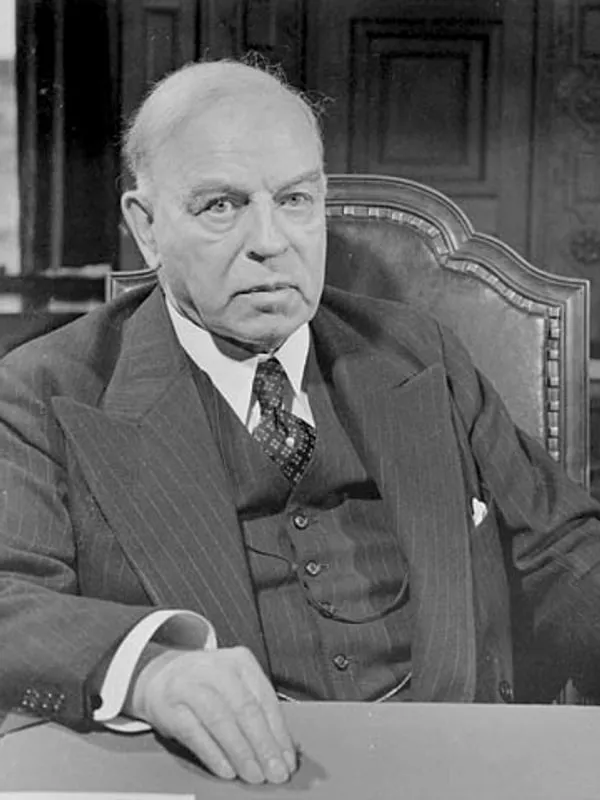
- Born:
- 17 December 1874, Berlin (now Kitchener, Ontario, Canada)
- Died:
- 22 July 1950, Kingsmere (Quebec, Canada)
- Author:
- Łukasz
- Photo:
- autor nieznany, domena publiczna, Wikimedia Commons

William Lyon Mackenzie King governed Canada for a total of more than 21 years, longer than any other Prime Minister in its history. He was a politician cautious to the point of inscrutability, a master of compromise and delay, who regarded holding together a country divided between its English- and French-speaking populations as his foremost task. For the history of the Second World War he matters for two reasons. In the 1930s he was a supporter of appeasement; in 1937 he talked with Adolf Hitler and judged him a man of peace, and his government closed the borders to Jewish refugees. Yet it was he who in September 1939 took Canada into the war in a way that demonstrated its full sovereignty, and who then led it through the whole war while avoiding the rift that the previous one had brought.
The rebel’s grandson
He was born on 17 December 1874 in Berlin, Ontario, a town renamed Kitchener in 1916. His maternal grandfather was William Lyon Mackenzie, the first mayor of Toronto and leader of the Upper Canada Rebellion of 1837. The memory of his grandfather, and above all his deep attachment to his mother, stayed with him all his life. His father was a lawyer who never made his fortune.
He studied at the University of Toronto, where he took three degrees, then in Chicago, where he worked at the Hull House settlement, and at Harvard. There, in 1909, he received his doctorate, the first future Prime Minister of Canada to hold one. He was a devout Presbyterian, convinced that politics should serve social reform.
Specialist in labour disputes
In 1900 he became deputy minister in the new federal Department of Labour, where he dealt with the settlement of industrial disputes. In 1908 he won a seat in the House of Commons, and in 1909 Prime Minister Wilfrid Laurier made him Canada’s first Minister of Labour. He lost his seat when the Liberals were defeated in 1911. In 1914 John D. Rockefeller Jr. engaged him at the Rockefeller Foundation as an adviser on labour relations after the Ludlow Massacre in Colorado. He set out his views on reconciling labour and capital in his book Industry and Humanity (1918).
During the First World War he remained loyal to Laurier, who opposed conscription for service overseas. The conscription crisis of 1917 split both the Liberal Party and the country: Quebec voted against the government that had sent conscripts to the front. Mackenzie King drew a lesson from this that guided him for the next thirty years: conscription for a war overseas could tear Canada apart.
Prime Minister in the 1920s
In August 1919, after Laurier’s death, he became leader of the Liberal Party of Canada, and after the 1921 election Prime Minister. He steadily widened the dominion’s independence. In September 1922, during the Chanak crisis, when London asked the dominions for troops against the Turks, he replied that parliament would decide, and Canada sent no one. The crisis was ended by the Armistice of Mudanya. In 1923 Canada for the first time signed a treaty with a foreign state on its own, and at the Imperial Conference of 1926 King was among those who secured the recognition of the dominions as equal in status to Britain. This was confirmed by the Statute of Westminster of 1931.
In 1926 he went through a constitutional crisis. The Governor General, Julian Byng, refused his request to dissolve parliament and entrusted the government to the Conservative Arthur Meighen. Meighen’s ministry fell within days, and King won the ensuing election by presenting the affair as a defence of Canadian self-government against interference by London’s representative. At the beginning of the Great Depression, in 1930, he lost the election to the Conservatives. He returned to power in October 1935.
Appeasing Hitler
King’s second spell in office coincided with the years in which Europe was heading for war. The Canadian Prime Minister believed that Canada should not let itself be drawn into European quarrels. In March 1936, after the remilitarisation of the Rhineland, he let London understand that in a war over the Rhineland Canada would remain neutral. At the Imperial Conference of 1937 he backed Neville Chamberlain, who had just become Prime Minister, in his policy of accommodation with Germany.
On 29 June 1937 Mackenzie King met Adolf Hitler in Berlin. During the same visit he also talked with Hermann Göring. By his own account he told Hitler that if Germany attacked Britain, Canada would stand by her side. Yet the conversation made an enormous impression on him. He wrote in his diary that Hitler truly loved his fellow men, and predicted that he would one day be ranked alongside Joan of Arc among the deliverers of his people – though he also wrote that he could not accept the persecution of the Jews and the brutality of the regime. In September 1938 he greeted the Munich Agreement with great relief.
The darkest chapter of those years was the policy towards refugees. At the Évian Conference in 1938 Canada, like other states, refused to take in more refugees from Germany and Austria. King’s government, mindful of opinion in Quebec and of the antisemitism of some officials, admitted only a few thousand Jewish refugees between 1933 and 1945. In June 1939 Canada refused to accept the passengers of the St. Louis, which took them back to Europe. A reply attributed to a senior official, asked how many Jews Canada would admit after the war, has passed into history: “None is too many.”
September 1939
King nevertheless had no doubt that if Britain found itself in a major war, Canada would join it. In May and June 1939 he accompanied King George VI on his tour of the country. On 1 September, when Germany invaded Poland, his government placed the armed forces on active service and announced that if Britain went to war it would ask parliament for approval to cooperate at her side. He did not, however, declare war on 3 September together with London. Parliament met on 7 September; the Minister of Justice, Ernest Lapointe, promised on the government’s behalf that there would be no conscription for service overseas; and on 9 September both houses endorsed participation in the war. On 10 September George VI, acting as King of Canada on the advice of his Canadian ministers, approved the proclamation of a state of war. Canada entered the war as the last of the dominions to do so, and the first to show so plainly that it decided for itself.
War leader
King was not a leader who swept crowds along, and he did not try to be one. He wanted a “limited” war in which Canada would supply above all food, raw materials, armaments and airmen. The HX convoys sailed from Halifax, and in December 1939 Canada agreed to run the British Commonwealth Air Training Plan, which trained more than 130,000 airmen. In October 1939 the Liberals defeated the anti-war Maurice Duplessis in Quebec, and in March 1940 King won the federal election with the largest majority in the country’s history up to that time.
After the fall of France, Canada became the second most important power in the Commonwealth. In August 1940 King concluded the Ogdensburg Agreement with Franklin Delano Roosevelt on the joint defence of North America, and in 1941 an agreement on economic cooperation. He acted as a link between Roosevelt and Winston Churchill and hosted both Quebec Conferences, in 1943 and 1944, although he had little say in the great powers’ strategic deliberations themselves. After the attack on Pearl Harbor his government removed more than 20,000 Canadians of Japanese descent from the coast of British Columbia, interned them and confiscated their property, even though the army and the police did not regard them as a threat.
The hardest issue was conscription. In 1940 it was introduced for home defence only. In April 1942 King asked the citizens in a plebiscite to release him from the pledge of 1939. The country as a whole agreed, but Quebec voted overwhelmingly against. King then summed up his policy in a famous formula: “Not necessarily conscription, but conscription if necessary.” It became necessary in the autumn of 1944, after the losses in Normandy and Italy. King dismissed the Minister of National Defence, who had been demanding conscription, but in November he himself agreed to send some 16,000 conscripts overseas. Fewer than 13,000 of them actually sailed, and about 2,500 reached the front. The crisis was acute, but unlike in 1917 the country did not break into two hostile halves.
Last years
In June 1945 the Liberals won another election, although King lost his own seat and returned to the House of Commons in a by-election. In the autumn of 1945 the affair of Igor Gouzenko, a cipher clerk at the Soviet embassy in Ottawa, broke: he exposed a Soviet spy ring in Canada, which made the country one of the first fronts of the Cold War. On 15 November 1948 King handed over office to Louis St. Laurent. He died of pneumonia on 22 July 1950 at his Kingsmere estate in Quebec.
He never married. Only after his death did his diaries, kept for more than half a century, reveal that he had attended spiritualist séances and believed that he spoke with the spirits of his late mother, of Laurier and of Roosevelt.
Significance
Mackenzie King did not make his mark on history with great speeches or bold decisions. His achievement lay in what he managed to avoid: the break-up of Canada during a war that mobilised more than a million of its citizens. On the road to the Second World War he was one of the politicians who underestimated Hitler, and one of those who did not open their borders to his victims. In September 1939, however, he showed that the independence the dominions had won in the 1920s did not mean turning away from Britain, and he ensured that Canada went to war by choice rather than by obligation.
Sources
Mentioned in battles
(01)Often appears with
People who appear in the same events.
On the timeline
(25)1922
1928
1939
1940
1941
December
- 08
- The “Day of Infamy” speechOn 8 December 1941 Roosevelt called Pearl Harbor a day of infamy and Congress declared war on Japan. Within days a dozen or more other states had done the same.
- The Battle of Hong Kong beginsOn 8 December 1941 Japan attacked Hong Kong. In five days it took the New Territories and Kowloon, and the defenders withdrew to Hong Kong Island.