1944–1945: The liberation of Western Europe
Battle of Hürtgen Forest
- Dates:
- 19 September 1944 – 10 February 1945
- Front:
- Western Front
- Location:
- Germany, the Rhineland: the wooded Eifel plateau south-east of Aachen, between Stolberg, Monschau and the Roer valley – the Hürtgen, Wenau, Merode and Roetgen forests with the villages of Germeter, Vossenack, Kommerscheidt, Schmidt, Hürtgen, Kleinhau, Bergstein and Gey, and the Schwammenauel damOn the battle map →
- Sides:
- United StatesCourtney Hodges, Joseph Lawton Collins, Norman CotaNazi GermanyWalter Model, Erich Straube
- Result:
- Inconclusive, with the advantage to the defenders. For three months the US First Army advanced through the forest a few hundred metres a day, and the 28th Infantry Division’s attack on Schmidt in November ended in failure. The Germans held the Roer dams and the rear area of the Ardennes offensive; the Americans took the Schwammenauel dam only on 10 February 1945, after the defenders had already damaged its outlet works. American losses are estimated at about 33,000 men (over 50,000 in some studies), German losses at about 28,000.
- Author:
- Łukasz
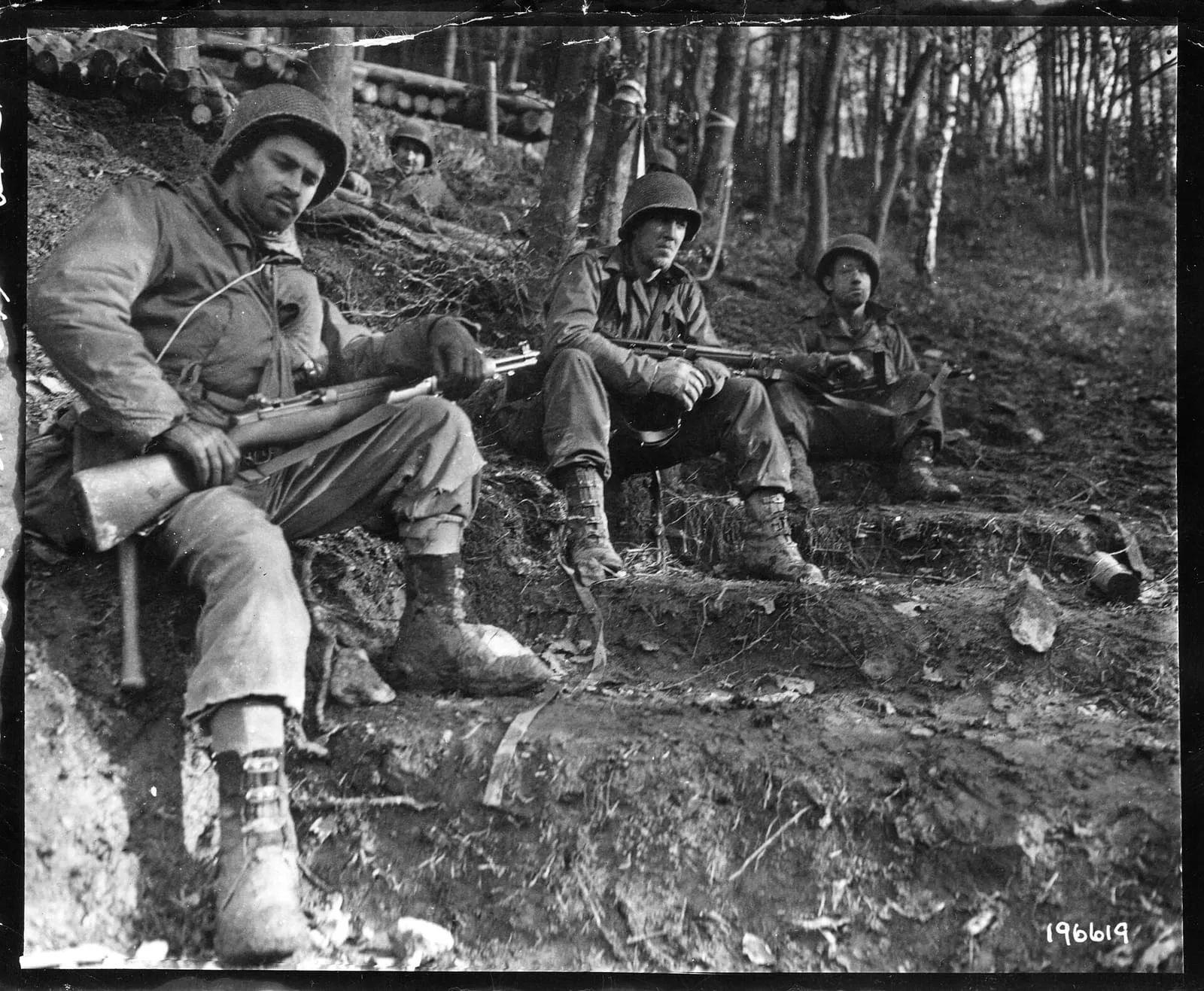
The Battle of Hürtgen Forest was a series of engagements between the US First Army and German forces, fought from the autumn of 1944 to the winter of 1945 in a dense, hilly forest in Germany, near the Belgian border, south-east of Aachen. Across an area of some 130–140 km², cut by deep ravines and served by only a handful of roads, one American division after another tried to break through to the Roer river and its dams. They entered the forest at full strength and came out a few weeks later bled white, having gained a few kilometres of woodland and a handful of ruined villages.
The battle is regarded as the longest the US Army fought on German soil and one of the costliest in its history. American losses are usually estimated at about 33,000 killed, wounded and put out of action by sickness and frostbite. It was overshadowed, however, by the German Ardennes offensive, which began in mid-December 1944 right next door, in the same hilly Eifel. After the war the battle became, for American military historians, an example of an offensive pursued doggedly, without a clear objective and in defiance of the terrain. That verdict is not unanimous, however.
Name and dates
The name comes from the village of Hürtgen and the forest around it (German: Hürtgenwald), although the fighting spread across the whole wooded massif between Stolberg, Monschau and Düren: the Hürtgen, Wenau, Merode and Roetgen forests. Today the area lies within the municipality of Hürtgenwald and neighbouring municipalities in North Rhine-Westphalia. The Germans also call the November fighting for Schmidt and Vossenack the “All Souls’ Battle” (Allerseelenschlacht), because it peaked at the beginning of November. American soldiers twisted the forest’s name into “Hurt-gen”, from the English “to hurt”.
The battle is usually taken to have begun on 19 September 1944, when units of the US 9th Infantry Division began pushing deep into the forest. Its end is dated in different ways. English-language historiography often closes the battle on 16 December 1944: on that day the German Ardennes offensive began and the American attacks in the forest ceased. Some accounts, including part of the German literature, count the fighting up to 10 February 1945, when the Americans, having resumed their attack, took Schmidt and the Schwammenauel dam on the Roer – the objective around which the whole battle had revolved since November. The battle can thus be dated more broadly, from 19 September 1944 to 10 February 1945. It should be borne in mind, however, that between 16 December and the end of January the forest was relatively quiet, and the main action had shifted to the Ardennes.
Background
After the Germans were routed in Normandy and pursued rapidly across France and Belgium, the Allies reached the western border of the Reich in mid-September 1944. Lieutenant General Courtney Hodges’s First Army, part of Lieutenant General Omar Bradley’s 12th Army Group, crossed the German border on 11 September, and two days later Major General Joseph Lawton Collins’s VII Corps attacked the fortifications of the Siegfried Line south of Aachen. The attack by exhausted divisions short of fuel soon lost momentum, however. Supplies still had to be brought up from the Normandy beaches, and priority in supply had been given to Field Marshal Bernard Law Montgomery, who on 17 September launched Operation Market Garden in the Netherlands.
East of Aachen lay the so-called Aachen Gap, a flat corridor leading towards the Rhine and the Ruhr. Its southern flank was closed by the great wooded massif around the village of Hürtgen. The American commanders – Hodges, Collins and, in the later phases, Bradley as well – decided that the forest could not be left on their flank. They feared that the Germans, sheltering in it, would strike the flank of the troops advancing through the gap towards the Roer. They also wanted to tie down German forces in the forest that might otherwise reinforce the defence of Aachen. From November onwards the Roer dams, above all the Schwammenauel and the Urft dam (Urfttalsperre) higher upstream, played an ever greater role. As long as the Germans controlled them, they could at any moment open the sluices or blow the dams and flood the Roer valley, cutting off any troops that had crossed the river further downstream. The shortest route to the dams led through the forest and through the village of Schmidt on the ridge above the valley.
On the German side, the front from Aachen to the Eifel was held by General Erich Brandenberger’s Seventh Army, subordinate to Field Marshal Walter Model’s Army Group B, which in turn answered to the Commander-in-Chief West, Field Marshal Gerd von Rundstedt. The Hürtgen Forest lay in the sector of General of Infantry Erich Straube’s LXXIV Army Corps. At the start of the fighting the main burden of the defence fell on Lieutenant General Hans Schmidt’s 275th Infantry Division – a unit shattered in Normandy and hastily reconstituted, some 5,000 men strong, with little artillery and no tanks. It was supplemented by soldiers of fortress battalions, Luftwaffe trainees and older reservists. Hitler was determined to hold the Eifel at all costs for one more reason, of which the Americans were unaware: behind it, since the autumn, forces had been assembling for the planned Ardennes offensive.
The forest favoured the defenders. The dense, dark spruce woods were crossed by only a few roads, forest tracks and firebreaks, while steep slopes and deep ravines – especially the valley of the Kall stream – hampered the movement of vehicles. Part of the fortifications of the Siegfried Line – concrete bunkers, anti-tank obstacles and ditches – ran through the forest. To these the Germans added log-covered dugouts, wire entanglements, booby traps and extensive minefields, in which they also used wooden and glass mines that were hard to find with a mine detector. The firebreaks and the few clearings through which the attackers had to pass had been registered in advance by German artillery and mortars. In the autumn of 1944 the weather was mostly wet and overcast, and later freezing and snowy, so Allied aircraft could seldom support the infantry. In the forest it was also hard to spot targets for one’s own artillery. American superiority in men, equipment and air power – by some assessments as much as five to one – largely lost its significance here.
Course
September and October: the 9th Infantry Division
The first to enter the forest was Major General Louis Craig’s 9th Infantry Division of VII Corps. Its 47th Infantry Regiment took Schevenhütte on the northern edge of the massif on 16 September almost without loss, but the division lacked the strength to go further: its other two regiments, the 39th and the 60th, were fighting further south, around Lammersdorf and the Höfen–Alzen ridge near Monschau. They could not drive the Germans out of the woods at the edge of the village. Divisional headquarters then decided to advance north-east through the forest towards the villages of Hürtgen and Kleinhau. From 19 September battalion after battalion went deep into the forest, but the small-scale attacks bogged down in front of prepared positions, and the only gains by the end of the month were scraps of ground around Germeter.
After two weeks of reinforcement, on 6 October the 9th Division launched its main attack. The 39th and 60th Infantry Regiments were to cut the road from Monschau to Düren and take Germeter, Vossenack and finally the village of Schmidt, while the 47th Regiment held its positions near Schevenhütte. The road was cut quickly, but beyond it the attack stalled. In the first days the battalions of the 60th Regiment lost as much as two-thirds of their strength, and the 39th Regiment was halted on the Weisser Weh stream. Soldiers lost their way among identical spruces, called down artillery fire to work out their own position from the bursts, and could neither evacuate their wounded nor bring up ammunition along the narrow, blocked firebreaks. At night the Germans infiltrated into the rear, retook bunkers that had been captured earlier and counter-attacked in small groups. By 16 October the 9th Division had advanced roughly 2.7 km and lost about 4,500 men, many of them officers and NCOs. The Germans, by German estimates, lost about 3,200 men.
At the same time, to the north, the Battle of Aachen was being fought; it ended on 21 October with the surrender of the German garrison. The corps boundary was then shifted so that the forest fell within the sector of Major General Leonard Gerow’s V Corps. At the end of October the 9th Division, worn out after a month of fighting, was relieved by Major General Norman Cota’s 28th Infantry Division – a Pennsylvania National Guard formation that had come through Normandy and paraded through liberated Paris, but had been brought back up to strength largely with inexperienced recruits. Cota set up his command post at Rott on 25 October. The men of the 28th Division were dismayed at the sight of the filthy, exhausted soldiers of the 9th Division coming out of the forest.
November: Schmidt and Kommerscheidt
The plan of attack on Schmidt was drawn up by the staffs of First Army and V Corps, and Cota received it in the form of a detailed order that left him little latitude. It was essentially the same plan that had failed the 9th Division in October. The division was to use one regiment to cover the northern flank in the direction of Hürtgen, a second to take Vossenack and strike across the Kall valley at Kommerscheidt and Schmidt, and a third to clear the forest to the south towards Simonskall. The attack was to be First Army’s only major offensive action at the time, which allowed the Germans to concentrate their artillery against it. The main supply route was to be the track through the Kall gorge – the so-called Kall Trail – which was marked on maps as a passable road but had never been reconnoitred on the ground. Historians also fault Cota for failing to send patrols deep into the forest and for leaving most of his tanks and tank destroyers in the rear, on the grounds that they would be of little use in the forest anyway.
The attack, planned for 31 October, was postponed to 2 November because of the weather. That day the 109th Infantry Regiment, attacking north of Germeter, walked into an unmarked minefield after 300 metres, was pinned down by mortar fire and over the following days made almost no progress. The 110th Regiment got stuck in the woods short of Simonskall. Only the 112th Infantry Regiment succeeded, taking Vossenack and the ridge above the village on 2 November. On 3 November its 1st Battalion crossed the Kall valley and took Kommerscheidt, and its 3rd Battalion took Schmidt. The Americans thereby cut the German supply road to Monschau and stood a few kilometres from the Schwammenauel dam.
The German command reacted swiftly. According to the US official history, on the morning of 2 November Model was conducting a war game at Schlenderhan Castle near Cologne with the commanders of the Seventh Army and its corps, whose scenario was precisely an American attack at the junction of LXXIV and LXXXI Corps. When reports of the attack came in, Model used the presence of the commanders to prepare a counter-attack on the spot, and sent Major General Siegfried von Waldenburg’s 116th Panzer Division, just withdrawn from the Aachen area, to Schmidt. At dawn on 4 November tanks of the 116th Division and infantry of the 89th Infantry Division attacked Schmidt from several directions. The battalion, which had had no time to dig in or mine the approaches and had no tank support, disintegrated under fire. Some of the men fled west to Kommerscheidt; others strayed east and were taken prisoner.
Over the following days the remnants of two battalions of the 112th Regiment held out in Kommerscheidt. Of the eight M4 Sherman tanks of the 707th Tank Battalion that tried to drive along the track through the Kall gorge, only three got across. With their help, and with the support of aircraft, which on 5 November were at last able to fly, the defenders beat off several German attacks and destroyed several tanks. The Kall Trail, however, was being cut by German patrols, and evacuating the wounded and bringing up ammunition was all but impossible. On 6 November, under artillery fire and a German attack, the 2nd Battalion of the 112th Regiment in Vossenack broke. Some of the men fled the village, and it took engineers from the engineer combat battalions to retake its western part. On 7 November Cota received permission to withdraw from across the Kall, and during the night of 7/8 November the survivors crossed back through the gorge, leaving behind their wounded, equipment and abandoned vehicles. The Germans took Kommerscheidt and part of Vossenack.
At the Kall bridge a German regimental doctor, Captain Günter Stüttgen, negotiated an informal truce with the Americans which, according to various accounts, lasted several days from 7 November. During that time medics from both sides collected the wounded, and the Germans also treated Americans. A memorial by the bridge commemorates it today. According to American figures, the 28th Division lost 6,184 men in the operation against Schmidt – killed, wounded, missing, captured and put out of action by sickness and exhaustion. It was one of the heaviest defeats suffered by a single American division in the campaign in Western Europe. In mid-November the division was withdrawn to a quiet sector in the Ardennes, in Luxembourg, where a month later it took the main weight of the German offensive.
Operation Queen: the 4th and 8th Infantry Divisions
On 16 November the Allies launched Operation Queen – a great offensive by the US First and Ninth Armies towards the Roer, preceded by one of the heaviest tactical bombing raids of the war on German positions between Aachen and Düren. In VII Corps’ sector the northern part of the forest, between Schevenhütte and Hürtgen, was to be cleared by Major General Raymond Barton’s 4th Infantry Division, while the 1st and 104th Infantry Divisions attacked further north. One of the 4th Division’s regiments, the 12th Infantry Regiment, had already been bled white in fighting on the 28th Division’s flank. The other two, the 8th and 22nd Regiments, advanced through the forest in parallel columns, and their exposed flanks invited the Germans to infiltrate between them. The very first attacks along the Rother Weh stream and near the Rabenheck hill were repulsed with heavy losses, especially among officers and NCOs.
Engineers began blasting lanes through the forest for tanks, but the problems with communications, supply and the evacuation of the wounded were so serious that on 19 November the attack was halted for two days. The Germans reinforced their defence with units of the 344th and 353rd Infantry Divisions. Over the following weeks the 4th Division advanced a few hundred metres a day. By the beginning of December it had lost, according to the US official history, more than 4,000 men in combat and about 2,000 to sickness and frostbite. The war correspondent Ernest Hemingway was with Colonel Charles Lanham’s 22nd Regiment, and Staff Sergeant J.D. Salinger, later the author of The Catcher in the Rye, served in the ranks of the 12th Regiment.
On 21 November the forest again came under V Corps. The attack on the village of Hürtgen was taken up by Major General Donald Stroh’s 8th Infantry Division, which attacked from the Germeter area along the Weisser Weh valley. Its 121st Infantry Regiment ran into strong resistance from the first day and, despite tank support, advanced only a few hundred metres a day. The village of Hürtgen was taken on 28 November (some sources give 29 November) in house-to-house fighting, with the support of tanks from Combat Command R of the 5th Armored Division. The neighbouring village of Kleinhau fell the next day. On the northern edge of the forest, at Merode, two companies of the 1st Infantry Division took the village on 29 November but were cut off and destroyed in a German counter-attack.
December: Brandenberg, Hill 400 and the pause
At the beginning of December units of the 8th Division and Combat Command R of the 5th Armored Division struck from Kleinhau at the Brandenberg–Bergstein ridge, the last high ground before the Roer valley. Brandenberg was taken on 3 December, and Bergstein – after heavy fighting against German counter-attacks – on 5 December. On 7 December the 2nd Ranger Battalion stormed Hill 400 (the Burgberg) above Bergstein, from which German observers had been directing artillery fire over the whole area. Further north, Major General Robert Macon’s 83rd Infantry Division, which had relieved the 4th Division, took the villages of Gey and Strass on the eastern edge of the forest on 10–12 December.
The Roer dams were still in German hands, and only now did the American command fully appreciate their importance. On 13 December V Corps launched an attack further south, around Simmerath and Kesternich, with the newly arrived 78th Infantry Division, in order to reach the dams from the south. Three days later, on 16 December, the Germans struck in the Ardennes on the sector from Monschau to Luxembourg. The attack on the dams was broken off, and the divisions from the Hürtgen Forest were sent to defend the northern shoulder of the breakthrough. Many accounts end the battle on that day.
February 1945: the Roer dams
After the Ardennes offensive had been beaten back, the Americans returned to the Roer. Without the capture of the dams, Operation Grenade could not begin – the crossing of the Roer by Lieutenant General William Hood Simpson’s Ninth Army, synchronised with the British-Canadian offensive in the Rhineland. At the beginning of February 1945 V Corps threw the 78th Infantry Division against Schmidt, supported by other units, including the 82nd Airborne Division, which cleared the area around the Kall gorge. The fighting again proved heavy, but the German defence was by now exhausted. On 8 February the Americans finally took Schmidt, and during the night of 9/10 February units of the 78th Division reached the Schwammenauel dam. It turned out that German engineers had already destroyed the outlet machinery. The dam did not collapse, but water poured out of it for many days and the Roer valley was flooded. Operation Grenade had to be postponed from 10 to 23 February. In the broader reckoning, the battle ends on the day American troops stood on the dam, although German stragglers in the western part of the wooded massif held out for a few more days.
Conditions of combat
Soldiers on both sides remembered the Hürtgen Forest as an exceptionally cruel place. Artillery inflicted the heaviest losses. The Germans set their fuzes so that shells burst in the treetops. Soldiers sheltering in foxholes or lying on the ground were then showered with steel fragments and wooden splinters, against which hugging the ground gave no protection. The Americans had to learn to cover their positions with thick logs, and experienced soldiers stood close against a tree trunk during shelling instead of throwing themselves to the ground. On the roads and firebreaks lay minefields, in which wooden and glass mines defeated detection, and the Germans also set booby traps for the wounded and for those who came to rescue them. Snipers in the treetops and small groups infiltrating the rear at night meant that no one ever knew where the front line ran.
In November the frosts and snow set in. Soldiers spent weeks in wet foxholes, unable to change their clothes or dry their boots. They went down in large numbers with trench foot, lung diseases and frostbite – a condition familiar from the First World War returned on a large scale in the US Army precisely in the autumn and winter of 1944. On top of this came combat exhaustion – mental breakdown under constant shelling – whose victims had to be withdrawn to the rear. Losses were made good by replacements, often thrown into battle singly, straight off the trucks, without knowing their comrades or commanders. Many were killed or wounded in their first days. Serving in the 28th Division was Private Eddie Slovik, who in October 1944 refused to fight and deserted. He was sentenced to death and shot on 31 January 1945 – the only American soldier executed for desertion since the Civil War. The sentence was confirmed by Cota and by General Dwight Eisenhower.
The German side endured the same conditions, compounded by supply shortages: for lack of fuel and lorries, ammunition and food were often carried up to the positions on men’s backs, and divisions were filled out with poorly trained recruits and older reservists. The German defenders nevertheless had experienced commanders, knew the terrain thanks to local foresters and could prepare fire plans for their artillery and mortars in advance. The fighting was at times so ferocious that – as German literature records – there were occasions when neither side took prisoners. At the same time the Hürtgen Forest saw several acts of humanity, such as the truce at the Kall bridge or the conduct of Lieutenant Friedrich Lengfeld, mortally wounded in a minefield on 12 November 1944 while trying to rescue a wounded American soldier. After the war veterans of the US 4th Infantry Division paid for a plaque in his honour in the German war cemetery at Hürtgen.
Losses
Loss figures are incomplete and vary according to the time frame and area adopted. It is most often stated that between September and mid-December 1944 the First Army lost about 33,000 men in the Hürtgen Forest: about 24,000 killed, wounded, missing and captured, and about 9,000 put out of action by sickness, frostbite, trench foot and combat exhaustion. Some authors, including the fighting on the fringes of the forest and that of early 1945, arrive at over 50,000. The 9th Division’s attacks in October alone cost about 4,500 men, the operation against Schmidt 6,184 men of the 28th Division and attached units, and the 4th Division’s November fighting more than 6,000. German losses are estimated at about 28,000 killed, wounded and captured, although this figure too is uncertain, because the records of many German units were lost.
The traces of the fighting remained in the forest for decades. Minefields, often without surviving plans, for years hampered the return of inhabitants to the ruined villages and the exhumation of the fallen. Sappers and specialist clearance services still find unexploded shells and mines in the forest today.
The debate over the battle’s purpose
The Battle of Hürtgen Forest has long been a subject of controversy among historians. The harshest verdict came from Charles B. MacDonald, author of the volumes of the US Army’s official history devoted to this campaign and himself a veteran of the Ardennes fighting as a company commander. He called it a “misconceived and basically fruitless battle” that should have been avoided. Critics charge General Hodges and his staff with feeding one division after another into the forest without learning from the failures of their predecessors, with failing for a long time to see the importance of the Roer dams or of Hill 400, and, when weighing the attack, with failing to consider seriously bypassing the forest across the open country to the north, where the Americans could have exploited their superiority in tanks and aircraft. General James Gavin, commander of the 82nd Airborne Division, whose men crossed this ground in February 1945, judged it one of the costliest and worst-conducted battles the US Army had fought.
Defenders of the commanders’ decisions point out that the forest could not simply be bypassed: it lay on the flank of the main thrust through the Aachen Gap, and the Roer dams did indeed threaten any crossing of the river further downstream. They also recall that in the autumn of 1944 the Allies knew nothing of the German plans for the Ardennes, and that the battle itself tied down forces which the Germans would gladly have committed to that offensive. The dispute, then, is not so much over whether the forest needed to be secured as over the way it was done – by frontal attacks by single divisions, in terrain that cancelled out American superiority.
Significance
The Battle of Hürtgen Forest exemplified the end of the Allies’ September optimism and their expectation that the war would be over by Christmas. On the Siegfried Line and in the forests of the Eifel, manoeuvre gave way to a war of attrition in which the Germans, though weaker, were able to hold up their opponent for a long time. For Model, who after the Allied defeat at Arnhem scored another defensive success here, holding the forest and the dams also screened the preparations for the Ardennes offensive. The American divisions worn down in the forest – the 28th and, to a lesser extent, the 4th – were resting in December on a quiet sector of the Ardennes and found themselves in the path of the German offensive of 16 December 1944.
The Hürtgen Forest was taken only after the defeat of the German Ardennes offensive, and the capture of the Roer dams on 10 February 1945 opened the way – after two weeks of waiting for the water to subside – for Operation Grenade. On 23 February the Ninth Army crossed the Roer, and at the beginning of March 1945 the Allies reached the Rhine. Model, whose Army Group B was encircled in the Ruhr in April 1945, committed suicide on 21 April. In American memory the Battle of Hürtgen Forest long remained in the shadow of the Ardennes. Literature returned to it – Hemingway described it in his novel Across the River and into the Trees (1950) – and later films and historians’ works, for which it became a warning against frontal attacks in terrain that favours the defender.