United States
Omar Bradley
Commander of II Corps (1943), the First Army (1943–1944) and the 12th Army Group (1944–1945), Chief of Staff of the US Army (1948–1949), Chairman of the Joint Chiefs of Staff (1949–1953), General of the Army (1950)
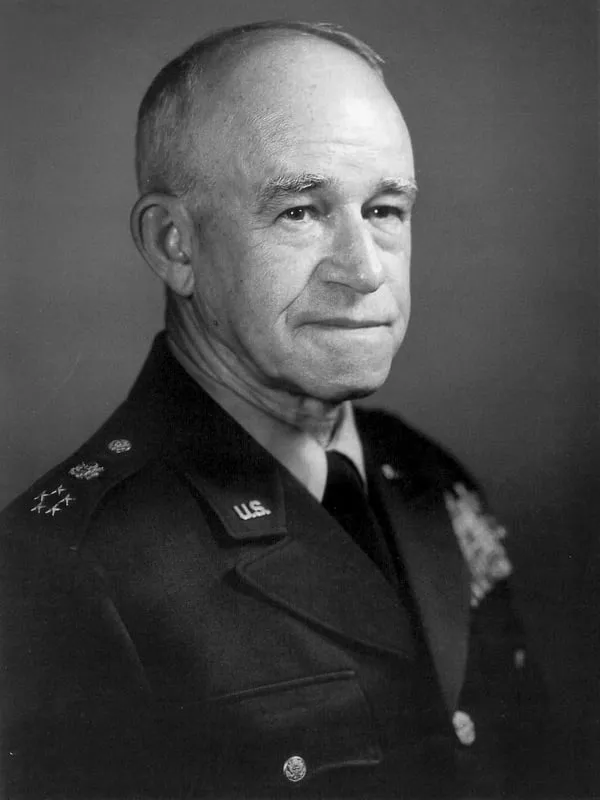
- Born:
- 12 February 1893, Clark (Missouri, United States)
- Died:
- 8 April 1981, New York City (United States)
- Author:
- Łukasz
- Photo:
- United States Army, domena publiczna, Wikimedia Commons

Omar Nelson Bradley was the calmest of the great American commanders of the Second World War. The son of a poor rural schoolteacher from Missouri, he spent most of his career teaching at military schools, did not fight in the First World War and first saw the front line at the age of fifty. Within two years he rose from deputy commander of a corps in Tunisia to commander of the 12th Army Group – the largest body of ground troops ever led in the field by an American general. Journalists called him “the GI’s General”, and after the war he became the first Chairman of the Joint Chiefs of Staff and the last American promoted to the five-star rank of General of the Army.
Childhood and West Point
He was born on 12 February 1893 near the small town of Clark, Missouri, into the poor family of a country schoolteacher. His father died in 1908, when Omar was a teenager, and from then on the family was supported by his mother, who worked as a seamstress. In 1910 Bradley finished high school in Moberly and took a job in the railway workshops to save money for university. He was persuaded to try for the military academy at West Point, where tuition was free – for the Bradleys the decisive argument. He passed the entrance examination in 1911.
The class of 1915, with which he graduated, went down in the history of the US Army as “the class the stars fell on”: according to American tallies, 59 of its 164 graduates became generals. One of Bradley’s classmates was Dwight Eisenhower, and their acquaintance from West Point – both played in the academy’s baseball team – later weighed heavily on his career.
As a second lieutenant he was posted to the 14th Infantry Regiment and served on the Mexican border. After the United States entered the war in 1917 he was promoted to captain, but instead of going to France his regiment was sent to Montana, where it guarded the copper mines around Butte. In 1918 he was assigned to the 19th Infantry Division, which was due to sail for Europe; before it could, the Armistice was signed.
A teacher in uniform
He spent most of the interwar years in schools. From 1920 to 1924 he taught mathematics at West Point; in 1925 he completed the advanced course at the Infantry School at Fort Benning, Georgia; he then served in Hawaii, where he met George Patton, and graduated from the Command and General Staff School at Fort Leavenworth. From 1929 to 1933 he was an instructor at the Infantry School at Fort Benning. Its assistant commandant at the time was Colonel George Marshall, who was reforming the curriculum with an emphasis on simple orders and the initiative of commanders in the field. Marshall remembered Bradley as a level-headed, matter-of-fact officer – according to his biographers, Bradley’s name went into the famous notebook in which the future Chief of Staff recorded men worthy of promotion.
After graduating from the Army War College (1934), Bradley returned to West Point as a tactics instructor, became a lieutenant colonel in 1936 and in 1938 moved to the General Staff in the War Department. When Marshall became Army Chief of Staff in 1939, Bradley worked in his immediate circle. In February 1941, skipping the rank of colonel, he was promoted to brigadier general and took command of the Infantry School at Fort Benning.
After the United States entered the war, as a major general he commanded first the 82nd Infantry Division (from March 1942; it was converted into an airborne division in August) and then the 28th Infantry Division of the National Guard.
Tunisia and Sicily
In February 1943 Marshall sent Bradley to North Africa as the “eyes and ears” of Eisenhower, who needed a trusted observer at the front. Bradley arrived just after the defeat at the Kasserine Pass, when the American II Corps was in disarray. At the beginning of March Patton took command of the corps, with Bradley as his deputy, watching the fighting at El Guettar at close quarters. When in mid-April Patton went back to planning the invasion of Sicily, Bradley took over II Corps.
The corps was moved from the south to the northern end of the Tunisian front, facing Bizerte. There Bradley conducted his first independent operation: his divisions took the fiercely defended Hill 609 and pushed through the mountains onto the plain. On 7 May 1943 the American 9th Infantry Division entered Bizerte, on the same day as the British took Tunis; Bradley agreed to let the French lead the ceremonial entry into the city. A few days later the Axis forces in Tunisia surrendered, and the US Army, humiliated at Kasserine, ended the campaign in victory.
In Sicily Bradley’s II Corps formed part of Patton’s Seventh Army. On 10 July 1943 his divisions landed at Gela and Scoglitti, then cut across the island to reach the north coast. Their hardest fighting was in the mountains at Troina. Relations with Patton were not easy: Bradley, a man of few words and meticulous habits, could not abide Patton’s theatricality and his ostentatious haste in the race for Messina, and he was among the first to learn of the soldier-slapping incidents. He passed the medical officer’s report to his superiors but, by most accounts, took it no further. He emerged from Sicily with a reputation as a calm commander who cared for his soldiers and did not make costly mistakes. In the dispatches of the war correspondent Ernie Pyle, who spent several days at his headquarters, Bradley appeared as the modest “GI’s General” – a label that stuck to him for the rest of his life.
The First Army in Normandy
In the autumn of 1943 Marshall and Eisenhower chose Bradley – rather than the more senior and more famous Patton – to command the American ground forces in the invasion of France. In October he arrived in England, where he took over the First Army and at the same time began building the headquarters of a future army group; under SHAEF plans, this was to take over the American forces once a second army was on the Continent. Bradley backed the extension of the plan to include a landing at the base of the Cotentin Peninsula (the future Utah Beach) and, together with Eisenhower, put General Joseph Lawton Collins, a veteran of the fighting in the Pacific, at the head of VII Corps. He watched the amphibious exercises in Lyme Bay, including Exercise Tiger, which ended in the tragedy at Slapton Sands, and on 15 May 1944 at St Paul’s School he presented the tasks of the American corps to the King, Churchill and the commanders.
On the day of the Normandy landings, 6 June 1944, Bradley watched the assault from the deck of the cruiser USS Augusta. At Utah Beach things went easily, but on Omaha the men of the 1st and 29th Infantry Divisions lay pinned down under fire for hours on a narrow strip of sand. Bradley later wrote in his memoirs that around midday he considered diverting the follow-up waves to other beaches; in the end, reports of units fighting their way up the bluffs decided that the beachhead would be held. The following weeks brought the linking of the beachheads, the cutting of the Cotentin and the liberation of Cherbourg on 26 June, but also the hardest phase of the Battle of Normandy: the gruelling fighting in the Norman bocage – a maze of fields enclosed by hedgerows on earth banks, in which every meadow had to be taken separately. Until mid-July the First Army advanced slowly and at heavy cost; Saint-Lô was not taken until 18 July.
The way out of the deadlock was to be Operation Cobra, which Bradley planned personally: a massive raid by heavy bombers on a narrow sector of the front west of Saint-Lô, followed by an infantry and armoured thrust into the gap. On 24 and 25 July some of the bombs fell on American positions, killing more than a hundred soldiers, among them General Lesley McNair. Even so, the German defence, decimated by the bombing, collapsed, and the American armoured columns broke out into open country, reaching Avranches on 30 July. The scale of the success surprised Bradley himself.
The 12th Army Group
On 1 August 1944 Bradley took command of the 12th Army Group, handing the First Army over to General Courtney Hodges. Patton’s Third Army also came under his command – his former superior from Africa and Sicily was now his subordinate. One of Bradley’s most criticised decisions came on 13 August, when he halted Patton’s XV Corps at Argentan instead of letting it continue north towards Falaise to meet the Canadians. He explained that he preferred “a solid shoulder at Argentan to the possibility of a broken neck at Falaise”, and he feared a collision between Allied forces under fire from their own artillery and aircraft. Some of the German troops managed to slip out of the pocket, which was not closed until 19–21 August, when the American 90th Infantry Division linked up at Chambois with the Polish 1st Armoured Division of General Stanisław Maczek. A few days later Bradley agreed that the first troops to enter Paris should be the French 2nd Armoured Division of General Philippe Leclerc.
In the autumn the advance stalled on the German frontier: for lack of fuel, in the fighting for Aachen and in the bloody Hürtgen Forest. When on 16 December 1944 the Germans struck in the Ardennes, Bradley’s headquarters in Luxembourg found itself on the wrong side of the German wedge, and Eisenhower placed the First and Ninth Armies under Field Marshal Bernard Montgomery for the duration of the battle. Bradley took this as a humiliation, and he regarded the press conference at which Montgomery described his part in repelling the offensive in January 1945 as an insult to the American soldier; by some accounts he even threatened to resign if the Briton were made commander of all ground forces. In March 1945, when he was promoted to (temporary) four-star general, his troops exploited the capture of the Ludendorff Bridge at Remagen, and at the beginning of April they encircled the German Army Group B in the Ruhr, taking, according to American figures, more than 300,000 prisoners.
From there the 12th Army Group pushed east towards the Elbe. On 12 April Bradley, together with Eisenhower and Patton, toured the liberated camp at Ohrdruf, a subcamp of Buchenwald. He advised against a drive on Berlin, which lay in the future Soviet occupation zone; according to his memoirs, he estimated that taking the city would cost some 100,000 casualties – “a pretty stiff price to pay for a prestige objective”. On 25 April 1945 soldiers of his First Army met Red Army troops at Torgau, an event that went down in history as Elbe Day. On the day of Germany’s surrender the 12th Army Group comprised four armies (the First, Third, Ninth and Fifteenth) and more than 1.3 million men – according to American historians, the largest force ever to serve under a single American field commander.
After the war: the veterans and the Joint Chiefs of Staff
In August 1945 President Harry Truman put Bradley in charge of the Veterans Administration – the agency that had to provide medical care, pensions, loans and GI Bill education grants to millions of demobilised servicemen. In February 1948 he succeeded Eisenhower as Army Chief of Staff, and in August 1949 he became the first Chairman of the Joint Chiefs of Staff, established in its new form after the reorganisation of the armed forces. His tenure coincided with budget cuts, inter-service quarrels – in 1949 he sharply criticised the admirals who had publicly protested against the cancellation of a large aircraft carrier – and the birth of NATO, whose military structures he helped to shape.
Korea – “the wrong war”
After the outbreak of the Korean War in June 1950, Bradley was Truman’s chief military adviser. In September 1950 he was promoted to the five-star rank of General of the Army – the fifth and last American to receive it. He supported the President’s decision to dismiss General Douglas MacArthur in April 1951, after MacArthur had demanded that the war be extended to China. During the Senate hearings in May 1951 he said that, in the opinion of the Joint Chiefs of Staff, such a strategy would involve the United States “in the wrong war, at the wrong place, at the wrong time, and with the wrong enemy”. The phrase is often quoted as a verdict on the whole Korean War, but Bradley was speaking only of a war with China.
Final years
In August 1953 he retired, although as a General of the Army he formally remained on active duty for the rest of his life. In 1951 he published his memoirs, A Soldier’s Story; a second autobiography, A General’s Life, written with Clay Blair and more critical of Patton and Montgomery, appeared after his death, in 1983. He was a consultant on the film Patton (1970), in which he was played by Karl Malden. In 1977 he received the Presidential Medal of Freedom. He died in New York on 8 April 1981, a few minutes after receiving an award at a ceremony, and was buried at Arlington National Cemetery.
Significance
Bradley had neither Patton’s brilliance nor Montgomery’s fame, but it was he who led the largest American land army in history into battle – from the beaches of Normandy to the Elbe. His strengths were method, an ability to work with others and concern for his soldiers; his weakness was caution, evident at Falaise and in his readings of the situation at the front. Historians argue over his decisions of August 1944 and his conflict with Montgomery, but they agree that, with Eisenhower and Marshall, he was one of the men who built an American army capable of winning the war in Europe.
Sources
Commanded in battles
(04)Mentioned in battles
(07)Often appears with
People who appear in the same events.
On the timeline
(60)The 40 most important of 60 events. All tagged “Omar Bradley” (10) →