Germany
Gerd von Rundstedt
Commander of Army Group South (1939, 1941) and Army Group A (1939–1940), Commander-in-Chief West (1940–1941, 1942–1944, 1944–1945), field marshal (1940)
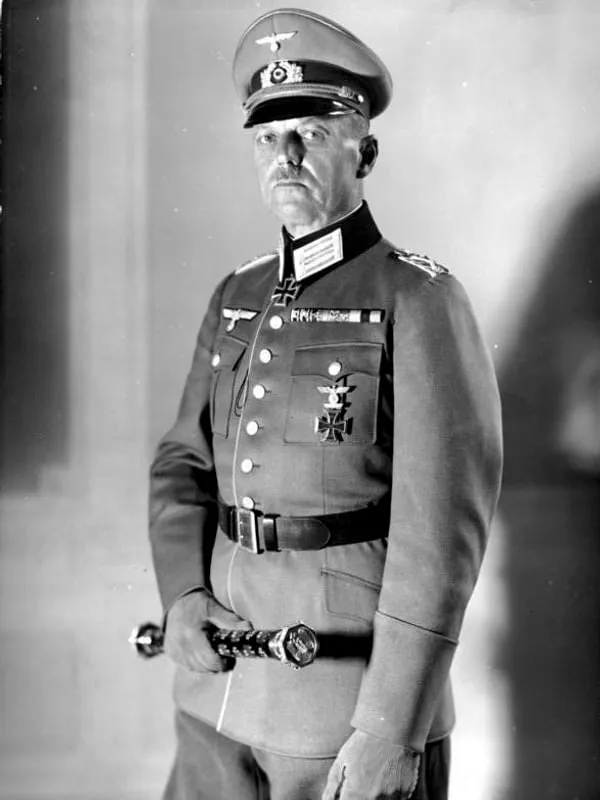
- Born:
- 12 December 1875, Aschersleben (Prussian Saxony, German Empire)
- Died:
- 24 February 1953, Hanover (West Germany)
- Author:
- Łukasz
- Photo:
- autor nieznany, CC BY-SA 3.0 DE, Wikimedia Commons

Gerd von Rundstedt was the oldest and longest-serving commander in Hitler’s army and its most recognisable face: an upright, austere Prussian aristocrat who liked to say that generals did not concern themselves with politics. In September 1939 he commanded Army Group South, which delivered the main blow against Poland from Silesia, Moravia and Slovakia. In May 1940 his Army Group A drove through the Ardennes and split the Allied front in France, and in 1941 his troops conquered Ukraine as far as Rostov-on-Don. For most of the war he was Commander-in-Chief West; he failed to repel the Allied landings in Normandy, and in December 1944 the Allied press named the Ardennes offensive after him. He despised the Nazis yet served them faithfully, and his name is also linked with orders that justified the murder of Jews and with the court of honour that delivered the conspirators of 20 July 1944 into the hands of the executioner.
A Prussian officer
He was born on 12 December 1875 in Aschersleben in Prussian Saxony, the eldest son of a cavalry officer. The Rundstedts belonged to the old but impecunious nobility of the Altmark, and almost every man in the family since the days of Frederick the Great had served in the Prussian army. Gerd went through the cadet schools at Oranienstein and Groß-Lichterfelde, and in March 1892 he joined the 83rd Infantry Regiment in Kassel as an ensign – a town he afterwards regarded as his home. In 1893 he was commissioned as a second lieutenant. From 1903 to 1906 he studied at the War Academy in Berlin, and in 1907 he was posted to the Great General Staff. In 1902 he married Luise von Götz. Their only son, Hans Gerd, was born in 1903.
The First World War
In 1914 Rundstedt was operations officer of the 22nd Reserve Infantry Division during the march through Belgium. Suffering from a lung complaint, at the end of the year he was assigned to the military administration in Antwerp, and in 1915 to the Eastern Front. From September 1915 to November 1916 he served on the staff of the German administration of the occupied Kingdom of Poland in Warsaw; then, as a corps chief of staff, he fought against the Russians in the Carpathians, and in the last months of the war he was chief of staff of a corps in Alsace. He ended the war as a major, with a reputation as one of the army’s best staff officers.
The Weimar Republic
After the revolution Rundstedt remained in the 100,000-strong Reichswehr. During the Kapp Putsch in March 1920 he was serving on the staff of the military district in Stuttgart and, like most of the army leadership, did not support the putschists. He remained a monarchist all his life, but held to the principle that an officer should serve any government and keep out of politics. He rose quickly: he became a colonel in 1923 and a Generalmajor in 1927; in 1928 he took over the 2nd Cavalry Division in Breslau (Wrocław), and in January 1932 the 3rd Division and the Berlin military district. On 20 July 1932 Chancellor Franz von Papen stripped the Prussian government of power, and Rundstedt, as plenipotentiary for the state of emergency in Berlin and Brandenburg, ensured that this coup against the legal government of the largest state of the Reich had the backing of the army. In October 1932 he became a General of Infantry and commander of Group Command 1 in Berlin.
In the service of the Third Reich
After Hitler came to power, Rundstedt made no secret in private of his dislike of the new regime, but declared that he would do nothing to oppose it. At the same time he defended the interests of the officer corps. In 1934 he led a group of generals who prevented the appointment of the ardent Nazi Walter von Reichenau as head of the Army Command, and the post went instead to Werner von Fritsch. After the Night of the Long Knives he pressed for the rehabilitation of the murdered generals Kurt von Schleicher and Ferdinand von Bredow. When in 1938 Fritsch fell victim to a Gestapo intrigue, Rundstedt defended him before Hitler, but talked him out of challenging Himmler to a duel. He knew of the plans of the conspirators around the Chief of the General Staff, Ludwig Beck, who wanted to remove Hitler if he started a war over Czechoslovakia, but he refused to take part and betrayed them to no one. In 1938, after the Munich Agreement, he commanded the 2nd Army in the occupation of the Sudetenland. On 31 October 1938, at his own request, he retired with the rank of Colonel General. Hitler made him honorary colonel of the 18th Infantry Regiment, and Rundstedt undertook to return to service in the event of war.
The September Campaign
He was back as early as the spring of 1939. At the head of the secret “Working Staff Rundstedt”, with Erich von Manstein as chief of staff and Günther Blumentritt as operations officer, he prepared the southern part of Case White. On 25 August his staff took command of Army Group South: General Johannes Blaskowitz’s 8th Army, General Walter von Reichenau’s 10th Army and General Wilhelm List’s 14th Army. It was the strongest part of the forces sent against Poland, with some 880,000 men and most of the panzer divisions. Its task was to destroy the Polish armies in western and southern Poland and reach Warsaw before they could withdraw behind the Vistula.
Rundstedt’s troops took Kraków on 6 September, and on 8 September Reichenau’s tanks reached the outskirts of Warsaw, where, however, they were beaten back with losses. Soon afterwards the Poznań and Pomorze Armies struck from the Bzura at the overextended northern flank of the 8th Army. Rundstedt and Manstein took over the conduct of the battle, drew in forces from other directions and by 18–19 September had crushed the Poles in the largest battle of the campaign. List’s army meanwhile reached Lwów (Lviv). Warsaw, besieged and bombed, capitulated on 28 September. From the first days of the campaign Wehrmacht soldiers and SS units shot prisoners and civilians, and the Einsatzgruppen followed the army, murdering members of the Polish intelligentsia and Jews. In the 14th Army’s sector Udo von Woyrsch’s SS Einsatzgruppe burned, among other things, a synagogue with people inside in Dynów. After complaints from officers, Rundstedt ordered it to leave his area, and together with Blaskowitz he complained to the Chief of the General Staff, Franz Halder, about the leniency shown towards such acts. As commander of the army group, however, he bore responsibility for the conduct of his troops.
On 3 October Rundstedt became Commander-in-Chief East (Oberbefehlshaber Ost), in charge of all the occupation forces in Poland, with his headquarters at Spała. He held the post only until 20 October. Military administration of the occupied territories lasted until 26 October, when civilian governors took over.
The Ardennes and Dunkirk
At the end of October 1939 his staff, renamed Army Group A, moved to Koblenz. It was at Rundstedt’s prompting that Manstein drew up the plan for an armoured thrust through the Ardennes which – after long resistance from the Army High Command – became the basis of the offensive in the west. On 10 May 1940 the panzer divisions of Army Group A advanced through Luxembourg and the Belgian Ardennes; on 13 May they crossed the Meuse at Sedan, and on 20 May they reached the Channel, cutting off the best Allied armies in Belgium and northern France. On 24 May Hitler, on the advice of Rundstedt and of the panzer group commander Ewald von Kleist, halted the tanks before Dunkirk. After the war Rundstedt called this order an “incredible blunder” on Hitler’s part, but his biographer concedes that the impulse to halt the advance came from Rundstedt himself. The pause allowed the British to evacuate more than 330,000 men from Dunkirk. On 19 July 1940 Rundstedt was made a field marshal. In the autumn he prepared for the landing in Britain that never took place, and from October 1940 to April 1941 he was Commander-in-Chief West.
War against the USSR
In Operation Barbarossa Rundstedt commanded Army Group South, whose task was to conquer Ukraine. After heavy tank battles in Volhynia his troops encircled Soviet armies at Uman, and in September, together with Guderian’s forces, sent south from Fedor von Bock’s Army Group Centre, they closed one of the largest pockets in the history of warfare around Kiev. Einsatzgruppen C and D operated in his area. On 29–30 September 1941 more than 33,000 Jews of Kiev were murdered in the ravine of Babi Yar, with the cooperation of officers of the 6th Army. On 10 October its commander, Reichenau, issued an order on the “conduct of the troops in the Eastern territories”, which spoke of a “severe but just atonement” on Jewish “subhumanity”. Rundstedt circulated it to his commanders with a note saying that he fully agreed with it. In November his troops took Rostov-on-Don, but under the pressure of a Soviet counter-offensive Rundstedt withdrew them against Hitler’s wishes. On 1 December 1941 he was dismissed, the first of many generals to be removed that winter. A few days later Hitler sent him a birthday cheque for 250,000 Reichsmarks. He did not cash it for a long time, but in the end he accepted it.
Defending the West
In March 1942 Hitler again appointed him Commander-in-Chief West, with his headquarters at Saint-Germain near Paris. Rundstedt was responsible for the defence of the coast from the Netherlands to the Pyrenees and for building the Atlantic Wall, although he himself had no faith in its value. In 1942 Hitler issued an order for the shooting of captured Allied commandos. Rundstedt issued no orders for executions, but as commander in the West he was later blamed for them. In 1944 he argued with Erwin Rommel over the deployment of the panzer divisions, and Hitler, settling the dispute with a compromise, kept them at his own disposal. After the Normandy landings on 6 June 1944 the Allies could not be thrown back into the sea. On 1 July, according to Blumentritt, when the head of the OKW, Wilhelm Keitel, asked him what was to be done, Rundstedt replied: “Make peace, you fools!” The next day he was dismissed.
After the 20 July 1944 plot Rundstedt, who had known about the conspiracies for years, presided over the army’s “court of honour”. The court expelled from the army officers suspected of involvement in the plot so that they could be tried before the Nazi People’s Court rather than by court-martial. Many of them were sentenced to death. In October Rundstedt delivered the address at Rommel’s state funeral, although Rommel had been forced by the regime to take his own life. In September 1944 he took up command in the West for the third time. In December he was formally in command of the Ardennes offensive, planned by Hitler, in whose success he himself did not believe. In March 1945, after the loss of the bridge over the Rhine at Remagen, he was dismissed for the last time.
Captivity and final years
At the beginning of May 1945 the Americans took him prisoner at Bad Tölz. At the Nuremberg trial he testified as a defence witness for the High Command and claimed that the army had opposed the Commissar Order, which had “simply not been carried out” – which was untrue. The British intended to try him for war crimes, including complicity in the murder of prisoners, hostages and Jews. In January 1949 charges were brought against him, but doctors judged that the old and ailing field marshal would not survive a trial. In May 1949 he was released without trial. He died on 24 February 1953 in Hanover.
Significance
Rundstedt commanded on the decisive sectors in Hitler’s three greatest victories: in Poland, in France and in Ukraine. His Army Group South delivered the main blow in September 1939 and destroyed the most important Polish forces on the Bzura, and a year later his Army Group A carried out the manoeuvre that sealed the defeat of France. After the war the image of the “last Prussian”, an apolitical soldier who merely obeyed orders, promoted by British writers, long obscured what the documents show: Rundstedt knew of the crimes committed in the areas under his troops’ control, protested against them in Poland only half-heartedly, and in 1941 openly endorsed an order justifying the murder of Jews. His career shows how a traditional officer elite, convinced of its own independence from politics, became an instrument of a war of aggression and of genocide.
Sources
Commanded in battles
(10)- 1 September – 6 October 1939Invasion of PolandPoland
- 9–22 September 1939Battle of the BzuraPoland
- 10 May – 25 June 1940Battle of FranceWestern Front
- 26 May – 4 June 1940Battle of DunkirkWestern Front
- 22 June – 5 December 1941Operation BarbarossaEastern Front
- 7 July – 26 September 1941Battle of Kiev (1941)Eastern Front
- 17 November – 2 December 1941Battle of Rostov (1941)Eastern Front
- 6 June – 30 August 1944Battle of NormandyWestern Front
- 16 December 1944 – 25 January 1945Battle of the BulgeWestern Front
- 7–31 March 1945The Rhine crossingsWestern Front
Mentioned in battles
(08)Often appears with
People who appear in the same events.
On the timeline
(66)The 40 most important of 66 events. All tagged “Gerd von Rundstedt” (5) →