1940–1941: The East African campaign
Battle of Keren
- Dates:
- 3 February – 1 April 1941
- Front:
- Africa
- Location:
- The area around the town of Keren in Eritrea (Italian East Africa): the Dongolaas Gorge and the peaks surrounding it – Sanchil, Brig's Peak, Hog's Back and Samanna to the west; Dologorodoc, Falestoh, Zeban and the Acqua Col to the east; in the final phase, the road from Keren to Asmara through Ad TeclesanOn the battle map →
- Sides:
- United Kingdom (with troops from British India and Sudan) and the Free FrenchWilliam Platt, Noel Beresford-Peirse, Lewis HeathItaly (with colonial troops from Eritrea)Luigi Frusci, Nicolangelo Carnimeo, Orlando Lorenzini
- Result:
- British victory. After eight weeks of fighting, the Italians abandoned their positions at Keren on the night of 26–27 March 1941, lost their last line of defence at Ad Teclesan on 31 March, and on 1 April Asmara, the capital of Eritrea, surrendered. According to the British official history, Platt’s forces lost 536 killed and 3,229 wounded at Keren; the Italians, according to General Frusci’s reports, lost about 3,000 killed.
- Author:
- Łukasz
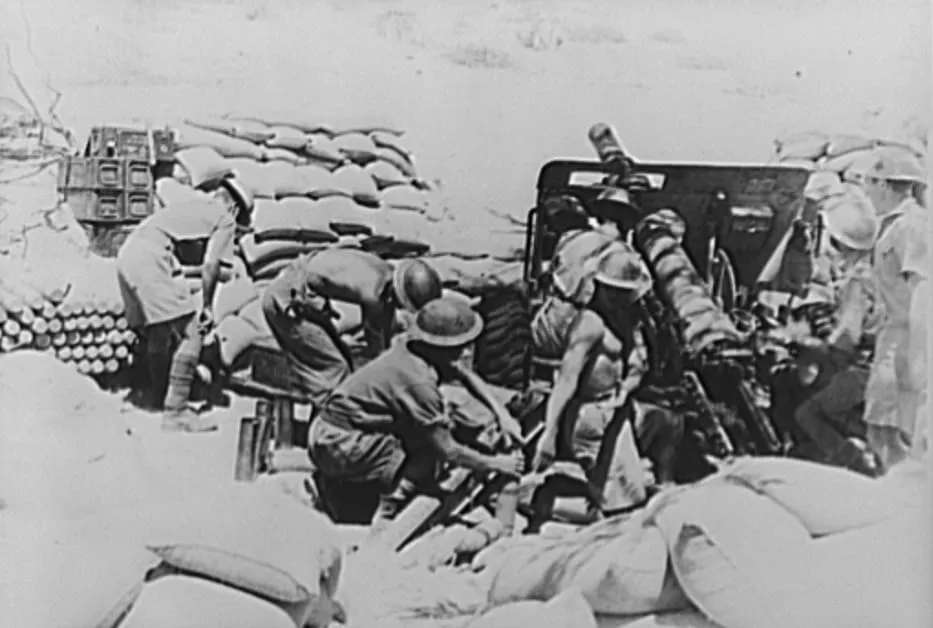
The Battle of Keren was the hardest-fought and decisive battle of the East African campaign. For almost eight weeks, from early February to the end of March 1941, two Indian divisions under General William Platt assaulted the granite peaks above the Dongolaas Gorge, through which ran the only road and railway from western Eritrea to Asmara and the port of Massawa. The heights were held by the best troops in Italian East Africa: the Savoy Grenadiers, Bersaglieri, Alpini, Blackshirt battalions and crack brigades of Eritrean askaris, under Generals Nicolangelo Carnimeo and Orlando Lorenzini. The first attacks, in February, ended in bloody failure. Only the general assault launched on 15 March, after twelve days of hand-to-hand fighting for every summit, opened the road to Keren for the British – and, a few days later, the road to Asmara.
For the British it was a victory that opened the Red Sea to shipping and sealed the fate of Italy’s oldest colony. For the Italians Keren became the symbol of the most stubborn defence of the entire African war, fought with no hope of reinforcement from home and against almost complete enemy superiority in the air. Both sides later remembered the battle with respect for their opponents: the British official historian wrote that the Italians had defended themselves “exceptionally well”, and Carnimeo paid tribute to the courage of the Indian soldiers.
Name and dates
The town of Keren (Cheren in Italian) lay on a plateau in northern Eritrea, roughly halfway between Agordat (Akordat) and Asmara. The battle bears its name, although the fighting took place a few kilometres west and south-west of the town, on the peaks around the Dongolaas Gorge. Italians call it the “battaglia di Cheren”, and sometimes also speak of the siege of Keren.
The dates given for the start and end of the battle vary. The British vanguard, the motorised Gazelle Force, reached the blocked gorge on the afternoon of 2 February 1941, and the first infantry attack, by the 11th Indian Infantry Brigade, went in on the afternoon of 3 February. Italian authors, among them Carnimeo himself in a book published in 1950, date the battle from 31 January or 1 February, when the first units falling back from Agordat took up positions in the mountains. The end of the battle is usually placed on 27 March 1941, when the Italians abandoned Keren and British tanks drove into the town. The battle can, however, be taken more broadly, from 3 February to 1 April, to include the pursuit along the road to Asmara, the fight for the last line of defence at Ad Teclesan (31 March) and the surrender of Asmara (1 April), which was the direct consequence of the victory at Keren. The capture of Massawa on 8 April was a separate operation.
Background
Eritrea was Italy’s oldest colony and the base from which Mussolini attacked Ethiopia in 1935. After Italy entered the war in June 1940 it became the northern bastion of Italian East Africa, which was cut off from the mother country by British control of the Suez Canal. In July 1940 the troops of General Luigi Frusci, commander of the northern sector, took Kassala in Sudan, but advanced no further. The Viceroy, Prince Amedeo, Duke of Aosta, short of fuel, tyres, spare parts and aircraft, went over to the defensive. In the autumn General Lewis Heath’s 5th Indian Infantry Division arrived in Sudan, and at the turn of 1940 and 1941, after the first successes of Operation Compass, General Archibald Wavell also transferred there from Egypt General Noel Beresford-Peirse’s 4th Indian Infantry Division.
In January 1941 the Duke of Aosta, with Mussolini’s approval, decided to give up the flat, open borderland, where British tanks and vehicles would have the advantage, and to make his stand further east, in the mountains. The British, who were reading Italian ciphers, immediately set off in pursuit and entered Kassala on 19 January. After the hard-fought Battle of Agordat, decided on 31 January, and the capture of Barentu on 2 February, the Italian army in Eritrea had suffered heavy losses, but its core managed to withdraw into the mountains. The Viceroy, alarmed by the constant retreats that were breaking the soldiers’ spirit, especially that of the askaris, forbade any further withdrawal and sent to Keren the best troops he had in reserve at Addis Ababa: the 11th Savoy Grenadiers Regiment from the elite “Granatieri di Savoia” Division, with a Bersaglieri battalion, followed by the Alpini battalion “Uork Amba”. Their task, as he put it, was to “close the gap absolutely”.
Keren was not a fortress in the strict sense of the word, but nature had done more there than engineers could have. On the Agordat side the plateau was closed off by a wall of mountains rising more than six hundred metres above the valley floor, broken only by the narrow Dongolaas Gorge. The road ran along its eastern side and a narrow-gauge railway along its western side. West of the gorge rose the Sanchil massif and beyond it, along a single ridge, Brig’s Peak, Hog’s Back, Flat Top and Mount Samanna. In front of Sanchil lay a lower ridge, which the British named Cameron Ridge after the battalion of the Cameron Highlanders that first took it. East of the gorge stood the Dologorodoc massif with a concrete fort on its summit, and behind it Falestoh, Zeban and Zelale, known as the Sphinx; between them a track led over steep ridges through the Acqua Col to Keren. From the summits of Sanchil and Brig’s Peak Italian observers could see every enemy movement in the valley, while British artillery could not reach positions concealed just behind the crests.
General Platt disliked frontal attacks, but he had no choice. The track through Arresa in the south was impassable for vehicles, and the road from Karora in the north could serve at most for a subsidiary thrust. The only way to Asmara lay through the Dongolaas Gorge.
Opposing forces
The defence of Keren was taken over by General Nicolangelo Carnimeo, commander of one of the Eritrean colonial divisions, which was falling back along the road from Karora (sources differ on its number). He was subordinate to General Frusci, Governor of Eritrea and commander of the whole northern front. At the beginning of February he had one colonial brigade and three grenadier battalions in position, and in the rear the remnants of three brigades beaten at Keru and Agordat, which were being hastily rebuilt. Among them was the 2nd Colonial Brigade of General Orlando Lorenzini, a veteran of the colonial wars in Libya and Ethiopia, who had commanded the entire 4th Colonial Division at Agordat. Over the following days and weeks further colonial brigades arrived – from Barentu, from Om Ager and from the reserve at Addis Ababa – and in March also the 6th Brigade from Metemma and more Blackshirt battalions. Estimates of the defenders’ numbers vary widely. According to some studies there were about 25,000 of them in March; the British historian Andrew Stewart writes of 31,000, while some Italian authors give much lower figures, counting only the units in the front line.
On the British side fought two divisions of the Indian Army, each made up of three brigades in which one battalion was British and two Indian. Beresford-Peirse’s 4th Division had the Battle of Sidi Barrani behind it; Heath’s 5th Division had already fought on the Sudanese frontier. Many of their soldiers knew mountain warfare from India’s North-West Frontier, but not against an enemy with artillery and a great many mortars. They were supported by British artillery, a squadron of Matilda infantry tanks from the 4th Royal Tank Regiment, units of the Sudan Defence Force, and aircraft: Blenheim, Wellesley and Hardy bombers and Hurricane and Gladiator fighters of the Royal Air Force and the South African Air Force. From the north came Brigadier Harold Briggs’s 7th Indian Infantry Brigade, reinforced by the Free French Brigade of the Orient under Colonel Monclar (Raoul Magrin-Vernerey), made up of the 14th Battalion of the 13th Demi-Brigade of the Foreign Legion and the 3rd Marching Battalion from Chad.
British superiority lay above all in firepower, supplies and air power, not in the number of infantrymen fit to storm the heights. The Italian air force in East Africa was crippled by a shortage of spare parts and fuel: according to the British official history, in mid-February it had 188 aircraft, of which 67 were serviceable, and a month later 39 out of 150.
Course of the battle
The first attacks (3–8 February)
On 1 February Gazelle Force was halted at the River Baraka, where the Italians had blown the bridge and mined the approaches. At midday on 2 February it crossed and pushed on up the Ascidera valley until, a few kilometres short of Keren, it came up against the Dongolaas Gorge. The Italians had blasted down the overhanging rocks and buried the road under boulders for several hundred metres. Matilda tanks that reconnoitred the gorge confirmed that the block was impassable.
The commander of the leading brigade of the 4th Division, Brigadier Reginald Savory, found no way round and decided to attack Sanchil and Brig’s Peak. On the afternoon of 3 February the 11th Indian Infantry Brigade went into the attack. The Cameron Highlanders took the ridge in front of Sanchil, named after them from then on, and on the night of 6–7 February a Punjabi battalion reached Brig’s Peak. Counter-attacks by the Savoy Grenadiers, Bersaglieri and askaris, however, drove the attackers back. Only the Scots and the soldiers from Rajputana held on to Cameron Ridge, under fire from three sides. All their food, water and ammunition had to be carried up the steep slope on men’s backs, under fire.
On the night of 7–8 February Brigadier Lloyd’s 5th Indian Infantry Brigade tried to strike elsewhere, through the Acqua Col east of the gorge, where desertions by askaris suggested a weak spot. A company of the 4th/6th Rajputana Rifles took the col, but by dawn it had run out of ammunition, and communications had failed in the darkness. The next day, after many hours under artillery and mortar fire, the men returned to their start line.
The second attempt (10–13 February)
Beresford-Peirse, with Platt’s consent, renewed the attack on 10 February, this time on both flanks at once. The 11th Brigade was to take Brig’s Peak, the 5th Brigade the Acqua Col, and the 29th Indian Infantry Brigade, borrowed from the 5th Division, was to pass through the breach and advance on Keren. On the afternoon of 10 February the 3rd/1st Punjab Regiment forced its way onto Brig’s Peak, and by the morning of 11 February it was on the summit of Sanchil. So many men had to be detached to carry ammunition, water and the wounded, however, that the summit was held by only two platoons. After a whole day under artillery and mortar fire, a grenadier counter-attack threw them off Sanchil and Brig’s Peak. Brig’s Peak changed hands twice that day, as did the neighbouring Saddle and Hog’s Back. In Italian accounts of this fighting a special place is held by the Alpini battalion “Uork Amba”, which had recently arrived from Addis Ababa.
On the right flank, at dawn on 12 February, after a heavy artillery preparation, the 4th/6th Rajputana Rifles attacked the Acqua Col for the second time. Subedar Richhpal Ram, who had already led his men in the first attack, reached the crest, but a shell tore off his foot and he died soon afterwards. He was awarded a posthumous Victoria Cross. The attack broke down: the 4th/6th Rajputana Rifles, already weakened by the first attempt, lost 123 men and the accompanying 4th/11th Sikh Regiment more than a hundred. There was no force left to tip the balance, because the Mahratta Light Infantry battalion intended as support had had to be sent to the threatened Cameron Ridge. Beresford-Peirse concluded that with such losses he could not go on attacking, and Platt agreed. The enemy was defending very well, in a strong position and with a great many mortars and machine guns.
These first weeks showed what the fighting at Keren was like. The attacking infantryman climbed in the heat, up waterless slopes, through boulders, scree and thorn scrub, laden with weapons and ammunition. Over the last few dozen metres the artillery had to lift its fire, and the defenders would then emerge from their shelters behind the crest and shower the exhausted soldiers with small Italian hand grenades, painted red and called “red devils” by the British. Those who reached the top were usually too tired and too few to beat off the immediate counter-attack, backed by accurate fire from concealed mortars. The defenders, for their part, clung to bare rock in which it was not even possible to bury the dead, under constant artillery fire and air attack.
Preparations and fighting on the flanks (mid-February – mid-March)
Platt decided to break off the attacks and prepare a great, carefully planned battle involving both divisions. For the following weeks everything depended on transport. A hundred and eighty miles, about three hundred kilometres, separated the front from the railhead at Kassala. As there were not enough lorries to supply both divisions in the mountains, the 5th Division (less the 29th Brigade) went back to the Kassala area and trained there in mountain warfare, while the 4th Division held the positions it had taken, suffering losses every day. The railhead was moved forward to Tessenei, and lorries brought up food, fuel and ammunition for fourteen days of fighting. At night, hidden from the observers on the peaks, sappers and signallers built roads and telephone lines.
On the flanks Platt sought to stretch the enemy’s forces. In the direction of Arresa a small detachment of Skinner’s Horse cavalry and the Sudan Defence Force was to pose as a much larger force. From the north, from Karora, Briggs’s group (Briggs Force) was moving south. Supplied through the small harbour of Mersa Taclai on the Red Sea, on 23 February it fought a successful action at Cub Cub (Kubkub), some seventy kilometres north-east of Keren. According to some authors, the Marching Battalion from Chad of the Brigade of the Orient was the first French unit to go into action against Axis forces since the fall of France in 1940. On 1 March Briggs’s group crossed the Mescelit Pass and halted a little more than twenty kilometres north-east of Keren, also threatening the road to Massawa and forcing the Italians to keep reserves there.
At the same time British and South African aircraft, which after the capture of Agordat and Barentu could reach the main Italian bases in Eritrea, waged a systematic campaign against Italian airfields, workshops and supply lines. Wellesley bombers bombed the Caproni workshops at Mai Edaga, Hurricane fighters patrolled as far as Gura and Asmara; on 19 February Asmara and its airfield were heavily attacked, on 21 February the airfield at Massawa, and on 23 February, from a distance of almost 250 kilometres, the airfield at Makalle, where eight aircraft were burned. Aircraft from the carrier HMS Formidable, passing through the Red Sea on her way to the Mediterranean, attacked Massawa several times. Thousands of leaflets in Amharic and Tigrinya were dropped over the Italian positions; according to prisoners’ statements, they persuaded many askaris to desert. The Italian air force was all but driven out of Eritrea and in the decisive phase of the battle hardly appeared over the battlefield at all. On 22 March it had only 37 serviceable aircraft left in the whole of East Africa.
The Duke of Aosta reported to Rome that nothing more would reach the empire from outside except a handful of aircraft, and he could only scrape together reinforcements for Keren wherever he could find them. Benito Mussolini told him to play for time and await the outcome of the war in Europe.
The general assault (15–27 March)
Platt’s plan, ready on 1 March, provided for two successive attacks supported by the same artillery: first the 4th Division west of the gorge, against the peaks from Sanchil to Samanna, then the 5th Division east of the gorge, against Fort Dologorodoc, with Falestoh and Zeban as further objectives. The 5th Division, to which the 9th Brigade of Brigadier Frank Messervy, until then commander of Gazelle Force, had returned, moved up to the front by night from 8 March. The defenders also received reinforcements: the 6th Colonial Brigade from Metemma, more Blackshirt battalions and further colonial units. On 14 March Platt told his commanders that no one should imagine this would be a walk-over. It would be a bloody battle, against the enemy and against the ground, and it would be won by the side that held out longer. He knew, he said, that they would last longer than the enemy, and he promised that he would last longer than his opposite number.
On the morning of 15 March Blenheim, Wellesley and Hardy bombers attacked the Italian artillery and infantry positions, and at seven o’clock the guns of both divisions opened fire. The 11th Brigade, reinforced to five battalions, took Sanchil and Brig’s Peak but could not hold them. Hog’s Back and Flat Top were taken and held, while the 5th Brigade forced its way onto the slopes of Samanna and stuck there. At half past ten the 2nd Battalion of the Highland Light Infantry advanced across the gorge against the lower hills in front of Dologorodoc, named the Pimple and the Pinnacle, but flanking fire from the slopes of Sanchil pinned it to the ground until dusk. At night Messervy’s 9th Brigade took up the attack. Lieutenant Colonel Denys Reid’s 3rd/5th Mahratta Light Infantry took the Pinnacle and the 3rd/12th Frontier Force Regiment the Pimple. Messervy then threw in his reserve, the 2nd Battalion of the West Yorkshire Regiment, which approached the fort from the south along a narrow ridge and took it at 6.30 a.m. on 16 March, capturing about forty prisoners.
Fort Dologorodoc became the turning point of the battle. It gave observation over both sides of the gorge and over the reverse slopes of the massif, until then safe for the defenders. The Italians understood this well. According to the British official history, they counter-attacked the fort seven times between 18 and 22 March, suffering heavy losses, and the fighting was often hand to hand. At 3 p.m. on 17 March General Orlando Lorenzini was killed by a shell splinter; he was respected by both sides as a commander who could inspire his askaris to follow him. He was posthumously awarded the Gold Medal of Military Valour. General Frusci reported daily to the Viceroy on heavy losses, especially from aircraft and artillery; by 20 March the strength of the units had fallen by a third.
The British did not succeed everywhere either. On the night of 16–17 March Platt threw his last reserve, battalions of the Baluch Regiment and the Royal Garhwal Rifles, against Sanchil and Brig’s Peak, again without success. The same night the 29th Brigade advanced through Dologorodoc against Falestoh and Zeban, but in the difficult terrain it fell behind the barrage, was pinned down by heavy fire and, cut off for a whole day, had to be supplied from the air with ammunition and food dropped in improvised containers. It was withdrawn at night. On the night of 17–18 March the 4th Division came down from the slopes of Sanchil and Brig’s Peak, keeping Hog’s Back and Flat Top.
The breakthrough in the gorge
The 29th Brigade’s attack nevertheless had one important result: the sappers were able to examine the block in the gorge at close range. From a distance it had seemed impossible to clear; now they estimated that clearing it for tracked vehicles would take about 48 hours, provided no one interfered with them. Heath concluded that the key to the gorge was not the impregnable Sanchil but two small hillocks right above the block, the so-called Railway Bumps, which could be approached along the railway line from the tunnel beneath Cameron Ridge. Platt ordered the 5th Division to take the hills on both sides of the gorge, clear the block and pass tanks and Bren carriers through it to Keren. The attack was set for 25 March. Command of the 10th Brigade was taken over by Brigadier Thomas “Pete” Rees, and his predecessor, Lieutenant Colonel Bernard Fletcher, formed a pursuit force of Matilda tanks, carriers and Central India Horse cavalry, called Fletcher Force.
On the night of 24–25 March the West Yorkshires and the 3rd/5th Mahrattas came down from Dologorodoc and occupied three hills above the mouth of the gorge. At 3 a.m. on 25 March, covered by the fire of a hundred guns directed at Sanchil, the 2nd Highland Light Infantry and the 4th/10th Baluch Regiment emerged from the railway tunnel and advanced into the gorge, followed by the 3rd/2nd Punjab Regiment. The defenders, busy holding Sanchil, were taken by surprise. By half past five both brigades had taken almost all their objectives, capturing nearly five hundred prisoners, many of them Bersaglieri. Indian sappers, working in shifts under mortar fire, spent the next day and a half dismantling the block, and by the afternoon of 26 March the way was open.
That same day General Frusci reported that the situation was critical and that the British tanks could no longer be stopped. On the night of 26–27 March the Italians skilfully withdrew most of their troops and guns, leaving only a covering force. At dawn on 27 March the 29th Brigade occupied Falestoh and both summits of Zeban without a fight, white flags appeared on Sanchil, and the grenadiers and Bersaglieri cut off on the western peaks had to surrender. At about eight in the morning the tanks of Fletcher Force drove into Keren and carried on along the road to Asmara. Carnimeo, who had defended Keren for nearly eight weeks, was promoted that day to the rank of major general for war merit.
Ad Teclesan and Asmara (28 March – 1 April)
The winding mountain road from Keren to Asmara favoured delaying actions. The Italians had prepared a last line of defence on this road at Ad Teclesan, not far from the Eritrean capital, and knew that if they lost it they would lose the whole colony. On 31 March, after a day-long fight, the 9th Indian Infantry Brigade took it, capturing 460 prisoners and 67 guns. On 1 April the Italian authorities in Asmara surrendered the town without a fight. On 30 March the Viceroy had telegraphed Mussolini that the long-foreseen rapid collapse had begun, and he decided to continue resistance in the Amba Alagi massif, where he arrived on 3 April and gathered the remnants of Frusci’s army.
Losses
Figures for losses are incomplete and often refer to different periods. According to the British official history, compiled by Ian Playfair, Platt’s forces lost 536 killed and 3,229 wounded at Keren. The historian of the 4th Division, George Stevens, gave 3,273 casualties for that division alone, about a tenth of them killed. To these must be added the sick and the victims of accidents, who were numerous in the heat and the mountains.
Italian losses are even less certain. General Frusci reported about 3,000 killed, a figure accepted by the British official history. Compton Mackenzie, in his history of the Indian Army, wrote that in the final phase of the battle the Italians lost about 5,000 men, including 1,135 killed. Some Italian publications give much higher figures – more than 12,000 killed and about 21,700 wounded among the Italians and askaris – but these are hard to verify. What is known is that many battalions dwindled to 150 or 200 men, and that the askaris’ losses must also include large numbers of deserters.
Significance
The Battle of Keren decided the fate of Eritrea. The Italians withdrew a large part of their artillery and infantry, but, as the British official historian observed, they never again fought with the same determination. After the fall of Asmara, Massawa capitulated on 8 April, where Admiral Mario Bonetti surrendered nearly ten thousand men after scuttling the ships and floating docks in the harbour, and the last Italian destroyers in the Red Sea were sunk. The threat to British shipping on the route from India, Australia and Africa to Egypt – the main strategic aim of the whole campaign – disappeared. On 11 April President Franklin Delano Roosevelt announced that the Red Sea and the Gulf of Aden were no longer a combat zone, and from then on American ships could carry supplies to Egypt. Prime Minister Winston Churchill paid tribute to the two Indian divisions, which had borne the brunt of the fighting.
The victory came, however, just as the British position in the Middle East was rapidly deteriorating. German troops under Erwin Rommel were arriving in Libya, and Wavell’s best divisions were preparing for the expedition to Greece. As early as the beginning of April the 4th Indian Division was ordered back to Egypt, and the 5th Division and most of the air squadrons later followed. In April Beresford-Peirse took over command in the Western Desert, and soon afterwards Heath took command of a corps in Malaya. Fought in the shadow of the defeats in Greece, on Crete and in Cyrenaica, the Battle of Keren was long regarded in Britain as a “forgotten victory”. For the Indian Army, however, it was one of the most important tests of the whole war.
In Italy Keren remained a symbol of the self-sacrificing, if futile, defence of the colonial empire, and its defenders, the Savoy Grenadiers and the Eritrean askaris, became the heroes of the memory of the African campaign. After the fall of Keren the Duke of Aosta could do no more than prolong resistance: he surrendered at Amba Alagi in May, and the last Italian garrison, at Gondar, capitulated in November 1941.