Germany
Erwin Rommel
Commander of the 7th Panzer Division (1940), the Afrika Korps and Panzer Army Africa (1941–1943), Army Group B (1943–1944); field marshal (1942)
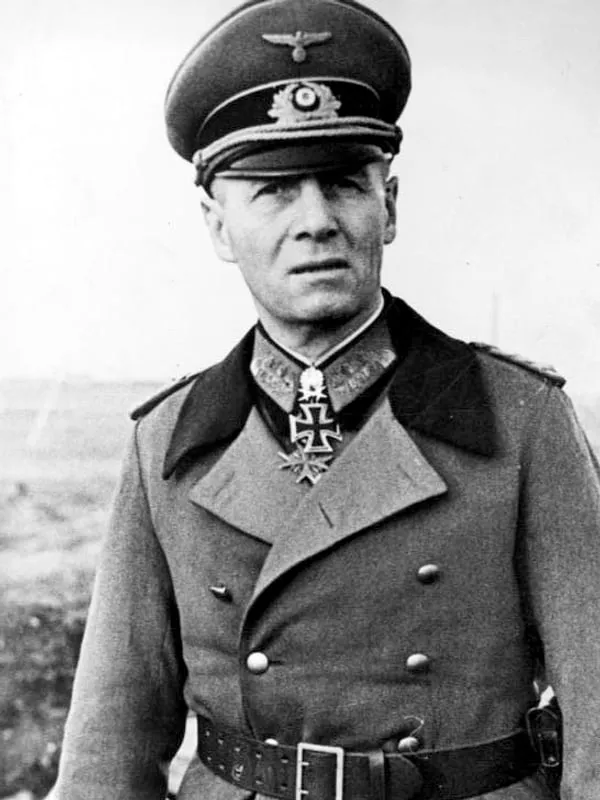
- Born:
- 15 November 1891, Heidenheim an der Brenz (Württemberg, German Empire)
- Died:
- 14 October 1944, Herrlingen near Ulm (Third Reich)
- Author:
- Łukasz
- Photo:
- Winkelmann, CC BY-SA 3.0 DE, Wikimedia Commons

Erwin Rommel was a German general, and from 1942 a field marshal, the most celebrated field commander of the Wehrmacht and one of the best-known soldiers of the Second World War. The son of a Swabian schoolmaster, an outsider to the Prussian military aristocracy, he won the Pour le Mérite in the First World War and in the 1930s the favour of Adolf Hitler, to whom he owed his further advancement. In September 1939 he commanded the protection of Hitler’s headquarters in Poland. In May 1940 his 7th Panzer Division crossed the Meuse at Dinant and, as one of the fastest German divisions, drove across northern France. In North Africa, as the “Desert Fox”, he twice brought the British to the brink of defeat. In 1944 he prepared the coastal defences against the Allied invasion. Implicated in the conspiracy against Hitler, he was forced to commit suicide. After the war he became the hero of a legend of the “chivalrous” general, which historians have been subjecting to criticism for years.
Youth and the First World War
Johannes Erwin Eugen Rommel was born on 15 November 1891 in Heidenheim an der Brenz in the Kingdom of Württemberg. He was the third of the five children of a teacher, later headmaster of a Realschule, also named Erwin, and Helene, née von Luz. In 1910 he joined the 124th Württemberg Infantry Regiment at Weingarten as an officer cadet, and in 1911 he was sent to the war school in Gdańsk (Danzig) (PL). There he met Lucia (Lucie) Maria Mollin, a young woman living in Gdańsk, of Italian and Polish descent, whom he married in November 1916. In January 1912 he was commissioned as a second lieutenant. From a relationship with Walburga Stemmer of Weingarten he had a daughter, Gertrud, born in December 1913, whom the family later presented as his niece. The only son of his marriage, Manfred, was born in December 1928.
In the First World War Rommel fought from August 1914 in Lorraine and the Argonne. He was wounded several times and received the Iron Cross, both classes. In the autumn of 1915 he transferred to the Württemberg Mountain Battalion, with which he fought in the Vosges, in Romania and on the Italian front. At the Battle of Caporetto in October 1917 a small detachment under his command outflanked the Italian positions in the mountains, took the summit of Monte Matajur and captured some 9,000 soldiers and 81 guns. In November, at the capture of Longarone, an entire Italian division surrendered to him. In December 1917 he received Prussia’s highest military decoration, the Pour le Mérite. He spent the last year of the war as a captain on the staff. His experience in Italy – surprise, rapid outflanking, leading his unit from the front line and taking decisions against orders – shaped his style of command for the rest of his career.
Between the wars
Rommel remained in the 100,000-strong Reichswehr. In 1919 and 1920 his company put down revolutionary unrest in southern Germany and the Ruhr, though, as his biographers stress, he tried to avoid bloodshed. For nine years he commanded a company in Stuttgart, and from 1929 to 1933 he taught at the infantry school in Dresden. In 1933, as a lieutenant colonel, he took command of a rifle battalion at Goslar, where in September 1934 he met Hitler for the first time. From 1935 he lectured at the war school in Potsdam. In 1937 he published Infanterie greift an (“Infantry Attacks”), based on his wartime memories. It became a bestseller and brought him to Hitler’s attention.
In 1937 the War Ministry appointed him liaison officer to the Hitler Youth. Rommel wanted the military training of young people placed under the army and came into conflict with Baldur von Schirach, who had him removed. In August 1937 he was promoted to colonel. Several times he commanded Hitler’s escort battalion, among other occasions in October 1938, when the Wehrmacht occupied the Sudetenland after the Munich Agreement. From November 1938 he was commandant of the Theresian Military Academy in Wiener Neustadt. In March 1939 he accompanied Hitler to Prague and to Memel (Klaipėda). He never joined the Nazi Party, but he was captivated by Hitler. In letters to his wife he wrote of Hitler’s “magnetic, perhaps hypnotic power”, and in 1938 he called the Wehrmacht “the sword of the new German world view”.
At Hitler’s side in Poland
In August 1939 Hitler promoted him to Generalmajor, with effect from 1 August, and made him commandant of his headquarters. Rommel was responsible for Hitler’s security during the invasion of Poland. On 2 September he wrote to his wife: “It’s wonderful that we have this man.” He attended Hitler’s briefings every day and accompanied him on his trips to the front, which let him observe the panzer divisions at work at close quarters. Among other places he was with him in Sopot, where in the second half of September Hitler stayed at the Kasino-Hotel. After the surrender of Warsaw he organised the victory parade that Hitler reviewed in the capital on 5 October. He wrote to his wife at the time that the inhabitants of the ruined city had greeted the occupation “with relief” and had been “saved”.
The Polish war also touched his family. According to German biographers, Lucie Rommel’s uncle was Father Edmund Roszczynialski (PL), parish priest and dean in Wejherowo and a Kashubian community leader. The Gestapo arrested him on 30 October 1939, and on 11 or 12 November he was murdered, according to some sources at Piaśnica. At his wife’s request Rommel tried to find out what had happened to him. The authorities put him off for a year, and in the end he had to admit that he had learned nothing.
The 7th Panzer Division in France
After the Polish campaign Rommel lobbied for command of a panzer division, although he had never served in the armoured arm and the army personnel office was offering him a mountain division. With Hitler’s backing, in mid-February 1940 he took over the 7th Panzer Division, equipped mainly with light tanks of Czech design. For three months he trained it intensively. On 13 May he crossed the Meuse at Dinant, personally directing the crossing under fire. On the night of 16–17 May he broke through the extension of the Maginot Line, passed Avesnes and by morning stood before Le Cateau, far ahead of the rest of his own division and in defiance of an order to halt. For several hours corps headquarters did not know where he was. This speed and elusiveness earned the unit the nickname of the “ghost division” (Gespensterdivision). On 18 May he took Cambrai, and when Guderian’s tanks reached the sea on 20 May, the division stood before Arras.
On 21 May a British tank counter-attack at Arras smashed its columns and those of the SS Totenkopf Division. Rommel, directing the defence in person, stopped it with the fire of his artillery and 88 mm anti-aircraft guns. His aide-de-camp was killed beside him. Rommel put the British strength at five divisions, which heightened the anxiety of the German command in the days before the panzers were halted outside Dunkirk. At the end of May he received the Knight’s Cross, and his division took part in encircling the French forces near Lille. In June it crossed the Somme, on 10 June it reached the sea on the Normandy coast, and on 12 June at Saint-Valery-en-Caux it accepted the surrender of the British 51st (Highland) Division and the French IX Corps. On 19 June Rommel accepted the surrender of Cherbourg. By his own reckoning the division, at a cost of more than 2,100 men and 42 tanks, took nearly 100,000 prisoners.
The campaign made him famous, not least thanks to propaganda. Rommel was happy to work with photographers and reporters, and one of his officers was Karl Hanke, one of Joseph Goebbels’s men. His superiors, among them the commander of the Fourth Army, General Günther von Kluge, accused him of claiming credit for the achievements of his neighbours and of the Luftwaffe. The campaign also had a dark side. The historian Raffael Scheck has documented that in June 1940, on the Somme, including in the fighting at Airaines, soldiers of the 7th Panzer Division murdered captured black soldiers of the French colonial forces. There is no evidence that Rommel ordered this, but it happened in his division.
North Africa
After the Italian defeat in Operation Compass, Hitler sent a German expeditionary corps to Libya. On 6 February 1941 Rommel was appointed commander of the Afrika Korps, and on 12 February he flew into Tripoli. He was formally subordinate to the Italians and was supposed to remain on the defensive, but on 24 March, against his instructions, he went over to the attack and in less than three weeks recovered almost the whole of Cyrenaica. He failed, however, to take Tobruk, which was defended by Australians, then by British troops and, from August 1941, by soldiers of the Polish Independent Carpathian Rifle Brigade. The British Operation Crusader in November and December 1941 forced him to retreat.
In January 1942 Rommel attacked again, and on 26 May he opened the Battle of Gazala. On 21 June he took Tobruk, capturing more than 30,000 Commonwealth soldiers, and the next day Hitler made him a field marshal. He was then 50, the youngest field marshal in the German army. His pursuit of the Eighth Army came to a halt in July at El Alamein, less than a hundred kilometres from Alexandria. Rommel was a master of mobile warfare but neglected supply, which had to come from Europe across a sea controlled by the British, and his success at Tobruk contributed to the abandonment of the plan to capture Malta. His offensive at Alam Halfa at the turn of August and September failed. In the Second Battle of El Alamein, which began on 23 October 1942, General Bernard Montgomery’s Eighth Army broke through the front. On 3 November Hitler forbade any retreat; Rommel hesitated for a day before beginning to withdraw against orders.
The retreat across Libya to Tunisia was one of his most skilful achievements, but it also destroyed his trust in Hitler. In February 1943 he defeated the Americans at the Kasserine Pass and took command of Army Group Africa. After a failed attack at Medenine in March 1943 he left for Germany, sick and exhausted. He never returned to Africa, where in May some 250,000 German and Italian soldiers surrendered. War in the desert, without a civilian population and without the SS apparatus behind the lines, earned him a reputation as a chivalrous opponent who treated prisoners in accordance with the laws of war. Historians point out, however, that an SS unit intended to murder Jews was to follow his army into Egypt, and that in Tunisia, outside his area of authority, Jews were subjected to forced labour. There is no evidence that Rommel knew of this.
Italy and Normandy
In the summer of 1943 Rommel took command of Army Group B in northern Italy, which after the Italian surrender in September disarmed the Italian forces there in Operation Achse. An order signed by him and Albert Kesselring, stating that “sentimentality” towards the former allies was out of place, was in the view of some historians, among them Gerhard Schreiber, one of the documents that brutalised the occupation of Italy. Hitler gave the command in the peninsula to Kesselring and in November 1943 sent Rommel to France as inspector of coastal fortifications. From January 1944 Rommel commanded Army Group B, from the Netherlands to the Loire. He had the Atlantic Wall strengthened and millions of mines and beach obstacles laid. He quarrelled with Gerd von Rundstedt and Guderian over the use of the panzer divisions. He believed that, given Allied air supremacy, the invasion had to be repulsed on the beaches themselves, because reserves from the interior would not arrive in time.
On 6 June 1944, the day of the Normandy landings, he was at home in Herrlingen for his wife’s birthday. When he returned he was unable to drive the Allies back into the sea. On 17 June at Margival he warned Hitler that the front would collapse, and on 15 July he wrote to him that the troops were fighting heroically but “the unequal struggle is nearing its end”, adding: “In my opinion, the conclusions must be drawn from this situation.” On 17 July his car was strafed by Allied fighters near Sainte-Foy-de-Montgommery. Rommel was taken to hospital with severe head injuries.
The conspiracy and death
The extent of Rommel’s involvement in the conspiracy against Hitler remains disputed. In the spring of 1944 his chief of staff, General Hans Speidel, General Carl-Heinrich von Stülpnagel and the Lord Mayor of Stuttgart, Karl Strölin, drew him into plans to end the war in the west. Rommel seems to have supported the idea of an armistice with the Western Allies and the removal of Hitler, although at first he opposed killing him and preferred arrest and trial. He took no part in the 20 July plot, as he was then lying in hospital. More recent research, including that of Peter Lieb, indicates that he knew of the conspirators’ plans and supported them. His name came up in the testimony of Stülpnagel and Caesar von Hofacker, and Carl Goerdeler saw him as a candidate for office in the new state.
Hitler did not want to put the most popular general in the Reich before the People’s Court. On 14 October 1944 Generals Wilhelm Burgdorf and Ernst Maisel arrived at Rommel’s house in Herrlingen. They gave him a choice: trial, with reprisals against his family and associates, or suicide, after which his family would receive a pension and he a state funeral. Rommel said goodbye to his wife and son, got into the car and a few minutes later, outside the village, took poison. It was officially announced that he had died of the injuries he had suffered in Normandy. A state funeral was held in Ulm on 18 October. The funeral oration was given by Rundstedt, who did not know how Rommel had died; in a text prepared at the Propaganda Ministry he said that the dead man’s heart “belonged to the Führer”.
The Rommel myth
Rommel became a legend in his own lifetime, thanks to Goebbels’s propaganda but also to the British press and British commanders, who found it easier to explain their defeats by the genius of their opponent. After the war Desmond Young’s biography (1950), the film The Desert Fox (1951) and The Rommel Papers (1953), edited by Basil Liddell Hart, fixed the image of an apolitical, chivalrous soldier and victim of Hitler. That image suited the needs of West Germany, which was building the Bundeswehr and joining NATO. His former associates played a key role in this, above all Speidel, later one of NATO’s most senior commanders. Bundeswehr barracks and a German navy destroyer were named after Rommel. His son Manfred Rommel was Lord Mayor of Stuttgart for 22 years.
Historians today judge him more critically. They do not question his courage, his intuition or his tactical talent, but they point out that as an operational commander he neglected logistics and wider strategy, led from the front even when he should have been controlling an entire army, and was eager for fame. They recall that for most of the war he was a loyal executor of Hitler’s will and did not protest against the crimes of the regime that had raised him up. On the other hand, no war crimes have been proved against him personally, he did not carry out the Commando Order, and he was one of the few field marshals to demand that Hitler bring the lost war to a political end. For the history of the war he is above all a symbol of May 1940: the general who, together with Guderian, showed how panzer divisions led from the front line could in a few days shatter an army regarded as the strongest in Europe.
Sources
Commanded in battles
(12)- 24 March – 15 April 1941Rommel’s first offensiveMediterranean
- 10 April – 27 November 1941Siege of TobrukMediterranean
- 15–17 June 1941Operation BattleaxeMediterranean
- 18 November – 30 December 1941Operation CrusaderMediterranean
- 21 January – 6 February 1942Rommel's second offensive (1942)Mediterranean
- 26 May – 21 June 1942Battle of GazalaMediterranean
- 1–27 July 1942First Battle of El AlameinMediterranean
- 30 August – 5 September 1942Battle of Alam el HalfaMediterranean
- 23 October – 11 November 1942Second Battle of El AlameinMediterranean
- 17 November 1942 – 13 May 1943Tunisian campaignMediterranean
- 14–24 February 1943Battle of the Kasserine PassMediterranean
- 6 June – 30 August 1944Battle of NormandyWestern Front
Mentioned in battles
(12)Often appears with
People who appear in the same events.
On the timeline
(148)The 40 most important of 148 events. All tagged “Erwin Rommel” (56) →