United Kingdom
William Platt
Commander of the Sudan Defence Force and British troops in the Sudan (1938–1941), commander of the northern front in the East African campaign (1941), Commander-in-Chief East Africa (1941–1944), general
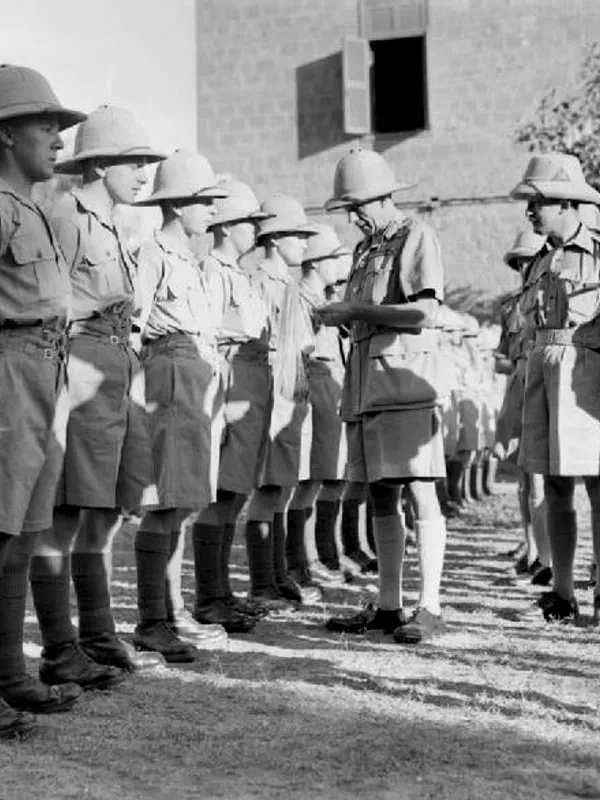
- Born:
- 14 June 1885, Brooklands near Sale, Cheshire (England)
- Died:
- 28 September 1975, London
- Author:
- Łukasz
- Photo:
- No 1 Army Film & Photographic Unit, domena publiczna, Wikimedia Commons

William Platt was the British general who in the winter and spring of 1941 led the offensive from the Sudan into Eritrea, the hardest part of the campaign in which the British Empire destroyed Italian East Africa. For most of his career he was an ordinary staff and regimental officer, without fame and without great commands. In 1938 he took command of the Sudan Defence Force, a small colonial army whose job was to watch the frontier with the Italian empire, and it was this post that made him one of the important commanders of the first years of the war. In the summer of 1940 he defended the Sudan with forces several times weaker than the enemy’s, and in January 1941 he went over to the attack, won at Keren the hardest battle of the whole campaign and pushed on to Amba Alagi, where the Viceroy of Italian East Africa surrendered. After that he commanded British forces in East Africa for several years, from which tens of thousands of African soldiers were recruited for the fronts in Asia.
Youth and early service
He was born on 14 June 1885 at Brooklands near Sale in Cheshire, on the outskirts of Manchester, the son of John Platt and Margaret, née Graham. The family was connected with Manchester’s engineering industry: the firm of Mather & Platt made pumps, textile machinery and fire-fighting equipment. William, however, chose the army. He was educated at Marlborough College and then at the Royal Military College, Sandhurst, and on passing out in August 1905 was commissioned as a second lieutenant in the Northumberland Fusiliers, an infantry regiment. Some accounts give the year as 1908, but according to the British army lists the commission dates from 1905.
He spent his first years of service in India. On the North-West Frontier, fighting the Pashtun tribes, he distinguished himself enough to receive the Distinguished Service Order, a rare award for a junior officer, and was mentioned in dispatches for the first time. He was promoted to lieutenant in 1909 and to captain in November 1914.
The First World War
During the First World War he fought in France and Belgium. He was soon drawn into staff work. In 1915–1916 he was brigade major – in effect chief of staff – of the 103rd Infantry Brigade, made up of volunteer Tyneside Irish battalions of Kitchener’s Army. On the first day of the Battle of the Somme, 1 July 1916, this brigade suffered at La Boisselle some of the heaviest losses in the entire British Army. In 1916–1917 Platt was a staff officer with the 21st Division; in 1917 he moved to the staff of II ANZAC Corps, later converted into the British XXII Corps, and in July 1918, as a temporary lieutenant colonel, he became chief of staff of the 37th Division. He was mentioned in dispatches several more times during the war, six times in all over his career.
Between the wars
After the war he attended the Staff College at Camberley in 1919–1920 and then followed the typical path of a staff officer. He served with brigades in England and in Ireland, where in 1920–1922 he was a brigade major in Galway during the Irish War of Independence. In 1921 he married Mollie Dendy Watney; they had a daughter and two sons. From 1924 to 1926 he was brigade major of the brigade guarding the Suez Canal in Egypt, his first contact with the Middle East. From 1927 to 1930 he worked at the War Office in London, in the Adjutant-General’s department. In 1930, by now a lieutenant colonel, he transferred to the Wiltshire Regiment and until 1933 commanded its 2nd Battalion. He was then chief of staff of the 3rd Infantry Division at Bulford, and in 1934–1938 he commanded the 7th Infantry Brigade. In 1937–1938 he was aide-de-camp to King George VI.
In November 1938, promoted to major general, he took up the post in Khartoum of Commander of the Sudan Defence Force and at the same time General Officer Commanding British troops in the Anglo-Egyptian Sudan. He bore the Arabic title al-kaid al-amm, “commander of the army”, and from then on the whole army knew him simply as “the Kaid”. The Sudan Defence Force was a police-cum-military formation of a few thousand Sudanese soldiers, without artillery or tanks, trained to guard the desert, not to fight the army of a European power. Across the border, meanwhile, lay Italian East Africa, with troops numbered in the hundreds of thousands.
The defence of the Sudan in 1940
When Italy entered the war on 10 June 1940, Platt had about nine thousand troops in the Sudan: three British infantry battalions and about 4,500 men of the Sudan Defence Force in 21 companies, to defend a frontier nearly two thousand kilometres long. He decided not to disperse the British battalions. He kept them at Khartoum, Atbara and Port Sudan and ordered the frontier units to watch, harass and delay the Italians, but not to let themselves be destroyed. On 4 July 1940 the Italians took Kassala and the fort at Gallabat, and later Kurmuk. The Kassala garrison, a few hundred Sudanese soldiers and policemen, withdrew after a few hours of fighting, having inflicted heavier losses on the attackers than it suffered itself. Platt then tried, by moving small detachments about, to give the impression that he had far more troops, and the Italians made no move on Khartoum or Port Sudan.
In the summer the exiled Emperor of Ethiopia, Haile Selassie I, arrived in the Sudan, convinced that his return would spark a rising. Platt received him coolly: he thought the emperor overrated his influence and feared a premature rebellion that could not be supported. He kept a similar distance from Major Orde Wingate, who arrived in Khartoum in November to conduct irregular operations and made no secret of his contempt for the caution of the staffs. At a conference in Khartoum at the end of October 1940, however, attended by Anthony Eden, Jan Smuts, Archibald Wavell and the emperor, a plan was agreed in which the rising in Gojjam became part of the offensive. From September Platt received reinforcements: the 5th Indian Infantry Division and, in December and early January, the 4th Indian Infantry Division as well, which Wavell brought from the Western Desert after the first victory of Operation Compass. In November William Slim’s 10th Indian Brigade retook the fort at Gallabat, but under attack from the Italian air force it had to abandon it.
Eritrea and Keren
By January 1941 Platt, promoted to acting lieutenant general, was commanding a corps-sized force. He planned to strike at Kassala on 8 February, but when British codebreakers read Italian orders to withdraw, Wavell brought the attack forward. The Italians evacuated Kassala on 17 and 18 January, and on 19 January Platt’s troops entered it and set off at once in pursuit into Eritrea. At Keru the askaris, including the cavalry of Lieutenant Amedeo Guillet, delayed the pursuit, but lost their brigade commander and several hundred prisoners. On 31 January the 4th Indian Division, supported by Matilda tanks, defeated the Italians at Agordat, and on 2 February the 5th Division took Barentu. English-language biographies of Platt give 28 January as the date of Agordat’s capture, but the fighting went on until 31 January.
Beyond Agordat the only road and railway to Asmara ran through the Dongolaas gorge below Keren, overlooked by granite peaks held by Italian grenadiers, Alpini and the best Eritrean battalions. The first attacks in February brought only bloody fighting for the heights, from which Italian counter-attacks drove the Indian troops back time and again. Platt then halted operations for several weeks, built up supplies, artillery and air support, and on 15 March threw both Indian divisions into the attack, together with Free French units. On the night of 15–16 March the 5th Division took Fort Dologorodoc above the gorge and held it against repeated counter-attacks, and on 27 March British forces broke through to Keren. The Battle of Keren was the hardest engagement of the campaign. According to the American historian Harold Raugh, the attackers lost 536 killed and more than 3,200 wounded.
After Keren resistance in Eritrea collapsed. On 1 April the 5th Indian Division took Asmara, on 8 April Massawa surrendered and the Red Sea was opened to shipping. Platt then lost the 4th Division, which Wavell sent back to Egypt, but with the remaining forces he advanced south towards the Amba Alagi massif, where the Duke of Aosta, Amedeo d’Aosta, was holding out. From the south came Alan Cunningham’s troops from Kenya. On 19 May 1941 the Viceroy and some five thousand of his men came down from the mountain with the honours of war and went into captivity. The Eritrean campaign brought Platt a knighthood: in May 1941 he was made a Knight Commander of the Order of the Bath, and his rank of lieutenant general was made substantive.
East Africa Command
In 1941 Platt took over the newly created East Africa Command, with its headquarters in Nairobi, and ran it until December 1944. After the surrender of the last Italian garrisons in Ethiopia, at Gondar in November 1941, it was no longer a theatre of major fighting, but it was of great importance as a base. Under Platt’s command seventeen new battalions of the King’s African Rifles were raised, and soldiers from Kenya, Uganda, Tanganyika and Nyasaland were sent to the Burma front, where the 11th (East Africa) Division and other African units fought. Platt also dealt with Madagascar: as early as December 1941 he was instructed by London to cultivate support for the Free French on the island, and when in 1942 the British took it from Vichy France in the Battle of Madagascar, East African units from his command also took part in the fighting. In January 1943 he was made a Knight Grand Cross of the Order of the British Empire and promoted to full general. Emperor Haile Selassie awarded him the Grand Cross of the Order of the Star of Ethiopia, and Egypt the Order of the Nile.
Last years
Platt retired in April 1945. From 1942 to 1954 he was Colonel of the Wiltshire Regiment, the regiment whose battalion he had commanded before the war. After leaving the army he joined the board of the family firm of Mather & Platt and remained a director until 1957. He died in London on 28 September 1975, at the age of ninety.
Significance
Platt was one of those British generals whose fame was overshadowed by the events that immediately followed. The victory at Keren coincided with defeats in Greece, on Crete and in Cyrenaica, and his Eritrean campaign became one of the “forgotten” ones in British memory. Yet it was he who, with only a few thousand Sudanese soldiers at the outset, held the Sudan in the summer of 1940, and in the winter led the offensive that opened the Red Sea and allowed two Indian divisions to be moved to North Africa. He was a methodical and cautious commander, less flamboyant than Cunningham or Wingate, but at Keren, in the most difficult of situations, he knew how to halt an attack, prepare it afresh and carry it through to victory. The East African campaign, which he conducted together with Cunningham under Wavell’s overall command, was Britain’s first great land victory of the war, and Ethiopia was the first country conquered by the Axis powers to regain its independence.
Sources
Commanded in battles
(03)Often appears with
People who appear in the same events.