1944: The liberation of the Philippines
Battle of Manila
- Dates:
- 3 February – 3 March 1945
- Front:
- Pacific
- Location:
- Manila, capital of the Philippines, on the island of Luzon – the northern districts with the University of Santo Tomás and Bilibid Prison, the line of the Pasig river, the districts of Paco, Ermita and Malate in the south, the old walled city of Intramuros and the government buildings by its wallsOn the battle map →
- Sides:
- United States and the PhilippinesDouglas MacArthur, Oscar Griswold, Verne Mudge, Robert Beightler, Joseph SwingJapanSanji Iwabuchi, Tomoyuki Yamashita
- Result:
- Victory for the United States and the Filipino guerrillas. The Japanese Manila Naval Defence Force was almost entirely destroyed and its commander, Rear Admiral Sanji Iwabuchi, committed suicide. According to the US official history, about 1,000 Americans and some 16,000–17,000 Japanese were killed; by the most widely accepted estimates some 100,000 Filipino civilians died, murdered by the Japanese or killed in the fighting. Most of Manila, including historic Intramuros, was destroyed.
- Author:
- Łukasz
Name and dates
The Battle of Manila is the name given to the month of fighting for the capital of the Philippines, from the moment the first American units entered the northern districts of the city on the evening of 3 February 1945 until the capture of the last building held by the Japanese – the Finance Building – on 3 March 1945. It formed part of the Battle of Luzon, which had begun on 9 January with the landing in Lingayen Gulf, and of the wider Philippines campaign of 1944–1945.
The opening and closing dates are only slightly arbitrary. On 3 February American cavalry crossed the city limits and that same evening freed the internees held at the University of Santo Tomás. On 3 March the commander of XIV Corps, General Oscar Griswold, reported that organised resistance in Manila had ceased. Some studies give 4 March as the end, when the city was officially declared cleared, and individual Japanese soldiers were still being rounded up in the ruins for several weeks afterwards.
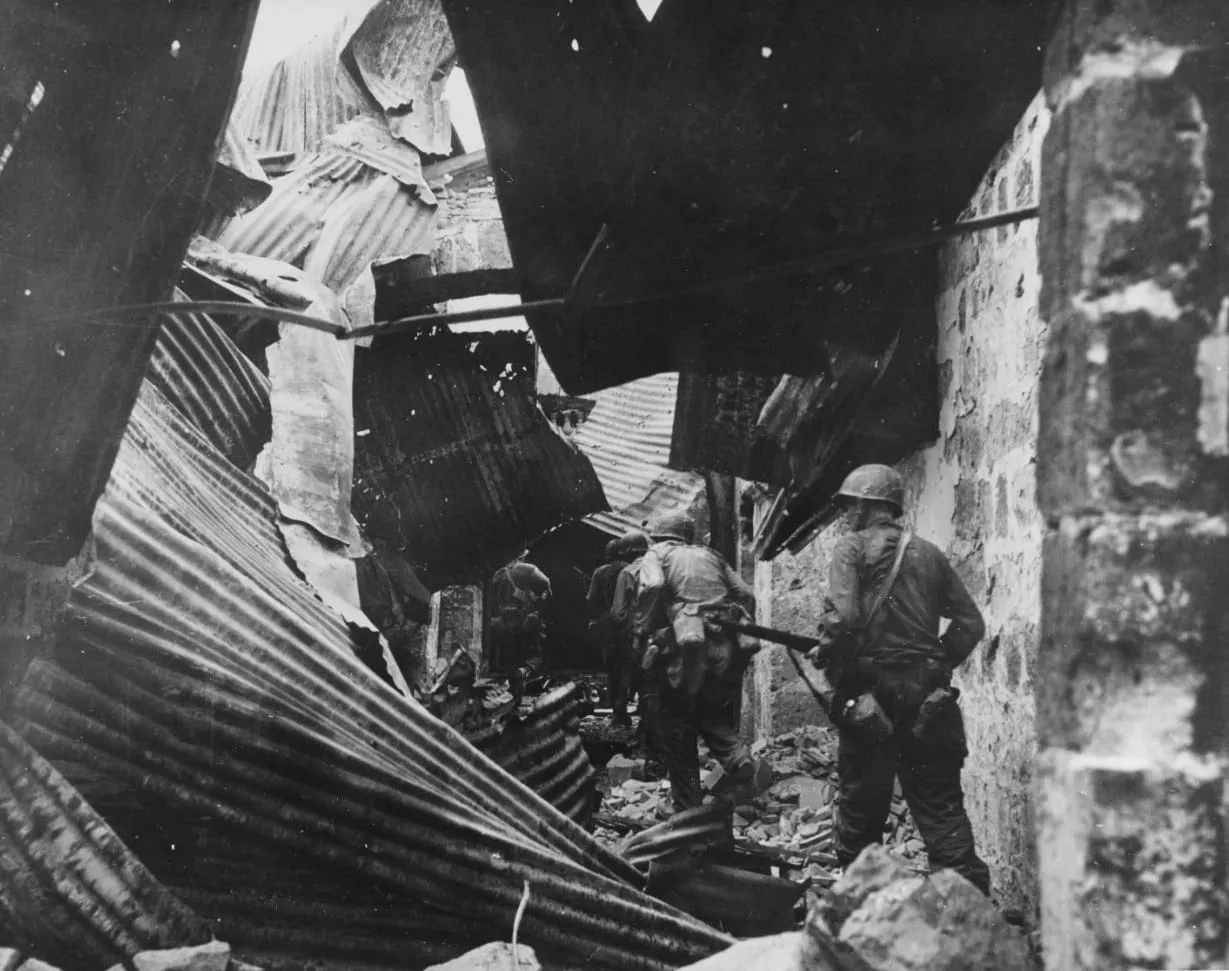
For the Americans this was the only major battle for a large city in the entire Pacific war and the biggest street fight their army waged in the Second World War. For Filipinos it is above all a tragedy: by the most widely accepted estimates some 100,000 civilians died in the ruins of the capital, victims both of crimes committed by Japanese sailors and soldiers and of the artillery fire of both sides. These events, known as the Manila massacre, are inseparable from the battle itself in Filipino memory.
Three divisions fought on the American side: General Verne Mudge’s 1st Cavalry Division and General Robert Beightler’s 37th Infantry Division of XIV Corps, attacking from the north, and General Joseph Swing’s 11th Airborne Division, approaching from the south. They were supported by Filipino guerrillas. On the Japanese side the city was defended by Rear Admiral Sanji Iwabuchi’s Manila Naval Defence Force – contrary to the intentions of the commander-in-chief in the Philippines, General Tomoyuki Yamashita, who had no intention of defending the capital.
Background
The city under occupation
In 1941 Manila was one of the most important cities in South-East Asia: the capital of the Commonwealth of the Philippines, a great port on Manila Bay, and a place where Spanish, American and Asian cultures had been layered upon one another for more than three centuries. At its heart lay Intramuros – the old Spanish city, enclosed by 16th- and 17th-century walls, with its cathedral, the Church of San Agustín, its monasteries and Fort Santiago at the mouth of the Pasig river. South of the river stood the government buildings erected in the American period, including the Legislative Building and the Finance and Agriculture Buildings, and beyond them the residential districts of Ermita, Malate and Paco.
In December 1941 General Douglas MacArthur, as he withdrew his forces to Bataan, declared Manila an open city to spare it from destruction. On 2 January 1942 the Japanese occupied Manila without a fight. For three years of occupation the city lived under the Japanese military administration and the collaborationist Second Philippine Republic, with growing food shortages, the terror of the Kempeitai military police and arrests of people suspected of working with the guerrillas. In the grounds of the University of Santo Tomás in the north of the city, the Japanese set up a camp for several thousand interned civilians from Allied countries, mainly Americans and Britons, and they held prisoners of war in Bilibid Prison. By late 1944 the internees were starving, and many of them died.
After the Battle of Leyte and the landing on Mindoro, General Walter Krueger’s Sixth Army landed on Luzon on 9 January 1945 and advanced south across the central Luzon plain. MacArthur pressed for speed: he wanted to recover the capital as quickly as possible, to free the prisoners and internees before the Japanese could massacre or starve them, and to gain a port for further operations. At the end of January, to speed up the advance and close the road to Bataan to the Japanese, the landings in Zambales and near Nasugbu were carried out; from the second of these beachheads the 11th Airborne Division of General Robert Eichelberger’s Eighth Army advanced on Manila from the south.
Yamashita and Iwabuchi
Yamashita, commander of the 14th Area Army, did not intend to defend Manila. In his view a city of nearly a million inhabitants, built largely of flammable wooden houses, could be neither defended nor fed. He withdrew his main forces into the mountains to the north and east of Luzon, and ordered the commander of the Shimbu Group, General Shizuo Yokoyama, to destroy the bridges and important installations in the city and then pull his units out as soon as substantial American forces arrived. He did not, however, declare Manila an open city as MacArthur had done in 1941 – according to historians, he feared it would weaken his army’s fighting spirit.
The Imperial Japanese Navy had other plans. Rear Admiral Sanji Iwabuchi commanded the 31st Special Base Force and was formally subordinate to the Shimbu Group, but in practice he listened above all to his naval superiors, who wanted to hold on to the port installations and had no intention of giving up the city without a fight. In 1942 Iwabuchi had commanded the battleship Kirishima, sunk in the Naval Battle of Guadalcanal; some historians believe that he regarded the loss of his ship as a stain on his honour that he wished to wipe out by dying in battle. In Manila he gathered some 12,500 sailors – mostly base personnel, crews of sunken ships and poorly trained recruits – together with about 4,500 army troops: in all, according to the US official history, some 16,000–17,000 men, designated the Manila Naval Defence Force.
These forces turned public buildings, schools, churches and hospitals south of the Pasig into strongpoints, mined the streets, put up barricades and prepared the bridges, port and depots for demolition. Iwabuchi told his men they would fight “to the last man”. No one evacuated the inhabitants: hundreds of thousands of civilians remained in a city that was about to become a battlefield.
Course of the battle
The “flying column” and Santo Tomás (3–5 February)
At the end of January MacArthur ordered the 1st Cavalry Division, which had only just landed on Luzon, to reach Manila as quickly as possible. According to accounts, his order ran: “Get to Manila. Free the internees at Santo Tomás.” Mudge formed motorised “flying columns” from the division which, helped by Filipino guerrillas, bypassed Japanese strongpoints and covered more than a hundred kilometres in a couple of days. At the same time the 37th Infantry Division was marching on foot from the north.
On the evening of 3 February the spearhead of Brigadier General William Chase’s 1st Cavalry Brigade – a squadron of the 8th Cavalry Regiment – drove into the northern districts of the city. Guided by Filipino guerrillas, it reached the gate of the University of Santo Tomás; at around 9 p.m. tanks smashed through the fence. Nearly 3,700 emaciated internees regained their freedom. The Japanese guard, however, barricaded itself in one of the buildings with more than two hundred hostages; after negotiations, on 5 February the Americans allowed the Japanese soldiers to leave with their personal weapons in exchange for releasing the hostages. On 4 February the 37th Infantry Division reached Bilibid Prison, abandoned by the Japanese, and freed more than a thousand prisoners and civilians, many of them defenders of Bataan and Corregidor from 1942.
General Griswold, commanding XIV Corps, at first expected the city to fall quickly. On the evening of 4 February the cavalry tried to seize the Quezon Bridge, the only bridge over the Pasig still intact, but were stopped by machine-gun fire, and the Japanese blew up the crossing. As they withdrew to the south bank of the river, Iwabuchi’s units destroyed the remaining bridges, the port, depots and industrial installations; explosions and arson set whole blocks of the northern part of the city ablaze. The fires, spreading through the wooden buildings, burned for several days.
On 6 February MacArthur’s headquarters announced that Manila had fallen, and his staff began planning a ceremonial victory parade. In reality the battle was only just beginning. That same day the Americans secured the north bank of the Pasig, and over the following days they captured the dam and water-treatment plants in the suburbs on which the city’s supply depended.
Across the Pasig and the encirclement (7–12 February)
On 7 February the 148th Infantry Regiment of the 37th Division crossed the Pasig in assault boats under heavy fire and began clearing the districts of Paco and Pandacan. The heaviest fighting was for the power station on Provisor Island, which the Japanese held until 11 February. Every masonry building had to be taken separately, often floor by floor, and the Japanese sailors defended them to the end, seldom surrendering.
Meanwhile the 11th Airborne Division, after the 511th Parachute Infantry Regiment had been dropped on Tagaytay Ridge on 3 February, reached the southern outskirts and ran into the fortified Genko Line with its hundreds of concrete bunkers. By 13 February it had taken Nichols Field, and in the second half of the month it captured Fort McKinley. On 10 February the division was placed under the Sixth Army and Griswold’s XIV Corps, which unified command over the whole battle. The 1st Cavalry Division crossed the Pasig further east and on 12 February reached the shore of Manila Bay. The Japanese forces in the city were encircled.
Iwabuchi had the chance to save at least some of his men. Yokoyama repeatedly ordered him to withdraw, and on the night of 17–18 February, in conjunction with Shimbu Group counter-attacks on the outskirts, tried to enable him to break out of the encirclement. The attempt failed, and several thousand Japanese sailors and soldiers remained in the city, squeezed into an ever smaller area between Ermita, Malate and the walls of Intramuros.
The Manila massacre
As the ring closed and American artillery destroyed one position after another, Japanese sailors and soldiers began to murder, on a mass scale, the civilians who found themselves in the area they controlled. The crimes went on throughout February, until the last days of the fighting, in Intramuros, Ermita, Malate, Paco and other districts south of the Pasig. Victims were shot, bayoneted and put to the sword, burned alive in buildings into which they had been herded; women and girls were raped. Surviving Japanese documents, later presented before the tribunal in Manila, contained orders to kill civilians, who were described in them as potential guerrillas; some historians point out that these orders and the acquiescence of commanders gave the violence a systematic character.
Among the best-documented crimes are the killings in Intramuros, where – according to the few survivors – hundreds, perhaps more than a thousand, men, separated from the women and children, died in the dungeons of Fort Santiago and other buildings. Around 10 February Japanese troops burst into the German Club in Ermita, where several hundred people had taken refuge, and murdered most of them. On 12 February several dozen people were killed at De La Salle College on Taft Avenue, among them more than a dozen Christian Brothers and whole families who had sought shelter there. Crimes were committed in hospitals, including San Juan de Dios Hospital and the headquarters of the Philippine Red Cross, where doctors, nurses and patients were killed, as well as in churches and monasteries. The dead included not only Filipinos but also citizens of neutral countries and even of countries allied with Japan, among them Spaniards and Germans, as well as diplomats. People were also used as human shields.
Neither historians nor eyewitness accounts make it possible to establish what proportion of the victims died at Japanese hands and what proportion from artillery fire. The British historian Max Hastings estimates that of every ten civilians killed in Manila, about six were murdered by the Japanese and about four died under American fire; other researchers give similar or somewhat different proportions. There is no doubt, however, that the mass, deliberate killing of defenceless people was the work of the Japanese side. Japanese commanders, Yamashita among them, later claimed that they had not known of the crimes and had no control over the naval units in the city.
Artillery and ruins
At the start of the battle MacArthur banned aerial bombing of the city and restricted the use of artillery, wishing to spare its people and buildings. As his infantry’s losses mounted in the fight for every concrete and brick building, however, commanders on the ground turned more and more to their guns. From around 9 February the restrictions effectively ceased to apply: howitzers, tank guns and tank destroyers fired on buildings at point-blank range, bringing them down together with the defenders and the civilians sheltering inside. The US official history acknowledges that, in the face of the defenders’ tenacity, it was decided that American soldiers’ lives counted for more than historic buildings, and that the effect of such artillery preparation was no different from the aerial bombing MacArthur had forbidden.
On 17 February the Americans took the Philippine General Hospital and the University of the Philippines campus on Padre Faura Street, freeing several thousand civilians who had been held or were hiding there. Over the following days the police headquarters, St Vincent de Paul Church, the City Hall and the main post office fell, and on 22 February the Manila Hotel, where MacArthur had lived before the war. All that remained in Japanese hands was Intramuros and three government buildings by its walls.
The assault on Intramuros (23–26 February)
Griswold and Beightler were unwilling to send infantry against the walls of the old city without support. From 17 February corps and divisional artillery – from 240 mm howitzers down to lighter guns – shelled Intramuros with indirect and direct fire, from ranges of several kilometres down to only a few hundred metres, blasting breaches in the walls. At 7.30 a.m. on 23 February the final hour-long artillery preparation began, after which the 148th Infantry Regiment burst through the breaches between the Quezon and Parian Gates, while elements of the 129th Infantry crossed the Pasig by boat and attacked from the direction of the Mint.
That same day the Japanese released some 3,000 people they had been holding in San Agustín and other buildings, mostly women and children; most of the men held with them – about a thousand, according to survivors – had already been killed. The fighting among the ruins of churches, monasteries and walls lasted until 25–26 February. Of the old Intramuros, apart from the Church of San Agustín, almost nothing remained: the cathedral, most of the churches and monasteries, archives, libraries and collections built up since Spanish times were destroyed.
Iwabuchi, who had directed the defence from one of the government buildings by the walls of Intramuros, committed suicide – according to the US official history, most probably at dawn on 26 February, together with officers of his staff. Some sources give 25 February; the circumstances of his death are not entirely clear, and his body was never identified with certainty.
The last buildings (26 February – 3 March)
After the fall of Intramuros the Japanese still held out in three massive reinforced-concrete neoclassical buildings: the Legislative Building and the Agriculture and Finance Buildings. The Americans shelled them at point-blank range with guns and tanks and then took them floor by floor, using flamethrowers and demolition charges. The Legislative Building fell on 28 February, the Agriculture Building on 1 March, and the Finance Building, reduced to a ruin by the shelling, on 3 March. That day Griswold reported the end of organised resistance in Manila.
Even before the fighting was over, on 27 February, at Malacañang Palace, which had come through the battle undamaged, MacArthur handed civil authority over the liberated country to the President of the Commonwealth of the Philippines, Sergio Osmeña, and proclaimed the restoration of the Commonwealth government. According to those present, he spoke with emotion of the capital, “cruelly punished though it be”, regaining its rightful place. The ceremony took place in a city where, a few kilometres away, fighting was still going on.
Losses
According to the US Army’s official history by Robert Ross Smith, XIV Corps lost 1,010 killed and 5,565 wounded in the fighting for Manila. Smith puts Japanese losses at some 16,700 killed; according to some estimates, about 3,500 men managed to escape from the city across the Marikina river before the ring closed, and only a handful were taken prisoner. These figures are approximate, since many of the dead were buried in the rubble.
Civilian losses are the hardest to estimate. The most frequently cited figure – accepted by American and Filipino historians – is about 100,000 Filipinos and foreigners killed, although this is a rough estimate and some studies give somewhat lower or higher numbers. It covers victims of deliberate murder, people killed by the artillery and mortar fire of both sides, and those who died in the fires. By way of comparison: over the whole battle several times more civilians died than soldiers of both sides combined.
The material losses were also immense. According to post-war assessments, most of the buildings south of the Pasig were destroyed, along with almost all of Intramuros, the commercial district, the port, government buildings, universities, schools, churches and hospitals. The collections of archives, libraries and museums were lost, including priceless documents from the Spanish period. Most of the ruined buildings were demolished after the war, and the city was largely rebuilt from scratch.
Significance
The Battle of Manila was one of the most destructive urban battles of the Second World War. Following American war correspondents and historians, Manila is often named alongside Warsaw, destroyed after the Warsaw Uprising, as one of the most devastated Allied capitals; many writers call it the most devastated after Warsaw. The comparison is made with the caveat, however, that the causes of the destruction differed: Warsaw was methodically demolished by the Germans after the uprising was crushed, whereas Manila was reduced to rubble in the course of fighting in which the damage was caused both by Japanese arson and demolitions and by American artillery.
Militarily, the capture of Manila did not end the campaign. For several weeks the port was blocked by wrecks and mines, and opening it required the recovery of Bataan and the islands at the mouth of Manila Bay. Yamashita’s main forces were still holding out in the mountains to the east and north of the capital and fought on until Japan’s surrender in August 1945. Even so, recovering the capital allowed the Commonwealth government to be restored to its seat and gave the Americans a base for further operations in the Philippines and towards Japan.
The crimes committed in Manila became the principal charge at General Yamashita’s trial before an American military commission in Manila in the autumn of 1945. Although the defence argued that Yamashita had not ordered the defence of the city, did not control the naval units and had no communication with Manila, the commission held him responsible for failing to prevent the crimes of his subordinates and on 7 December 1945 sentenced him to death. The sentence was carried out on 23 February 1946. The case, upheld by the US Supreme Court with two justices dissenting, became a reference point in debates over command responsibility for war crimes, known as the “Yamashita standard”.
In the Philippines the battle is remembered above all for its civilian victims. In Intramuros stands the Memorare – Manila 1945 monument, dedicated to the innocent victims of the battle, and the February anniversaries are observed as days of remembrance. The debate over whether MacArthur and his commanders could have spared the city, and over the role of American artillery in the deaths of civilians, continues among historians to this day; it does not, however, alter the fact that it was the Japanese decision to defend the city to the last man, and the crimes committed against its inhabitants, that determined the scale of the tragedy.