- Category:
- Military operations
- Front:
- Pacific
- Date:
- 9 January 1945
- Author:
- Łukasz
- Battle:
- Battle of Luzon
- Tags:
- United States, Japan, Philippines, Douglas MacArthur
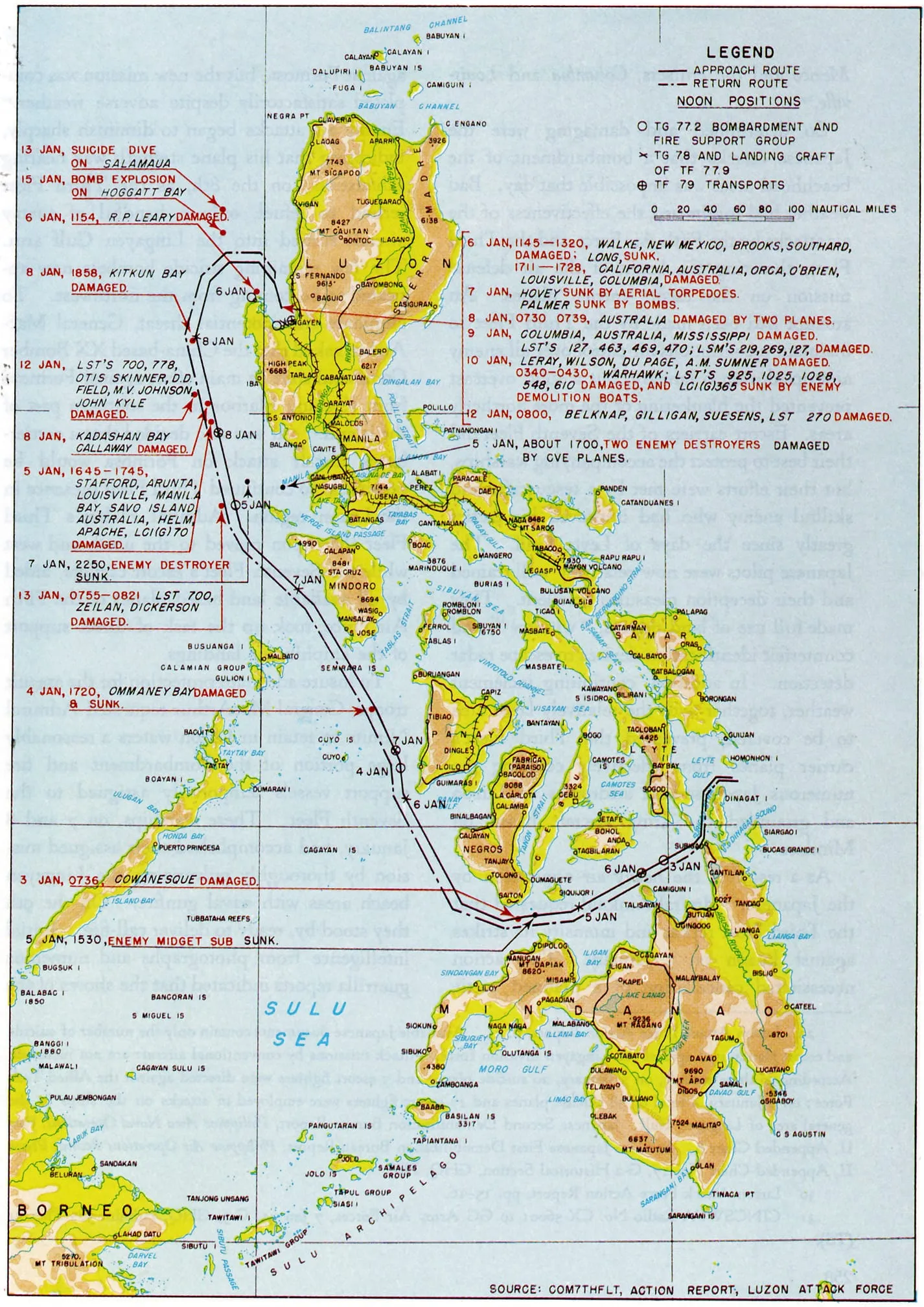
At 9.30 a.m. on 9 January 1945 the first waves of American infantry came ashore on the beaches at the southern end of Lingayen Gulf, on the west coast of Luzon – the largest island of the Philippines. It was S-Day of an operation intended to give the Americans back control of the heart of the archipelago and its capital, Manila. On a stretch of coast some 30 kilometres long, between the towns of Lingayen and San Fabian in Pangasinan province, Lieutenant General Walter Krueger’s Sixth Army put about 68,000 men ashore on the first day. Hardly anyone met them with fire on the beaches – the Japanese commander in the Philippines had decided not to defend the coast. At sea it was a different story: the kamikaze pilots who had been attacking the task forces heading for Luzon for a week again hit several ships that day, among them a battleship and two cruisers.
Lingayen Gulf held symbolic meaning for the Americans. It was here, on 22 December 1941, that the main body of General Masaharu Homma’s Japanese Fourteenth Army had landed, sealing the fate of the Philippines campaign and forcing Douglas MacArthur to pull his troops back to the Bataan peninsula. Contrary to an often repeated simplification, however, the Americans did not land “on the same beaches” in 1945. In December 1941 the Japanese had come ashore on the eastern shore of the gulf, at Agoo, Caba, Santiago and Bauang, several dozen kilometres further north. The Americans chose the broad, flat shore at its base. It was the same gulf and the same logic: from Lingayen ran the shortest route, roughly 160 kilometres long, across the Central Luzon Plain to Manila.
The road to Luzon
Whether the Americans would return to Luzon at all had been settled by a long dispute within the high command. Admiral Ernest King and some of the navy’s planners wanted to bypass the island and strike at Formosa, while MacArthur insisted on liberating the Philippines as a political and moral obligation to the Filipinos. In the summer of 1944 the dispute over the road to Japan was resolved in MacArthur’s favour, and on 3 October 1944 the Joint Chiefs of Staff approved the invasion of Luzon.
The first step was the landing on Leyte on 20 October 1944. The Japanese fleet tried to thwart it and was defeated in the Battle of Leyte Gulf, but the fighting on land dragged on until the end of December and delayed further plans. The invasion of Luzon, originally set for 20 December, was postponed to 9 January. The second step was the landing on Mindoro on 15 December: on that island, south of Luzon, engineers built airfields from which army fighters could cover the convoys sailing north.
MacArthur’s staff tried to persuade the Japanese that the blow would come from the south. Aircraft bombed targets in southern Luzon, minesweepers cleared Batangas and Balayan Bays, and guerrillas carried out sabotage there. The Japanese command was not deceived, however – it had long expected a landing precisely at Lingayen.
The armada and its passage through the kamikazes
The forces committed to the invasion were greater than anything the Philippines had yet seen. The naval operation as a whole was commanded by Vice Admiral Thomas Kinkaid, commander of the Seventh Fleet, whose warships and auxiliaries – together with the transports and landing ships – numbered, according to various tallies, about 800–850 vessels. First to sail was Vice Admiral Jesse B. Oldendorf’s bombardment and fire support group, with old battleships, cruisers, destroyers, minesweepers and escort carriers. Behind it, a few days later, came two attack forces: that of Vice Admiral Theodore Wilkinson, which was to land a corps at Lingayen, and that of Vice Admiral Daniel Barbey, bound for San Fabian. Distant cover was provided by the carriers of Admiral William Halsey’s Third Fleet, which from 3 January struck Formosa and the airfields of Luzon to paralyse Japanese air power.
The convoys took a roundabout route: from Leyte Gulf through the Surigao Strait and the Mindanao Sea, then along the western coasts of Negros, Panay and Mindoro to the entrance of Lingayen Gulf. All the way they were within range of Japanese airfields, and from 2 January they became the target of massed kamikaze attacks. Vice Admiral Takijirō Ōnishi’s Japanese First Air Fleet and the army air force threw into battle the last aircraft they had in the Philippines. On 4 January the escort carrier USS Ommaney Bay was sunk, and on 6 January, when Oldendorf’s ships entered the gulf and began shelling the coast, suicide pilots hit more than a dozen vessels (more than twenty, according to some tallies) – among them the battleships New Mexico and California, the heavy cruiser Louisville and the Australian cruiser HMAS Australia. It was the fleet’s worst day of the campaign, and the minesweepers, which had to work close inshore, were in a particularly exposed position.
For three days, from 6 to 8 January, the ships shelled the shore while frogmen of the underwater demolition teams surveyed the beaches. They made a surprising discovery: there were no obstacles, mines or fortifications. The minesweepers found only a handful of mines in the gulf. Much of the bombardment turned out to be unnecessary – the Japanese had long since withdrawn from the coast. Filipino guerrillas had in fact reported earlier that the beaches were undefended, but the command was unwilling to take risks, and the bombardment went ahead as planned, destroying buildings in the coastal towns in the process.
Yamashita’s plan
The absence of a defence was the result of a deliberate decision. Since October 1944 the army’s forces in the Philippines had been commanded by General Tomoyuki Yamashita, the conqueror of Singapore, at the head of the Fourteenth Area Army. The defeat on Leyte, to which he had sent division after division on the orders of his superiors, had cost him many of his best units, and the air force and navy could no longer give him support. On Luzon he had some 260,000 men, but they were poorly armed and short of ammunition, fuel and transport.
Yamashita concluded that a decisive battle on the plain of central Luzon, within range of American naval guns and aircraft, would mean the rapid destruction of his army. He therefore decided to defend neither the beaches nor the Central Luzon Plain, but to tie the enemy down in the mountains for as long as possible in order to delay the American advance on Japan. He divided his forces into three groups:
- Shōbu – the strongest, about 150,000 men under his personal command, in the mountains of northern Luzon, with headquarters at Baguio and the Cagayan valley as its food base;
- Kembu – about 30,000 men under Lieutenant General Rikichi Tsukada, in the mountains west of the Clark airfields, which it was to hold for as long as possible;
- Shimbu – about 80,000 men under Lieutenant General Shizuo Yokoyama, in the mountains east of Manila, where the dams and water intakes supplying the capital were located.
Yamashita had no intention of defending Manila. He knew that feeding and defending a city of about a million inhabitants, built largely of wood, was impossible, and he ordered the army’s troops to leave it. The navy, however, had plans of its own – and this was to have tragic consequences.
S-Day
On the morning of 9 January, at around 7 a.m., the battleships and cruisers began the final preparatory bombardment, while aircraft from the escort carriers attacked targets behind the beaches. At 9.30 a.m. the first waves of amphibious tractors and landing craft reached the shore. The landing was carried out by two corps. On the right, western flank, between Lingayen and Dagupan, Major General Oscar Griswold’s XIV Corps landed with the 37th and 40th Infantry Divisions. On the left, eastern flank, near San Fabian, Major General Innis P. Swift’s I Corps came ashore with the 6th and 43rd Infantry Divisions.
There was almost no fighting on the beaches. Units of XIV Corps took the town of Lingayen with its airfield, and Dagupan, and by nightfall the beachhead was several kilometres deep in places. Only on I Corps’ left flank, where hills rise above the plain to the east, did the 43rd Division come under fire from Japanese artillery and mortars in the Damortis and Rosario area – a foretaste of the heavy fighting with the Shōbu group that would go on in that direction in the weeks that followed. Losses among the ground troops on the first day were light. MacArthur, who had watched the landing from the deck of the cruiser USS Boise, also came ashore that day. Three years after the defeat of 1941, and after the famous promise “I shall return” made when he left Corregidor, he was back on Luzon.
Over the next few days further units landed in the beachhead – the 25th Infantry Division, the 158th Regimental Combat Team and the 13th Armored Group. By mid-January more than 175,000 men in all had been put ashore, and the beachhead stretched for about 30 kilometres along the coast.
The kamikazes of 9 January
Although all was quiet on land, the air battle over the gulf went on. At around 7.45 a.m. a Japanese Nakajima Ki-44 fighter carrying a bomb crashed into the light cruiser USS Columbia, which had already been badly hit by a suicide plane on 6 January. This second attack destroyed her main battery director and started a fire. According to navy figures 17 sailors were killed, 97 wounded and 6 listed as missing; even so, the ship stayed on station and supported the landing with her guns. At 1.02 p.m. an Aichi D3A (“Val”) dive bomber crashed into the battleship USS Mississippi, killing 23 and wounding 63 of her crew. The battleship went on shelling the shore for another month. A few minutes later, at 1.11 p.m., the fifth and last suicide plane to strike her during the operation hit the Australian cruiser Australia, which soon afterwards left for repairs.
On the night of 9–10 January the Japanese turned to another suicide weapon: from bases hidden along the coast came Shin’yō explosive boats – motorboats carrying a charge of explosives in the bow. They sank or damaged several landing ships and transports at the anchorage before the rest were hunted down and destroyed. Air attacks continued until 13 January but grew weaker. The Japanese air forces on Luzon had used up their last aircraft, and the headquarters of the First Air Fleet moved to Formosa.
The toll was heavy. According to American figures, between 3 and 13 January kamikazes damaged several dozen ships – some studies speak of about 47 – and sank several vessels, and the fleet’s losses ran to several hundred killed. Post-war American analyses found that roughly one attacking suicide plane in three hit a ship or damaged it with a near miss, and the experience of Lingayen became a warning to the US Navy of what awaited it in the operations to come.
The Filipino guerrillas
The Americans were not returning to an island where they had no allies. Throughout three years of occupation numerous guerrilla units had operated on Luzon. The strongest in the north of the island were the forces of Colonel Russell Volckmann, an American officer who had refused to surrender to the Japanese in 1942 and had organised a regular force in the mountains – USAFIP-NL (United States Armed Forces in the Philippines – Northern Luzon), made up of five regiments of Filipino volunteers. From August 1944 he was in direct radio contact with MacArthur’s headquarters. In central Luzon the communist Hukbalahap was active, fighting the Japanese but distrustful of the guerrillas who answered to the Americans.
The guerrillas passed on information about the dispositions of Japanese troops, pointed out targets for aircraft and warned that the beaches at Lingayen were undefended. On the day of the landing and in the weeks that followed they cut Japanese communications, destroyed bridges, raided isolated garrisons and guided American columns. In the course of 1945 Volckmann’s forces grew to well over ten thousand men and played an important part in the fighting against the Shōbu group. In Pangasinan, 9 January is marked today as the province’s Veterans’ Day.
The first days in the beachhead
After the landing a difference of opinion emerged within the American command. MacArthur’s staff intelligence put Japanese strength on Luzon far lower than Sixth Army intelligence, which – more accurately, as it turned out – expected more than 200,000 of the enemy. Krueger was therefore worried about his left, eastern flank, exposed to a blow from the mountains, and wanted to advance cautiously. MacArthur pressed for a rapid drive on Manila: he wanted to free the interned civilians and prisoners of war as quickly as possible and to seize the Clark airfields and the capital’s port.
As a result XIV Corps moved south across the Central Luzon Plain, crossed the Agno River and, meeting almost no resistance, reached the Clark airfields at the end of January, where it began fighting the Kembu group. I Corps, meanwhile, pinned down the Shōbu forces on the eastern flank, where the Japanese 2nd Tank Division was committed. The attack on the American beachhead that Krueger feared never came: Yamashita stuck to his plan of defence in the mountains and had no intention of throwing his forces onto the open plain.
Place in the war
The landing in Lingayen Gulf opened the largest land campaign the Americans fought in the Pacific. At the end of January further forces joined the Sixth Army: on 29 January XI Corps landed on the coast of Zambales, north-west of Bataan, and on 31 January units of Lieutenant General Robert Eichelberger’s Eighth Army came ashore at Nasugbu, south of Manila. On 30 January American Rangers and Filipino guerrillas freed more than five hundred people in the raid on Cabanatuan – mostly American prisoners of war, among them survivors of the Bataan Death March and defenders who had been captured after the surrender of Corregidor.
From 3 February the Battle of Manila raged. Contrary to Yamashita’s intentions, the city was defended by more than ten thousand sailors under Rear Admiral Sanji Iwabuchi. The fighting, which by 3 March had turned the capital into ruins, and the accompanying massacre of the civilian population by the Japanese cost the lives of about a hundred thousand Filipinos, according to the most frequently cited estimates. The Shimbu and Shōbu groups fought on in the mountains throughout the spring and summer. Yamashita, with the remnants of his forces surrounded in the mountains of northern Luzon, surrendered only on 2 September 1945, after Japan’s capitulation.
According to American historiography the fighting on Luzon cost the Americans about 8,000–10,000 killed, and the Japanese – depending on how they are counted – from about 190,000 to more than 200,000 killed and dead, many of them from hunger and disease in the mountains. For MacArthur, 9 January 1945 was the fulfilment of his promise to return; for the Filipinos it was the beginning of liberation, but also of the bloodiest months of the occupation. And the kamikaze attacks in Lingayen Gulf showed that Japan, stripped of its fleet and experienced airmen, was ready to wage war by methods that in the landings to come – on Iwo Jima and Okinawa – would cost both sides even more.
Sources
Meanwhile
(04)Elsewhere, within a week.
- 7 January 1945 · Western FrontOperation Sonnenwende in AlsaceOn 7 January 1945 the Germans struck north from the Colmar Pocket towards Strasbourg. The French lost a battalion at Obenheim but halted the attack on the Ill.
- 12 January 1945 · Eastern FrontThe Vistula–Oder offensive beginsOn 12 January 1945 Konev’s 1st Ukrainian Front struck from the Sandomierz bridgehead, opening an offensive that took the Red Army to the Oder in three weeks.
- 5 January 1945 · Western FrontThe Gambsheim bridgeheadOn 5 January 1945 the German 553rd Volksgrenadier Division crossed the Rhine at Gambsheim, north of Strasbourg, and formed a bridgehead on the left bank.
- 13 January 1945 · Eastern FrontThe East Prussian offensive beginsOn 13 January 1945 the 3rd Belorussian Front attacked East Prussia; next day the 2nd Belorussian Front struck from the Narew. The East Prussian offensive began.
Related events
(04)The same battle, people or subject.
- 31 January 1945 · PacificThe landings at Zambales and NasugbuOn 29 January 1945 XI Corps landed unopposed in Zambales to seal off Bataan; on 31 January the 11th Airborne Division came ashore at Nasugbu, south of Manila.
- 23 February 1945 · PacificThe raid on Los BañosOn 23 February 1945 US paratroopers, amphibious tractors and Filipino guerrillas freed 2,147 internees from the Japanese camp at Los Baños.
- 20 October 1944 · PacificThe landing on LeyteOn 20 October 1944 the US Sixth Army landed on Leyte. General MacArthur waded ashore and told the Filipinos by radio: “I have returned”.
- 15 December 1944 · PacificThe landing on MindoroOn 15 December 1944 the Americans landed unopposed near San Jose on Mindoro. Airfields on the island were to cover the coming invasion of Luzon.