1944: The liberation of the Philippines
Battle of Leyte
- Dates:
- 17 October – 31 December 1944
- Front:
- Pacific
- Location:
- The island of Leyte in the central Philippines (the Visayas) – the islets at the entrance to Leyte Gulf, the beaches between Tacloban and Dulag on the east coast, the Leyte Valley with the airfields at Tacloban, Dulag and Burauen, the mountainous spine of the island's interior, and the Ormoc Valley and the port of Ormoc on the west coastOn the battle map →
- Sides:
- United StatesDouglas MacArthur, Walter Krueger, Robert EichelbergerJapanTomoyuki Yamashita, Sōsaku Suzuki
- Result:
- American victory. On 25 December 1944 MacArthur announced the end of organised resistance, and on 26 December the Eighth Army took over the mopping-up of the island. According to the US official history, the US Army lost more than 3,500 killed and nearly 12,000 wounded on Leyte; Japanese losses are estimated at about 49,000–60,000 killed.
- Author:
- Łukasz
Name and dates
The Battle of Leyte is the name given to the fighting for Leyte, one of the islands of the central Philippines, from 17 October to the end of December 1944. It was the first and decisive operation in the American liberation of the archipelago and one of the largest land campaigns of the Pacific War. On the American side fought the Sixth Army of Lieutenant General Walter Krueger, under General Douglas MacArthur; on the Japanese side, the 35th Army of Lieutenant General Sōsaku Suzuki, part of General Tomoyuki Yamashita’s Fourteenth Area Army.
The battle is taken to have begun on 17 October, when Rangers landed on the islets at the entrance to Leyte Gulf; the main forces went ashore three days later, on 20 October. Its end is harder to pin down. On 25 December, after the capture of Palompon, the last important port on the west coast, MacArthur announced that organised resistance on the island had ceased, and on 26 December command of the troops on Leyte and neighbouring Samar passed from Krueger to Lieutenant General Robert Eichelberger’s Eighth Army. The literature usually places the end of the battle in the last days of December 1944; many studies give 31 December. It should be borne in mind, however, that fighting against scattered Japanese units went on much longer: according to the US official history, the Eighth Army conducted mopping-up operations until 8 May 1945, and the west coast of the island was not fully secured until early January.
The land fighting on the island should not be confused with the naval Battle of Leyte Gulf, fought on 23–26 October around the islands of the central Philippines.
Background
The road to the Philippines
The Philippines fell in the spring of 1942. MacArthur, ordered out of the archipelago by the President, announced on arriving in Australia that he would return, and on 6 May General Jonathan Wainwright surrendered Corregidor. Over the next two years MacArthur’s forces advanced along New Guinea, and those of Admiral Chester Nimitz across the islands of the Central Pacific. After the victory in the Philippine Sea and the capture of the Marianas in the summer of 1944, Washington argued over the next stage of the road to Japan: some admirals wanted to bypass the Philippines and strike at Formosa, while MacArthur demanded the liberation of the archipelago, invoking among other things a moral obligation to the Filipinos.
The Joint Chiefs of Staff instructed him to prepare first a landing on Mindanao and then, on 20 December, on Leyte. In September the plan changed. The carriers of Admiral William Halsey’s Third Fleet met surprisingly weak opposition over the Philippines, so on 13 September Halsey proposed striking at Leyte straight away. MacArthur’s chief of staff gave consent on his behalf, and on 15 September the Joint Chiefs brought the landing forward to 20 October and cancelled the operations against Mindanao and Yap. XXIV Corps, earmarked for Yap, was diverted to Leyte; the landing on Peleliu, already too far advanced, went ahead as planned.
Leyte was a suitable target for several reasons. It lies in the middle of the archipelago, between Luzon and Mindanao, and opens to the east onto a deep gulf capable of holding a great invasion fleet. Along the east coast stretches the flat Leyte Valley, with a road and several airfields built by the Japanese. The Americans intended to establish bases there for General George Kenney’s land-based air forces, which were to cover the next step – the assault on Luzon. The plan took insufficient account of either the weather or the ground: in the rainy season the waterlogged valley proved a very poor place to build airfields.
The Japanese defence
For Japan the Philippines were irreplaceable, because the seas around them carried the routes along which oil flowed to the home islands from Borneo, Sumatra and Malaya. Imperial General Headquarters had prepared for the event of an invasion a “decisive battle” plan codenamed Shō-Gō, whose first variant concerned the Philippines. In the archipelago command lay with Field Marshal Hisaichi Terauchi, head of the Southern Army. The defence of the Philippines themselves was entrusted to the Fourteenth Area Army, whose command Yamashita took over at the beginning of October. He believed that the decisive land battle should be fought on Luzon, where he could concentrate the most troops; the Visayas and Mindanao were to be defended by Suzuki’s 35th Army, headquartered on Cebu.
Leyte was held by Lieutenant General Shirō Makino’s 16th Division, the same division that had landed on Luzon in December 1941 and fought on Bataan. American intelligence estimated the Japanese forces on the island at about 20,000 men. Makino had no intention of defending the beaches under naval gunfire: he deployed his main forces inland, on the hills above the coast and around the airfields. In the days before the invasion the Japanese command was labouring under an illusion. Its air arm, which had lost several hundred machines in clashes with Halsey’s carriers over Formosa, reported sinking many American ships; in reality two cruisers had been damaged. The belief that the American fleet had been weakened weighed heavily on the decisions taken after the landing.
American forces
Two fleets were heading for Leyte Gulf. The landing force was carried by Vice Admiral Thomas Kinkaid’s Seventh Fleet, under MacArthur; it was covered from a distance by Halsey’s Third Fleet, under Nimitz. The literature usually states that more than 700 warships and auxiliary vessels took part in the operation. Krueger’s Sixth Army consisted of two corps: Major General Franklin Sibert’s X Corps (the 1st Cavalry Division and 24th Infantry Division) and Major General John R. Hodge’s XXIV Corps (the 7th and 96th Infantry Divisions). The 32nd and 77th Infantry Divisions were held in reserve, and the 11th Airborne Division joined later. At the peak, in January 1945, there were according to the US official history more than 257,000 US Army personnel on Leyte, including the air forces.
Course of the battle
The Rangers and A-Day (17–20 October)
On 17 October, in stormy weather, minesweepers entered the gulf, followed by ships carrying Lieutenant Colonel Henry Mucci’s 6th Ranger Battalion. The US Army Rangers landed on the islets of Suluan and Dinagat at the entrance to the gulf. On Suluan they scattered a small Japanese detachment and destroyed a radio station; Dinagat proved undefended, and a third islet, Homonhon, was occupied without a fight the next day. The Rangers set up navigation lights on the islets for the transports. A report from Suluan, sent before the station was destroyed, gave the Japanese their first warning of the invasion; on 18 October Admiral Soemu Toyoda, commander of the Combined Fleet, ordered Operation Shō-1 to begin.
On 20 October, the day designated A-Day, after several hours of naval bombardment, four divisions came ashore on the beaches of the east coast at 10 a.m. In the north, between the airfield at Tacloban and the Palo River, X Corps landed – the 1st Cavalry Division, fighting as infantry, and the 24th Infantry Division; about 24 kilometres to the south, around San José and Dulag, XXIV Corps put ashore the 96th and 7th Infantry Divisions. One regiment of the 24th Division seized Panaon Strait at the southern tip of the island. Resistance on the beaches was weaker than expected; the 24th Division’s sector was the hardest, as fire from the hills damaged several landing craft. By evening the Americans had taken the airfields at Tacloban and Dulag and Hill 522, which dominated the beaches. According to the US official history, the Sixth Army’s losses on A-Day were 49 killed, 192 wounded and six missing.
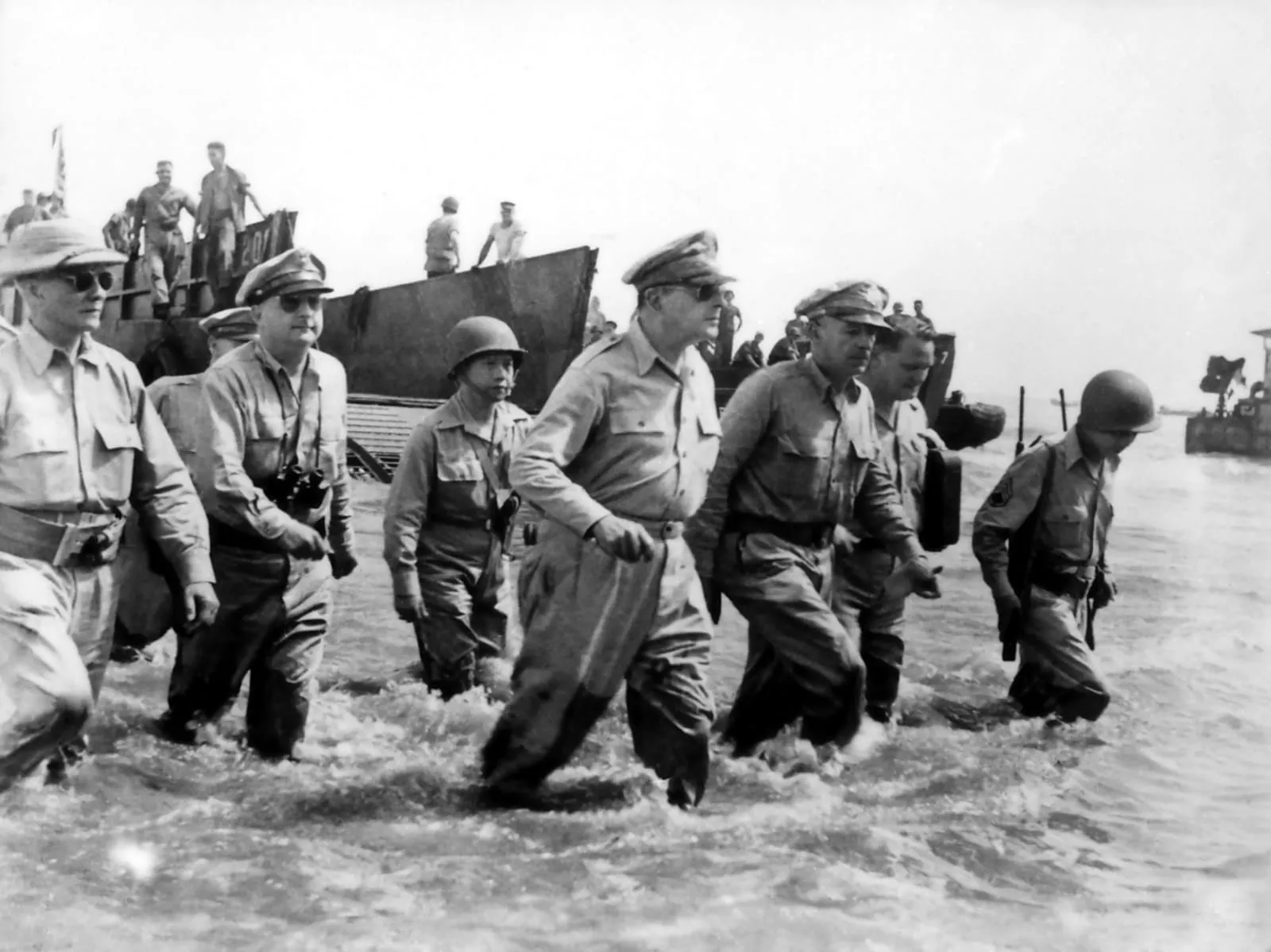
In the afternoon MacArthur waded ashore at Red Beach near the town of Palo, accompanied by the President of the Philippine Commonwealth, Sergio Osmeña. In a radio address that opened with the words “People of the Philippines, I have returned”, MacArthur called on the Filipinos to rise against the occupier. The scene, together with the photograph of the general wading ashore, became the symbol of the campaign.
The Leyte Valley (21 October – 2 November)
In the following days both corps pushed deeper into the Leyte Valley. On 21 October the 1st Cavalry Division took Tacloban, the provincial capital, where crowds of residents poured into the streets; MacArthur’s headquarters and Osmeña’s civil administration were set up there too. The cavalry then secured the shores of the San Juanico Strait, which separates Leyte from Samar, and moved units across to the southern tip of that island. The 24th Division, having broken resistance on the hills above the beaches, reached the road that led through Jaro to the north coast. In the south the 96th Division fought hard to take Catmon Hill, from which the Japanese had been shelling the beaches, while the 7th Division seized the airfields around Burauen and then Dagami. Makino’s 16th Division, broken into several groups, was withdrawing into the mountains of the island’s interior; since the landing it had lost most of its strength.
On 29 October a battalion of the 7th Division took Abuyog on the east coast, and its leading company crossed by a mountain road to Baybay on the Camotes Sea on the west coast. On 2 November the 1st Cavalry Division and the 24th Division entered Carigara, on the bay of the same name on the north coast; the Japanese garrison had abandoned the town during the night. After two weeks of fighting the Americans controlled the whole of the Leyte Valley and the east coast. There remained the port of Ormoc and the valley around it in the west of the island, separated from the east by a range of forested mountains crossed by only two roads: a northern one, from Carigara through Limon, and a southern one, along the coast from Baybay. Meanwhile, on 23–26 October, the Battle of Leyte Gulf was fought at sea, in which the Japanese fleet tried to destroy the invasion force. It was defeated, but during the action off Samar on 25 October Vice Admiral Takeo Kurita’s force threatened the escort carriers covering the landing. Japanese aviation also began to strike at the ships in the gulf with air raids and, from 25 October, with the first organised kamikaze attacks.
Japanese reinforcements through Ormoc
That Leyte was not taken within a few weeks was due to the Japanese command’s decision to fight the decisive land battle precisely there. According to the US official history and Japanese post-war accounts, Yamashita was opposed, but on 22 October Field Marshal Terauchi, in line with the wishes of Imperial General Headquarters, ordered him to reinforce Leyte. The illusion of victory over Formosa and the optimistic reports from the first days of the naval battle meant that the 35th Army staff – as its chief of staff, Major General Yoshiharu Tomochika, recalled after the war – seriously considered forcing the Americans to surrender. The fleet’s defeat in Leyte Gulf did not change these plans.
Reinforcements were shipped to the port of Ormoc on the island’s west coast in a series of convoys that the Japanese called Operation TA. According to the US official history, nine convoys were sent between 23 October and 11 December. First came battalions from neighbouring islands and elements of the 30th and 102nd Divisions; on 1–2 November the elite 1st Division, brought from Luzon and numbering about 11,000 men with its support units, unloaded without loss, and on 9 November about 10,000 men of the 26th Division arrived, though with only a small part of their supplies. After that American aircraft intercepted the transports with increasing success. On 10–11 November American air power – bombers of the Fifth Air Force and aircraft from Halsey’s carriers – destroyed in Ormoc Bay an entire convoy carrying troops of the 26th Division: all the transports and most of the escorting destroyers were sunk. The struggle for these routes, in which American PT boats and destroyers fought alongside the aircraft, is called the Battle of Ormoc Bay; on the night of 2/3 December the Americans lost the destroyer Cooper in it. The last convoys, in December, brought the 68th Independent Mixed Brigade and a regiment of the 8th Division. Japanese historians estimated after the war that in all about 70,000 army troops fought on Leyte.
That the reinforcements got through at all was due to the weakness of American land-based air power. The airfields in the Leyte Valley were unfit for heavy use, and the Fifth Air Force, which on 27 October took over from the carriers the task of covering the Sixth Army, could at first move only small forces to the island. Halsey’s carriers, needed for other tasks, therefore had to stay off the Philippines longer than planned.
Breakneck Ridge and the rains (November)
Suzuki’s intention was simple: the 1st Division was to advance through the Ormoc Valley to Carigara and, together with the remnants of the 102nd Division, destroy the Americans in the north, while the 26th Division was to strike at Jaro. The Americans, however, took Carigara before the Japanese column could get there, and on 3 November American aircraft attacked it on the road in the Ormoc Valley. Krueger, for his part, feared that the Japanese might land in Carigara Bay behind X Corps, and before moving south he ordered the north coast to be fortified. Seventh Fleet officers thought such a landing unlikely. Some historians judge that this caution gave the 1st Division time to occupy positions in the mountains south of the bay.
On 5 November the 24th Division attacked along Highway 2 from Pinamopoan towards Limon. There the road climbed into a tangle of hills that the Americans named Breakneck Ridge, which the Japanese division had turned into a network of trenches and emplacements linked by tunnels and hidden in tall grass. Just after the attack began, on 8 November, a typhoon swept over the island, felling trees, tearing down telephone lines and turning roads into torrents of mud. The 21st Infantry Regiment, which fought there for eleven days, lost 630 killed, wounded and missing according to the US official history. On 16 November it was relieved by Major General William Gill’s fresh 32nd Infantry Division. At the same time a battalion of the 34th Infantry Regiment under Lieutenant Colonel Thomas Clifford outflanked the Japanese positions from the west and for several weeks held Kilay Ridge in the enemy’s rear despite incessant attacks. At the end of November the leading units of the 32nd Division entered Limon, but clearing the mountains between Pinamopoan and the valley went on into December.
The worst enemy of both sides was the weather. By November the rainy season had set in: according to the US official history, nearly 600 millimetres of rain fell on the island in November alone, and around 890 millimetres in forty days in the area of the Dulag airfield. The roads meant to supply the front broke up under the weight of the lorries; engineers had to be taken off airfield construction to keep them open. On the mountain stretches food and ammunition were carried by Filipino porters, and the wounded were carried out on stretchers for hours on end. Soldiers on both sides suffered from tropical diseases and foot ailments caused by constant damp; on the Japanese side, cut off from supplies, hunger soon set in.
The shore of Ormoc Bay and the mountains (November)
XXIV Corps advanced on Ormoc by the southern road. Only when Major General Joseph Swing’s 11th Airborne Division arrived on the island and took over the sector near Burauen could the 7th Division, on 22 November, shift its main forces to the west coast. Its 32nd Infantry Regiment, advancing north along Ormoc Bay, repulsed an attack by units of the 26th Division on the Palanas River, near Damulaan, on 23–25 November. The soldiers called this action the battle of “Shoestring Ridge”, after the meagre supplies on which it was fought – run “on a shoestring”. In late November and early December the 7th Division pushed further north, while paratroopers of the 11th Division, fighting as infantry, forced their way through the mountains from east to west, supplied largely from the air.
The strike at the airfields (26 November – 11 December)
The Japanese, having failed to break the American positions in the mountains, tried to seize the initiative by striking at the airfields. Under a plan that the US official history calls “reckless”, army aviation was first to weaken the American air forces, and then, on the night of 26/27 November, transport aircraft carrying sabotage engineers were to crash-land on the Dulag and Tacloban airfields. The aircraft sent against Tacloban were shot down by anti-aircraft artillery, and those meant to attack Dulag crashed on landing.
The main attack came on 6 December against the three airfields around Burauen: Buri, San Pablo and Bayug. At dawn several hundred exhausted soldiers of the 16th Division attacked from the mountains, and in the evening Japanese transport aircraft appeared over the airfields carrying paratroopers of the 3rd and 4th Raiding Regiments from Luzon. Several hundred of them landed near San Pablo and Buri, destroyed several aircraft and stores of fuel and supplies, and for a few days cut off the headquarters of the Fifth Air Force. Engineers, gunners, air force personnel and units of the 11th Airborne Division and the 38th and 96th Divisions were thrown into the fight. Of the 26th Division, which was to support the attack, little more than a battalion got through the mountains. Within a few days the Japanese groups had been destroyed or driven back into the mountains. According to the US official history, the Japanese delayed the construction of the airfields but had no significant effect on the course of the campaign.
The landing near Ormoc (7–10 December)
Krueger, meanwhile, had decided to end the fighting with a blow from the sea. On 7 December, exactly three years after the attack on Pearl Harbor, Major General Andrew Bruce’s 77th Infantry Division landed near the village of Deposito, a few kilometres south-east of Ormoc, in the rear of the Japanese fighting the 7th Division. The landing, made almost unopposed on the beach, was paid for with losses at sea: Japanese aircraft, some of them attacking in suicide fashion, sank the destroyer Mahan and the fast transport Ward. That same day American aircraft destroyed a convoy that was landing troops of the 68th Independent Mixed Brigade at San Isidro on the west coast.
Suzuki at once broke off the operation against the airfields and ordered all units to defend Ormoc, but the shattered groups straggled back through the mountains in disarray. On 10 December the 77th Division entered the town, which had been reduced to ruins by bombing. General Bruce then reported to Hodge: “Have rolled two sevens into Ormoc. Come seven, come eleven” – a reference to the numbers of the 7th and 77th Divisions and to the 11th Airborne Division approaching through the mountains. The loss of Ormoc cut the 35th Army off from the only major port through which it had been receiving reinforcements. On 11 December the last Japanese convoy, carrying a regiment of the 8th Division, entered the bay; under fire it lost a destroyer and finished unloading at Palompon.
The Ormoc Valley and Palompon (11–31 December)
After the fall of Ormoc the 77th Division moved north through the Ormoc Valley, while the 32nd Division and the 1st Cavalry Division attacked from the opposite direction, from Limon. In the second half of December, by wide outflanking moves, General Bruce’s regiments took the small town of Valencia with its airfield and cut Highway 2, splitting the Japanese forces into scattered groups. On 21 December the 77th Division and the 1st Cavalry Division met south of Kananga; the whole of Highway 2 from Ormoc to the north coast was now in American hands, and the remnants of the 35th Army had been pushed into the mountains in the west of the island.
The Japanese command had already written the battle off. On 15 December the Americans landed on Mindoro, heralding an imminent assault on Luzon. Yamashita cancelled a planned landing in Carigara Bay and on 19 December informed Suzuki that he would send no more reinforcements or supplies and that the 35th Army would have to fend for itself. On 25 December he declared the Leyte campaign lost; the units on the island were to defend designated areas and live off the land.
The last important port through which the Japanese could still evacuate or supply their troops was Palompon on the west coast. On the night of 24/25 December a battalion of the 77th Division, brought from Ormoc in amphibious vehicles and landing craft, came ashore near the town and took it on 25 December. That day MacArthur announced the end of organised resistance and in a message to Krueger wrote that the campaign had “few parallels” in destroying enemy forces while sparing his own. On 26 December Krueger handed Leyte and Samar over to Eichelberger’s Eighth Army, and his Sixth Army began preparing for the landing on Luzon.
The claim that resistance had ended was premature. The Japanese were still holding out in the mountains west of the Ormoc Valley and on the peninsula in the north-west of the island, and Eichelberger, who later made no secret of his irritation with MacArthur’s communiqués, wrote that his troops had killed more than 27,000 Japanese after 26 December. This figure, like other American estimates, is probably inflated. The Americans secured the west coast in early January 1945. Suzuki, who had survived in the mountains with part of his staff, left Leyte by boat on the night of 17/18 March 1945 to continue the fight on other islands of the Visayas; in April he was killed off the coast of Negros when American aircraft attacked the vessel in which he was travelling.
Guerrillas and civilians
The Americans did not come to Leyte blind. A guerrilla movement had been active there since 1942, and in 1943 it was united by Colonel Ruperto Kangleon, a former officer of the Philippine Army whom MacArthur’s headquarters recognised as district commander. His forces, several thousand strong, sent radio reports on Japanese dispositions and airfield construction. After the landing the guerrillas served as guides and scouts, raided Japanese outposts and stragglers, and in time took over policing duties in the rear and the guarding of roads. The US official history also notes, however, that after the landing hundreds of people came forward claiming to be guerrillas without having taken any real part in the resistance, which complicated their recruitment and arming.
For the island’s more than 900,000 inhabitants the battle meant both liberation and destruction. The villages of the Leyte Valley and the shores of Ormoc Bay lay in the line of fire of both sides’ artillery, ships and aircraft; Ormoc and many small towns were left in ruins. Thousands of refugees gathered in camps and in the towns taken by the Americans, where the military administration, together with the Commonwealth authorities, distributed food and organised medical care. Thousands of Filipinos worked as porters and as labourers unloading ships and building roads. Japanese soldiers, cut off from supplies, requisitioned food from the villages, and support for the guerrillas brought reprisals against the population. The number of civilian victims of the battle cannot be stated precisely.
Losses
According to the US official history (M. Hamlin Cannon’s “Leyte: The Return to the Philippines”), US Army battle casualties on Leyte between 20 October 1944 and 8 May 1945 amounted to 15,584 men, including 3,504 killed, 11,991 wounded and 89 missing; the great majority fell in the period of Sixth Army command up to 25 December. These figures do not include naval losses in Leyte Gulf and Ormoc Bay or the casualties of the naval battle. Many soldiers were put out of action by disease and the weather.
Japanese losses cannot be established precisely. The Sixth Army reported that up to 25 December it had killed 56,263 Japanese and taken 389 prisoner, and the Eighth Army that during the mopping-up of the island it had killed or found dead a further 24,294 and taken 439 prisoner. The US official history regards these figures as unreliable. The 35th Army’s chief of staff, Tomochika, estimated after the war that the number of Japanese committed to the fight for Leyte – including sailors, airmen and the troops aboard sunk transports – was about 59,000–62,000, of whom about 13,000 were still alive in March 1945. The literature usually states that between about 49,000 and 60,000 Japanese were killed. According to the same reports, little more than 800 men were taken prisoner.
Significance
The Battle of Leyte sealed the fate of the Philippines. Japan, which chose to fight the decisive battle there against the wishes of the commander responsible for defending the archipelago, lost several of its best divisions on the island, and in the Battle of Leyte Gulf and in the air fighting most of what remained of its fleet and air power. Yamashita had to defend Luzon without them. The Americans paid for this with a longer campaign than they had expected: instead of a few weeks of fighting came more than two months of struggle in the mountains and mud, and the airfields in the Leyte Valley failed to live up to the hopes placed in them, which delayed further plans – the Mindoro landing was postponed from 5 to 15 December, and the Luzon landing from 20 December to 9 January.
Leyte was also the first place where the Japanese used organised kamikaze suicide attacks on a large scale – in Leyte Gulf, in Ormoc Bay and at the subsequent landings in the Philippines and further north they became a permanent feature of the war at sea. Leyte was followed by the whole Philippines campaign: on 9 January 1945 the Sixth Army landed in Lingayen Gulf on Luzon, and in February began the Battle of Manila, in which about 100,000 civilians were killed. In the first half of 1945 Eichelberger’s Eighth Army liberated the remaining islands of the Visayas and Mindanao. For MacArthur Leyte was the fulfilment of his 1942 promise, and for the Filipinos the beginning of the end of the occupation; a memorial commemorating the scene of 20 October stands today at the landing site near Palo.