Philippines
Sergio Osmeña
Speaker of the Philippine Assembly and House of Representatives (1907–1922), Vice-President (1935–1944) and President of the Commonwealth of the Philippines (1944–1946)
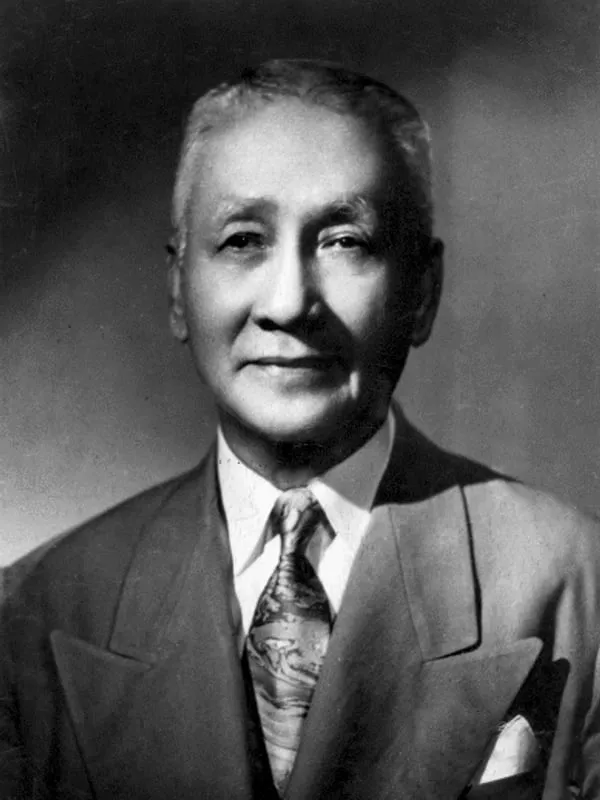
- Born:
- 9 September 1878, Cebu (Philippines)
- Died:
- 19 October 1961, Quezon City (Philippines)
- Author:
- Łukasz
- Photo:
- National Library of the Philippines (distributed by Philippine Presidential Museum and Library), domena publiczna, Wikimedia Commons

For almost half a century Sergio Osmeña was one of the most important politicians in the Philippines, yet he almost always stood in the shadow of others. First, as Speaker of the first elected legislature, he was the highest-ranking Filipino in the American colony; then for twenty years he yielded first place to his partner and rival, Manuel Quezon. He became President of the Commonwealth of the Philippines only in August 1944, in exile in Washington, after Quezon’s death. He returned to the islands alongside General Douglas MacArthur in the landing on Leyte, took over power from him in ruined Manila on 27 February 1945, and a year later lost the election to Manuel Roxas. Cautious, conciliatory and taciturn, he was seen as the opposite of the charismatic Quezon – and as one of the most honest politicians of his generation.
Childhood in Cebu and education
He was born on 9 September 1878 in the city of Cebu, on the island of the same name in the central part of the archipelago, which was then still a Spanish colony. He was born out of wedlock: he took his surname from his mother, Juana Osmeña y Suico, who came from a wealthy family of Chinese-Filipino descent. He himself never spoke publicly about his father. Biographers had long pointed to Antonio Sanson, a rich merchant and landowner in Cebu, also a mestizo of Chinese descent; according to genetic research carried out in the 21st century and cited by them, this supposition has been confirmed.
He was educated at the Colegio de San Carlos in Cebu and then in Manila, at the Colegio de San Juan de Letran. There he met a contemporary from Tayabas, Manuel Quezon – an acquaintance that was to shape his entire political life. He studied law at the University of Santo Tomas in Manila; in 1903 he passed the bar examination with the second-highest mark in the country.
His youth coincided with a time of upheaval. In 1896 the Philippine Revolution broke out against the Spanish, and in 1899, after the United States took over the islands, the Philippine–American War began. According to his biographers, Osmeña served at the time in the forces of Emilio Aguinaldo’s republic as a courier and propagandist. In 1900 he founded a Spanish-language daily in Cebu, El Nuevo Día, which appeared for three years and in which he championed the rights of Filipinos. This was the start of a path taken by his whole generation: from armed resistance to a struggle for independence by political means, within the institutions created by the Americans.
Governor and Speaker of the Assembly
Under the new administration the young lawyer’s career advanced rapidly. In 1904 he became acting governor of the province of Cebu, then provincial fiscal (public prosecutor), and in 1906 he won the election for governor. A year later, in the first elections to the Philippine Assembly – the lower house of the colony’s legislature, elected by Filipinos – he won a seat, and on 16 October 1907, aged 29, he became Speaker of the house. From then on he was the highest-ranking Filipino in the colonial apparatus of government.
That same year he and Quezon created the Nationalist Party (Partido Nacionalista), which, unlike the pro-American Federalist Party, demanded “immediate, absolute and complete” independence. In practice Osmeña pursued a patient policy: time and again the Assembly passed bills abolishing the ban on flying the Philippine flag or the penalties for advocating independence, and the American Philippine Commission, which acted as the upper house, rejected them. Gradually, however, Filipinos took over more and more areas of government. The Jones Act of 1916 replaced the Commission with an elected Senate and promised independence as soon as a “stable government” had been established in the islands. Quezon became President of the Senate, while Osmeña remained Speaker of the House of Representatives.
Quezon’s partner and rival
The duo from Cebu and Tayabas dominated Philippine politics for three decades, but it was not free of tension. Quezon, impetuous and a gifted orator, found the role of number two increasingly hard to bear. In 1922 he accused Osmeña of “one-man” leadership of the party and brought about a split. Osmeña gave up the Speakership and moved to the Senate, where for the next thirteen years he represented the district that included Cebu; there he served as president pro tempore. The two factions did reunite in 1924, but leadership of the independence movement passed to Quezon.
The next clash concerned independence itself. In 1931–1933 Osmeña, together with the Speaker of the House, Manuel Roxas, led a mission to Washington which produced the Hare–Hawes–Cutting Act, passed by Congress in January 1933 over the veto of President Herbert Hoover. It provided for independence after a ten-year transitional period. Quezon – officially because of the provisions on American military bases and immigration restrictions, but in the view of many historians also because the success would have gone to his rivals – had it rejected by the Philippine legislature. He then went to Washington himself and obtained the almost identical Tydings–McDuffie Act of March 1934. The dispute between the “pros” and the “antis” divided the country, and Osmeña’s faction lost the 1934 elections.
Pragmatism nonetheless prevailed. Before the 1935 elections the two politicians reached an agreement: Quezon would run for president of the new Commonwealth of the Philippines and Osmeña for vice-president. On 17 September 1935 they won decisively, and on 15 November they were sworn in. Osmeña also took over the Department of Public Instruction. The Commonwealth was an autonomous transitional period before full independence, planned for 4 July 1946; defence and foreign policy remained in American hands, and that same year MacArthur became Quezon’s military adviser. After a constitutional amendment in 1940 allowed the president to seek a second term, Quezon and Osmeña won the elections again in November 1941. A month later Japan attacked the Philippines.
War and exile
After the Japanese landing in Lingayen Gulf in December 1941 the Commonwealth government moved to the island of Corregidor, where on 30 December, at the entrance to the Malinta Tunnel, Quezon and Osmeña were sworn in for their second term. Two days later the Japanese occupied Manila. Some of the pre-war politicians whom Quezon had instructed to remain in the capital joined the administration set up by the occupiers. Washington considered the president and vice-president too valuable to fall into enemy hands: on 20 February 1942 the submarine Swordfish took them from Corregidor to the south of the archipelago, from where they reached the United States by way of Australia – as did MacArthur, whom Roosevelt recalled from the Philippines. After the surrender of Corregidor in May 1942 the whole archipelago was under occupation, and the Commonwealth government operated in exile in Washington. So ended the Philippines campaign of 1941–1942.
In exile Osmeña once again stood in the second rank. Quezon, gravely ill with tuberculosis, sat on the Pacific War Council and maintained close contacts with President Franklin Delano Roosevelt. In 1943 a dispute arose that revealed the character of both men. Under the constitution Quezon’s term expired on 30 December 1943, and the office should have passed to Osmeña. The vice-president pointed this out, and a legal opinion he requested in Washington agreed with him. Quezon, however, had no intention of stepping down. Roosevelt did not want to settle the dispute. It was Osmeña himself who proposed a way out: he asked the United States Congress to suspend the provisions on succession until the islands were liberated. A joint resolution of Congress of 12 November 1943 thereby extended Quezon’s term. Rather than fight for power at a moment of crisis, Osmeña preferred to preserve the unity of the government-in-exile.
Quezon died on 1 August 1944 at the health resort of Saranac Lake in New York State. That same day in Washington, Justice Robert H. Jackson of the US Supreme Court swore Osmeña in as President of the Commonwealth of the Philippines. He was then almost 66 and the first vice-president to succeed to the office on the death of his predecessor.
Return to the Philippines
Osmeña did not have as close a relationship with MacArthur as his predecessor had, and the general, accustomed to working with Quezon, treated the new president with reserve. But each needed the other. On 20 October 1944, during the landing on Leyte, Osmeña went ashore together with MacArthur, wading through the water off Palo. His presence was meant to show that it was the lawful government returning to the islands, not a foreign administration – in contrast to the Second Philippine Republic of José P. Laurel, proclaimed by the Japanese in 1943. On 23 October in Tacloban MacArthur announced the restoration of the Commonwealth government on liberated territory, and the town became its temporary seat. For the following months, however, the president’s authority remained largely symbolic: the military governed the areas that had been taken.
President of a ruined country
After the landing in Lingayen Gulf in January 1945 the capital became the main objective of the campaign. The Battle of Manila, which began on 3 February, reduced the city to ruins; according to commonly accepted estimates some 100,000 civilians died in it. On 27 February 1945, while fighting was still going on in the southern part of the city, MacArthur handed over civil authority over the liberated Philippines to Osmeña in the surviving Malacañang Palace. The president thanked the United States and proclaimed the restoration of the Commonwealth government in the capital. The Battle of Luzon continued until the end of the war.
Over the following months Osmeña rebuilt the state almost from scratch. On 8 April 1945 he swore in a new cabinet, the Supreme Court and the lower courts were restored, and in June the Commonwealth Congress convened and elected Manuel Roxas President of the Senate. In June 1945 in San Francisco a Philippine delegation led by Carlos Romulo signed the Charter of the United Nations, so that the Philippines – even before independence – became one of the founding members of the UN. The president lobbied Washington for reconstruction aid; in April 1946 the US Congress passed the war damage act and the Bell Trade Act, which in return for tariff preferences gave Americans the same rights as Filipinos to exploit the country’s resources.
The most difficult issue proved to be collaboration. Many pre-war politicians had held posts in the occupation administration and in Laurel’s government. Osmeña, who had sat out the war abroad, was in an awkward position towards those who had stayed. Under pressure from Washington, Congress set up a People’s Court for collaboration cases in September 1945. Meanwhile, as early as April 1945, MacArthur had declared Roxas “liberated” rather than detained, although he had been a minister under Laurel while at the same time maintaining contacts with the guerrillas. In central Luzon the left-wing Hukbalahap guerrillas had no intention of submitting to the old elites.
Defeat and last years
At the beginning of 1946 Roxas, backed by MacArthur, broke with Osmeña and placed himself at the head of the liberal wing of the Nationalist Party, from which the Liberal Party grew. In the election of 23 April 1946 he defeated the incumbent president, winning about 54 per cent of the vote against Osmeña’s 45 per cent or so. According to many accounts Osmeña hardly campaigned at all, believing that the voters knew his record. On 28 May 1946 he handed over the office to Roxas, who on 4 July 1946, when the United States recognised the independence of the Republic of the Philippines, became its first president. Osmeña’s presidency, counting from August 1944, lasted less than two years – the shortest in the country’s history.
Osmeña withdrew from politics and settled in Cebu. He died on 19 October 1961 in the veterans’ hospital in Quezon City, aged 83, and was buried in Manila with state honours. With his first wife, Estefania Chiong Veloso, he had ten children, and with his second, Esperanza Limjap, three. His son Sergio Osmeña Jr. was a senator and in 1969 ran for president against Ferdinand Marcos, and his grandson Sergio Osmeña III also sat in the Senate.
Significance
Osmeña belonged to the generation that travelled from rebellion against the Spanish and war with the Americans to building a state of its own within American institutions. All his life he was a politician of compromise – with the Americans, with Quezon and with circumstances – which some admired as statesmanlike wisdom and others criticised as a lack of resolve. During the war he became a symbol of the continuity of lawful government: his return to Leyte and his assumption of power at Malacañang robbed Laurel’s puppet republic of its significance and opened the way to independence in 1946. He himself was no longer able to lead the country further. In the Philippines he is remembered as the “Grand Old Man of Cebu”; his portrait appears on the 50-peso banknote.
Sources
Mentioned in battles
(03)Often appears with
People who appear in the same events.