- Category:
- Military operations
- Front:
- Pacific
- Date:
- 3 February 1945
- Author:
- Łukasz
- Battle:
- Battle of Manila
- Tags:
- United States, Japan, Philippines, civilians
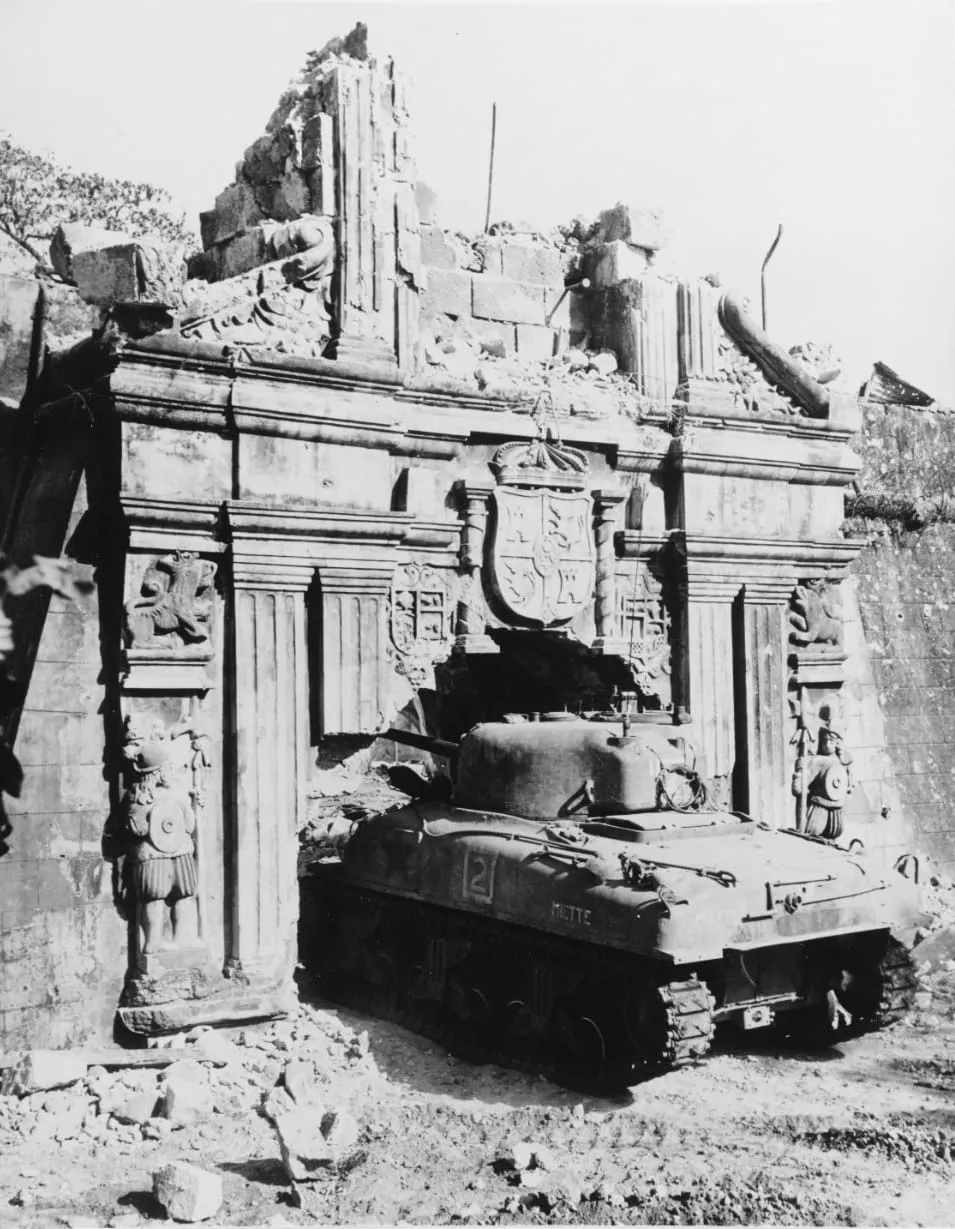
On the evening of 3 February 1945 tanks and lorries of the American 1st Cavalry Division drove into the northern suburbs of Manila. At about 9 p.m. five tanks of the 44th Tank Battalion broke through the fence of the University of Santo Tomás, where since the beginning of 1942 the Japanese had been holding civilians from the Allied nations. So began the Battle of Manila – a month of street fighting in which the capital of the Commonwealth of the Philippines was almost completely destroyed and, according to the most frequently cited estimates, some 100,000 of its inhabitants were killed.
The standard chronicle formula says that United States and Filipino troops entered Manila and that a massacre of civilians took place during the fighting. Both statements are accurate, though they are worth qualifying. The main burden of the fighting was borne by the soldiers of the American Sixth Army; the Filipino side consisted above all of guerrillas, who guided the American columns, reconnoitred Japanese positions and fought alongside the Americans. Nor was the massacre a single event: it was a series of crimes, lasting throughout February, committed by Japanese sailors and soldiers cut off in the city.
The race for Manila
Manila was the goal of the entire Luzon campaign. After the landing in Lingayen Gulf on 9 January 1945, General Walter Krueger’s Sixth Army advanced south across the central Luzon plain more cautiously than General Douglas MacArthur would have liked. The commander-in-chief wanted the capital taken quickly for several reasons: its port and airfields, prestige – MacArthur had left the Philippines in 1942 with a promise to return – and above all the fate of several thousand prisoners of war and interned civilians. The Americans feared that the Japanese would massacre them at the last moment. These fears were not unfounded: on 14 December 1944, on the island of Palawan, Japanese soldiers had burned alive and shot almost all the American prisoners in the camp there (the Palawan massacre).
At the turn of January and February MacArthur gave Major General Verne Mudge’s 1st Cavalry Division, which had come ashore in Lingayen Gulf only on 27 January, a brief order: get to Manila, free the internees at Santo Tomás, and take the Malacañang Palace and the Legislative Building. The division formed so-called flying columns – motorised groups of cavalry infantry, tanks and artillery under Brigadier General William C. Chase – which set out on 1 February from the Guimba and Cabanatuan area. In little more than two days they covered some 160 kilometres, bypassing Japanese strongpoints and relying on Filipino guerrillas for information on the state of roads and bridges. At Novaliches, on the Tullahan river, according to American accounts, a naval bomb-disposal officer managed to cut the burning fuse of a charge laid under the bridge, and the crossing fell into the cavalrymen’s hands intact.
At the same time Major General Robert Beightler’s 37th Infantry Division of General Oscar Griswold’s XIV Corps was advancing from the north along the main highway and railway line; it was delayed by demolished bridges, but on 4 February its leading elements reached the city. From the south came Major General Joseph Swing’s 11th Airborne Division, which had landed at Nasugbu on 31 January and on 3 February dropped its parachute regiment on Tagaytay Ridge. The capital was to be caught in a pincer from three directions.
The city Yamashita did not want to defend
On the Japanese side the question of defending Manila was surprisingly unclear. General Tomoyuki Yamashita, commander of the Fourteenth Area Army in the Philippines, had decided to withdraw his main forces into the mountains of northern and eastern Luzon and fight a long defensive campaign there that would tie the Americans down for as long as possible. He did not intend to defend Manila. He believed that a city of nearly a million people, built largely of wood, could be neither held nor fed. He did not, however, declare it an open city, as the Americans had done in December 1941 before the Japanese entry; the commander of the Shimbu Group, General Shizuo Yokoyama, was to destroy the bridges, depots and port installations and then lead the army units out of the city as soon as larger American forces arrived.
The navy had other intentions. Rear Admiral Sanji Iwabuchi, commander of the 31st Special Base Force, resolved to fight a battle in Manila to the last man. His force, called the Manila Naval Defence Force, numbered according to the American official history some 16,000–17,000 men: about 12,500 sailors – most of them untrained for land fighting, including the crews of sunk ships and base personnel – and several thousand army soldiers who had remained in the city. Formally Iwabuchi was subordinate to the Shimbu Group, but the naval command backed his plan, and Yamashita, hundreds of kilometres away in Baguio, did not enforce his orders. Historians also point to a personal motive on the admiral’s part: in November 1942 he had commanded the battleship Kirishima, sunk in the Naval Battle of Guadalcanal, and the loss of the ship is said to have weighed on him as a stain on his honour.
Iwabuchi’s sailors turned the concrete government and university buildings in the southern part of the city, the walls of the sixteenth-century Spanish Intramuros, churches and hospitals into strongpoints. They blocked the streets with barricades of lorries and wrecks, sited guns taken from ships at the intersections and placed machine guns in the buildings. They made no preparations whatever for a withdrawal.
The night at Santo Tomás
On the evening of 3 February the spearhead of the 8th Cavalry Regiment, guided by two officers of the Filipino guerrillas, Captain Manuel Colayco and Lieutenant Diosdado Guytingco, fought its way through the northern districts to the campus of the University of Santo Tomás. A Japanese soldier threw a grenade under the leading jeep; Colayco died of his wounds a week later. Shortly after 9 p.m. the tanks drove into the camp. There were then 3,785 internees, about 2,870 of them Americans and most of the rest British; over three years of captivity more than 450 people had died there, many of them from starvation in the last months.
The camp guards, several dozen soldiers (47, according to accounts) under Lieutenant Colonel Toshio Hayashi, barricaded themselves in the three-storey Education Building and took some 200 internees hostage. After a night of exchanges of fire and negotiations conducted through one of the internees, the interpreter Ernest Stanley, it was agreed that the Japanese would release the hostages in return for safe passage, with their personal weapons, to their own lines. They were led out under escort, but released in an area already in American hands; according to accounts, several of them, Hayashi among them, were killed shortly afterwards in an exchange of fire.
The liberation of Santo Tomás did not end the danger. Japanese artillery on the south bank of the Pasig went on shelling the campus for days afterwards; on 7 and 10 February shells killed 28 people in the camp, 16 of them internees. On 4 February the 37th Infantry Division took Bilibid prison, abandoned by the Japanese, where it found more than a thousand prisoners of war and interned civilians – among them defenders of Bataan and Corregidor who had survived the Death March and three years in the camps.
The Pasig bridges and the fires
Iwabuchi did not defend the northern part of the city. His units withdrew across the Pasig river, which cuts Manila from west to east, blowing the bridges behind them. Late in the afternoon of 4 February General Griswold ordered the cavalrymen to seize the Quezon Bridge, the only one still intact; halted by machine-gun fire from a barricade on Quezon Boulevard, they pulled back, and during the night the Japanese blew this bridge too. At the same time units withdrawing from the commercial and port districts north of the river – Binondo, San Nicolas, Tondo – were blowing up depots, port installations and buildings. The explosions set the wooden houses alight and for several days a red glow hung over northern Manila; for the first days the soldiers of the 37th Division had to fight fires and evacuate residents instead of fighting the enemy. On 5 February Griswold divided the northern part of the city between the two divisions: the 37th Division was to attack south across the river, and the 1st Cavalry Division to encircle the city from the east. By 6 February the north bank of the Pasig was in American hands.
That same day MacArthur’s headquarters announced that Manila had fallen, and his staff began planning a victory parade. In reality the battle was only beginning. On 7 February regiments of the 37th Division crossed the Pasig in assault boats in the Pandacan district and entered the zone of Japanese fortifications. In the south the 11th Airborne Division, supported by Filipino guerrillas of the Hunters ROTC, was held up before a fortified line on the approaches to Nichols Field. The ring around Iwabuchi’s sailors closed in mid-February.
MacArthur forbade the aerial bombing of the city, explaining that it would kill thousands of civilians, and at first he also restricted artillery fire to observed targets. Faced with the losses suffered in assaults on fortified buildings, however, the commanders of XIV Corps and its divisions soon concluded that they could not take the city without heavy fire. From about 9–10 February howitzers and tank guns destroyed one building after another in which the Japanese were holding out – and in which residents were sheltering. The American official historian Robert Ross Smith later wrote that for XIV Corps the lives of American soldiers were worth more than historic buildings, and observed that for the people trapped in the ruins the effect of artillery fire differed little from that of bombing.
The massacre
Japanese crimes against the people of Manila began on the very first day of the battle – according to Filipino records, on 3 February more than a hundred men, women and children were shot in a timber yard in the Tondo district – and continued to the last days of the fighting. As the ring tightened, the trapped sailors and soldiers increasingly treated every civilian as a guerrilla. According to documents captured by the Americans and later presented in court, some Japanese units received orders to kill the inhabitants while using as little ammunition as possible. People were shot, bayoneted and burned in locked buildings; rape of women and girls was widespread.
Among the most notorious crimes were the killings at the German Club in the Ermita district on 10 February, where several hundred people had taken refuge – among them citizens of Germany, Japan’s ally – and the attackers set fire to the building and murdered those who fled; the massacre at De La Salle College on 12 February, in which 41 people died, including 16 Christian Brothers and the families who had sought shelter with them; and the killings at San Juan de Dios Hospital, at St Paul’s College in the Malate district, in the churches of Intramuros and in Fort Santiago, where, according to survivors, several thousand detained men were put to death. Women and children were at times driven into the line of fire as human shields. Many details are known from the testimony of survivors, collected by American war crimes commissions as early as 1945.
The number of civilian victims is an estimate. The figure most often cited – by American and Filipino historians and on the Memorare monument in Intramuros – is about 100,000 inhabitants killed, although higher estimates also appear. Most of them died at Japanese hands, but some – according to certain estimates as many as about 40 per cent – were killed by American artillery fire and in the fires. It is no longer possible to separate these causes; the dispute concerns the proportions, not the fact that Manila saw one of the greatest war crimes in the Pacific, the Manila massacre.
Place in the war
The battle that began on 3 February lasted a month. On 17 February the Americans took the Philippine General Hospital, freeing several thousand civilians who had sought refuge there; a failed attempt by Iwabuchi’s sailors to break out of the city on the night of 17/18 February, coordinated with a counter-attack by the Shimbu Group, closed their last escape route. On 23 February, after days of artillery preparation, infantry of the 37th Division stormed the walls of Intramuros; the same day paratroopers and guerrillas freed the internees of the camp at Los Baños. Iwabuchi committed suicide at dawn on 26 February. On 27 February, at the Malacañang Palace, MacArthur handed over civil authority to the President of the Commonwealth of the Philippines, Sergio Osmeña. The last Japanese strongpoint, the Finance Building, fell on 3 March.
According to the American official history, the US Army lost 1,010 killed and 5,565 wounded in the fighting for the city, and the Japanese about 16,000 killed; almost none of Iwabuchi’s men survived. Manila – with Intramuros, the Legislative and ministry buildings, and the churches and colleges of the Spanish and American eras – lay in ruins. It is often named alongside Warsaw, destroyed after the Warsaw Uprising, among the most devastated capitals of the Allied nations. It was also the only urban battle on such a scale that the American army fought in the Pacific.
The recapture of the capital was the political and symbolic high point of the campaign MacArthur had begun in the autumn of 1944 with the landing on Leyte, but it did not end the fighting on Luzon: Yamashita’s forces held out in the mountains until Japan’s surrender. The Manila massacre, for its part, became the main count of the indictment at Yamashita’s trial before an American military commission in the autumn of 1945. The general, who had not wanted to defend the city and claimed that he had known nothing of the sailors’ crimes, was held responsible for the acts of subordinates whom he had failed to restrain, and was hanged on 23 February 1946. The verdict, upheld by the United States Supreme Court with two dissenting opinions, remains a subject of legal controversy to this day; from it grew the principle of command responsibility known as the “Yamashita standard”. In the Philippines February 1945 is remembered above all as a tragedy of the people of Manila – both those murdered by Japanese soldiers and those who died in the fighting to liberate the city.
Sources
Meanwhile
(04)Elsewhere, within a week.
- 4 February 1945 · DiplomacyThe Yalta ConferenceOn 4–11 February 1945 at Yalta Roosevelt, Churchill and Stalin agreed on the occupation of Germany, Poland’s borders and government, UN rules and war on Japan.
- 4 February 1945 · Western FrontBelgium free of GermansIn early February 1945 the Americans drove the Germans from the last scraps of eastern Belgium. The country was free, but V-2s were still falling on Antwerp.
- 31 January 1945 · Eastern FrontThe bridgehead on the OderOn 31 January 1945 a forward detachment of the 5th Shock Army crossed the frozen Oder at Kienitz and seized a bridgehead some 70 km from Berlin.
- 30 January 1945 · MediterraneanThe Malta ConferenceOn 30 January 1945 British and American chiefs of staff met on Malta to agree the plan for the attack on Germany before Yalta. Roosevelt joined on 2 February.
Related events
(04)The same battle, people or subject.
- 3 March 1945 · PacificThe end of the Battle of ManilaOn 3 March 1945 the Americans took the Finance Building, the last centre of resistance in Manila. A month of fighting cost the lives of some 100,000 civilians.
- 31 January 1945 · PacificThe landings at Zambales and NasugbuOn 29 January 1945 XI Corps landed unopposed in Zambales to seal off Bataan; on 31 January the 11th Airborne Division came ashore at Nasugbu, south of Manila.
- 23 February 1945 · PacificThe raid on Los BañosOn 23 February 1945 US paratroopers, amphibious tractors and Filipino guerrillas freed 2,147 internees from the Japanese camp at Los Baños.
- 20 October 1944 · PacificThe landing on LeyteOn 20 October 1944 the US Sixth Army landed on Leyte. General MacArthur waded ashore and told the Filipinos by radio: “I have returned”.