1937–1945: The Sino-Japanese War
The Battle of Nanjing
- Dates:
- 1–13 December 1937
- Front:
- Far East
- Location:
- Nanjing, capital of the Republic of China, and its approaches in Jiangsu province – from Jurong, Chunhua and Tangshui to Zijin Hill (Purple Mountain), the Yuhuatai plateau, the city walls and the Xiaguan waterfront on the YangtzeOn the battle map →
- Sides:
- Japan (Central China Area Army – the Shanghai Expeditionary Army and the 10th Army, supported by the navy)Iwane Matsui, Yasuhiko AsakaChina (Nanjing Garrison, National Revolutionary Army)Tang Shengzhi
- Result:
- Japanese victory. On 13 December 1937 the Japanese took Nanjing, and the Chinese garrison disintegrated during the retreat. After capturing the city Japanese troops carried out mass killings of prisoners and civilians.
- Author:
- Natalia
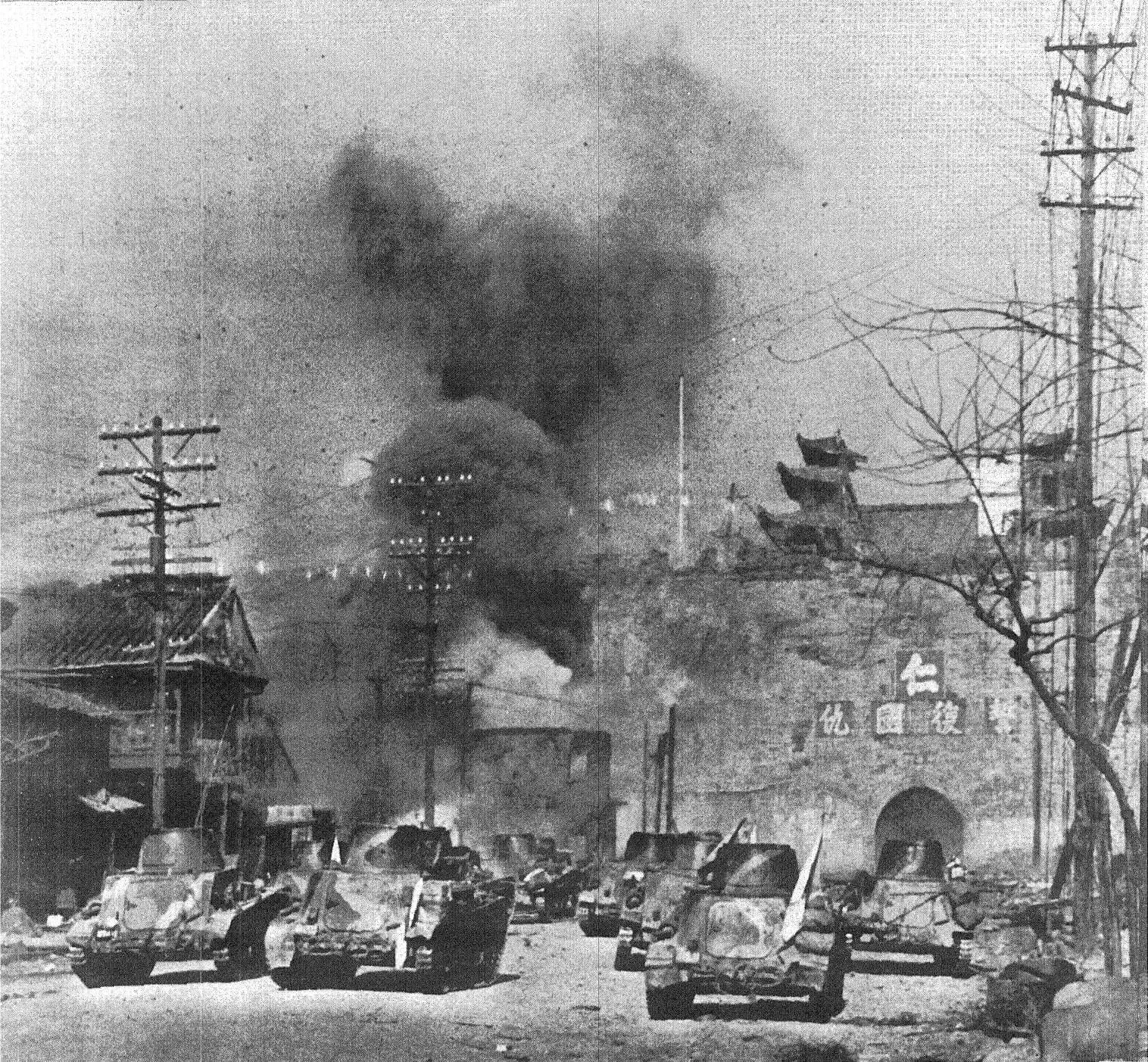
The Battle of Nanjing was the struggle for the capital of the Republic of China, fought in December 1937, five months after the outbreak of full-scale war between China and Japan. General Iwane Matsui’s Central China Area Army, victorious in the Battle of Shanghai, set off in pursuit of the shattered Chinese forces and, less than two weeks after the formal order was given, took the city, which Chiang Kai-shek had decided to defend against the advice of his own generals. The defenders, commanded by General Tang Shengzhi, fought with great tenacity on the approaches and on the walls, but they were exhausted, poorly armed and in large part only recently conscripted. When on 12 December the command ordered a breakout, the garrison fell apart, and thousands of soldiers died on the Yangtze, where there were not enough boats. On 13 December the Japanese entered Nanjing. The military victory was overshadowed by the crimes they committed in the city in the following weeks, and it is these, rather than the course of the fighting, that wrote Nanjing into the history of the twentieth century.
Name and dates
The Chinese call the battle the Defence of Nanjing (Nanjing baowei zhan), the Japanese the Nanjing capture campaign (Nankin kōryaku-sen). Its time limits are a matter of convention. The Japanese began their march on Nanjing on 11 November, when they set off in pursuit of the Chinese retreating from Shanghai, and some historians date the whole campaign from then. The start of the battle proper, however, can be taken as 1 December 1937, when the Japanese Imperial General Headquarters issued the order to capture the Chinese capital, and its end as 13 December, when Japanese troops seized the gates and entered the city. The fighting for the outer defence line lasted from 4–5 to 9 December, and the assault on the walls from 10 to 13 December. Scattered groups of Chinese soldiers kept up resistance on the approaches for several days afterwards, and the Yamada Detachment took the Mufushan forts north of the city on 14 December.
Background
After the Marco Polo Bridge incident of July 1937 Japan quickly took Beijing and Tianjin. In August Chiang Kai-shek shifted the main weight of the war to Shanghai. The battle for that city lasted three months, consumed the best Chinese divisions, trained by German advisers, and was decided only when General Heisuke Yanagawa’s Japanese 10th Army landed in Hangzhou Bay at the beginning of November. The Chinese began a disorderly retreat westwards.
The General Staff in Tokyo wanted to limit the war. On 7 November it combined the Shanghai Expeditionary Army and the 10th Army into the Central China Area Army under Matsui’s command, but forbade it to go beyond the Suzhou–Jiaxing line. The Deputy Chief of Staff, General Hayao Tada, was hoping for peace through the mediation of the German ambassador, Oskar Trautmann. Matsui and Yanagawa, by contrast, wanted to take Nanjing, convinced that the fall of the capital would bring down Chiang’s government. In mid-November the 10th Army set off in pursuit on its own initiative, and Matsui backed it. On 24 November Tokyo lifted the restriction line, and on 1 December Imperial General Headquarters issued the order: “The commander of the Central China Area Army, in cooperation with the navy, shall capture Nanjing, the capital of the enemy state.” The next day command of the Shanghai Expeditionary Army passed to Prince Yasuhiko Asaka, an uncle of Hirohito married to a daughter of Emperor Meiji, while Matsui remained at the head of the Area Army.
On the Chinese side, conferences on the defence of the capital were held in mid-November. He Yingqin, Bai Chongxi, Li Zongren and the German adviser General Alexander von Falkenhausen advised confining the defence to a symbolic one or giving up the city. Nanjing had the broad Yangtze at its back, cutting off the defenders’ line of retreat, while to the east and south it was surrounded by terrain favouring an attacker. Chiang, however, believed that surrendering the capital without a fight would be a disgrace and would weaken China in the eyes of the powers meeting in Brussels to discuss compliance with the Nine-Power Treaty. He was backed by Tang Shengzhi, a former Hunanese warlord who had commanded an army in the Northern Expedition in the 1920s and later turned against Chiang several times. In the second half of November Tang became commander of the capital’s garrison (sources give various dates, from 20 to 26 November). On 20 November the government announced the transfer of the capital to Chongqing, and government offices left, mainly for Wuhan. Both Chiang and Tang subsequently gave their subordinates contradictory instructions: at one moment to defend to the last man, at another to delay the enemy.
Opposing forces
At the beginning of December the Central China Area Army numbered more than 160,000 soldiers, and according to some Japanese tallies about 200,000, of whom some 70,000 took part in the fighting for the city itself. The Shanghai Expeditionary Army attacked from the east with Lieutenant General Kesago Nakajima’s 16th Division, the 9th Division and part of the 13th Division (the Yamada Detachment), as well as elements of the 3rd and 11th Divisions. The 10th Army struck from the south with Lieutenant General Hisao Tani’s 6th Division, the 114th and 18th Divisions, and the Kunisaki Detachment, which was to cross the Yangtze upstream of the city and take Pukou on the opposite bank. A naval flotilla sailed up the river to cut off the Chinese escape route. The Japanese had complete command of the air, plentiful artillery and tanks.
On paper the Nanjing garrison comprised thirteen divisions and more than a dozen regiments. Its core consisted of the German-trained 36th, 87th and 88th Divisions and the elite Training Brigade (Jiaodao Zongdui), alongside the Cantonese 66th and 83rd Corps, the 74th Corps, the 2nd Army sent from Hankou, the military police and the city police. Almost all the units, except the 2nd Army, had come out of Shanghai badly depleted. The German-trained divisions numbered 6,000–7,000 men each, half of them recruits, and had lost much of their officer corps in the earlier fighting. Replacements, including well over ten thousand young men conscripted in Nanjing itself and the surrounding area, were taught to shoot on the way to the front. Historians’ estimates of the total number of defenders vary: from 70,000–80,000 (David Askew, Masahiro Yamamoto, and also Tan Daoping, a garrison staff officer, who gave 81,000), through about 100,000 (Ikuhiko Hata), to some 150,000 including rear services (Tokushi Kasahara, Sun Zhaiwei).
The defence rested on two semicircles of fortifications. The outer one ran a dozen or so kilometres from the city; the inner one, known as the Fukuo line, lay just in front of the walls. The key points were Zijin Hill (Purple Mountain) to the north-east, with the Sun Yat-sen Mausoleum on its slope, and the Yuhuatai plateau to the south, in front of the Zhonghua Gate. Behind them stood the Ming-dynasty walls, more than 30 kilometres long and in places well over ten metres high. At the beginning of December the gates were bricked up and banked with sandbags.
Course
The approaches (1–9 December)
When the order was issued in Tokyo, the Japanese vanguards stood a few dozen kilometres from Nanjing. At Guangde, near Lake Tai, the 18th and 114th Divisions had by 30 November routed the Sichuanese 23rd Army Group, while on the Yangtze the 13th Division took the fortress of Jiangyin, from which the Chinese began to withdraw on 1 December, losing most of two divisions in the chaos. On 2 December the Japanese took Danyang, and on 5 December Jurong. They marched 30–40 kilometres a day, far outstripping their supply trains. They lived off what they took from the population, and plunder went hand in hand with killing, rape and the burning of villages. Captured Chinese soldiers were usually killed. Divisional commanders raced one another to be the first to reach the capital.
On the morning of 7 December Chiang Kai-shek and his wife Soong Mei-ling flew out of Nanjing. The mayor left the same day, and Tang ordered the buildings on the approaches to be burned in a belt up to several kilometres from the walls and along the roads, to deny the attackers cover and quarters. Of the city’s more than a million inhabitants, fewer than half a million remained, mostly the poorest and refugees from the burned villages. A group of foreigners led by the German John Rabe set up the Nanking Safety Zone in the city centre, and on 8 December Tang called on civilians to move into it. On 7 December Matsui issued guidelines for the capture of the city: only selected units were to enter Nanjing, and looting and violations of diplomatic premises and of the safety zone were to be severely punished. The guidelines remained on paper. Matsui was ill at the time, and the divisional commanders had no intention of enforcing them.
The fighting for the outer line lasted from 4–5 to 9 December. At Chunhua the 9th Division spent several days breaking the resistance of the Chinese 51st Division of the 74th Corps, which lost more than 2,000 men before withdrawing on 8 December. In the south the 10th Army attacked the Jiangjun and Niushou hills, defended by the 58th Division, which held out until the evening of 9 December. In the east the 16th Division spent three days pushing back General Xu Yuanquan’s fresh but inexperienced 2nd Army, which lost nearly 4,000 killed, and closed in on Purple Mountain, defended by the Training Brigade. On 8 December the Japanese took the Zhenjiang forts on the Yangtze. By 9 December they stood before the Fukuo line and the city walls.
The assault (9–12 December)
At dawn on 9 December units of the 9th Division reached the Guanghua Gate on the eastern stretch of the walls and were repulsed. That day aircraft dropped Matsui’s call to surrender over Nanjing: the Chinese were to send envoys to the Zhongshan Gate by noon on 10 December. Tang did not reply. He forbade any unauthorised retreat and posted the 36th Division at the Xiaguan waterfront to prevent escape across the river. The larger vessels were sent up the Yangtze to Hankou.
At 1 p.m. on 10 December Matsui ordered a general assault. The 16th Division attacked Purple Mountain, taking the Training Brigade’s positions step by step. Around the Sun Yat-sen Mausoleum and the tomb of the first Ming emperor the Japanese, on Matsui’s instructions, restricted their use of artillery. In the evening sappers blew a breach in the wall by the Guanghua Gate and two companies of the 36th Regiment forced their way onto the gate, but Chinese counter-attacks by the 87th Division and the 83rd Corps cut them off for two days. One of the companies lost 80 of its 88 men. In the south the 6th Division stormed Yuhuatai, densely fortified with bunkers and entanglements and defended by the 88th Division. The Japanese noticed that some Chinese bunkers had been chained shut from the outside so that their crews could not flee. On 11 December some 300 Japanese got onto the walls by the Zhonghua Gate and were driven off. By noon on 12 December Yuhuatai had fallen. The defenders died almost to a man, including three of the four regimental commanders, and the 6th Division, by its own figures, lost more than 2,200 men on the plateau, 566 of them killed.
On 12 December the 16th Division took the second summit of Purple Mountain and from there shelled the Zhongshan Gate, where part of the wall collapsed. In the evening Japanese troops of the 6th and 114th Divisions seized the Zhonghua Gate, and the 10th Army, supported by tanks, pushed through the marshes towards the Shuixi Gate. According to Chinese accounts, some thousand soldiers were shot during the battle for attempting to retreat without orders. On the same day, a few dozen kilometres upriver, Japanese aircraft sank the American gunboat USS Panay, and the artillery of Colonel Kingorō Hashimoto fired on British warships on the Yangtze.
The disintegration of the garrison (12–13 December)
On 11 December Chiang passed on to Tang, through General Gu Zhutong and then by telegram, his consent to a retreat if the positions could not be held. Tang delayed, and on 12 December he was still trying, through Rabe and his colleague Eduard Sperling, to obtain a short truce from the Japanese. When this failed, after 5 p.m. he sent out a plan: under cover of darkness the units were to break through the Japanese ring and reassemble in Anhui province. He himself crossed the Yangtze to Pukou. Many units, including the 87th Division defending the Guanghua Gate, never received the order, because communications had been cut.
Some units escaped the encirclement. The Cantonese 66th and 83rd Corps broke out eastwards through the Taiping Gate, minefields and Japanese outposts. Of some 12,500 soldiers, accounts differ as to whether 3,000–4,000 or more than 7,000 reached the assembly point. Xu Yuanquan’s 2nd Army, which had gathered boats in advance, crossed the river almost 12,000 strong. About 5,000 soldiers of the 74th Corps also managed to cross. Other units were wiped out. On the night of 12–13 December crowds of soldiers and civilians from the southern districts surged towards the river. In the narrow passage of the Yijiang Gate, only half open, hundreds of people were trampled to death, and soldiers of the 36th Division, unaware of the order to retreat, fired into the crowd, taking it for deserters. On the Xiaguan waterfront, ablaze under shellfire, there were not enough boats. Overloaded boats sank, and most of those who threw themselves into the icy water on planks and doors drowned. On 13 December the Japanese flotilla reached Nanjing, and warships and patrols on both banks fired on those trying to cross. Thousands of soldiers who had failed to escape threw away their uniforms and weapons, changed into civilian clothes and sought refuge in the safety zone.
At about 4 a.m. on 13 December the Japanese climbed onto the abandoned Guanghua Gate. By late morning they held all the main gates, and the Kunisaki Detachment had taken Pukou on the other side of the river. Nanjing had fallen.
Losses
According to Japanese figures, excluding the Yamada Detachment, 1,558 Japanese soldiers were killed and 4,619 wounded in the fighting for Nanjing. The historian Benjamin Lai estimates the losses of the whole campaign from Shanghai to Nanjing at about 26,000 killed and wounded.
Chinese losses cannot be established precisely, because the line between those killed in action and those murdered after being taken prisoner is blurred. The Japanese claimed to have killed up to 84,000 Chinese soldiers in the Nanjing campaign. Ikuhiko Hata puts the number killed in combat at about 50,000, Jay Taylor at 70,000, and the Chinese historian Sun Zhaiwei at 6,000–10,000. The New York Times correspondent Tillman Durdin estimated at the time that some 33,000 Chinese soldiers died in the city itself, 20,000 of them killed after the fighting was over. Many wounded were left in the city without care. Tens of thousands more prisoners and men deemed to be soldiers were executed in the following days.
Significance
The capture of Nanjing came to the Japanese faster and more cheaply than they had expected. At home it was celebrated with lantern processions as a sign that the war was ending. Matsui believed that the fall of the capital would force China to capitulate. Nothing of the kind happened. Chiang moved the seat of power into the interior and on 17 December declared that the war would be decided not by the great cities but by the will of the nation and China’s vast hinterland. Japan responded by hardening the peace terms conveyed through Trautmann, and in January 1938 Prime Minister Fumimaro Konoe announced that he would no longer deal with Chiang’s government. The war that Nanjing was supposed to end went on for another eight years.
The verdict on the Chinese command remains harsh. Some historians regard the very decision to defend a city that could not be held, with a river at its back, as one of the greatest strategic mistakes of the war, taken by Chiang for reasons of prestige. Tang was blamed for an order to retreat that came late and was badly transmitted, and for leaving the city before most of his troops had got out. The Japanese historian Tokushi Kasahara believes that an orderly withdrawal was still possible on 11 December. The defenders paid for these decisions with their lives, and many of them, abandoned in the city, died after the fighting had ended.
After capturing Nanjing, Japanese troops spent the following weeks murdering prisoners and civilians, raping women, looting and burning the city. The scale of these crimes is a separate history, but their roots lay in the campaign itself: in orders that permitted looting to feed the army, in the practice of killing prisoners from the first days of the march from Shanghai, and in commanders who would not or could not maintain discipline. The reports sent out by Western journalists and members of the safety zone, together with the sinking of the Panay, changed the image of Japan in the West, especially in the United States.
On the road to world war, Nanjing was a turning point in Asia. The loss of the capital did not break China, and Japan, unable to end the war in victory, began looking for ways to cut Chiang off from outside help. That path led through the capture of Wuhan and Guangzhou (Canton) in 1938, the move into Indochina in 1940 and the American oil embargo, all the way to the attack on Pearl Harbor in December 1941. After the war Matsui was sentenced to death by the Tokyo tribunal, and Hisao Tani by the tribunal in Nanjing. Prince Asaka, protected as a member of the imperial family, never stood trial.