1937–1945: The Sino-Japanese War
The Battle of Shanghai (1937)
- Dates:
- 13 August – 26 November 1937
- Front:
- Far East
- Location:
- Shanghai (the Zhabei, Hongkou, Yangshupu, Jiangwan and Nanshi districts) and its surroundings, the Yangtze shore from Wusong to Liuhe, Luodian and Dachang, Suzhou Creek, the northern shore of Hangzhou Bay (Jinshanwei) and the line of retreat through Kunshan and Suzhou to the Wuxi–Jiangyin lineOn the battle map →
- Sides:
- Japan (Shanghai Expeditionary Army, from November also the 10th Army, naval infantry and the 3rd Fleet)Iwane MatsuiChina (National Revolutionary Army, 3rd War Zone)Chiang Kai-shek, Zhang Zhizhong, Chen Cheng
- Result:
- Japanese victory. After three months of fighting the Chinese army, having lost its best divisions, withdrew from Shanghai and its surroundings, and the Japanese advanced on Nanjing.
- Author:
- Łukasz
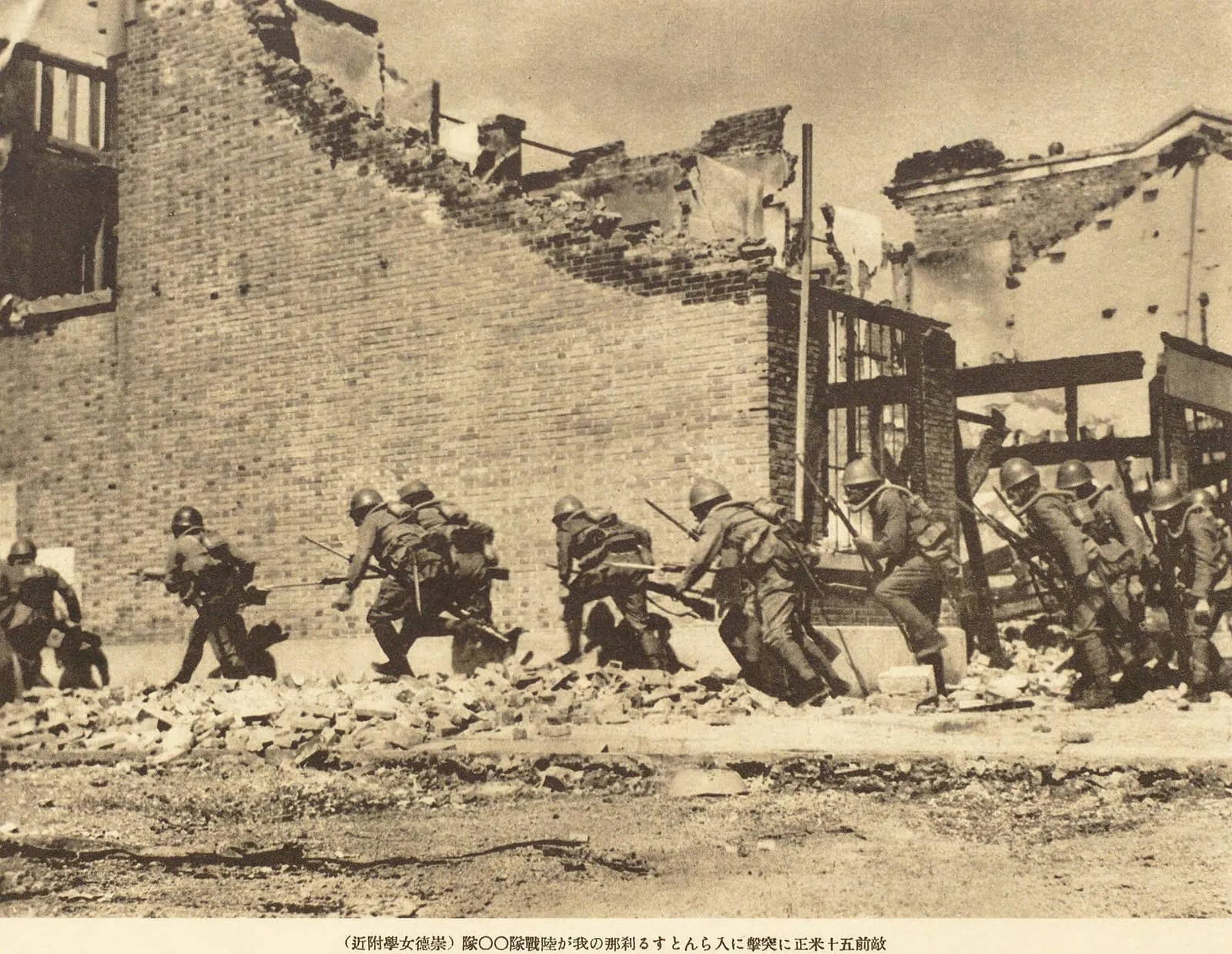
The Battle of Shanghai was the first great battle of the Sino-Japanese War and one of the largest of the whole conflict. It began on 13 August 1937 with clashes between the Chinese army and Japanese naval infantry in the northern districts of Shanghai, China’s largest city, and ended in the second half of November with the retreat of the beaten Chinese forces towards Nanjing. For more than three months some seven hundred thousand Chinese and nearly three hundred thousand Japanese soldiers fought in the ruins of the city, on the beaches of the Yangtze, in the network of canals and villages of the delta and, from November, on the shores of Hangzhou Bay. The Japanese, who had expected to take Shanghai in a few days, suffered their heaviest losses since the war with Russia. China lost about a quarter of a million soldiers, and with them the German-trained elite of its army. The battle was fought in full view of the city’s foreign districts, of correspondents and of newsreel cameras, and historians call it the largest urban battle before Stalingrad.
Name and dates
The Chinese call it the Battle of Songhu (Songhu huizhan, from Wusong – the old name of Suzhou Creek – and Hu, the short name for Shanghai) or the Battle of 13 August. In Japan it is known as the Second Shanghai Incident, to distinguish it from the fighting of 1932. Western literature uses the name Battle of Shanghai, sometimes with the year added to distinguish it from the 1932 fighting.
The beginning is not in doubt: the first clashes took place in Zhabei on 13 August 1937, and on 14 August the Chinese launched a general assault. The end is a matter of convention. The fighting in the city itself ended on 9–12 November: on 9 November the Chinese forces began a general retreat, on 11 November the last units defending the Nanshi district withdrew, and Chinese sources take 12 November as the day Shanghai fell. Some Chinese studies, however, date the end of the battle to 26 November, when the Chinese command ordered the abandonment of the line of fortifications between Wuxi and Jiangyin, the last before Nanjing. Many war chronologies also adopt this date. From mid-November the rearguard fighting merged seamlessly into the march on the capital.
Background
A city within a city. Shanghai was the financial, commercial and industrial heart of China and the fifth-largest city in the world. Alongside the Chinese municipality it contained the International Settlement and the French Concession, where troops of the powers were stationed. The Japanese, the largest group of foreigners, were concentrated in Hongkou, which the Settlement’s defence plan assigned to the Japanese naval infantry. The truce of May 1932 forbade the Chinese to keep troops in a zone around the city, while allowing Japan to maintain a garrison there. The naval infantry built a network of concrete fortifications in Hongkou and Yangshupu, and its headquarters was housed in a reinforced-concrete building on North Sichuan Road.
Chinese preparations. From 1932 the government of Chiang Kai-shek had been preparing for the next war with Japan. German military advisers – from 1933 Hans von Seeckt and from 1935 General Alexander von Falkenhausen – trained several divisions on the German model. Germany sold arms to China in exchange for tungsten and other raw materials. The Chinese 36th, 87th and 88th Divisions, equipped with German rifles and helmets, were the best units in the army. Two lines of bunkers were built between Shanghai and Nanjing: one between Suzhou and Fushan and one between Wuxi and Jiangyin. General Zhang Zhizhong, commander of the defence of the Nanjing–Shanghai area, drew up plans to destroy the Japanese garrison in the city.
From the Marco Polo Bridge to Shanghai. After the clash at the Marco Polo Bridge on the night of 7–8 July 1937 the war spread across northern China, and at the end of July the Japanese took Beijing and Tianjin. Chiang Kai-shek, whom the Xi’an incident had deprived of the option of avoiding war any longer, decided to resist. He chose Shanghai as the site of the main battle for several reasons. He wanted to shift the weight of the war from the plains of the north, where Japanese motorised columns could advance quickly southwards along the railways, to the canal-crossed delta of the Yangtze. He hoped that in a city where the powers had enormous interests the war would force them to intervene, or at least to mediate. He also needed time to evacuate factories into the interior. Historians still argue over whether he provoked the battle himself or accepted it once the Japanese began reinforcing their garrison.
On 9 August, near Hongqiao airfield, Sub-Lieutenant Isao Ōyama of the Japanese navy and his driver were shot dead by Chinese sentries. The circumstances remain disputed to this day. Japan demanded the withdrawal of Chinese troops and fortifications from around the city and sent warships and naval infantry reinforcements to Shanghai. On 11 August Chiang moved the 87th and 88th Divisions into the city.
Forces. At the start of the battle the Japanese garrison numbered a few thousand naval infantrymen – according to Japanese sources at most about five thousand – supported by several dozen warships of Vice Admiral Kiyoshi Hasegawa’s 3rd Fleet. On 15 August Tokyo formed the Shanghai Expeditionary Army (the 3rd and 11th Divisions) under General Iwane Matsui. In September the 9th, 13th and 101st Divisions, heavy artillery and tanks followed, and in November General Heisuke Yanagawa’s 10th Army (the 6th, 18th and 114th Divisions) and the 16th Division. In all some 250,000–300,000 Japanese took part in the battle, with overwhelming superiority in artillery, aircraft and tanks and with the support of naval gunfire. The Chinese gradually committed more than 70 divisions, some 700,000 soldiers in all. Apart from the central divisions, these were mostly poorly armed provincial troops from Guangdong, Hunan, Sichuan, Guangxi and other provinces, often without artillery. The Chinese air force had several hundred aircraft of various types; the navy counted for practically nothing.
Course
First phase: the assault on the Japanese districts (13–22 August)
On the morning of 13 August shots were exchanged between Japanese naval infantry and the Chinese Peace Preservation Corps in Zhabei, and in the afternoon fighting broke out at the Bazi Bridge. Each side blamed the other for starting it. In the evening Japanese warships shelled the Chinese districts. On 14 August the Chinese government issued a declaration of self-defence, Chinese aircraft attacked the warships, and the 87th and 88th Divisions went over to the assault. That day Chinese bombs which missed the cruiser Izumo, flagship of the 3rd Fleet, fell on Nanjing Road in the International Settlement and in front of the Great World amusement centre on the edge of the French Concession, killing anything from several hundred to more than a thousand civilians. The day went down in history as Black Saturday. It is sometimes also called Bloody Saturday, although that name more often refers to the Japanese air raid on the South Station on 28 August, captured in the famous photograph of a crying child. On 15 August the government of Fumimaro Konoe declared that Japan had to “chastise” the Chinese army, and Japanese aircraft began bombing Nanjing and other cities.
The Chinese assault broke against Japanese bunkers, which withstood the shells of the Chinese 150 mm howitzers, and against the fire of warships on the Huangpu. A second attempt, made on 17 August using German storm-troop tactics and the encirclement of strongpoints, captured several positions but brought no breakthrough. The 36th Division, thrown into the fighting on 19 August with Vickers light tanks, broke through in Yangshupu to the Huangpu waterfront but could not overcome the quay walls and the fortified cotton mills. Soldiers paid for every street with hundreds of dead. Meanwhile the Japanese were receiving reinforcements, and by 19 August the naval infantry had grown to more than six thousand men. The plan to destroy the garrison before the army arrived had failed.
Second phase: the landings and the fighting for Luodian (23 August – September)
On 23 August Matsui’s Expeditionary Army landed on the Yangtze, a few dozen kilometres north of the city centre, at Wusong, Chuanshakou and Shizilin. The front now stretched from the city along the Huangpu to the Yangtze shore. The Chinese had to move troops there from the city, and the fighting in Zhabei and Jiangwan froze into a bloody stalemate that lasted until the end of October. On the coast the Chinese, supported only by light weapons, dug in in sandy ground where the trenches collapsed in the rain. The Japanese opened every attack with naval gunfire and air raids that could wipe out an entire garrison, and the Chinese retook by night what they had lost by day. On 26 August Japanese aircraft strafed the car of the British ambassador, Hughe Knatchbull-Hugessen, on the road from Nanjing, and he was seriously wounded. On 28 August an air raid on the South Station killed hundreds of refugees. H.S. Wong’s photograph of a crying baby in the ruins of the station went round the world.
The symbol of this phase was the defence of the small town of Baoshan on the Yangtze, whose defending battalion of the 98th Division under Yao Ziqing died almost to the last man on 6 September. The fighting then centred on Luodian, a road junction linking the coast with the city and with the road to Suzhou. Falkenhausen advised holding it at all costs. The Chinese concentrated some 300,000 soldiers around Luodian, the Japanese more than a hundred thousand, backed by tanks, heavy artillery and aircraft. The fighting earned the name “the mill of flesh and blood”. Chen Cheng’s army group lost more than half its strength, and some divisions lost 70–80 per cent of their men within a few days. At the end of September the Chinese withdrew to the line of the Wenzaobang (Wusong) creek.
Meanwhile the Chinese command changed. Zhang Zhizhong, criticised for the costly attacks of the first days and for his fondness for press conferences, left the front in September. Chiang Kai-shek himself took command of the 3rd War Zone, while the front was in practice directed by his deputy Gu Zhutong and by Chen Cheng. In Tokyo the head of the General Staff’s operations department, Kanji Ishiwara, an opponent of widening the war, lost the argument over sending more divisions to Shanghai and left the General Staff at the end of September.
The fighting for Dachang (October)
By the beginning of October the Japanese had more than 200,000 soldiers in the Shanghai area. Their objective was Dachang, a walled town linking the Chinese troops in the city with their rear. The Chinese, taught by their German advisers on the example of Verdun and the Somme, had built a network of trenches, wire entanglements and machine-gun nests on the southern bank of the Wusong creek. From 5 October positional fighting went on there, with villages changing hands several times a day. Between 11 September and 20 October the Japanese advanced only a few kilometres, and in October they suffered their heaviest losses of the whole battle: by estimates some 25,000 killed and wounded in less than three weeks. The 9th Division lost almost its entire strength.
On 14 October divisions from Guangxi arrived, led by Li Zongren and Bai Chongxi. Their badly prepared counter-offensive of 21 October collapsed after two days under artillery, tank and air attack, and according to Chinese accounts the Japanese used gas. Within a week the Guangxi divisions had lost two-thirds of their men. The Japanese used some 700 guns and 400 aircraft to reduce Dachang to rubble and took the town on 26 October. The defence of Zhabei and Jiangwan, held for 75 days, had lost its purpose.
The Sihang Warehouse
On the night of 26–27 October the Chinese began withdrawing from Zhabei across Suzhou Creek. Chiang Kai-shek, who wanted to show the world that China was still fighting in Shanghai, ordered one battalion of the 88th Division to stay behind. Some four hundred men of the 1st Battalion, 524th Regiment, under Lieutenant Colonel Xie Jinyuan, occupied the five-storey concrete warehouse of the Four Banks (Sihang) on Suzhou Creek, opposite the International Settlement. The Japanese could not bring their full firepower to bear on it for fear of hitting the foreign districts. For four days thousands of Chinese and foreigners watched from the other bank as the defenders beat off attacks. A Girl Guide, Yang Huimin, carried a Chinese flag into the warehouse, and the defenders raised it on the roof. The press wrote of the “Eight Hundred Heroes”, because the commanders, to mislead the enemy, gave the battalion’s original strength. On the night of 31 October – 1 November, on Chiang’s orders, the defenders crossed into the International Settlement, where the British interned them. They remained in a camp until December 1941. Xie Jinyuan was killed there in 1941 by several of his own soldiers. The defence of the warehouse had no military significance, but it became a legend in China, still recalled today in films such as The Eight Hundred (2020).
The Jinshanwei landing and the retreat (November)
The Chinese plan was to continue the defence on the southern bank of Suzhou Creek. On 28 October Chiang Kai-shek came to the front in person to raise the soldiers’ morale, but on 30 October the Japanese crossed the creek. By now Chinese divisions were often at less than half strength. On 3 November a conference of the signatories of the Nine-Power Treaty of 1922 opened in Brussels, and Chiang hoped that holding on in Shanghai would influence its decisions.
On 5 November the Japanese 10th Army, made up mainly of divisions transferred from northern China, landed at Jinshanwei on the northern shore of Hangzhou Bay, in the rear of the Chinese forces. The coast there was held by a weak detachment, because the divisions meant to guard it had earlier been sent to Dachang. The Japanese pushed north, threatening to encircle the entire Chinese army. On 7 November the Shanghai Expeditionary Army and the 10th Army were combined into the Central China Area Army under Matsui. Only on 8 November did the Chinese command issue the order for a general retreat, and on 9 November the troops began leaving the city.
The retreat turned into a partly disorderly flight. Japanese aircraft attacked columns and bridges, and units crowded at the crossings. At Songjiang the 67th Army, covering the retreat, lost most of its men and its commander, General Wu Keren. In Nanshi, the Chinese district in the south of the city, police and army units held out until 11 November and then crossed into the French Concession. On 12 November the Japanese occupied the whole of the Chinese city. On 13 November the 16th Division landed at Baimaokou on the Yangtze, behind the Suzhou–Fushan line. The retreating units that reached the bunkers of that line could not use them: the maps had been lost, and the officials holding the keys to the shelters had fled. On 19 November the Chinese abandoned the Suzhou–Fushan line and the Japanese took Suzhou. On 26 November the Chinese command ordered the abandonment of the last line of fortifications, between Wuxi and Jiangyin. The Battle of Shanghai was over, but the Japanese divisions marched on towards Nanjing without waiting for orders from Tokyo.
Losses
The losses of both sides are disputed. According to an official Chinese report of 5 November, the Chinese army had lost 187,200 killed and wounded, and by 15 November the war ministry had counted 229,382 killed, wounded and missing, not including reports from some of the Sichuan and Guangxi units. Historians estimate Chinese military losses at 250,000–300,000 men, probably including more than 100,000 dead. According to official Japanese figures, the army lost 9,115 killed and 31,257 wounded between 23 August and 8 November, not counting naval losses. Historians such as Peter Harmsen and Richard Frank consider these figures too low. Matsui himself noted in his diary that his forces had lost more than 18,000 killed and dead from disease in the Shanghai–Nanjing campaign. Chinese sources give more than 60,000 Japanese killed and wounded, and some authors, counting the sick, still more.
Civilian losses are unknown but ran into the tens of thousands. Zhabei was almost completely destroyed, and Nanshi, Wusong and Pudong suffered severe damage. Hundreds of thousands of people fled to the International Settlement and the French Concession. From 9 November a safety zone for civilians existed in Nanshi, set up by the French Jesuit Robert Jacquinot de Besange with the consent of both sides; it sheltered hundreds of thousands of people and became the model for the zone in Nanjing. Both sides accused each other of using poison gas. Japanese documents confirm at least a dozen or more cases of the use of chemical weapons by the Japanese army. Japanese soldiers rarely took prisoners. According to Matsui’s diary, all of the roughly 500 prisoners taken at Wusong were shot, and the fate of the thousands of soldiers captured during the retreat in November remains unknown. Killings of civilians and air attacks on columns of refugees and on ambulances were also recorded. The Chinese army, for its part, used scorched-earth tactics, burning houses and destroying supplies.
Significance
The Battle of Shanghai ensured that the clash near Beijing grew into a war engulfing the whole of China. In the course of it, on 21 August 1937, China signed a non-aggression pact with the Soviet Union, which for several years became its main supplier of aircraft and arms. The Communists formally joined the government army, and in September the renewal of the united front was announced. On 2 September Japan changed the name of the conflict from the “North China Incident” to the “China Incident”, although no one had declared war. On 20 November the Imperial General Headquarters was established in Tokyo, and the Chinese government announced the transfer of the capital to Chongqing.
For China the battle was at once a moral success and a military catastrophe. The resistance at Shanghai shattered Japanese faith in a quick victory and showed the world that China was fighting. But in three months Chiang Kai-shek lost most of his German-trained divisions and, by frequently cited estimates, some 10,000 of the 25,000 junior officers trained at the Whampoa Military Academy and its successor. The central army never recovered, and from then on Chiang had to rely more heavily on provincial troops of doubtful loyalty. The hopes of intervention by the powers came to nothing. The Brussels Conference ended on 24 November with vague declarations and no sanctions against Japan.
For Japan victory proved a trap. The army that had won the battle advanced without orders on Nanjing, where in December 1937 its soldiers committed mass atrocities against prisoners and civilians. The war, which the General Staff had wanted to end quickly in order to prepare for a confrontation with the Soviet Union, turned into a long, exhausting struggle. Entanglement in China, sanctions and the need for raw materials pushed Japan in the following years towards an alliance with Germany and expansion southwards, and finally into war with the United States and Britain.
The battle also mattered beyond Asia. It was the largest urban battle before Stalingrad and one of the first in which aircraft bombed a great city in full view of the world. It showed that war between modern armies in a city meant the deaths of thousands of civilians. Germany, although bound to Japan by the Anti-Comintern Pact, continued to supply China with arms for many months and recalled its advisers only in the summer of 1938, when Joachim von Ribbentrop opted for an alliance with Tokyo. Many historians, especially Chinese ones, believe that the Second World War began not in September 1939 in Poland but in the summer of 1937 in China, and that the Battle of Shanghai was its first great battle.