China
Li Zongren
Leader of the Guangxi clique, commander of the 5th War Zone (1937–1943), Vice-President (1948–1954) and acting President of the Republic of China (1949)
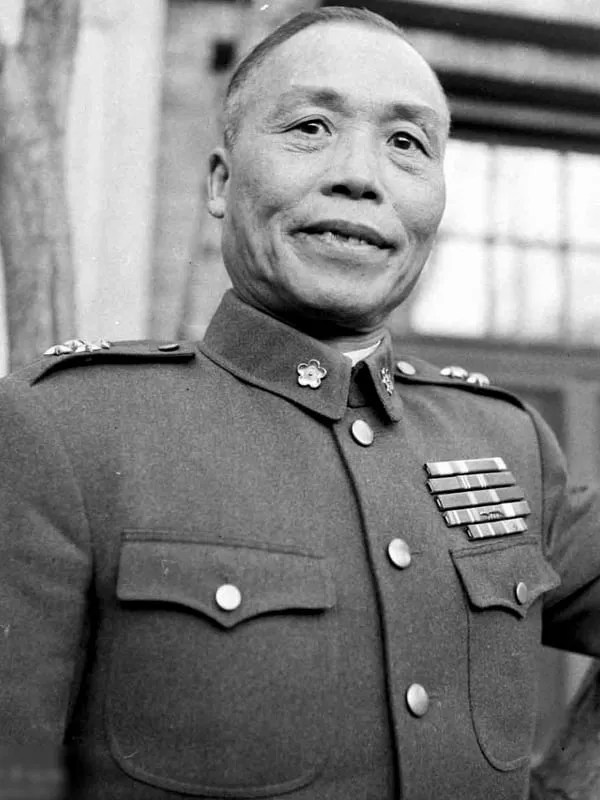
- Born:
- 13 August 1890, Xixiang near Guilin (Guangxi, Qing Empire)
- Died:
- 30 January 1969, Beijing
- Author:
- Natalia
- Photo:
- autor nieznany, domena publiczna, Wikimedia Commons

Li Zongren was one of the ablest Chinese commanders of the first half of the twentieth century and, for a quarter of a century, the most dangerous rival of Chiang Kai-shek within his own camp. Together with Bai Chongxi and Huang Shaohong he created the so-called New Guangxi clique, which united that poor province in southern China, fought in the Northern Expedition and then twice rose in armed rebellion against Chiang. When Japan attacked China in 1937, Li took up the fight alongside his former enemy. As commander of the 5th War Zone he won China’s first major victory of the war at Taierzhuang in the spring of 1938, and then led his armies out of encirclement at Xuzhou. Ten years later, as Vice-President, he took over power from Chiang for a few months and tried to make peace with the Communists. He died in Beijing, to which he had returned from exile in America.
Youth in Guangxi
He was born on 13 August 1890 (some sources, Chinese ones in particular, give 1891) in the village of Xixiang near Guilin in Guangxi province, the second son of a village schoolteacher. The family was poor and the boy worked in the fields. In 1908 he entered the provincial military school in Guilin, and in 1910 he joined the Tongmenghui, the revolutionary organisation of Sun Yat-sen. After the 1911 Revolution he completed an accelerated officers’ course and for a time taught gymnastics at a school in Guilin.
In 1916 he joined the forces fighting Yuan Shikai, who wanted to make himself emperor, and served as a platoon commander in the army of the Old Guangxi clique, ruled by General Lu Rongting. This was the warlord era, when China fell apart into the fiefdoms of generals. Li fought in Hunan and Guangdong, was wounded and rose to command a battalion. After Lu Rongting’s defeat in the war with Guangdong in 1921 his army disintegrated into bands, and Li took refuge in the mountains with a few hundred men and began to build his own disciplined army.
The New Guangxi clique
Together with two younger fellow graduates of the military school, Huang Shaohong and Bai Chongxi, Li defeated the province’s old rulers in 1923–1925 and united Guangxi. In 1923 the three commanders secretly joined the Kuomintang and recognised the authority of Sun Yat-sen’s government in Guangzhou (Canton). Thus was born the New Guangxi clique, in which Li was the political and military leader, Bai the strategist and Huang the administrator. Li’s partnership with Bai Chongxi was so close that the two were called “Li-Bai”, after the famous poet.
In 1926 the Guangxi troops, renamed the 7th Corps of the National Revolutionary Army, set out on the Northern Expedition. Li fought the armies of Wu Peifu in Hunan and Hubei and those of Sun Chuanfang in Jiangxi. His soldiers earned the nickname of the “Steel Army”. Li was a determined anti-Communist, and in 1927 he backed Chiang Kai-shek against the Kuomintang left in Wuhan. Bai Chongxi played a leading part in the Shanghai massacre, and Guangxi units took part in the purge of the Communists. In August 1927, when Chiang temporarily stepped down under pressure from his rivals, including those from Guangxi, the troops of Li Zongren and his allies threw back Sun Chuanfang’s last great counter-offensive against Nanjing at Longtan on the Yangtze. In 1928 Li commanded the 4th Army Group, and after the withdrawal of Zhang Zuolin Guangxi troops under Bai Chongxi reached Beijing.
Rebellions against Chiang
After the country’s reunification the Guangxi clique controlled, at least indirectly, an area stretching from Beijing to Guangzhou. Chiang Kai-shek sought centralisation, and in the spring of 1929 war broke out. The campaign lasted barely a few weeks. Li was expelled from the party, fled to Hong Kong and later returned to Guangxi. In 1930 he backed Yan Xishan and Feng Yuxiang in the Central Plains War, the largest civil war of those years, and lost again. In 1931 he joined the opposition government in Guangzhou, and a new war was averted only by the Mukden incident and the Japanese attack on Manchuria.
In the 1930s Li and Bai made Guangxi a model province: they expanded schools and roads, organised a universal militia in which hundreds of thousands of men were trained, and proclaimed the slogan of self-defence, self-government and self-sufficiency. Like many Chinese leaders of the time, Li admired the efficiency of the European fascist states, but he was more interested in the strength of the army and the state than in ideology. In June 1936 Li and Bai, together with the ruler of Guangdong province, Chen Jitang, announced that they were marching north to fight Japan – something Chiang was still avoiding. It was in fact a rebellion against Nanjing. Chiang bribed Chen Jitang’s airmen and commanders, forcing Chen to flee, and in September he came to terms with Guangxi. When Chiang was taken prisoner in Xi’an in December 1936, Li called on Zhang Xueliang to release him.
Taierzhuang and Xuzhou
After the Marco Polo Bridge incident in July 1937 Guangxi was one of the first provinces to join the fight. Its divisions fought at Shanghai, and Li came to Nanjing and was given command of the 5th War Zone, which covered northern Jiangsu, southern Shandong and Anhui, with headquarters at Xuzhou. His task was to defend the junction where the Tianjin–Nanjing railway crossed the Longhai line. His forces were a patchwork of provincial armies of varying quality, and as a former rebel he could not count on Chiang’s full trust.
In the spring of 1938 Li exploited the fact that the Japanese divisions were advancing on Xuzhou separately and without coordination. At Linyi he halted the 5th Division of Seishirō Itagaki, while he let the forward group of the 10th Division become entangled in fighting for the small town of Taierzhuang, so that he could then cut it off with Tang Enbo’s forces. The Battle of Taierzhuang ended on 7 April 1938 with a Japanese retreat and became a symbol of Chinese resistance. In May, when the Japanese threw several armies against him, Li realised in time that Xuzhou was lost and ordered a withdrawal. His troops, broken up into small units, slipped between the Japanese columns by night, and on 19 May the Japanese entered an empty city. This retreat, which ended the Battle of Xuzhou, saved hundreds of thousands of soldiers for the defence of Wuhan and is regarded as one of the greatest achievements of the Chinese command in the war.
The war against Japan continues
Li commanded the 5th War Zone until 1943, in northern Hubei and southern Henan, covering the road to Sichuan. He fought in the battles of Suixian and Zaoyang in May 1939, in the winter offensive of 1939–1940 and in the Battle of Zaoyang–Yichang in 1940, in which his subordinate General Zhang Zizhong was killed. The war on this front settled into a long war of position. Chiang, distrustful of the ambitious general, removed him from command at the end of 1943 and made him head of the headquarters in Hanzhong, a post that carried no real power. Li spent the last years of the war far from the front, complaining of his enforced idleness.
Vice-President and acting President
After Japan’s surrender Li headed the headquarters in Beijing (then called Beiping), again without much power. In April 1948 the National Assembly elected the first President and Vice-President under the new constitution. Chiang Kai-shek, elected President, backed Sun Fo, Sun Yat-sen’s son, for Vice-President. Li stood against Chiang’s wishes and won on the fourth ballot on 29 April. It was a painful blow for Chiang, and from then on the two leaders were divided by open hostility.
By the end of 1948 the Kuomintang forces were losing the civil war, and in a great battle around Xuzhou, where Li had fought ten years earlier, the Communists destroyed the main government forces. On 21 January 1949 Chiang stepped down and Li became acting President. He lifted martial law, ordered the release of political prisoners and opened negotiations with the Communists on the basis of Mao Zedong’s eight conditions. Chiang, however, kept control of the party, a large part of the army and the gold reserves, which he moved to Taiwan. In April 1949 Li rejected the Communist draft agreement, which amounted to capitulation. On 21 April the People’s Liberation Army crossed the Yangtze, and two days later it took Nanjing. The government moved to Guangzhou, and after its fall in October to Chongqing. On 20 November 1949 Li flew to Hong Kong, and in December to the United States, officially for medical treatment. He never went to Taiwan, to which the government and Chiang withdrew in December.
Exile and return
In America Li met President Harry Truman and sharply criticised Chiang, who resumed the presidency in Taiwan on 1 March 1950. In 1952 the Control Yuan opened proceedings against Li, and in 1954 the National Assembly in Taipei removed him from the office of Vice-President. Li lived in New Jersey and recorded his memoirs with the historian Tong Te-kong as part of Columbia University’s oral history programme. They were published in 1979 and are one of the important sources for the history of Republican China, including the 1938 campaign.
On 20 July 1965, after secret talks with Premier Zhou Enlai, Li flew to Beijing by way of Switzerland. The Communist authorities exploited his return for propaganda as “a patriot’s return to the motherland”, while in Taiwan it was regarded as treason. He died in Beijing on 30 January 1969, during the Cultural Revolution. The official cause of death was cancer. Claims that occasionally surface that he was poisoned have no support in the sources.
Significance
Li Zongren belonged to the generation of generals who grew up in the warlord era and to the end defended their own province and army against the central government. This rivalry weakened China in the 1930s, when Japan was reaching for Manchuria and North China. Yet the war with Japan showed that Chiang’s former opponents could fight together in a moment of danger. Taierzhuang was the work of armies from various provinces under the command of a general from Guangxi, and the retreat from Xuzhou saved the forces that allowed China to survive 1938. In the story of the road to the Second World War, Li is above all the commander who in the spring of 1938 proved that Japan could not defeat China quickly – which condemned Japan to a long war of attrition and, in the end, to seeking raw materials and a way out in the war in the Pacific.
Sources
Commanded in battles
(02)Mentioned in battles
(02)Often appears with
People who appear in the same events.