Japan
Iwane Matsui
Commander of the Shanghai Expeditionary Army (1937) and the Central China Area Army (1937–1938), general
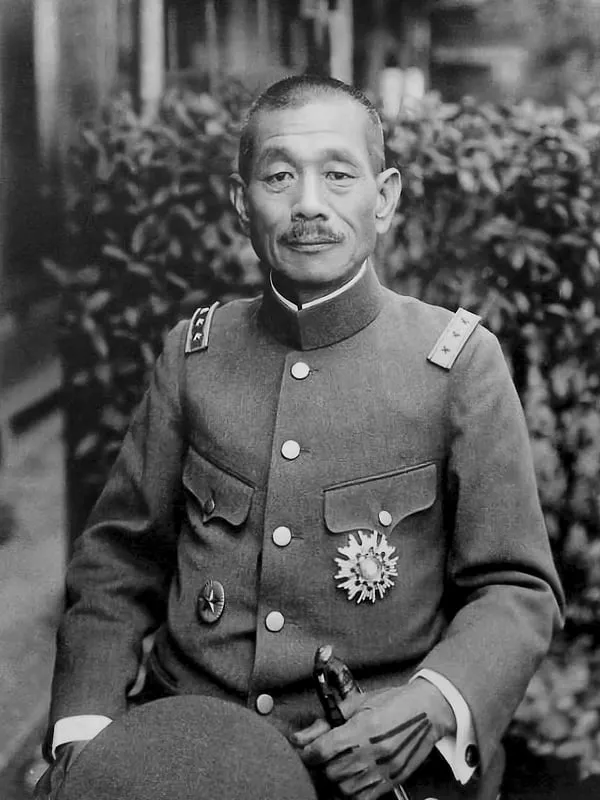
- Born:
- 27 July 1878, Nagoya (Aichi Prefecture, Japan)
- Died:
- 23 December 1948, Tokyo (Sugamo Prison)
- Author:
- Łukasz
- Photo:
- autor nieznany, domena publiczna, Wikimedia Commons

For most of his life Iwane Matsui was regarded in the Japanese army as a friend of China. He spoke Chinese, wrote Chinese verse, was a friend of Sun Yat-sen, helped the young Chiang Kai-shek and dreamed of an alliance between Japan and China which, under Japanese leadership, would free Asia from Western domination. Yet it was he who in 1937 led the Japanese forces against Shanghai and then insisted on taking Nanjing, the capital of the Republic of China. The soldiers under his command committed in Nanjing one of the worst war crimes of the twentieth century. After the war the Tokyo tribunal acquitted him of conspiring to wage aggressive war but found him guilty of having known of the massacre and done nothing effective to stop it. He was hanged as one of the seven Japanese leaders sentenced to death. His fate is one of the most frequently cited examples of a commander’s responsibility for the crimes of his subordinates.
A samurai’s son from Owari
He was born on 27 July 1878 in Nagoya, the sixth son of an impoverished samurai who had been a retainer of the lords of Owari. His father was a scholar of the Chinese classics, and the family could barely make ends meet. A short and sickly boy, he chose a military career partly because military schools were the cheapest. In 1897 he graduated second in his year from the Military Academy, together with the future generals Sadao Araki and Shigeru Honjō. His studies at the Army Staff College were interrupted by the war with Russia. As a company commander he fought in Manchuria and was wounded at the Battle of Liaoyang, in which most of his company was killed. After the war he returned to the college and graduated with distinction in 1906.
“China expert”
Matsui was an admirer of Sei Arao, an officer and activist from Nagoya who preached that Japan and China must stand together against Western imperialism. After his studies he himself asked to be posted to China, which the army of the day regarded as an unattractive assignment. After a short stay in France, from 1907 he worked in China as an assistant military attaché and intelligence officer; from 1915 to 1919 he was a liaison officer in Shanghai, in 1921 he joined the staff of the intervention force in Siberia, and from 1922 to 1924 he was an adviser and intelligence officer in Harbin, in the sphere of influence of Zhang Zuolin. He came to know many Chinese politicians and soldiers. He supported Sun Yat-sen’s revolutionaries, and in 1907 he helped the young cadet Chiang Kai-shek come to Japan to study.
In 1923 he became a major general, and from 1925 to 1928 he headed the intelligence department of the General Staff. He was the first “China expert” in that post and believed that Chiang Kai-shek would unite the country and become Japan’s partner against communism and the West. Japanese sources credit him with helping to arrange Chiang’s meeting with Prime Minister Giichi Tanaka in 1927. Events, however, took a different course. Against his advice the government sent troops to Shandong, which led to the Jinan incident, and in June 1928 Kwantung Army officers led by Daisaku Kōmoto killed Zhang Zuolin. Matsui, who had backed the marshal as a bulwark against communism, demanded that the perpetrators be punished, to no avail.
Pan-Asianist
From 1929 to 1931 he commanded the 11th Division. At first he regarded the Mukden incident and the Kwantung Army’s conquest of Manchuria as the unauthorised action of young officers, but when he went to the Geneva Disarmament Conference in 1932 as the army’s representative, he was more outraged by the accusations levelled at Japan in the League of Nations by the Chinese and the great powers than by the invasion itself. He concluded that Asia needed its own “Asian League” under Japanese leadership. In March 1933 he was one of the founders of the Greater Asia Association (Dai Ajia Kyōkai), which became the most influential pan-Asianist organisation in Japan. Its members included politicians and soldiers, among them Fumimaro Konoe.
In August 1933 he took command of the army in Taiwan, and in October he was promoted to general, the highest rank in the army. From 1934 he sat on the Supreme War Council. His attitude to the Nanjing government grew steadily cooler: he accused the Kuomintang leaders of betraying Asia to the West and drew closer to officers who wanted to break Chiang Kai-shek “with a single blow”. In August 1935, after General Tetsuzan Nagata was murdered by an officer of a rival faction, he retired. As a reservist he toured China, and in March 1936 he spoke with Chiang Kai-shek in Nanjing, but little came of it. He regarded Chiang’s agreement with the communists after the Xi’an incident of December 1936 as a personal betrayal.
Shanghai
When, after the Marco Polo Bridge incident, the fighting spread to Shanghai in August 1937, the army needed a commander for the expeditionary force it was sending there. The choice fell on the 59-year-old reservist, probably because of his experience of China and his contacts. On 15 August Matsui became commander of the Shanghai Expeditionary Army. He declared that he was going to the front “not to fight an enemy, but to pacify a brother”, yet even before leaving he said that the war would end only with the capture of Nanjing. On 23 August his divisions landed north of Shanghai and became bogged down in heavy fighting. He constantly demanded reinforcements, and the breakthrough came only after the 10th Army landed in Hangzhou Bay on 5 November. The Battle of Shanghai cost both sides enormous losses.
Nanjing
On 7 November Matsui became commander of the newly formed Central China Area Army, which comprised both armies. The General Staff in Tokyo wanted to limit the war and forbade the troops to advance any further, but Matsui pressed for a march on the capital, and the 10th Army set off for Nanjing without orders. On 1 December Tokyo gave way. Command of the Shanghai Expeditionary Army passed to Prince Yasuhiko Asaka, an uncle of Emperor Hirohito, while Matsui, ill and feverish (in his diary he wrote of malaria), directed the operation from his headquarters in Suzhou. On 7 December he issued guidelines forbidding looting and arson and ordering that only some of the units should enter the city, but they said nothing about the fate of prisoners and were in practice ignored. After the call to surrender was rejected, the troops launched their assault on 10 December and entered the city on 13 December.
The Nanjing massacre began: mass executions of prisoners and of men suspected of having served in the army, killings of civilians, tens of thousands of rapes, looting and fires. Matsui also contributed to it indirectly: he insisted that his ceremonial entry into the city take place as early as 17 December, and to guarantee his safety his subordinates sped up the “mopping-up” of the city – that is, the killing of those they had detained. After his entry he heard of the rapes and looting. In his diary he wrote that “some such acts are unavoidable”. In conversation he expressed regret, and on 7 February 1938, after a memorial service for the fallen, he gathered the commanders in Nanjing and sharply rebuked them for “disgraceful incidents”. Years later he told the prison chaplain that he had wept with anger at the time, while the officers laughed at him. But he did nothing that would effectively have restrained the soldiers.
The capture of the capital did not break China, as Matsui had expected it would. At the beginning of 1938 he was planning further operations and the creation of a new Chinese government under Japanese control, but the General Staff had had enough of him: he was blamed for conflicts with his subordinates, for incautious remarks against the Western powers and for the disgrace the army had brought upon itself at Nanjing. In February 1938 he was recalled together with Prince Asaka and several dozen other senior officers, and replaced by General Shunroku Hata. No one was punished. In Japan he was welcomed as a hero.
The war years
From 1938 to 1940 he was a cabinet adviser. He resigned in protest at Prime Minister Mitsumasa Yonai’s reluctance to ally with Germany and Italy. In 1940 he founded a temple in Atami with a statue of Kannon, the bodhisattva of mercy, dedicated to the fallen Japanese and Chinese soldiers, and prayed there every morning and evening. He did not, however, abandon political activity. Throughout the Pacific War he headed the Greater Asia Association and other organisations supporting the war effort, including an openly anti-Western and antisemitic one. In 1943 he toured occupied Asia, met Wang Jingwei and Subhas Chandra Bose, and promoted the Greater East Asia Co-Prosperity Sphere as the fulfilment of his idea. As late as 1945 he declared on the radio that Japan would not give up the Philippines even if Tokyo were reduced to ashes.
Trial and death
After the surrender the American occupation authorities issued a warrant for his arrest in November 1945. Suffering from pneumonia, he reported to Sugamo Prison in March 1946. Before the International Military Tribunal for the Far East he defended not only himself but Japanese policy as a whole, calling the war with China “a quarrel between brothers in the Asian family”. He admitted that he had known of individual crimes by soldiers and bore “moral responsibility” for them, but denied that mass killings had taken place in Nanjing and rejected legal responsibility. In doing so he took great care to shield Prince Asaka, shifting the blame onto the divisional commanders.
On 12 November 1948 the tribunal acquitted him on 37 of the 38 counts, including all those concerning conspiracy and aggressive war. It found him guilty, however, on Count 55: deliberate disregard of the duty to prevent breaches of the laws of war. “The Tribunal is satisfied that Matsui knew what was occurring. He did nothing, or nothing effective to abate these horrors,” the judgment stated. He was the only defendant sentenced to death on that single count alone. During the night of 22–23 December 1948, as the oldest of the condemned, he led a cry of “banzai” for the emperor before the execution, and was hanged together with Hideki Tōjō, Kōki Hirota, Kenji Doihara, Seishirō Itagaki and two other generals. Prince Asaka never stood trial.
Memory and controversy
The Americans took away the ashes of the executed men so that no place of veneration could arise, but some of the ashes were secretly kept and taken to the temple in Atami. In 1978 Matsui, together with the others executed on the tribunal’s sentence, was entered in the register of spirits venerated at the Yasukuni Shrine, which came to light a year later and still provokes protests from China and Korea.
Historians are divided in their assessment of Matsui. Some, especially in Japan, stress that he was an old, ailing reservist whom the younger commanders ignored, that he issued orders on discipline, and that the death penalty for mere neglect was disproportionately harsh, given that other defendants convicted on similar counts received prison sentences. Others, such as Yutaka Yoshida, list his failings: it was he who pushed on to Nanjing without supplies, forcing the soldiers to loot; he issued no rules on prisoners; he let too many troops into the city; he forced a premature triumphal entry; and he did not cooperate with the Safety Zone committee. The matter was further muddied by his former secretary Masaaki Tanaka, one of Japan’s leading deniers of the massacre, who when he published the general’s diary in 1985 introduced several hundred alterations to the text.
Matsui is a symbolic figure. He shows how Japanese pan-Asianism, which preached the brotherhood of the peoples of Asia, could go hand in hand with a war against those very peoples, and how a commander who considered himself a friend of China led an army that made Nanjing a hell for the Chinese. The verdict in his case became one of the first precedents in international law for a commander’s responsibility for the crimes of his subordinates.
Sources
Commanded in battles
(02)Mentioned in battles
(01)Often appears with
People who appear in the same events.