Japan
Fumimaro Konoe
President of the House of Peers (1933–1937), Prime Minister of Japan (1937–1939, 1940–1941), President of the Privy Council (1939–1940)
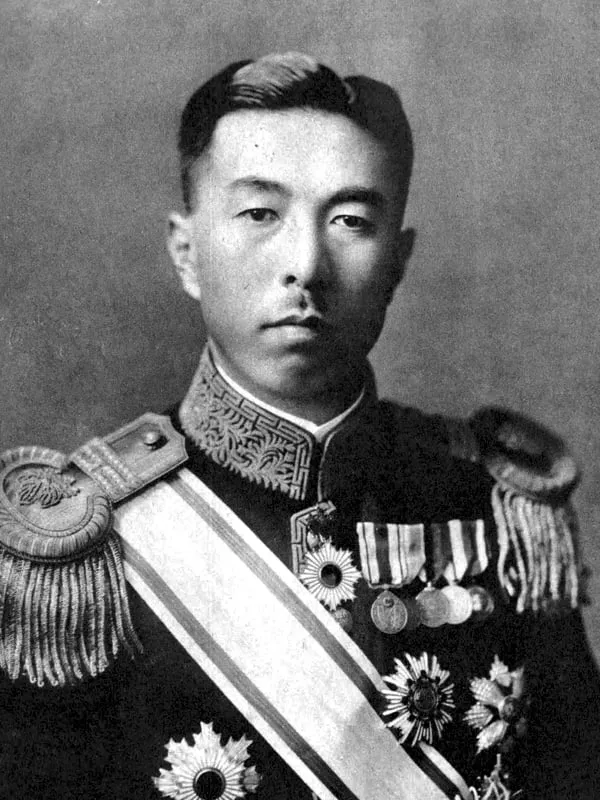
- Born:
- 12 October 1891, Tokyo (Japan)
- Died:
- 16 December 1945, Tokyo (Japan)
- Author:
- Natalia
- Photo:
- 内閣情報部, domena publiczna, Wikimedia Commons

Prince Fumimaro Konoe was the most promising politician of pre-war Japan and at the same time one of those who did most to bring about its catastrophe. An aristocrat from the oldest of the court families – tall, elegant and well read – he was regarded as the man who could reconcile the army, the court, the parties and big business. As prime minister in July 1937 he turned a clash near Beijing into a war with China, and in January 1938 he closed the road to peace with Chiang Kai-shek. In 1940 he concluded an alliance with Germany and Italy and created a single-organisation political system. In October 1941, unable either to reach agreement with the Americans or to restrain the army, he resigned, leaving the decision for war to General Tōjō. After the defeat, facing trial before a war crimes tribunal, he took his own life.
Heir of the Fujiwara
He was born in Tokyo on 12 October 1891, the eldest son of Prince Atsumaro Konoe. The Konoe house was the first of the five regent houses descended from the Fujiwara, who for centuries had supplied the emperors with regents and consorts. His father was President of the House of Peers, head of the Gakushūin, the school for the aristocracy, and an advocate of pan-Asianism. He founded the East Asia Common Culture Society, which trained Japanese for work in China. Fumimaro’s mother died soon after giving birth, and his father married her younger sister. For a long time Fumimaro believed his stepmother to be his mother, and discovering the truth was deeply painful to him. When his father died in January 1904, the twelve-year-old Fumimaro inherited the title of prince and enormous debts. The family was rescued by the sale of heirlooms and by help from the Sumitomo conglomerate.
Instead of the Gakushūin, he attended the elite First Higher School in Tokyo, where he fell under the spell of its headmaster, the Christian thinker Inazō Nitobe. He began studying philosophy at Tokyo Imperial University but switched to law at Kyoto Imperial University in order to hear the Marxist economist Hajime Kawakami and the philosopher Kitarō Nishida. In 1914 he translated Oscar Wilde’s essay “The Soul of Man under Socialism”, and the issue of the journal that printed it was confiscated. In Kyoto he met the elderly Prince Kinmochi Saionji, the last of the genrō, who became his patron for many years.
Paris and the House of Peers
In 1916, on turning 25, he took up his hereditary seat in the House of Peers, the upper house of parliament. In December 1918 he published a widely read article, “Reject the Anglo-American-Centred Peace”. In it he argued that the victorious powers preached peace and self-determination while in reality seeking to perpetuate a division of the world in which they held the colonies and raw materials and young nations such as Japan got nothing. The League of Nations, he maintained, was to be an instrument of that order. Saionji nevertheless took him to the Paris Peace Conference. The rejection of the Japanese racial equality proposal in April 1919, and the anti-Japanese mood he observed in the United States on the way home, strengthened his conviction that the West would never accept the Japanese as equals.
In the 1920s Konoe was active in the House of Peers, at first in the conservative Kenkyūkai faction and from 1927 in the Kayōkai club, which he founded with friends including Kōichi Kido. He supported universal male suffrage as a way of defusing revolutionary sentiment. In 1931 he became Vice-President and in 1933 President of the House of Peers. Around him formed the Shōwa Research Association, a group of intellectuals and officials seeking a “new order” for Japan and Asia. In 1934, visiting his son, who was studying at Princeton, he encountered American hostility towards Japan and came back even more embittered. He proclaimed that the world needed a “new international order” in which the “have” nations would share their resources with the “have-nots”.
He was by then the most popular aristocrat in the country. The military saw in him someone who understood their aspirations; the parties and the court saw someone who would rein in the army. After the coup attempt of 26 February 1936 Saionji proposed him as prime minister, but Konoe declined, pleading ill health.
The first cabinet and the war with China
On 4 June 1937, with Saionji’s backing, Konoe formed a government. He was 45, the second-youngest prime minister in the country’s history. A few weeks earlier he had appeared at a fancy-dress ball dressed as Adolf Hitler, which deeply troubled Saionji. One of the first matters he took up was the idea of an amnesty for the convicted participants in the putsch of February 1936.
A month later, on the night of 7–8 July, came the clash at the Marco Polo Bridge. Although a ceasefire was agreed on the spot, on 11 July the Konoe government approved the dispatch of reinforcements to northern China, announced it in a solemn statement and called on the press, the parties and industrialists to unite. General Kanji Ishiwara, who warned against war, suggested that Konoe fly to Nanjing and talk to Chiang Kai-shek. Konoe is said to have agreed at first, but then backed out. His secret envoy to China was detained by the military police. At the end of July the Japanese took Beijing and Tianjin; in August the fighting moved to Shanghai, and the government announced that the Chinese army had to be “chastised”. Officially the war was called an “incident”, which made a formal declaration unnecessary. In November Imperial General Headquarters was established, and in December the troops of General Iwane Matsui captured Nanjing, where they massacred prisoners and civilians.
Konoe took his most fateful decision after the fall of Nanjing. The General Staff, alarmed at the prospect of a long war, favoured accepting the mediation offered by the German ambassador, Oskar Trautmann. The government, however, hardened its terms so that China could not accept them, and on 16 January 1938 Konoe declared that Japan would “not deal with” Chiang Kai-shek’s Nationalist government. The American historian Gerhard Weinberg observed that this was the only occasion in the decade 1931–1941 when the civilian authorities in Tokyo managed to force their view through against the military on a crucial question of peace – and the consequences proved disastrous for Japan, for China and for Konoe himself.
On 1 April 1938 the National Mobilisation Law passed by parliament was promulgated, giving the government power over people, raw materials, prices and the press. Japanese troops took Xuzhou and, in the autumn, Wuhan and Canton (Guangzhou), but China fought on. In the summer of 1938, during the fighting at Lake Khasan, the army minister in his cabinet, General Seishirō Itagaki, was rebuked by the Emperor for trying to obtain consent to the use of force. On 3 November 1938 Konoe announced the building of a “New Order in East Asia” based on cooperation between Japan, Manchukuo and China, and on 22 December he set out three principles of peace: good-neighbourliness, a common struggle against communism and economic cooperation. They were addressed to Wang Jingwei, who had just fled Chongqing to head a collaborationist government. They drew no other Chinese leaders after him. On 5 January 1939 the Konoe government resigned, leaving a war with no end in sight.
The New Order and the Tripartite Pact
In 1939–1940 Konoe was President of the Privy Council and contemplated a new, unified political movement to replace the quarrelling parties. When Germany defeated France in June 1940, the conviction took hold in Tokyo that Japan had to act before the division of the world was complete. The army brought down the government of Admiral Mitsumasa Yonai, and on 22 July 1940 Konoe became prime minister again. Yōsuke Matsuoka became foreign minister and General Hideki Tōjō army minister. The government proclaimed a programme for building a “Greater East Asia”, from which grew the idea of the Co-Prosperity Sphere.
In September 1940 Japanese troops entered northern French Indochina, and on 27 September Japan concluded the Tripartite Pact with Germany and Italy. Konoe warned the Americans that if they failed to understand the intentions of the three powers, nothing would remain but war. The political parties dissolved themselves, and on 12 October 1940 the Imperial Rule Assistance Association was founded, headed by the prime minister. It did not become a party on the model of the NSDAP, because right-wing critics accused Konoe of creating a new shogunate that infringed the Emperor’s authority, but it ended the era of parties in Japan. In November Tokyo recognised Wang Jingwei’s government in Nanjing, and in April 1941 Matsuoka concluded a neutrality pact with Joseph Stalin in Moscow.
Negotiations with America and resignation
In the spring of 1941 the ambassador in Washington, Admiral Kichisaburō Nomura, opened talks with Secretary of State Cordell Hull. Matsuoka obstructed them, and after the German attack on the USSR he demanded a strike against Siberia. In July Konoe got rid of him in the only way available: the entire cabinet resigned, and on 18 July Konoe’s third cabinet was formed, now without Matsuoka. At the end of July Japanese troops entered southern Indochina. The United States froze Japanese assets and on 1 August halted exports of oil, on which the Japanese fleet depended.
Konoe proposed a face-to-face meeting with Franklin Delano Roosevelt. The Americans, however, demanded prior commitments, above all on the withdrawal of troops from China, which the army refused to accept. On 6 September an Imperial Conference attended by Emperor Hirohito decided that if the negotiations produced no result by early October, Japan would prepare for war with the United States, Britain and the Netherlands. Konoe made no open attempt to oppose this decision. In the following weeks he tried to persuade Tōjō that the military were taking war too lightly, to which Tōjō replied that sometimes a man must close his eyes and jump from the veranda of the Kiyomizu temple. On 12 October, at a conference at his villa, Tekigaisō, Konoe said that he did not believe in victory and would not conduct such a war, but neither he nor the navy minister put the matter openly. On 15 October his adviser, the journalist Hotsumi Ozaki, a member of the ring of the Soviet spy Richard Sorge, was arrested. On 16 October Konoe resigned. Two days later Tōjō became prime minister, and on 7 December 1941 Japan attacked Pearl Harbor.
War, defeat and death
During the Pacific War Konoe remained in the background, but he belonged to the circle of former prime ministers who advised the Emperor. On hearing the news of Pearl Harbor he is said to have remarked that he sensed a terrible defeat coming. He helped bring about the fall of the Tōjō government in July 1944. On 14 February 1945, at his first private audience in three years, he presented the Emperor with a memorandum urging that the war be ended as quickly as possible. He justified this, however, chiefly by his fear of a communist revolution, which, he claimed, was being encouraged by men within the army itself. Hirohito replied that one more victory had to be won first. In July 1945 the Emperor designated him as special envoy to Moscow, to ask the USSR to mediate. The Soviet government delayed its reply and on 8 August declared war on Japan.
After the surrender Konoe joined the first post-war government, under Prince Higashikuni, as minister without portfolio. On 4 October 1945 he met General Douglas MacArthur and, with his encouragement, took up a project to revise the constitution. Soon, however, the Americans distanced themselves from him, and the American press recalled his role in the war with China. On 6 December 1945 the occupation authorities ordered his arrest as a suspected war criminal. On the night before he was due to report to Sugamo Prison, on 16 December 1945, Konoe took cyanide at his villa, Tekigaisō, in Tokyo. In a note dictated to his son Michitaka on his last night, he admitted that he had made many political mistakes but said he could not bear to be tried as a war criminal. His eldest son, Fumitaka, taken prisoner by the Red Army in Manchuria, died in a Soviet camp in 1956.
Significance
Konoe was neither a general nor a fanatic. He was a man whom everyone trusted and who proved unable to stop any of the great decisions – and took several of them himself. His defenders, including some Japanese historians, see him as a politician who tried to keep the army in check, sought peace with China and with the United States, and fell victim to the military. His critics point out that it was his government that agreed to escalation in July 1937, broke off talks with Chiang Kai-shek in January 1938, concluded the Tripartite Pact, abolished the parties and led the war into Indochina. His ideas, from the “New Order in East Asia” to the grievances against the Anglo-Saxons he had formulated as early as 1918, became the language of Japanese expansion.
On the road to the Second World War Konoe is a key figure. Between July 1937 and October 1941 it was he, at the head of three cabinets, who led Japan from a local clash near Beijing to war with China, an alliance with Germany and the threshold of war with America. His grandson Morihiro Hosokawa became prime minister of Japan in 1993.
Sources
Mentioned in battles
(04)Often appears with
People who appear in the same events.
On the timeline
(33)1919
1936
1937
1938
1939
1940
1941
April
July
August
September
October
- 18
- The arrest of Richard SorgeOn 18 October 1941 Japanese police in Tokyo arrested Richard Sorge, the Soviet spy who for a month had been reporting that Japan would not attack the USSR.
- Key eventHideki Tōjō becomes Prime MinisterOn 18 October 1941 General Hideki Tōjō, the War Minister who had refused to withdraw troops from China, became Prime Minister of Japan after Konoe resigned.