1944–1945: The liberation of Western Europe
Colmar Pocket
- Dates:
- 20 January – 9 February 1945
- Front:
- Western Front
- Location:
- France: central and southern Alsace (Haut-Rhin department) – the plain between the Vosges and the Rhine from around Sélestat and Marckolsheim in the north to Cernay, Ensisheim and the outskirts of Mulhouse in the south, with Colmar, the fortress of Neuf-Brisach and the bridgehead at ChalampéOn the battle map →
- Sides:
- FranceJean de Lattre de Tassigny, Antoine Béthouart, Joseph de Goislard de MonsabertUnited StatesJacob Devers, Frank MilburnNazi GermanySiegfried Rasp, Heinrich Himmler
- Result:
- Allied victory. The pocket was eliminated, Colmar was liberated on 2 February, and the remnants of the German 19th Army withdrew across the Rhine, blowing up the bridge at Chalampé on 9 February. Not a single German soldier remained on the left bank of the Rhine south of Strasbourg, and the 6th Army Group could prepare to enter Germany.
- Author:
- Natalia
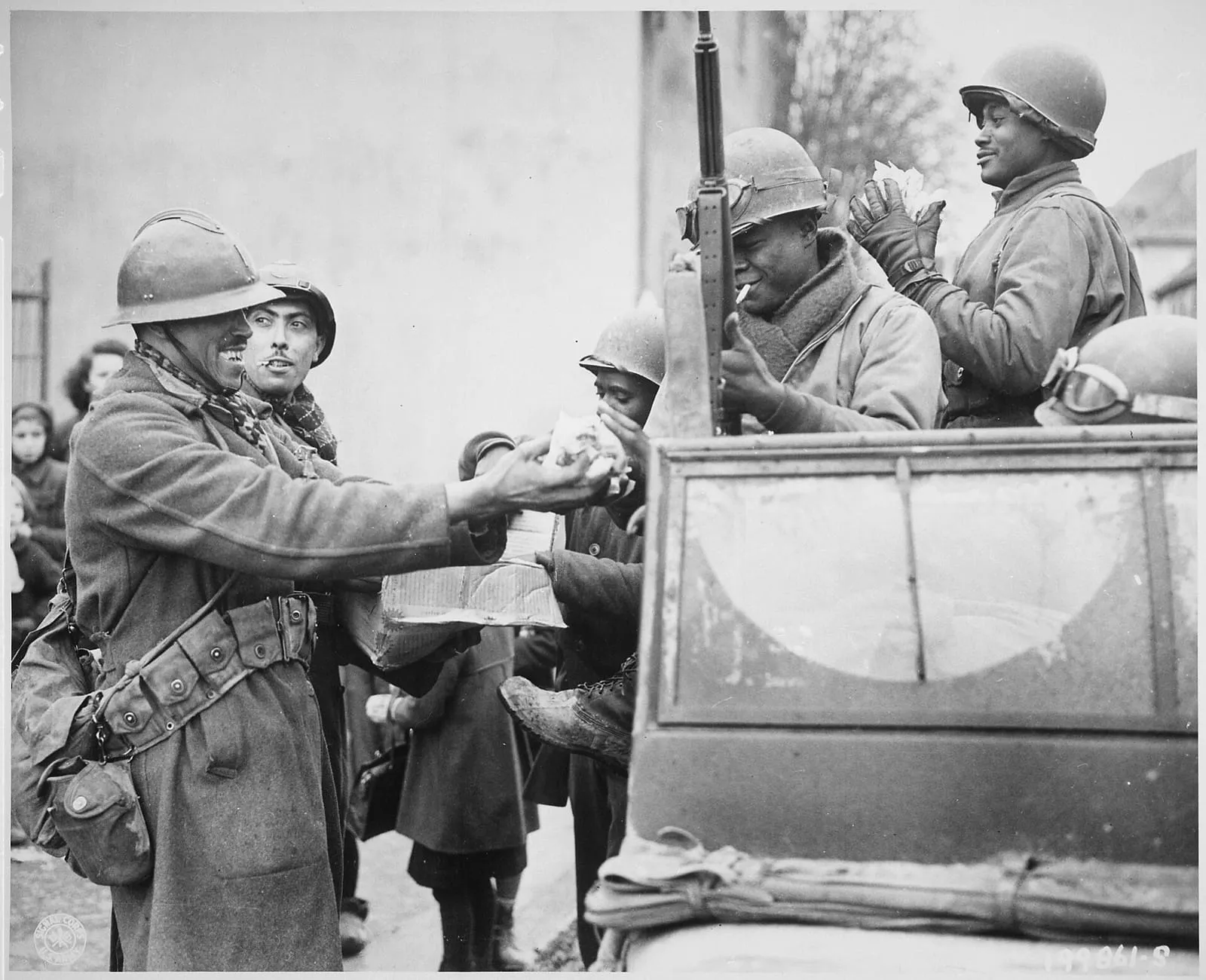
The Colmar Pocket (French poche de Colmar, German Brückenkopf Elsass – “the Alsace bridgehead”) was the last large stretch of French soil in German hands. From November 1944 the German 19th Army held a semicircular area on the left bank of the Rhine around Colmar – roughly 65 km from north to south and up to 50 km deep – backing onto the Vosges in the west and the river in the east. It was eliminated in three weeks, from 20 January to 9 February 1945, by General of the Army Jean de Lattre de Tassigny’s French First Army (PL), reinforced by the American XXI Corps. The fighting took place in knee-deep snow and in temperatures of ten to twenty degrees below zero, on a flat, open plain criss-crossed by canals and ditches, for every stone-built village.
Name and dates
The name “Colmar Pocket” is a convention. The Germans were not encircled in the strict sense: to the east they had the Rhine at their backs, and bridges over which supplies and reinforcements were brought in until the last days – the railway bridge at Breisach (opposite Neuf-Brisach) and the bridge at Chalampé. To the Germans it was therefore a bridgehead; to the Allies it was a “pocket” (French poche) that they had failed to eliminate in the autumn.
The battle is taken to have begun on 20 January 1945, when the French I Corps went over to the attack on the southern flank of the pocket, and to have ended on 9 February, when French units destroyed the German rearguard at Chalampé and the Germans blew up the bridge there behind them. The earlier fighting on the edges of the pocket – the unsuccessful French attack of 15–22 December 1944 and the German thrust northwards out of the pocket in January as part of Operation Nordwind – belongs to its history, but not to the offensive itself.
Background
In November 1944 General Jacob Devers’s American 6th Army Group broke through the German defences in the Vosges from two directions. In the south the French First Army forced the Belfort Gap, smashed German units at Burnhaupt and reached the Rhine between Mulhouse and Basel. In the north the US Seventh Army went through the Saverne Gap, and its spearhead – General Leclerc’s French 2nd Armoured Division – liberated Strasbourg on 23 November. Between the two breaches the Germans were left with central Alsace and Colmar.
Adolf Hitler regarded Alsace as German land – since 1940 it had been de facto incorporated into the Reich as part of Gauleiter Robert Wagner’s Gau Baden-Elsass – and at the end of November he forbade the surrender of the bridgehead. On 26 November Army Group Upper Rhine (Heeresgruppe Oberrhein) was formed under the command of Heinrich Himmler, the Reichsführer-SS, who had no experience of commanding troops. Under him was the 19th Army, commanded from mid-December 1944 by General of Infantry Siegfried Rasp, who had replaced General Friedrich Wiese.
The Allies did not eliminate the bridgehead at once. In the autumn all their forces in Western Europe were suffering from shortages of ammunition, fuel and replacements. The French First Army was in a particularly difficult position: the veterans of the fighting in Italy and Provence were exhausted, and by decision of the French authorities some of the experienced colonial units – especially the Senegalese Tirailleurs – had been withdrawn to the south and replaced by volunteers from the French Forces of the Interior. These were dedicated men, but poorly trained for offensive operations. The French attack of 15–22 December on the northern edge of the pocket, in the vineyards around Kaysersberg, Sigolsheim and Ammerschwihr, brought small gains and heavy losses, and the wine villages were reduced to ruins.
At the turn of the year the situation was reversed. When the Germans struck in northern Alsace, the 19th Army attacked northwards out of the pocket towards Strasbourg on 7 January – Operation Sonnenwende – and pushed the French II Corps back from Rhinau and Erstein. The front before the city held, and the dispute over Strasbourg between General Dwight Eisenhower, who wanted to shorten the line, and General Charles de Gaulle, who refused to give up the city, ended in a decision to defend it. Once the German offensive had petered out, Eisenhower ordered that all the Allied armies should stand on the Rhine before entering Germany. The Colmar Pocket had to be eliminated, and since it was surrounded mainly by French troops, the task was given to the French First Army.
Forces and plan
De Lattre’s plan provided for two converging attacks towards the Rhine bridges. In the south General Antoine Béthouart’s I Corps – the 2nd Moroccan Infantry Division, the 4th Moroccan Mountain Division, the 9th Colonial Infantry Division and tanks of the 1st Armoured Division – was to advance from Mulhouse and Cernay on Ensisheim and on towards Chalampé. Two days later General Joseph de Goislard de Monsabert’s II Corps was to strike in the north, with the 1st Free French Division, General John O’Daniel’s US 3rd Infantry Division and the US 28th Infantry Division (brought down from the Ardennes), with Leclerc’s 2nd Armoured Division in reserve. The I Corps attack was meant to draw the German reserves south before the main attack began from the north, bypassing Colmar itself and heading for Neuf-Brisach and the bridge at Breisach.
On the German side Rasp’s 19th Army numbered, by American estimates, about 50,000 men in eight weakened divisions of two corps: General Erich Abraham’s LXIII Corps in the south and General Maximilian Grimmeiss’s LXIV Corps in the north. Alongside ordinary infantry divisions – including the 198th Infantry Division – and the 2nd Mountain Division, the 708th Volksgrenadier Division (PL) fought here, while the armoured reserve consisted of the 106th Panzer Brigade “Feldherrnhalle” and a battalion of Jagdpanther heavy tank destroyers. The Allied forces were many times larger – at the peak, counting support troops, de Lattre had several hundred thousand men under his command – but the Germans had prepared defences in depth, minefields and the weather on their side.
The winter of 1944–1945 was exceptionally harsh. De Lattre later wrote of “Siberian” conditions: temperatures fell to –20°C, a strong wind blew, and in places the snow lay a metre deep. On the open Alsatian plain the only cover was provided by woods and by villages of thick-walled stone houses, from whose upper floors the defenders could see everything for kilometres around. Streams and drainage canals with boggy beds became obstacles to tanks, and the frozen ground could not be dug – the infantry was unable to entrench.
The attack from the south (20–24 January)
Béthouart’s I Corps set off on the morning of 20 January 1945 in a snowstorm. On the first day the Moroccans took the defenders of LXIII Corps by surprise, but that very night the Germans began to counter-attack, and in the days that followed the advance bogged down in the woods, suburbs and mining settlements of the potash basin north of Mulhouse. The 4th Moroccan Mountain Division advanced a mere 3 km or so towards Cernay, the 2nd Moroccan Infantry Division roughly 6 km towards Wittelsheim. Things went best on the right flank: the 9th Colonial Infantry Division fought its way through the suburbs of Mulhouse, took Richwiller and Wittenheim, and on 24 January its soldiers beat off a German armoured counter-attack, destroying a dozen or so tanks and assault guns.
The price was high. A single combat command of the 1st Armoured Division (CC1) lost 36 of its roughly 50 medium tanks to mines, and other armoured units suffered similar losses. Ensisheim, the objective for the first day, remained in German hands for another two weeks. And yet the attack from the south did its job: the Germans switched the 106th Panzer Brigade, the heavy tank destroyers and the 2nd Mountain Division against Béthouart, weakening the northern sector where the main blow was to fall.
The attack from the north and the battle for the Ill bridges (22–29 January)
De Monsabert’s II Corps attacked on the night of 22–23 January. The US 3rd Infantry Division advanced south-east across the river Ill, with the task of bypassing Colmar from the north and opening the way to Neuf-Brisach for the tanks of the French 5th Armoured Division. Its 30th Infantry Regiment crossed the Ill by a wooden bridge at the Maison Rouge farm and entered the Riedwihr woods. The bridge, however, collapsed under the first tank, and the infantry was left without armoured support. On the afternoon of 23 January it was attacked by grenadiers of the 708th Division backed by heavy tank destroyers. The soldiers, unable to dig in in the frozen ground, fell back in disorder across the river with heavy losses; the regiment was unfit for combat for three days.
On 25 January the 15th Infantry Regiment retook the bridge at Maison Rouge, engineers built a new one next to it capable of carrying tanks, and the Americans went back into the woods. On 26 January, on their southern edge facing the village of Holtzwihr, German infantry with tanks attacked Company B of the 1st Battalion, 15th Infantry. Its commander, Second Lieutenant Audie Murphy, sent his men back into the woods, climbed onto a burning M10 tank destroyer and – according to his citation – fired its heavy machine gun for about an hour while directing artillery fire onto his own position by telephone. Wounded in the leg, he then led a counter-attack. For this action he received the Medal of Honor; after the war, as one of the most decorated American soldiers of the conflict, he became an actor and played himself in the film To Hell and Back (1955). On the same day the 15th Infantry took Riedwihr, and on 27 January the 30th Infantry took Holtzwihr.
On the 3rd Division’s northern flank Jebsheim, defended by a German mountain infantry regiment, had to be taken. After two days of fighting, on 28–29 January, the village fell to Americans of the 254th Infantry Regiment together with tanks of the 5th Armoured Division and a battalion of the French 1st Parachute Chasseur Regiment. Further north still, to the left of the Americans, General Pierre Garbay’s 1st Free French Division pushed towards the Rhine through the woods around Elsenheim, where German infantry had dug in with assault guns. Among the units fighting in the woods was a battalion of the Marching Regiment of the Foreign Legion. Grussenheim fell on 28 January after heavy fighting by tanks of the 2nd Armoured Division; on 31 January the French took Elsenheim and Marckolsheim, and on 1 February they reached the Rhine. According to divisional figures, the 1st Free French Division lost 220 killed, 1,240 wounded, 96 missing and some 550 men to frostbite and trench foot in this fighting.
XXI Corps and the collapse of the German defence (28 January – 3 February)
Both corps’ attacks were making slow progress, and de Lattre asked Devers for reinforcements. On 28 January General Frank Milburn’s American XXI Corps took its place between the French corps, under the command of the French First Army. It took over the 3rd and 28th Infantry Divisions and received two new ones – the 75th Infantry Division and the 12th Armored Division – as well as the French 5th Armoured Division, paratroopers and a commando battalion (the 1er Bataillon de choc). Its task was to take Colmar and reach the bridge at Breisach. At the peak de Lattre thus commanded several American divisions – a rare case in this war of large American forces being placed under a French commander.
The Germans, meanwhile, misread the enemy’s intentions, expecting general pressure along the whole front rather than two coordinated thrusts. On the night of 28–29 January Hitler agreed to a limited withdrawal from the exposed northern salient near Erstein, but still forbade a retreat across the Rhine. The withdrawal of forward outposts from the Vosges and the haste of it left units intermingled, and the defence lost its cohesion. The command changed as well. In the last days of January Himmler left for the east to take over Army Group Vistula in Pomerania, formed on 24 January, and on 29 January Army Group Upper Rhine was dissolved; the 19th Army was placed under General Paul Hausser’s Army Group G.
On the evening of 29 January the 3rd Division’s artillery fired some 16,000 shells in three hours, after which the infantry crossed the Colmar Canal. Engineers put up Bailey bridges, and the next day the French combat commands CC4 and CC5 crossed over them. On 31 January French paratroopers took Widensolen, and American patrols reached the Rhine–Rhône Canal. On the left flank the 254th Infantry and the French CC6 were held up at Artzenheim, where dug-in Jagdpanthers destroyed six French tanks; CC6, with only 13 serviceable tanks in its battalion and 30 legionnaires in its infantry company, had to be withdrawn. Artzenheim fell on 1 February, and on 2–3 February, after a day-long fight, the 7th Infantry took Biesheim. Between the 3rd and 28th Divisions the 75th Infantry Division entered the fight on 31 January; on 1 February it cleared Horbourg and on 2 February it took Andolsheim, covering the advance on Colmar itself.
The liberation of Colmar (2–3 February)
The task of taking Colmar was given to General Norman Cota’s 28th Infantry Division, which had until then been holding a defensive line in the Kaysersberg valley, reinforced by combat command CC4 of the French 5th Armoured Division. On 2 February the US 109th Infantry Regiment crossed the anti-tank ditch north of the city, the French found a way through for their tanks, and at 11.30 a.m. their armoured spearhead stood in the Place Rapp in the centre of Colmar. By 3 February the Americans, the tank crews of CC4, French paratroopers and commandos had cleared the city. A symbolic gesture was the entry into the city of the French 152nd Infantry Regiment, which had been garrisoned in Colmar before the war. The city itself, with its medieval old town, came through the fighting without great damage. On 3 February the 28th Division’s 112th Infantry entered Turckheim, west of Colmar, while other units closed off the Germans’ escape routes from the Vosges.
Cutting the pocket and the retreat across the Rhine (3–9 February)
On 3 February the US 12th Armored Division passed through the lines of the 28th Division and drove south along the road from Colmar to Rouffach, to link up with I Corps and cut the pocket in two. Combat Command B seized a bridgehead at Sundhoffen, and on 4 February Combat Command A took Hattstatt. Meanwhile in the south I Corps, which had been clearing the ground between Cernay and Ensisheim until 3 February, forced the river Thur on 4 February and now met only weak resistance; the Germans abandoned Cernay. On 5 February tanks of the 12th Armored Division entered Rouffach and met the 4th Moroccan Mountain Division there – seventeen days after Béthouart had begun his attack. On the same day the Americans took Herrlisheim-près-Colmar; for the 12th Armored Division this was its second battle for an Alsatian Herrlisheim within a few weeks, after the heavy January fighting for the village of the same name north of Strasbourg, by the Gambsheim bridgehead.
The Germans, still without permission for a full withdrawal, evacuated as many men and as much equipment across the Rhine as they could during these days, under constant artillery fire and air attacks by American and French aircraft, which took advantage of the improving weather. They blew up the bridge at Breisach themselves. On 6 February the US 30th Infantry Regiment entered Neuf-Brisach, an 18th-century fortress built to a design by Vauban, without a fight – two French children and a local man showed the Americans undefended passages through the ramparts. On the same day the 9th Colonial Infantry Division completed the capture of Ensisheim, and the 2nd Moroccan Infantry Division took Hirtzfelden. The 75th Infantry Division reached the Rhine–Rhône Canal south of Neuf-Brisach.
On 7 February the French 9th Colonial Division and 1st Armoured Division reached the canal east of Ensisheim. On 8 February a brigade of spahis and the 151st Infantry Regiment cleared the Harth forest, and tanks of the 1st Armoured Division, heading south towards the last German bridgehead at Chalampé, linked up with units of the 2nd Armoured Division at Fessenheim. On 9 February I Corps destroyed the German rearguard at Chalampé. When the last units had crossed to the right bank, the Germans blew up the bridge. Not a single organised German unit was left on the left bank of the Rhine south of Strasbourg.
Losses
Figures for losses vary with the source and the method of counting. In his history of the French First Army, de Lattre gave for the army as a whole – including the Americans placed under it – 2,137 killed (1,595 French and 542 Americans) and 11,253 wounded (8,583 French and 2,670 Americans), a total of 13,390 men. The heaviest losses in killed were suffered by the divisions that bore the brunt of the fighting: the 9th Colonial Infantry Division (about 400) and the 1st Free French Division. The US official history (Jeffrey Clarke and Robert Ross Smith, Riviera to the Rhine) puts American losses at about 8,000 men – also counting non-battle casualties, above all frostbite, which affected a very large number of soldiers in this battle.
German losses are even less certain. The same official history gives a range of about 22,000 to about 38,500 men, a large proportion of them prisoners; the upper figure is based on French data. The Germans abandoned about 55 armoured vehicles and 66 guns in the pocket. The 19th Army was not destroyed, but it lost most of its experienced soldiers – only the 708th Volksgrenadier Division got back across the Rhine more or less intact – and had to rebuild in Baden, filling its ranks with untrained recruits and the Volkssturm.
Alsatians between the fronts
For the inhabitants of central Alsace the battle was another chapter in a war that had been tearing their region apart since 1940. After the defeat of France the Germans annexed Alsace de facto, banned the French language, expelled thousands of “undesirables” and from August 1942 conscripted young Alsatians into the Wehrmacht and the Waffen-SS. These forcibly conscripted men – some 130,000 from Alsace and Moselle together – came to be known as the malgré-nous, “against our will”; most were sent to the Eastern Front, and tens of thousands never came back. In the winter of 1945 it happened that sons of the same village stood on opposite sides: some in German uniform on other fronts, others – volunteers from the FFI and French regiments – in the ranks of the French First Army.
The civilian population of the pocket endured months of shelling, requisitioning and evacuation. Villages at the foot of the Vosges, such as Bennwihr, Mittelwihr, Sigolsheim and Ammerschwihr, had been largely razed to the ground as early as December; in January and February the same fate befell many villages on the plain which the Germans had turned into strongpoints. The inhabitants spent weeks in cellars in freezing temperatures, without electricity or water. The sources give no reliable figure for civilian casualties.
Significance
The elimination of the Colmar Pocket ended the fighting for Alsace south of Strasbourg and completed the liberation of this part of France – the fourth change of sovereignty over the region in 75 years. In the north, on the river Moder and on the border of the Palatinate, the Germans still held scraps of ground won during Operation Nordwind; these were taken from them in March. The 6th Army Group could now shorten its front, free divisions and prepare the advance through the Siegfried Line into the Palatinate – Operation Undertone in mid-March 1945 – while the French First Army, standing on the Rhine from Switzerland to Strasbourg since February, crossed the river at the turn of March and April and entered Baden and Württemberg.
The battle also had a political dimension. The French showed that their reborn army – made up of units from North Africa, the Legion, volunteers from the Resistance and growing numbers of conscripts – could carry out a major offensive operation, albeit with substantial American help. For de Gaulle, who was striving for France’s place among the victors and for its share in the occupation of Germany, this was important evidence; after the battle the French awarded the US 3rd Infantry Division and the 109th Infantry Regiment the right to wear the Croix de Guerre. Franco-American cooperation was not free of tension – the Americans accused the French of slowness and of losses caused by poor training, while the French complained of a lack of equipment and ammunition – but in the final reckoning it brought success.
For Germany, Colmar was further proof of how costly Hitler’s bans on retreat were. His insistence on defending every scrap of land he regarded as German cost the 19th Army most of its experienced soldiers, who were sorely missed a few weeks later when the Allies crossed the Rhine. Today the battle is commemorated by French and American war cemeteries, by memorials in the wine villages and by streets in Alsatian towns named after the commanders and units that fought in the pocket.