- Category:
- Military operations
- Front:
- Western Front
- Date:
- 23 November 1944
- Author:
- Natalia
- Tags:
- France, Philippe Leclerc, United States, resistance
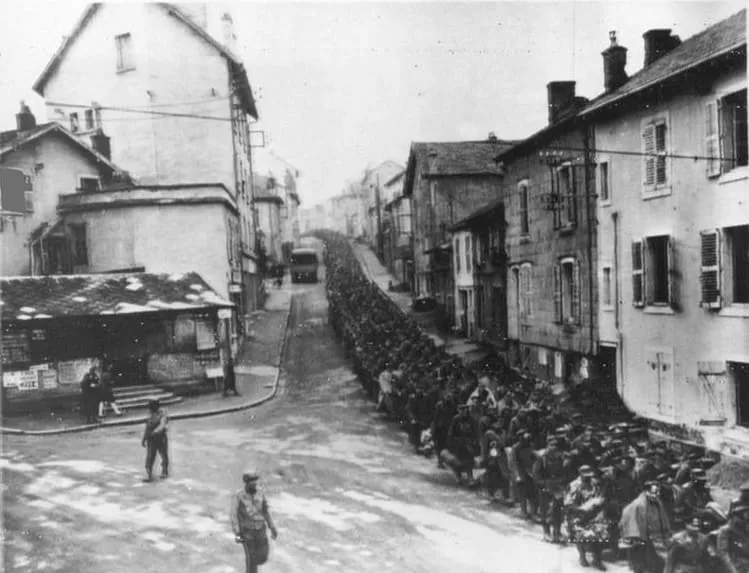
On Thursday 23 November 1944, at about 2.20 p.m., a French flag was raised on the tower of Strasbourg Cathedral. It was hoisted by soldiers of General Philippe Leclerc’s 2nd Armoured Division, which that morning, having crossed the Vosges, had hurled itself in five columns at the capital of Alsace and taken its German garrison by surprise. The trams were still running normally when the first Shermans drove through the streets.
The news that the French had entered Strasbourg – a city the Germans had treated as their own since 1940 – spread across the country the same day. For Leclerc and his men it was also the end of a road that had begun three and a half years earlier in the Libyan desert. Strasbourg was liberated by the French, with one qualification: Leclerc’s division fought as part of the American XV Corps and the US Seventh Army, and the breakthrough in the Vosges itself was the joint work of French and Americans. Fighting in the city went on for several more days, and the Germans held the forts and the bridgehead at the Rhine bridge until 25–28 November.
The Oath of Kufra
On 1 March 1941 the Italian garrison of the fort at the Kufra oasis in the Libyan Sahara surrendered. It had been taken by a column of a few hundred Free French from Chad commanded by Colonel Leclerc. In the courtyard of the fort (according to most accounts the next day, 2 March) Leclerc had his soldiers take an oath: “Swear not to lay down your arms until our colours, our beautiful colours, fly over the cathedral of Strasbourg.”
The choice of Strasbourg was no accident. The city, French since 1681, had been besieged and bombarded by the Prussians in 1870 and in 1871 incorporated into the German Empire together with Alsace and part of Lorraine. It returned to France after the First World War under the Treaty of Versailles. In 1940 it came under German rule again. For a French soldier Strasbourg Cathedral was the symbol of lands his country had fought over for three generations.
From Kufra Leclerc’s division had come a long way: through the Fezzan to Tripoli, through Tunisia, through training camps in Morocco and England. On 1 August 1944 it landed in Normandy, and on 25 August it entered Paris. In September, at Dompaire in Lorraine, it destroyed a German panzer brigade. In the autumn it passed from General George Patton’s Third Army to General Wade Haislip’s XV Corps, which was assigned to General Alexander Patch’s US Seventh Army. The Seventh Army in turn belonged to General Jacob Devers’s 6th Army Group – the forces that had landed in Provence in August and in September linked up near Dijon with the front advancing from Normandy. On the group’s right wing, by the Swiss border, fought General Jean de Lattre de Tassigny’s French First Army (PL).
Alsace under German rule
In September 1939, in the first days of the war, Strasbourg, lying right on the Rhine and within range of German artillery, was almost entirely evacuated; most of its inhabitants were taken into the interior of France, chiefly to the Dordogne and Haute-Vienne départements. In June 1940 the Germans occupied the city. The Armistice of Compiègne made no mention at all of Alsace and the Moselle, yet Berlin treated them as German land. Without a treaty or any formal, announced annexation, Alsace was placed under a head of civil administration, the Gauleiter of Baden, Robert Wagner, and the Moselle département under Gauleiter Josef Bürckel. The customs border was moved to the Vosges, and German law, the mark and German as the official language were introduced.
Germanisation was pursued methodically. The use of French in public places was forbidden, street names and French first names were changed, and French inscriptions were removed from monuments and shops. Tens of thousands of people deemed “undesirable” – Jews, people who had moved in from the French interior, known Francophiles – were expelled to the Vichy zone. The recalcitrant were sent to the security camp at Schirmeck, and in the Vosges, south-west of Strasbourg, the SS built the Natzweiler-Struthof concentration camp, the only such camp on the territory of pre-war France. In 1941 a German Reich University was opened in Strasbourg; the French University of Strasbourg had been operating in exile in Clermont-Ferrand since 1939.
The hardest experience for the people of Alsace and the Moselle was forced conscription. In August 1942, as in Luxembourg, the Germans introduced compulsory service in the Wehrmacht, and later in the Waffen-SS as well. According to the most frequently cited estimates, some 100,000–103,000 Alsatians and about 30,000 men from the Moselle were conscripted. They came to be called the malgré-nous – “against our will”. Desertion was punishable by death, and deserters’ families faced deportation to the Reich. Most were sent to the Eastern Front; tens of thousands of them – some 30,000–40,000 according to French historians’ estimates – were killed or went missing. Many of those taken prisoner by the Soviets ended up in Camp No. 188 at Tambov, from which some returned only years later. Some malgré-nous served in the SS division Das Reich, and a dozen or so of them were tried after the war for taking part in the Oradour-sur-Glane massacre – the 1953 trial divided France and Alsace for a long time.
At the same time many young Alsatians fled across the Vosges and through Switzerland to avoid the German army, and joined the Free French or the resistance. In November 1944 networks of the French Forces of the Interior (FFI) were active in Alsace, and the regional commander, Marcel Kibler (“commandant Marceau”), promised to place them at Leclerc’s disposal once the division came down onto the plain.
Across the Vosges
In the autumn of 1944 the front of the 6th Army Group came to a halt at the foot of the Vosges. The German Nineteenth Army under General Friedrich Wiese, part of General Hermann Balck’s Army Group G, was fortifying the passes with two defence lines, for whose construction – according to French studies – several tens of thousands of Alsatians were rounded up. The German command reckoned that the mountains, the rain and the coming winter would stop the Allies at least until the spring. To the north, in Lorraine, Patton’s Third Army had been attacking since 8 November on the Moselle and around Metz.
On 13 November the Seventh Army’s offensive began, and a day later that of the French First Army in the south, in the Belfort Gap. The French advanced faster than anyone had expected: on 19 November tanks of the 1st Armoured Division reached the Rhine near Rosenau, the first Allied troops on the whole Western Front to do so, and on 21 November they entered Mulhouse. At Belfort fighting went on for several more days.
In the northern sector Haislip’s XV Corps was attacking towards Saverne – the gap through which the road and railway run from Lorraine into Alsace. The American 44th and 79th Infantry Divisions were breaking the German fortifications frontally, while Leclerc’s division looked for a way round. On 17 November it took Badonviller; in the fighting Lieutenant Colonel Jean Fanneau de La Horie, one of Leclerc’s closest associates, was killed. Leclerc ordered his combat command leaders to bypass all resistance, not to look to their neighbours or their rear, and to find a “hole”. Guided by Alsatian FFI guides, the tank crews probed forest roads and tracks. Colonel Jacques Massu’s group found a passage near Dabo, blocked only by a barricade of felled trees, undefended and unmined. Other columns went through La Petite-Pierre. On 20–21 November Sarrebourg was liberated, on 22 November the Allies took Saverne, and the division came down from the mountains onto the Alsatian plain behind the Germans.
On the night of 22/23 November Leclerc received permission to strike at Strasbourg, which had previously been assigned to the American VI Corps. His order was brief: “Objective: Strasbourg – the Kehl bridge. (…) Do not stop, charge with all your might. Bypass resistance.” Prisoners were only to be disarmed, not guarded, and important personalities arrested.
The charge of 23 November
At 7 a.m. on 23 November the division set off from the Saverne area in five columns, led by Alsatian FFI volunteers. At about 9 the tanks reached the suburbs and the western ring of forts, built by the Germans after 1871. The forts, reinforced with anti-tank ditches and trenches that the city’s population had been forced to dig, stopped most of the columns. One of them, however – Lieutenant Colonel Rouvillois’s group from Colonel de Langlade’s combat command – came in from the north along the Marne–Rhine canal, slipped between the forts and drove into the city. Rouvillois sent the agreed signal: “Tissu est dans iode” (“The cloth is in the iodine”) – the division is in Strasbourg. The other columns turned onto his route.
The surprise was complete. Crowded trams were running in the city, and German soldiers and officials were walking the streets as the Shermans drove into them. A tank patrol captured the city commandant’s chief of staff during his morning ride, and the headquarters in the Palais du Rhin was seized. Gauleiter Wagner managed to escape across the Rhine. The garrison commander, Generalmajor Franz Vaterrodt, shut himself up with a few hundred men in Fort Ney in the north of the city. Several thousand German civilians, officials and their families, settled in Alsace after 1940, fell into French hands.
The fiercest fighting took place at the Rhine bridge leading to Kehl on the German side. Leclerc hoped to win a bridgehead in Germany itself, but the approaches to the bridge were heavily fortified and under fire. The FFI guide Robert Fleig was killed there, as was the commander of the tank Cherbourg, Staff Sergeant Albert Zimmer, an Alsatian from nearby La Wantzenau who had escaped from Alsace in 1941 to fight in the ranks of the Free French. The bridge was not taken.
At 2.20 p.m. Maurice Lebrun, a soldier of the 1st Moroccan Spahi Regiment, raised the flag on the cathedral tower. According to tradition it had been sewn at the soldiers’ request by Émilienne Lorentz, the owner of a butcher’s shop on the Place Saint-Étienne – from a sheet, a piece of cloth dyed blue and red fabric from a swastika banner. Leclerc announced to the inhabitants that the Oath of Kufra had been kept. General Charles de Gaulle, head of the provisional government, recognised by the Allies a month earlier, received the news as one of the most important symbols of France’s rebirth.
The last pockets of resistance
Over the following days the 2nd Armoured Division and FFI units commanded by Georges Kiefer (“commandant François”) cleared the city. The going was hardest in the barracks district on the Esplanade and in the port. The FFI guided the tanks, supplied infantry for the street fighting, guarded prisoners and interpreted at interrogations. On 25 November General Vaterrodt surrendered at Fort Ney with more than 600 soldiers; in all, according to French figures, some 6,000 German servicemen were taken prisoner. The city was shelled by artillery from across the Rhine. On the night of 27/28 November the last Germans withdrew from the bridgehead and blew the bridges to Kehl. On 27 November the pre-war mayor, Charles Frey, resumed office, and a Commissioner of the Republic took over authority on behalf of the provisional government.
In those same days the crimes committed in Alsace came to light. At the end of November (according to most studies on 23 November) soldiers of the 6th Army Group reached the already abandoned Natzweiler-Struthof camp, from which the SS had evacuated the prisoners to Dachau in September. In the anatomy institute of the German university in Strasbourg were found the bodies of victims murdered in 1943 in the Natzweiler gas chamber – several dozen Jews brought from Auschwitz for Professor August Hirt’s “skeleton collection”.
At the same time the American Third Army took Metz, though its forts held out into December. By the end of November both of the largest cities of the former German Reichsland of Alsace-Lorraine of 1871–1918 were in Allied hands.
What next: the Rhine, the Colmar Pocket and the January crisis
The 6th Army Group’s arrival on the Rhine raised the question of what to do next. On 24 November General Dwight Eisenhower and General Omar Bradley visited Devers’s headquarters at Vittel. According to accounts, they found Devers, Patch and Haislip planning to cross the Rhine at the beginning of December. Eisenhower refused: the Seventh Army was to turn north and support Patton’s offensive in Lorraine and the Saar, while the French cleared Alsace. The decision is still debated by historians.
Alsace was not cleared at that time. On 24 and 27 November Hitler ordered the Nineteenth Army to hold at all costs on the left bank of the Rhine, around Colmar. Thus arose the Colmar Pocket – an extensive German bridgehead south of Strasbourg that the French First Army was unable to eliminate before winter. Hitler entrusted command of the newly formed Army Group Upper Rhine to Heinrich Himmler.
Strasbourg was free, but not safe. After the German offensive in the Ardennes began, Eisenhower ordered at the end of December a shortening of the front in Alsace, which meant withdrawing troops from the city. On New Year’s Eve the Germans launched Operation Nordwind, and at the beginning of January they also struck from the bridgehead at Gambsheim and from the Colmar Pocket. De Gaulle declared that France would not abandon Strasbourg and its inhabitants to German reprisals, and ordered de Lattre to defend the city even without the Americans. On 3 January 1945, at a meeting attended by Winston Churchill, Eisenhower changed his decision. The city was held, though it remained under fire until the spring. The Colmar Pocket was eliminated in fighting from 20 January to 9 February 1945, and Colmar was liberated on 2 February.
Place in the war
Militarily, the capture of Strasbourg was one of the boldest Allied armoured manoeuvres on the Western Front in 1944: the division crossed mountains defended by the Germans, covered some 40 km of plain in a few hours and took a large city almost without street fighting. The 6th Army Group stood on the Rhine from the Swiss border to far north of Strasbourg, although its success was not exploited to cross the river.
Politically the event mattered even more. After Paris it was the second great symbol of France’s rebirth, and de Gaulle used the fact that it was the French who entered Strasbourg in his disputes with the Allies over France’s place among the victors. For Alsace itself liberation began a difficult return: the reckoning with collaboration, the return of those expelled and evacuated, the long wait for the malgré-nous in Soviet camps and the painful question of who they had been – victims or perpetrators. Gauleiter Wagner, captured after the war, was sentenced by a French military court in Strasbourg and shot in 1946.
Leclerc later led his division to Royan and Berchtesgaden, and in the autumn of 1945 to Indochina. He was killed in an air crash in Algeria on 28 November 1947 and was posthumously made a Marshal of France. His monument in Strasbourg, unveiled in 1951, recalls the Oath of Kufra, and the tank Cherbourg, standing in the port district, the death of Albert Zimmer at the Kehl bridge. A few years after the war Strasbourg – a city that had changed its national allegiance four times in 75 years – became the seat of the Council of Europe and later of the European Parliament, a symbol of Franco-German reconciliation.
Sources
Meanwhile
(04)Elsewhere, within a week.
- 25 November 1944 · Far EastNanning and the threat to KunmingOn 24 November 1944 the Japanese took Nanning again. After Guilin and Liuzhou fell, their push into Guizhou threatened Guiyang and the road to Kunming.
- 25 November 1944 · Eastern FrontThe capture of SaaremaaOn the night of 23–24 November 1944 the Germans evacuated the Sõrve peninsula. All of Saaremaa, most of it taken on 5–8 October, was now in Soviet hands.
- 26 November 1944 · PolandThe end of the gas chambers at BirkenauIn autumn 1944 the SS stopped gassing at Birkenau. On 26 November, by the accepted date, Himmler ordered the crematoria destroyed to hide the crime.
- 20 November 1944 · PoliticsHitler leaves the Wolf's LairOn 20 November 1944 Hitler left his headquarters near Rastenburg for good. In Berlin he had throat surgery; he moved into the Führerbunker only in January 1945.
Related events
(04)The same battle, people or subject.
- 1 January 1945 · Western FrontOperation Nordwind beginsOn New Year's Eve the Germans struck the overstretched US Seventh Army in northern Alsace. Operation Nordwind was their last great offensive in the west.
- 8 January 1945 · Western FrontThe dispute over StrasbourgIn early January 1945 Eisenhower wanted to pull back from around Strasbourg. De Gaulle refused and forced a change on 3 January. The French defended the city.
- 19 August 1944 · Western FrontThe Paris uprisingOn 19 August 1944 police officers seized the Prefecture on the Île de la Cité and Colonel Rol-Tanguy's FFI took on General von Choltitz's garrison in Paris.
- 5 January 1945 · Western FrontThe Gambsheim bridgeheadOn 5 January 1945 the German 553rd Volksgrenadier Division crossed the Rhine at Gambsheim, north of Strasbourg, and formed a bridgehead on the left bank.