1944–1945: The liberation of Western Europe
Operation Nordwind
- Dates:
- 31 December 1944 – 25 January 1945
- Front:
- Western Front
- Location:
- France: northern Alsace and eastern Lorraine – the Saar valley near Sarreguemines, the Northern Vosges around Bitche (Wingen-sur-Moder, Reipertswiller), the Alsace plain from Wissembourg and Lauterbourg to Hatten, Rittershoffen and the Haguenau forest on the river Moder, the Rhine bridgehead at Gambsheim and Herrlisheim, and the sector south of Strasbourg (Rhinau, Obenheim, Erstein) on the northern edge of the Colmar PocketOn the battle map →
- Sides:
- United StatesJacob Devers, Alexander Patch, Edward BrooksFranceJean de Lattre de TassignyNazi GermanyJohannes Blaskowitz, Heinrich Himmler, Hans von Obstfelder
- Result:
- Allied defensive victory. The Germans took part of northern Alsace and forced the US VI Corps to withdraw to the river Moder, but they did not destroy the Seventh Army, did not retake Strasbourg and did not draw significant Allied forces away from the Ardennes. By 25 January the offensive had petered out, and the best German divisions were sent east.
- Author:
- Natalia
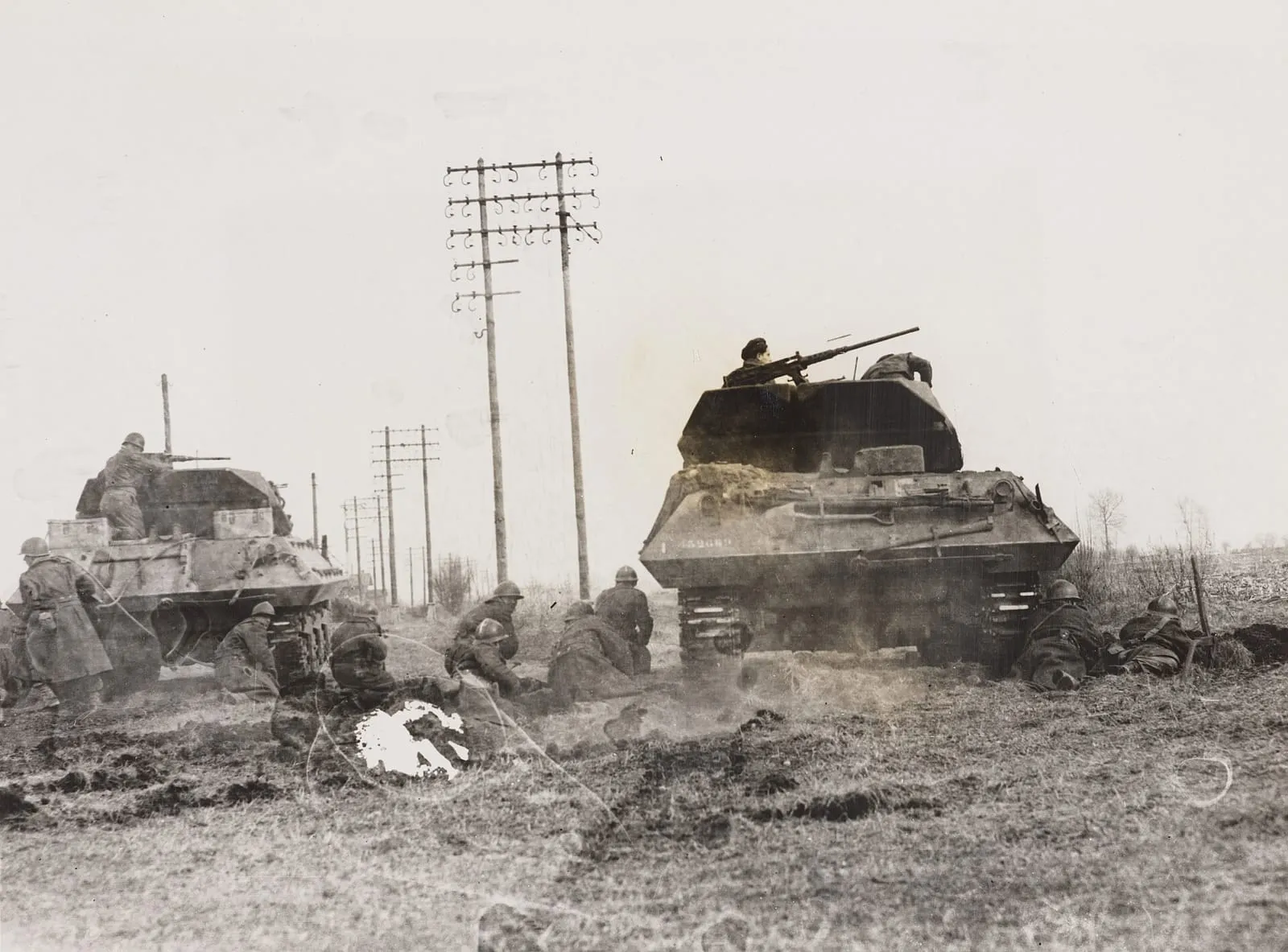
Operation Nordwind (“North Wind”) was the last German offensive on the Western Front, launched in the final hours of 1944. On New Year’s Eve the First Army of Army Group G struck from the area of Bitche and from the Saar valley at the US Seventh Army, which was stretched along a long front in northern Alsace and eastern Lorraine. In the weeks that followed further blows were added: across the Rhine at Gambsheim, from the pocket around Colmar south of Strasbourg, and on the Alsace plain at Hatten and Rittershoffen.
The offensive had two aims. The military one was to destroy the US VI Corps in the bend of the Rhine and to draw Allied forces away from the Ardennes, where the German attack had already broken down. The political one was to take Strasbourg, liberated only a few weeks earlier, back from the French. Neither was achieved. The Americans gave up some ground and withdrew to the river Moder, but their front did not collapse, and Strasbourg remained in French hands. The fiercest dispute of the campaign, however, was fought not on the battlefield but between General Dwight Eisenhower and General Charles de Gaulle – over whether the city should be defended at all.
Name and dates
The code name Nordwind originally applied to the First Army’s attack from the Bitche and Saar area. In the literature, especially American (Operation Northwind), the name is usually extended to the whole series of German attacks in Alsace from 31 December 1944 to 25 January 1945, including the actions of Heinrich Himmler’s Army Group Upper Rhine (Oberrhein) on the Rhine and the Nineteenth Army’s attack from the Colmar Pocket, which the Germans called Sonnenwende (“Solstice”). The same name was also borne by a later armoured operation near Stargard in Pomerania in February, with which it should not be confused. American soldiers called the whole struggle simply the “New Year’s Eve offensive”; the US Army’s official history (Jeffrey Clarke and Robert Ross Smith, Riviera to the Rhine) describes it as the battle for Alsace.
The operation is taken to have begun on the evening of 31 December 1944: the first German units moved off to attack without an artillery preparation before midnight and struck the American lines around midnight, at the turn of the year. For this reason some studies and chronicles give the date as 1 January 1945. It is considered to have ended on 25 January 1945, when the last attacks on the Moder line near Haguenau were repulsed and the German command called off the offensive. The fighting for the Colmar Pocket went on until 9 February, but by then it was an Allied offensive and not part of Nordwind.
Background
The southern wing of the Allied armies in the west was formed by General Jacob Devers’s 6th Army Group, made up of General Alexander Patch’s US Seventh Army and General Jean de Lattre de Tassigny’s French First Army (PL). Both armies had landed in Provence in August 1944 (Operation Dragoon), advanced north up the Rhône valley and reached the Vosges in the autumn. In November they broke through the front: General Philippe Leclerc’s French 2nd Armoured Division liberated Strasbourg on 23 November, and the French First Army reached the Rhine near the Swiss border. Between them, however, there remained a large German bridgehead on the left bank of the Rhine around Colmar, held by the Nineteenth Army – the so-called Colmar Pocket. In the north, in December, the Seventh Army crossed the German border in the Palatinate and approached the Siegfried Line.
The German Ardennes offensive of 16 December reversed the situation. General George Patton turned his Third Army north to relieve Bastogne, and the Seventh Army had to take over part of his former sector on the Saar and give up several divisions to the reserve. As a result, at the end of December Patch had about 135 kilometres of front to defend – from near Saarbrücken to the Rhine at Lauterbourg – plus the bank of the Rhine as far as Strasbourg. On the left flank stood General Wade Haislip’s XV Corps, and on the right, in the so-called Lauterbourg salient, General Edward Brooks’s VI Corps. Many divisions had only just arrived from the United States and had no combat experience; of some of them, such as the 42nd, 63rd and 70th Infantry Divisions, only the infantry regiments had so far arrived, and these were formed into improvised task forces.
Eisenhower expected the Germans to attack in the south as well. As early as 26 December he was considering shortening the front by withdrawing VI Corps from the salient on the Rhine to the line of the Vosges, which meant giving up the Alsace plain, together with Strasbourg, without a fight. Devers and Patch prepared to defend themselves, and reconnaissance – reports of troop concentrations and German reconnaissance flights – pointed to the Saar valley as the likely direction of attack. According to the US Army’s official history, however, decrypted German communications (Ultra) did not reveal the enemy’s specific intentions. The attack was therefore not a complete surprise to the Americans as to its timing and general location, but its main weight fell where it had not been expected – in the wooded, difficult Northern Vosges.
Forces and plan
The plan was drawn up at Adolf Hitler’s headquarters in the last days of December, when it had become clear that the Germans would not reach the Meuse in the Ardennes. On 28 December Hitler received the commanders of the divisions earmarked for the attack at the Adlerhorst headquarters near Bad Nauheim. According to the surviving stenographic record, he said that the aim was not prestige or the capture of ground but “the destruction and extermination of enemy forces wherever we find them”. He hoped that smashing VI Corps in the bend of the Rhine would force the Allies to move troops south from the Ardennes and, at a later stage, make possible a further blow against the rear of Patton’s Third Army (the planned Operation Zahnarzt, “Dentist”, which was never carried out).
The main attack was entrusted to Colonel General Johannes Blaskowitz’s Army Group G, and within it to General Hans von Obstfelder’s First Army. Two groupings were to attack. In the Saar valley, near Sarreguemines and Rimling, General Max Simon’s XIII SS Corps with the 17th SS Panzergrenadier Division Götz von Berlichingen and the 36th Volksgrenadier Division. To the east of it, from the Bitche area through the forests of the Northern Vosges, General Erich Petersen’s XC Corps and General Gustav Hoehne’s LXXXIX Corps with four Volksgrenadier divisions (the 256th, 257th, 361st and 559th). In support was to come the 6th SS Mountain Division Nord, arriving from Finland, rested and trained for winter warfare, while the XXXIX Panzer Corps, with the 21st Panzer Division and the 25th Panzergrenadier Division, remained in Army Group reserve. The troops moved at night and without radio communication, and the attack was to begin without an artillery preparation in order to achieve surprise.
The second pillar of the plan was the forces of Heinrich Himmler. The Reichsführer-SS, who had no experience whatsoever of commanding troops in the field, had since the end of November headed Army Group Upper Rhine, which was responsible for the stretch of the Rhine from Lauterbourg to Switzerland and for General Siegfried Rasp’s Nineteenth Army in the Colmar Pocket. In successive phases his troops were to force the Rhine north of Strasbourg and strike from the Colmar Pocket towards the city. According to accounts, Himmler promised Hitler that Strasbourg would be taken by 30 January 1945, the anniversary of the Nazis’ coming to power. The divided command – Blaskowitz answered to the Commander-in-Chief West, Field Marshal Gerd von Rundstedt, while Himmler answered directly to Hitler – hampered the coordination of the two parts of the offensive throughout its course.
On the Allied side the Seventh Army had about ten divisions in its two corps, including the 44th, 45th, 79th and 100th Infantry Divisions, the 14th Armored Division and the incomplete 42nd, 63rd and 70th Infantry Divisions; in January the 12th Armored Division and the 36th Infantry Division arrived, and at the end of the month the 101st Airborne Division from the Ardennes. The southern part of Alsace and Strasbourg were covered by the French First Army. The Allies had a decisive superiority in the air and in artillery, but in winter, with low cloud and snow, their air forces could exploit it only on the few clear days.
The Saar and the Vosges (31 December – 6 January)
The attack began in the final hours of 1944. On the western flank XIII SS Corps struck the 44th and 100th Infantry Divisions in the Saar valley, which were dug in and deployed in depth. It was here that the Americans had expected the main attack, and here that the Germans were most quickly defeated: the SS panzergrenadiers drove a narrow wedge a few kilometres deep near Rimling, but the 100th Division held its positions, and American artillery and counter-attacks over the following days won back most of the lost ground. After a few days the attack in the Saar valley stalled.
The situation was far more dangerous to the east, in the Northern Vosges. The densely wooded mountains between Bitche and Haguenau, cut by narrow valleys, were covered only by thinly spread cavalry groups and the inexperienced regiments of the 70th Division, and the command had not expected a strong attack there. The Volksgrenadier divisions infiltrated through the gaps and in the first few days advanced a dozen kilometres or more to the south. This threatened a breakout onto the Alsace plain behind VI Corps, which was still holding the salient on the Rhine east of the mountains. The fighting turned into fierce infantry clashes for mountain villages and roads – Lemberg, Wimmenau, Reipertswiller, Mouterhouse, Baerenthal, Philippsbourg – in snow and in frosts of minus ten degrees and more.
From 2 January the Germans committed the SS Nord division. On 4 January its mountain regiment took the village of Wingen-sur-Moder, the furthest point of the German penetration in the Vosges, on the road to the Moder valley. The Americans surrounded the village and, after two days of fighting, retook it by 7 January with forces of the 45th and 70th Divisions, freeing the prisoners held there. Patch and Brooks moved further units into the mountains, among them from the 45th Division, which knew the ground from the autumn fighting. By mid-January the attack in the Vosges had exhausted itself, and the German divisions, although they had taken a belt of forests and villages, had been unable to break out onto the plain.
At the same time, on 1 January, the Luftwaffe carried out Operation Bodenplatte – a massed fighter raid on Allied airfields in Belgium, the Netherlands and northern France. It did not directly support the fighting in Alsace, though it is sometimes linked with it as part of the same New Year series of attacks. For the Luftwaffe it ended in heavy losses, and over Alsace German air power played no significant part in January.
The dispute over Strasbourg
The German attack settled a decision that Eisenhower had been considering since Christmas. On 1 January he ordered Devers to withdraw VI Corps from the salient on the Rhine and gradually go over to the defensive on the line of the Vosges; he regarded the defence of Strasbourg as secondary to the need to shorten the front and rebuild reserves. Devers informed the French liaison officer of the order that same day, although he himself had asked headquarters to “clarify” it, and VI Corps began planning the first stage of a withdrawal to the Maginot Line.
For the French, giving up Strasbourg was unacceptable. The city, which Germany had de facto annexed together with Alsace in 1940, was of symbolic importance to France, and its inhabitants, who had welcomed Leclerc’s soldiers in November, might face reprisals if the Germans returned – de Gaulle raised such fears, and many Alsatians shared them. General Charles de Gaulle, head of the Provisional Government, learned of the withdrawal plans as early as 28 December. The Chief of Staff of National Defence, General Alphonse Juin, protested at SHAEF headquarters; on 1 January de Gaulle wrote to Eisenhower, and on 2 January he ordered de Lattre to defend the city even without the Americans. During the night of 2–3 January, in a heated conversation with Eisenhower’s chief of staff, General Walter Bedell Smith, Juin conveyed the threat that the French First Army would be withdrawn from Allied command if Strasbourg were abandoned. De Gaulle also appealed for support to Winston Churchill and President Roosevelt.
On 3 January Dwight Eisenhower met de Gaulle at Versailles, in the presence of Churchill, who had come to SHAEF headquarters, the Chief of the Imperial General Staff, General Alan Brooke, and Juin. Eisenhower gave way: he amended the order so that VI Corps would withdraw only to a shorter line in northern Alsace, and the French would take over the defence of Strasbourg. According to the US Army’s official history, he had changed his decision even before the meeting itself. The dispute showed how far, for de Gaulle, the war was also a struggle for France’s standing among the Allies, and, for Eisenhower, a struggle to keep together a coalition he could not put at risk for the sake of military logic.
Strasbourg itself was defended in January chiefly by French troops – units of the 3rd Algerian Infantry Division, brought over from the Vosges, and formations made up of former resistance fighters (FFI), among them the Alsace-Lorraine Brigade. The US VI Corps fought further north of the city – in the bend of the Rhine, on the Rhine at Gambsheim and on the plain near Hatten.
On the Rhine: Gambsheim and Herrlisheim
As the attack in the Vosges was losing momentum, Himmler’s troops entered the fight. During the night of 4–5 January the 553rd Volksgrenadier Division crossed the Rhine at Gambsheim, only a dozen or so kilometres north of Strasbourg, and established a bridgehead on the left bank. Its chain of command is given differently in the literature – some sources assign it to the XIV SS Corps of General Erich von dem Bach-Zelewski, who a few months earlier had crushed the Warsaw Uprising, others directly to the troops of Army Group Upper Rhine. The stretch along the Rhine was covered by weak units of a task force formed from regiments of the 42nd Division, which failed to drive the Germans back into the river.
The bridgehead threatened both Strasbourg and the right flank and rear of VI Corps. The Americans tried several times to eliminate it. From 8 to 10 January one of the combat commands of the newly arrived 12th Armored Division attacked Herrlisheim, without success. From 16 January the whole division went into the attack, but the Germans had reinforced the bridgehead with the 10th SS Panzer Division Frundsberg, brought across the Rhine. On 17 and 18 January two American battalions were destroyed in and around Herrlisheim – the 17th Armored Infantry Battalion and the 43rd Tank Battalion; some thirty knocked-out tanks of the latter were later found. The 12th Armored Division’s losses in this fighting are estimated at about 1,250 men. The Gambsheim bridgehead survived, and after the American withdrawal to the Moder it became part of the new front line, which held until the spring.
Operation Sonnenwende: the attack from the Colmar Pocket
On 7 January – 8 January according to some German sources – General Rasp’s Nineteenth Army went into the attack from the northern edge of the Colmar Pocket. In Operation Sonnenwende, LXIV Corps, with the 198th Volksgrenadier Division and the 106th Panzer Brigade, struck north from the Rhinau area, between the Rhine and the river Ill, towards Strasbourg. This was not a breakout “from encirclement”: the Colmar Pocket was a German bridgehead on the left bank of the Rhine, linked by bridges to Baden, and the attack went out of it northwards, not eastwards.
In the Germans’ path stood units of the 1st Free French Division and other formations of the French First Army, spread out over a wide sector. The French held out at Herbsheim, Rossfeld and Obenheim, where a surrounded battalion surrendered on the evening of 10 January (according to other sources on 11 January). The Germans reached the area of Krafft and Erstein, about twenty kilometres from Strasbourg, but on 12 January the attack came to a halt on the Ill. The French, reinforced, stabilised the front, and by about 16 January the fighting had died down. For Strasbourg this was the most dangerous moment of the campaign: the city was caught in a pincer between the Gambsheim bridgehead and Rasp’s wedge.
Hatten and Rittershoffen
The last and hardest phase of the offensive was fought on the Alsace plain south of Wissembourg. When VI Corps withdrew from the most exposed part of the salient on the Rhine to the old Maginot Line, Blaskowitz committed the XXXIX Panzer Corps from reserve. Its objective was to break through the Haguenau forest to the south and link up with the Gambsheim bridgehead, which would have cut off the American forces in the bend of the Rhine.
The first attacks on the villages of Hatten and Rittershoffen came on 8–10 January, and from 13 January the fighting reached its greatest intensity. On the German side the attackers were the 21st Panzer Division – including the regiment of Colonel Hans von Luck, a veteran of Africa and Normandy – and the 25th Panzergrenadier Division; on the American side the defenders were the 79th Infantry Division, supported by the 14th Armored Division and regiments of the 42nd Division. For a week the two sides held opposite ends of both villages, fighting for individual houses, streets and the bunkers of the Maginot Line, while the inhabitants survived in cellars under constant artillery and tank fire. Von Luck later wrote that it was one of the hardest and most costly battles he had ever taken part in. Both villages were almost completely destroyed, and there were dead and wounded among the civilians.
The withdrawal to the Moder and the end of the offensive
Around 19–20 January the Germans renewed their attack on VI Corps’s right flank – from the Gambsheim bridgehead, reinforced by the Frundsberg division, towards the river Zorn and Haguenau. Threatened with being outflanked, and with two exhausted armoured divisions, Brooks decided to withdraw. During the night of 20–21 January the units of VI Corps north of the Haguenau forest broke contact with the enemy and fell back to a prepared line on the rivers Moder and Zorn, shortening the front. According to the US Army’s official history, the manoeuvre took the Germans by surprise, and they spent the following days approaching the new positions.
On 24 and 25 January German divisions, including the 10th SS Panzer Division and the 6th SS Mountain Division, attacked the Moder line near Haguenau, Neubourg and Schweighouse. The attacks were repulsed; the 222nd Infantry Regiment of the 42nd Division received a Presidential Unit Citation for the fighting at Haguenau. On 25 January, as American reinforcements began arriving from the Ardennes, the German command called off the offensive. Meanwhile, on 12 January, the great Soviet offensive on the Vistula had begun, and the best divisions in Alsace – especially the armoured and SS divisions – began to be transferred east. By the end of January Himmler had taken command of Army Group Vistula in Pomerania, and on 28 January Blaskowitz was replaced at the head of Army Group G by General Paul Hausser.
Losses
The figures for losses are estimates, as the US Army’s official history itself stresses (Clarke and Smith, Riviera to the Rhine). According to it, the Seventh Army’s losses in January 1945 amounted to about 14,000 men. The Seventh Army’s post-war operational report, on which this figure is based, lists 11,609 battle casualties (killed, wounded and missing), plus 2,836 cases of trench foot and 380 of frostbite. French losses, suffered mainly in the fighting against Operation Sonnenwende and in the defence of the approaches to Strasbourg, are not given consistently in the literature; some studies put them at several thousand killed and wounded.
The same history estimates German losses at nearly 23,000 men – according to the Seventh Army’s report, about 17,000 killed and wounded and 5,985 prisoners. Clarke and Smith point out that the Allies could make good their losses while the Germans could not: in Alsace divisions were bled white that would be sorely missed a few weeks later, both on the Rhine and on the Oder.
The civilian population of northern Alsace suffered badly. Villages in the Northern Vosges, on the Maginot Line and around Gambsheim and Herrlisheim changed hands repeatedly, and some, such as Hatten and Rittershoffen, were almost entirely destroyed. The inhabitants, most of whom stayed put during the fighting, were killed by the fire of both sides; some of them, especially in places reoccupied by the Germans, faced reprisals for having welcomed the Allies in November.
Significance
Nordwind was the last German offensive in the west, and it ended in failure. The Germans won a belt of territory in the Northern Vosges and forced VI Corps to give up the salient on the Rhine, but they did not destroy any major Allied formation and did not retake Strasbourg. Nor did they achieve their main operational aim: Eisenhower did not move forces south in a way that would have relieved the German troops in the Ardennes. The offensive cut by several weeks the time the Germans had to rebuild their reserves before the coming offensives of the Allies and the Red Army.
The campaign exposed weaknesses on both sides. On the German side – the division of command between Blaskowitz and Himmler, whose military leadership proved incompetent, and the lack of forces to exploit initial successes. On the Allied side – the Seventh Army’s overly thin line after troops had been sent to the Ardennes, and political tensions within the Franco-American coalition. The dispute over Strasbourg ended in a compromise that confirmed de Gaulle’s position as a partner of the Allies rather than merely the commander of troops under their orders.
The direct consequence was the elimination of the Colmar Pocket. On 20 January the French First Army, reinforced by the US XXI Corps, launched an attack on the German bridgehead; Colmar was liberated on 2 February, and on 9 February the last German units withdrew across the Rhine. In mid-March 1945 the Seventh Army set off from the Moder on an offensive that carried it through the Palatinate to the Rhine and deep into Germany. The memory of the fighting in northern Alsace is preserved by, among other things, the museum in a Maginot Line bunker at Hatten and local memorials to the civilian victims.