1937–1945: The Sino-Japanese War
Japanese invasion of French Indochina
- Dates:
- 22–26 September 1940
- Front:
- Far East
- Location:
- Northern Tonkin (French Indochina) – the border with the Chinese province of Guangxi around Đồng Đăng and Lạng Sơn, and the coast of the Gulf of Tonkin near HaiphongOn the battle map →
- Sides:
- Japan (5th Division of the South China Area Army and the Indochina Expeditionary Force, supported by the navy)Aketo Nakamura, Takuma NishimuraVichy France (colonial forces of French Indochina)Jean Decoux, Maurice Martin
- Result:
- Japanese victory. The Lạng Sơn garrison surrendered on 25 September, and the Japanese occupied the airfields and ports of northern Tonkin. The French administration remained in place.
- Author:
- Łukasz
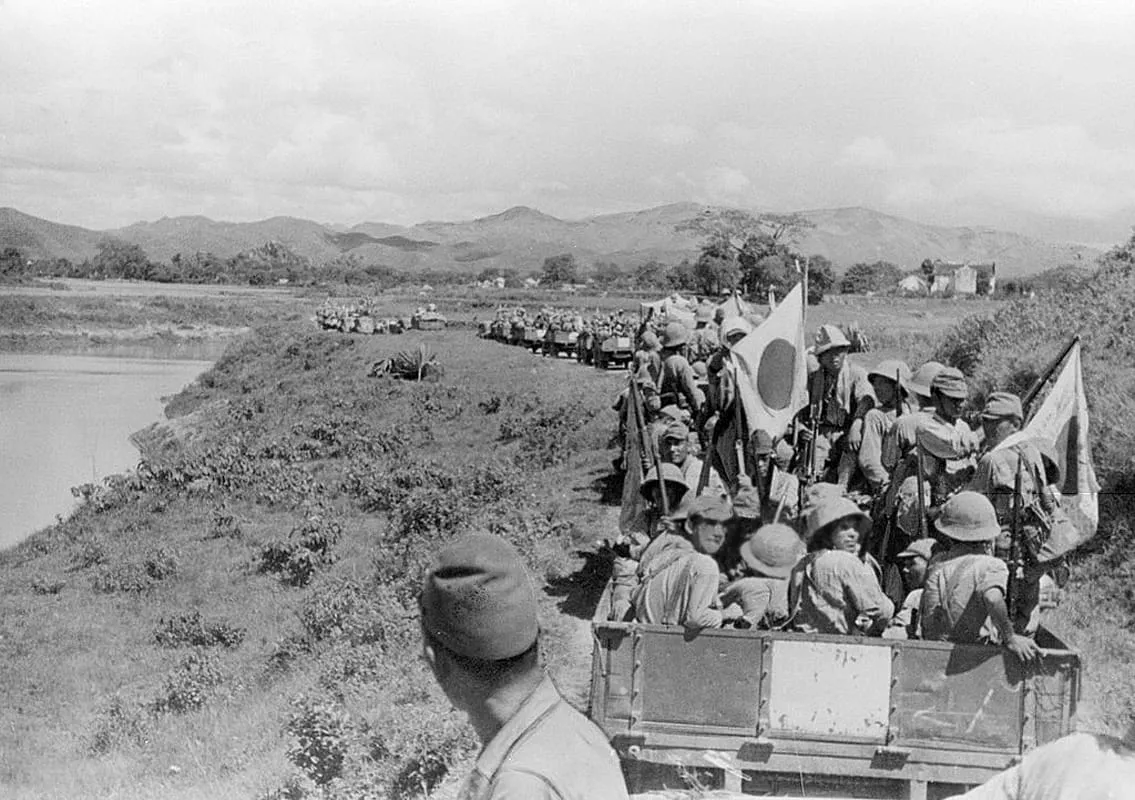
The Japanese invasion of French Indochina in September 1940 was a short, undeclared war between Japan and Vichy France. It broke out a few hours after representatives of the two sides had signed an agreement in Hanoi permitting the Japanese to enter the northern part of the colony peacefully. Even so, on the evening of 22 September the Japanese 5th Division under Lieutenant General Aketo Nakamura crossed the border from China and attacked the French posts around Lạng Sơn. After three days of fighting the town’s garrison surrendered. On 26 September other Japanese troops landed south of Haiphong, and aircraft bombed the port. The fighting ended the same day. Japan gained what it had been fighting for since the start of the war with China: the closure of the last railway route supplying the government of Chiang Kai-shek, and airfields and ports in Tonkin. The French administration and colonial army remained in place for another four and a half years, but from then on they existed on Japanese sufferance.
Name and dates
Japanese historiography calls these events the “advance into northern French Indochina” (hokubu Futsu-in shinchū). The word shinchū, denoting the entry of troops, was deliberately neutral: officially Japan was not at war with France, and its units entered the colony on the basis of an agreement. The French spoke of the “Lạng Sơn incident”, and French historians of “Japanese aggression” or “the Japanese invasion of Indochina”.
The start is taken to be 22 September 1940 at 10 p.m. local time, when the columns of the 5th Division crossed the border in the Đồng Đăng area. In Japanese sources the attack begins in the early hours of 23 September, because Tokyo time was then two hours ahead of Hanoi and the ultimatum expired at midnight Japanese time. The end is 26 September, when the last fighting ceased after the landing near Haiphong. A formal ceasefire on the border had already come into effect on the evening of 25 September, and some chronologies place the landing in the Gulf of Tonkin and the bombing of Haiphong on 25 September. The date of 26 September is supported by the French accounts on which historians rely (Claude Hesse d’Alzon, Paul Auphan and Jacques Mordal).
Background
The road to Kunming. After losing the coast in 1937–1938, the Chinese government in Chongqing received foreign aid almost exclusively along three routes: through Soviet Central Asia, by the Burma Road from Rangoon, and through French Indochina. The last was the most important. Goods unloaded at Haiphong travelled by rail through Hanoi and Lào Cai to Kunming in Yunnan province, or by rail to Lạng Sơn and from there by lorry into Guangxi. In 1937 France formally banned the carriage of arms to China, but the transit continued, and Japan demanded in vain that the border be closed in 1938 and 1939. Japanese aircraft bombed the Yunnan railway, and in November 1939 the 5th Division, landed on the coast of the Gulf of Tonkin, took Nanning and cut the road from Lạng Sơn into the interior of China. The railway to Kunming, however, kept running.
June 1940. France’s defeat in Europe gave Tokyo the opportunity the Japanese army had long been seeking. On 19 June the Japanese demanded that the Governor-General of Indochina, General Georges Catroux, close the border with China within twenty-four hours and admit a Japanese control commission. Catroux, knowing that the colony could count on help neither from metropolitan France nor from Britain or the United States, agreed without consulting the government. At the end of June the last train carrying ammunition for China crossed the border, and a Japanese mission under Major General Issaku Nishihara arrived in Hanoi. The government of Marshal Philippe Pétain treated Catroux’s acting on his own authority as grounds for recalling him. His successor was the commander of the French fleet in the Far East, Vice-Admiral Jean Decoux, who took office in July. Catroux, instead of returning to France, joined de Gaulle in London.
Japan quickly raised its demands. Nishihara insisted on the right to move troops through Tonkin and to use its airfields. In Tokyo the second Konoe government, formed on 22 July, wrote into its foreign policy programme that Indochina should be required to halt the transit to China and grant rights of passage for troops and the use of airfields, and that force should be used “depending on circumstances”. The Foreign Minister, Yōsuke Matsuoka, negotiated with the French ambassador, Charles Arsène-Henry. On 30 August the two sides concluded an agreement: France recognised Japan’s “special interests” in the Far East and agreed that for the duration of the war with China Japanese troops could be stationed in Tonkin and pass through it, in return for an assurance that Japan would respect French sovereignty over Indochina. The details were to be settled on the spot by the military.
Negotiations in Hanoi. Decoux believed that the colony could not defend itself against a real invasion, but he hoped to deter the Japanese and drag out the negotiations. General Maurice Martin, commander of the troops in Indochina, conducted talks with Nishihara from 3 September and delayed them as best he could. The French also sought arms in the United States and help from the British and American consuls in Hanoi, and the Vichy government asked the Germans to restrain their ally. Berlin did nothing. In Japan, for its part, there was a strong faction that wanted to enter Indochina by force. Its spokesman was the chief of the Operations Section of the General Staff, Major General Kyōji Tominaga, who came to Indochina to hasten the negotiations and openly threatened the French. On 6 September a battalion of the Japanese 22nd Army crossed the border near Đồng Đăng. According to Japanese sources it had lost its way; according to French sources it was a deliberate provocation. There was no clash, but Decoux used the incident to break off the talks.
On 14 September guidelines were approved in Tokyo that provided for a peaceful entry but allowed the army to move to armed action if the French resisted. Tominaga went to Canton (Guangzhou), to the headquarters of Lieutenant General Rikichi Andō’s South China Area Army, and according to Japanese sources made it understood there that the entry into Indochina would on no account be peaceful. On 18 September Nishihara handed Decoux an ultimatum: Japanese troops would enter the colony on 22 September at 10 p.m. local time whether or not France consented. The Japanese staff had initially wanted the right to station 25,000 troops, but on 21 September this figure was reduced to 6,000.
Forces
The colonial forces of Indochina numbered some 32,000 regular and 17,000 auxiliary troops, most of them Vietnamese, Cambodian and Lao riflemen under French officers. They were poorly armed: they had obsolete guns and a few dozen light tanks, and the air force consisted mainly of about 70 obsolete Potez 25 observation aircraft and a dozen or so Morane-Saulnier MS.406 fighters. On the Guangxi border, in the Lạng Sơn–Cao Bằng sector, command was held by Brigadier General Germain Mennerat of the 2nd Brigade of the Tonkin Division. He had about 5,000 men of the 3rd Tonkinese Rifle Regiment, the 9th Colonial Infantry Regiment and the 5th Foreign Infantry Regiment of the Foreign Legion, supported by a tank group, a battalion of 75 mm guns and a battery of 155 mm guns. French intelligence believed that the Japanese troops in Guangxi were exhausted and demoralised by the long war with the Chinese. This quickly proved to be a mistake.
On the Japanese side the border was held by Lieutenant General Aketo Nakamura’s 5th Division, which had been fighting in Guangxi since the autumn of 1939 and was now to be withdrawn from China by way of Indochina. Its strength is estimated at 25,000–30,000 men with artillery and tanks. It came under the 22nd Army and the South China Area Army. The second grouping was the Indochina Expeditionary Force, formed at the beginning of September under Major General Takuma Nishimura. It consisted of an infantry brigade, an Imperial Guards regiment, a tank regiment and anti-aircraft units. It waited aboard transports off Hainan, covered by ships of the 2nd Fleet with the light cruiser Sendai and by the aircraft of the carrier Hiryū. It was this force that, under the agreement, was to enter the colony through the port of Haiphong.
The Martin–Nishihara agreement
On the afternoon of 22 September, some seven hours before the ultimatum expired, General Martin and General Nishihara signed a military agreement in Hanoi. Japan could keep up to 6,000 troops in Tonkin north of the Red River, use three airfields (four according to some sources), including Gia Lâm near Hanoi, and move troops through Tonkin to Yunnan, provided that no more than 25,000 Japanese soldiers were in the colony at any one time. The 5th Division had the right to pass through Tonkin to Haiphong and embark there. The final article forbade Japanese land, naval and air forces to enter the territory of Indochina except in cases expressly provided for in the agreement. The first units were to arrive by sea. By 9 p.m. news of the signing had been passed to all commands.
Course of the fighting
The border (22–23 September). The command of the South China Area Army had no intention of waiting. General Nakamura, who had received news of the signing, ignored it and at exactly 10 p.m. sent three columns across the border on a front of about 70 kilometres. At around 3 a.m. the General Staff in Tokyo issued an order to halt the advance, but the fighting was already under way. The army in the field had been given freedom to fight “locally” and interpreted it broadly.
The northern column took the border posts and moved towards That Khe, away from the main fighting. The central column crossed the border at Nam Quan (Na Cham), pushed back two companies of Tonkinese riflemen and turned south towards Đồng Đăng, along the road and railway to Lạng Sơn. At Na Cham the 10th Company of the 9th Colonial Infantry Regiment under Captain Carli inflicted heavy losses on the Japanese for a time before withdrawing. The fort at Đồng Đăng held out until the late morning of 23 September. According to Japanese sources its commander and many officers were killed and the rest of the garrison taken prisoner. The southern column passed through the post at Chi Ma, attacked Lộc Bình and turned north to cut the railway from Lạng Sơn to Hanoi. On 23 September the French command in Hanoi tried to bring the chaos under control and sent reinforcements to the sector, but in the afternoon the Japanese vanguards approached Lạng Sơn from the north. Japanese bombers attacked the town’s airfield and destroyed an observation aircraft on the ground. The same day the Vichy government protested in Tokyo against the violation of the agreement.
Lạng Sơn (24–25 September). On 24 September the 4th Battalion of the 3rd Tonkinese Rifle Regiment, brought in overnight from the border posts, was to counter-attack towards Đồng Đăng, but it was forestalled by a Japanese attack. Most of the battalion’s native soldiers scattered, leaving only the French. The Japanese columns tightened the ring around Lạng Sơn from the north and the south. According to French accounts, confusion reigned among the defenders, orders were contradictory, and the French artillery at times fired on its own troops. The local commander wanted to withdraw while the road was still open, but General Martin ordered the town to be held.
At 5.30 a.m. on 25 September the Japanese opened heavy artillery fire on the fortified positions at Ky Lua, on the northern bank of the Kỳ Cùng river. A shell hit the command post of the 3rd Tonkinese Rifle Regiment and killed its commander, Colonel Louat de Bort, along with part of his staff. At around 8.30 a.m. General Mennerat reported to Hanoi that Lạng Sơn, cut off from the outside world and deprived of air and artillery support, could not be held. At 10.40 a.m. Martin agreed to a surrender. Before giving themselves up, the French destroyed their 155 mm guns and threw the breechblocks into the river. According to an often-repeated story, when they were recovered years later, chests of money were found alongside them, sunk by the French at the same spot during the retreat from Lạng Sơn in 1885, in the Sino-French War. Most of the 1st Battalion of the 3rd Tonkinese Rifle Regiment and of the 2nd Battalion of the 5th Foreign Infantry Regiment, the remnants of the 1st Battalion of the 9th Colonial Infantry Regiment and the brigade staff were taken prisoner. According to the legionnaires’ accounts, their commander, chef de bataillon Marcelin, refused to hoist a white flag, so the battalion pennant was run up the mast instead, and the next day the legionnaires marched down from their positions in formation, with their band. The Japanese separated some 200 legionnaires of German and Austrian origin from the other prisoners and tried, without success, to persuade them to change sides.
On the evening of 25 September the fighting on the border ceased on an order from Tokyo, issued, according to both French and Japanese accounts, at the wish of Emperor Hirohito. Decoux, fearing that further resistance would end in the loss of the whole colony, forbade any resistance. To the north and south of the sector the French positions at That Khe and Na Dương, as well as the fresh battalions blocking the road from Lạng Sơn to Hanoi, remained intact.
Haiphong (24–26 September). Throughout the fighting on the border, the Japanese warships and the transports carrying the Indochina Expeditionary Force lay in the Gulf of Tonkin, and the French would not allow them to land troops. General Nishihara, who had just signed the agreement, left Haiphong on the night of 23/24 September aboard the destroyer Nenohi and joined the force. On the morning of 24 September aircraft from the carrier Hiryū began reconnaissance and intimidation flights and, according to some sources, attacked French positions on the coast. A French envoy went aboard the cruiser Sendai to negotiate, but the coastal defences had orders to open fire on anyone who tried to land by force.
At 3.30 a.m. on 26 September Japanese troops landed on the beach at Đồng Tắc near Đồ Sơn, south of Haiphong, and advanced on the city. A second wave put tanks ashore. At 6.30 a.m. Japanese aircraft bombed Haiphong. According to French accounts 37 civilians were killed. Some studies link the bombing of the city and the civilian casualties to raids by aircraft from Hiryū as early as 24 September. At around 1 p.m. a column of some 4,500 troops with a dozen or so tanks reached the outskirts of Haiphong. The French offered no resistance, and by the evening of 26 September the fighting was over.
Losses
Casualty figures are incomplete and vary from source to source. According to the 5th Division’s detailed combat report for 22–29 September, the division lost 71 killed and 230 wounded. An earlier Japanese monthly report gave 67 killed and 205 wounded, and a rounded figure of about a hundred killed also appears in the literature. According to the same Japanese monthly report, the French and their native troops lost 408 killed, and 2,216 were taken prisoner. Western studies usually speak of some 800–900 killed, wounded and missing on the French side. To these losses must be added the civilians killed in Haiphong and during the border fighting, whose number cannot be established precisely.
Significance
Japan. The entry into northern Indochina was Japan’s first step southwards, into the heart of colonial South-East Asia. The Japanese took over the airfields at Gia Lâm, Lào Cai and Phủ Lạng Thương, stationed 900 troops in Haiphong and 600 in Hanoi, and closed the railway to Kunming. China lost its most important supply route. It was left with the Burma Road, which the British, having closed it for three months in July, reopened in October 1940, and the route through the Soviet Union. From the airfields in Tonkin Japanese bombers could attack Yunnan and the Burma Road. Holding Nanning no longer made sense, and at the end of October 1940 the Japanese abandoned it. In October and November the 5th Division embarked at Haiphong, and a year and a half later it took part in the conquest of Malaya and Singapore.
The army’s insubordination, however, caused a scandal in Tokyo. Nishihara cabled the General Staff that “command has broken down, and we have lost trust at home and abroad”. The War Minister, Hideki Tōjō, treated the border crossing as an infringement of the prerogatives of the supreme command. Tominaga lost his post as chief of the Operations Section on 25 September, and Generals Andō and Nakamura were recalled and transferred to the reserve. All of them returned to service in the following years. At the beginning of October the Japanese officially expressed regret for the “Lạng Sơn incident” and released the French prisoners. The German and Austrian legionnaires were handed back only in mid-October. At the end of the month, at the ceremony returning Lạng Sơn to the French administration, Nakamura read out a message from the Emperor expressing deep regret for the “unforeseen incident”.
France and Indochina. Decoux preserved France’s formal sovereignty over the colony, but at the price of concessions that only grew in the months that followed. The colony, with Japanese troops stationed in it, became a base of operations for Japan and a source of rice, rubber and coal. The defeat at Lạng Sơn also undermined French prestige among the native population and with neighbouring states. As early as the end of September a Vietnamese communist uprising broke out around Bắc Sơn, behind the scene of the fighting, while the Vietnamese nationalists who had fought alongside the Japanese were abandoned by them and crushed by the French. Thailand, convinced of France’s weakness, put forward territorial claims that escalated into the Franco-Thai War at the turn of 1940 and 1941. In July 1941 Japanese troops also entered southern Indochina, and on 9 March 1945 they overthrew the French administration in a coup. The resulting power vacuum opened the way for the Việt Minh and led to the First Indochina War.
The United States and the Tripartite Pact. Washington responded to the Japanese entry into Tonkin almost immediately. On 25 September a new American loan of 25 million dollars to China was announced, and on 26 September President Franklin Delano Roosevelt announced an embargo, from 16 October, on exports of iron and steel scrap to destinations outside the Western Hemisphere and Britain. It hit the Japanese steel industry, which depended heavily on American scrap. On 27 September in Berlin Japan signed the Tripartite Pact with Germany and Italy, which was intended to deter the United States from war in the Pacific. The September fighting in Tonkin thus set off a chain of moves and countermoves that, by way of the entry into southern Indochina in July 1941 and the American oil embargo, led to the war in the Pacific in December 1941.