Japan
Yōsuke Matsuoka
Vice-president (from 1927) and president (1935–1939) of the South Manchuria Railway, Japanese delegate to the League of Nations (1932–1933), Foreign Minister (1940–1941)
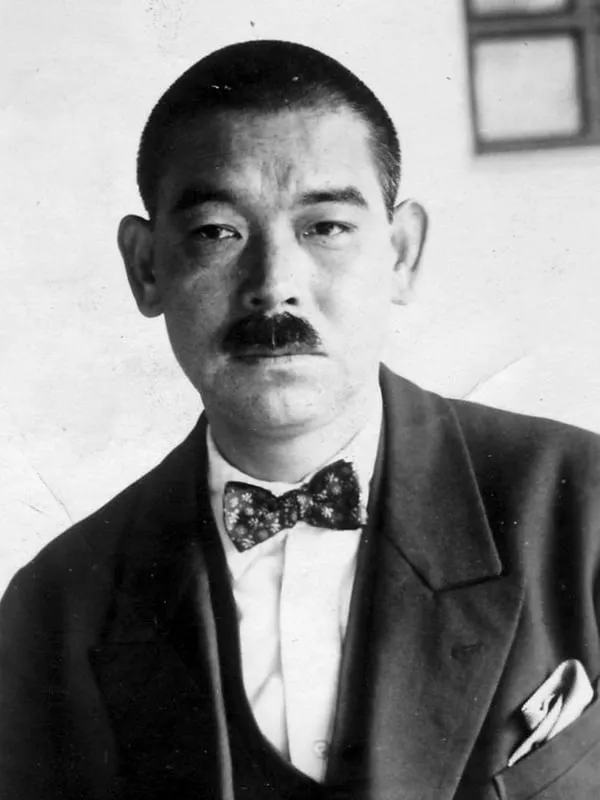
- Born:
- 4 March 1880, Murozumi, Kumage District, Yamaguchi Prefecture (Japan)
- Died:
- 27 June 1946, Tokyo
- Author:
- Natalia
- Photo:
- Credit line (ACME) 10/22/32, domena publiczna, Wikimedia Commons

Yōsuke Matsuoka was one of the most colourful politicians of Shōwa-era Japan, and one of the most harmful to his own country. Brought up in the United States from the age of thirteen and speaking better English than most Japanese diplomats, he believed all his life that he understood the Americans and knew how to deal with them: firmly, from a position of strength. In February 1933, as delegate in Geneva, he led the Japanese delegation out of the Assembly hall of the League of Nations, which opened the way to Japan’s withdrawal from the organisation. Seven years later, as Foreign Minister, he concluded an alliance with Germany and Italy and a neutrality pact with the USSR. After the outbreak of war with America he is said to have wept that the alliance with Hitler had been the greatest mistake of his life. He died during the Tokyo trial, before a verdict was reached.
A boy from Murozumi in Oregon
He was born on 4 March 1880 in the coastal village of Murozumi in Kumage District, Yamaguchi Prefecture, now part of the city of Hikari, the fourth son of a prosperous shipowner and merchant. When he was eleven his father went bankrupt. In 1893 the thirteen-year-old Yōsuke went with a cousin to the United States, where relatives of his were already living. He settled in Portland, Oregon. He lived with an American family, earning his keep as a houseboy, and his guardian, Mrs Isabelle Beveridge, became a kind of second mother to him. Under the influence of those around him he was baptised, and to the end of his life he described himself as a Christian.
He studied in Portland and in Oakland, California, and took all kinds of jobs – dishwasher, coffee salesman, interpreter. In 1900 he graduated in law from the University of Oregon. He also experienced the racism that Asian immigrants faced on the West Coast at the time. He brought back from America a conviction he repeated all his life: one must never give way to an American when one is in the right, because Americans respect only those who answer force with force. In 1902 he returned to Japan because his mother was ill.
Diplomat and man of Manchuria
He failed to get into Tokyo Imperial University, but in 1904 he passed the diplomatic and consular service examination with a very good result. His first postings were in Shanghai and in the administration of the Kwantung Leased Territory at Port Arthur, which Japan had taken in the war with Russia. There he met Shinpei Gotō, the first president of the South Manchuria Railway, and the businessman Jōtarō Yamamoto. Both became his patrons. He later served in Beijing, St Petersburg and Washington, and in 1916–1918 he was secretary to Prime Minister Masatake Terauchi and to Foreign Minister Gotō. He was an ardent supporter of the Siberian Intervention against the Bolsheviks. In 1919 he went to the Paris Peace Conference as press spokesman of the Japanese delegation. There he met the young Prince Fumimaro Konoe, with whom his fate would be bound up twenty years later.
In 1921 he left the diplomatic service and became a director of the South Manchuria Railway, a huge concern which, besides the railway, ran mines, ports, steelworks and research institutes and was the economic pillar of the Japanese presence in Manchuria. From 1927 he was its vice-president, alongside the president, Yamamoto, and he left the company at the turn of 1929 and 1930. Among other things he directed the expansion of the Fushun coal mine. He regarded Manchuria as crucial to Japan’s future and popularised the slogan that Manchuria and Mongolia were Japan’s “lifeline”.
In February 1930 he was elected to the House of Representatives for the Rikken Seiyūkai. In parliament he sharply criticised the conciliatory policy of Foreign Minister Kijūrō Shidehara towards China and the West. When in 1931 the Kwantung Army staged the Mukden Incident, he was at first dejected, believing that the economic approach in Manchuria had lost out to the military. He soon, however, became an advocate of recognising Manchukuo.
“Japan on the cross”
In the autumn of 1932 the government sent Matsuoka to Geneva as chief delegate to the League of Nations’ deliberations on the report of the commission headed by Victor Bulwer-Lytton. He was chosen above all for his gifts as an orator and his excellent English. Contrary to later legend, he did not go intending to break with the League. The government’s instructions envisaged withdrawal only as a last resort, and he himself spent several months looking for a compromise. Japan, however, could not agree to anything that called into question its recognition of Manchukuo, which it had announced in September 1932.
On 8 December 1932 Matsuoka delivered a speech to the Assembly, without notes, that lasted more than an hour. He argued that in Manchuria Japan was defending order against chaos and communism, and closed with a comparison: the world wanted to crucify Japan, but just as Jesus of Nazareth had in the end been understood, so Japan would be understood within a few years. At home the speech was received with enthusiasm; abroad, rather with astonishment. On 24 February 1933 the Assembly adopted, by 42 votes to one, a report that refused to recognise Manchukuo. Matsuoka read out a statement that Japan could not accept it and led the delegation out of the hall. On 27 March Japan withdrew from the League of Nations.
On his way home he visited Benito Mussolini in Rome. In Japan he was welcomed as a hero, “the man who told the world what needed saying”. He himself said that he was a defeated man, because he had failed to convince the world that Japan was in the right.
Against the parties
After his return Matsuoka, fascinated by fascism, left the Seiyūkai, gave up his seat in December 1933 and founded the League for the Dissolution of Political Parties. For a year he toured the country, arguing that parties divided the nation and calling for a “march on Tokyo” modelled on the March on Rome. His movement attracted many members but never became a political force.
In August 1935 Matsuoka returned to Manchuria as president of the South Manchuria Railway. He said that he felt more like an adviser to the Kwantung Army than the head of a company. Under his leadership the concern took over the management of practically the entire railway network of Manchukuo, including the Chinese Eastern Railway, bought from the USSR in 1935, and built new lines towards the Soviet border. He also expanded its research department. He was on close terms with the army leadership in Manchuria, including the chief of staff of the Kwantung Army, Hideki Tōjō, and was among the most influential men in Manchukuo. Although he supported the Anti-Comintern Pact, he declared that he did not share the Nazis’ antisemitism and backed plans to admit Jewish refugees to Manchuria.
Foreign Minister
In July 1940 Prince Konoe, forming his second government, gave Matsuoka the Foreign Ministry. He hoped that the energetic Matsuoka, who was popular with the army, would be able to keep foreign policy in civilian hands. Matsuoka began with a purge of the diplomatic service, recalling several dozen ambassadors and ministers. On 1 August 1940 he became the first member of the government to use the term “Greater East Asia Co-Prosperity Sphere” in public. During his tenure Japanese troops entered northern French Indochina, and in November Japan recognised Wang Jingwei’s collaborationist government in Nanjing.
Matsuoka envisaged a world divided into four great blocs: a European one led by Germany, an East Asian one led by Japan, a Soviet one and an American one. The alliance with Germany and Italy, followed by an understanding with the USSR, was meant to make the United States more accommodating and to deter it from war. On 27 September 1940 the Tripartite Pact between Germany, Italy and Japan was signed in Berlin. In the spring of 1941 Matsuoka travelled to Europe. In Berlin he held talks with Adolf Hitler and Joachim von Ribbentrop, who urged him to attack British Singapore but referred only obliquely to the planned invasion of the USSR. In Rome he met Mussolini and Pope Pius XII. On his way back, on 13 April 1941, he signed the Soviet–Japanese Neutrality Pact with Vyacheslav Molotov in Moscow. Joseph Stalin came to the station in person to see him off.
That was the high point of his career. Immediately afterwards everything began to fall apart. In his absence the ambassador in Washington, Admiral Kichisaburō Nomura, had opened talks with Secretary of State Cordell Hull. Matsuoka, offended that they had been conducted without him, obstructed them and hardened Japan’s terms. On 22 June 1941 Germany invaded the USSR. Matsuoka, who two months earlier had signed the neutrality pact, now demanded an immediate attack on Siberia alongside Germany, while at the same time opposing the occupation of southern Indochina, warning that it would lead to war with America. The army, the navy and the prime minister had had enough of him, and Emperor Hirohito also thought he should be removed. On 16 July 1941 Konoe submitted the resignation of the entire cabinet, and two days later formed a new one without Matsuoka. His successor was Admiral Teijirō Toyoda.
Defeat and trial
According to those around him, Matsuoka received the news of the attack on Pearl Harbor in tears, saying that the Tripartite Pact had been “the mistake of his life”. His surviving letters show, however, that he greeted the first victories with joy and blamed the war on those who had removed him from power. He suffered from tuberculosis and played no significant role during the war. In the summer of 1945 he met politicians and the War Minister, Korechika Anami, and argued for continuing the fight. According to his biographers, some of the conspirators who tried to prevent the surrender in August 1945 saw him as a possible prime minister of a government that would fight to the end.
In November 1945 the occupation authorities ordered his arrest as a suspect for crimes against peace. At the opening of the trial before the International Military Tribunal for the Far East in May 1946 he pleaded not guilty in English. He was already gravely ill. He died on 27 June 1946 in the Tokyo University hospital. Some sources give the date as 26 June. He did not live to hear a verdict. In 1978, together with thirteen others tried or charged as Class A war criminals, he was entered in the register of spirits of the Yasukuni Shrine, a fact that came to light the following year.
Significance
Matsuoka was not the architect of Japanese expansion. Manchuria was seized by the army, and the decisions to go to war with China and with America were taken by others. He did, however, play two roles that were remembered. In Geneva he became the face of Japan’s break with the system of collective security. As minister he tied Japan to Germany and Italy in the belief that this alliance would hold America back. The opposite happened: the Tripartite Pact confirmed Washington in its view that Japan belonged to the same bloc as Hitler and hardened its position in the negotiations that ended in war in the Pacific. Historians stress his intelligence and knowledge of the world, but also his garrulousness, his inconsistency, his fondness for theatrical gestures and his belief in his own infallibility. Admiral Mitsumasa Yonai said of him that he had good ideas but charged blindly in the wrong direction.
Sources
Mentioned in battles
(03)Often appears with
People who appear in the same events.