Germany
Kurt Student
Commander of the 7th Air Division (1938–1940), XI Air Corps (1941–1944), the 1st Parachute Army and Army Group H (1944–1945), Colonel General (1944)
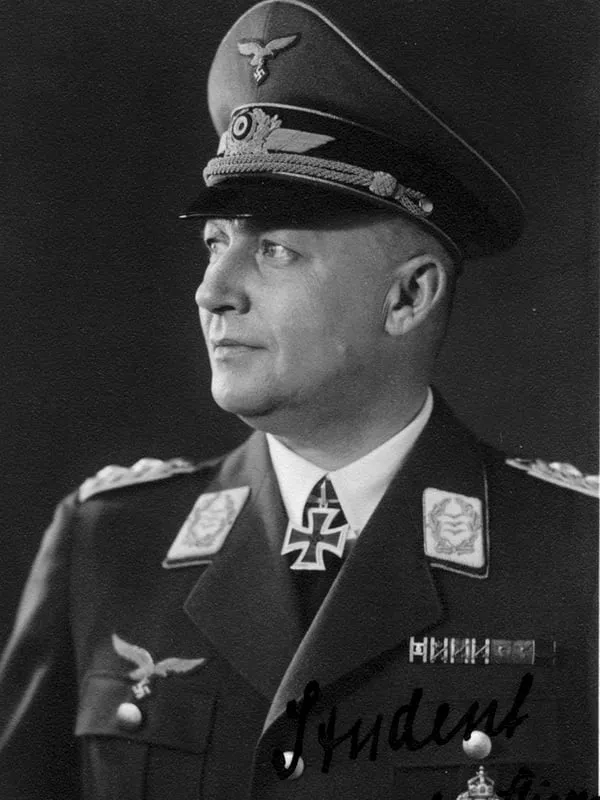
- Born:
- 12 May 1890, Birkholz (Neumark, Kingdom of Prussia)
- Died:
- 1 July 1978, Lemgo (West Germany)
- Author:
- Łukasz
- Photo:
- autor nieznany, domena publiczna, Wikimedia Commons

Kurt Student was the father of the German airborne forces. A First World War fighter pilot and an expert in aviation technology, from 1938 he built up a new arm of service for Hermann Göring, the Fallschirmjäger (PL), and, with short breaks, commanded it until the end of the war. In May 1940 his men captured the Belgian fort of Eben-Emael and the bridges in the Netherlands from the air; a year later, at his suggestion, they attacked Crete, winning a victory bought at such a heavy price that Adolf Hitler forbade any further large airborne landings. On Crete Student issued orders for reprisals against the civilian population, and after the war a British military court convicted him of war crimes. In post-war Germany he was for years revered in veterans’ circles, until historians cast his role in a fuller light.
Cadet and airman
He was born on 12 May 1890 at Birkholz in the Neumark, into the family of a landowner and official of the public prosecutor’s office in nearby Reppen (today Rzepin). In 1901, at the age of eleven, he entered the cadet corps, which he left in 1910 as a Fähnrich (officer cadet) in the 1st Jäger Battalion in East Prussia. By 1911 he was a Leutnant, but the infantry held no appeal for him. He volunteered for aviation, qualified as a military pilot in 1913 and from then on devoted his entire career to aircraft.
In the First World War he flew first in reconnaissance and bomber units and from 1916 as a fighter pilot on the Western Front. In October 1916 he took command of the fighter squadron Jagdstaffel 9. He scored six confirmed aerial victories, which made him an ace, was severely wounded, and in June 1918 was promoted to Hauptmann (captain). He was awarded both classes of the Iron Cross and the House Order of Hohenzollern.
The Reichswehr’s secret air force
The Treaty of Versailles banned Germany from having a military air force, but the Reichswehr retained a group of experienced airmen who quietly prepared its revival within the ordnance offices. Student was one of them. From 1920 to 1928 he worked in the Army Ordnance Office on aviation technology and new types of aircraft, took an interest in gliding, which the treaty did not prohibit, and took part in the cooperation with the Red Army. He visited the secret German flying school at Lipetsk and, according to his German biographer Wolfgang Schmidt, took part in Soviet–German trials of chemical weapons delivered from aircraft. It was in the USSR, too, that he is said to have first seen Soviet paratroopers on exercise.
After the Nazis came to power he moved in 1933 to the new Reich Air Ministry and then to the Luftwaffe, built up openly from 1935. He rose quickly, helped by Göring’s backing: he was a lieutenant colonel in 1934 and a colonel in 1935. He headed the technical schools, the Luftwaffe test centre at Rechlin and aviation training. In April 1938 he became a Generalmajor.
Creator of the airborne forces
In the summer of 1938 Göring entrusted him with the task that would define the rest of his life: to combine the scattered parachute units of the Luftwaffe and the army into a single division. The result was the 7th Air Division (PL), the first German parachute division, which Student commanded; from 1939 he was also Inspector of Parachute and Airborne Troops. As early as October 1938, during the occupation of the Sudetenland, his men rehearsed an airfield landing on territory that Czechoslovakia had been forced to cede to the Reich under the Munich Agreement.
From the outset Student argued that paratroopers should not merely be saboteurs dropped behind enemy lines, but a force capable of seizing airfields, bridges and fortifications before the arrival of their own ground troops. During the September Campaign in Poland the planned drops were called off one after another, because the armoured forces were reaching the objectives faster. The first combat jumps took place on 9 April 1940 in Denmark and Norway, where small detachments seized the airfields at Aalborg and Stavanger.
In the autumn of 1939 Hitler summoned Student and asked whether the Belgian fort of Eben-Emael and the bridges over the Albert Canal could be taken from the air. In the winter his division nearly lost everything when on 10 January 1940 one of its staff officers made a forced landing in Belgium carrying operational orders (the Mechelen incident). The plans were changed, and the secrecy surrounding the preparations was tightened still further.
May 1940: Eben-Emael and Rotterdam
On 10 May 1940 the airborne corps under Student’s command, made up of the 7th Air Division and General Hans von Sponeck’s air-transported 22nd Infantry Division, carried out the largest air operation in history up to that time. In Belgium Captain Walter Koch’s glider detachment captured Fort Eben-Emael and two of the three bridges over the Albert Canal. In the Netherlands paratroopers seized the bridges at Moerdijk, Dordrecht and Rotterdam and Waalhaven airfield, opening the way for German tanks into the heart of the so-called Fortress Holland. Things went far worse around The Hague, where the Dutch retook the airfields, destroyed many transport aircraft and captured more than a thousand German soldiers, and the plan to seize the queen and the government failed.
Student himself landed near Rotterdam and directed the fighting for the city. On 14 May, the day of the German bombing of Rotterdam and the capitulation of its Dutch defenders, as he was accepting their surrender and standing at the window of a building, he was hit in the head by a bullet. The prevailing view is that it was a German round, fired by soldiers of the SS regiment Leibstandarte Adolf Hitler, who had driven into the city and were shooting at Dutch troops being disarmed. Severely wounded, he took several months to recover. For May 1940 he received the Knight’s Cross of the Iron Cross on 12 May, and at the end of the month promotion to General der Flieger. Propaganda presented the campaign in the Netherlands and Belgium as the triumph of a new weapon.
Crete
In January 1941 Student took command of XI Air Corps, which combined all the parachute and glider troops. When the Wehrmacht occupied Greece in the spring of 1941, Student proposed to Göring and Hitler that Crete, held by British, New Zealand, Australian and Greek troops, be taken from the air. On 20 May 1941 the Battle of Crete began – the first operation in which an island was captured mainly from the air. On the first day the paratroopers suffered enormous losses, and victory was decided only by the capture of Maleme airfield, onto which Student, staking everything, threw all his reserves. The island fell on 1 June, but by their own figures the Germans lost nearly 4,000 killed and missing and several hundred transport aircraft. Student’s biographer points to serious errors in planning and command that contributed to these losses. Hitler concluded that the day of surprise airborne landings was over and banned any further large airborne operations.
On Crete the German troops met resistance from the civilian population, who took up arms alongside the soldiers. On 31 May 1941 Student, as the first German commandant of the island, issued an order for “punitive expeditions”: it provided for levies, shootings, the burning of villages and, with the general’s approval, even the “extermination of the male population of entire areas”. On this basis several dozen men were shot at Kondomari on 2 June, and on 3 June Kandanos was razed to the ground and many of its inhabitants were killed. The German historian of the occupation of Greece Hagen Fleischer pointed out that “reprisals” of such severity had not previously been applied outside occupied Poland and other Slav lands.
Italy, the Netherlands and the end of the war
In 1942 Student prepared a German-Italian airborne landing on Malta, but Hitler called it off and the troops earmarked for it were sent to North Africa. In the summer of 1943 Student’s paratroopers fought in Sicily and Italy, and after Italy went over to the Allies in September 1943 they helped secure Rome. Student directed the planning of Operation Eiche, in which on 12 September 1943 paratroopers and a detachment under SS-Hauptsturmführer Otto Skorzeny freed the deposed Benito Mussolini from a hotel on the Gran Sasso. Most of the fame went to Skorzeny, but Student received the Oak Leaves to the Knight’s Cross for the operation.
In July 1944 he was promoted to Colonel General. In September, as the Allied armies approached the borders of the Reich, his 1st Parachute Army, hastily assembled from the remnants of parachute divisions, Luftwaffe units and reserves, closed a gap in the front in the Netherlands and took part in repelling Operation Market Garden. From November 1944 to the end of January 1945 he commanded Army Group H in the Netherlands and on the lower Rhine. According to his biographer, Student remained ready to the very last days to sacrifice the soldiers under his command for “final victory”. At the end of April 1945 Hitler appointed him commander of Army Group Vistula in place of General Gotthard Heinrici, but Student never in practice took over the shattered forces retreating westwards. The end of the war found him in Schleswig-Holstein, and on 28 May 1945 he was taken prisoner by the British.
Trial and later years
In May 1946 Student went before a British military court in Lüneburg, charged with the mistreatment and killing of prisoners of war by troops under his command on Crete. The court found him guilty on some of the charges relating to prisoners, acquitted him on others and sentenced him to five years’ imprisonment. He was never held to account for the crimes against Cretan civilians, and Greece’s request for his extradition was not granted. Favourable testimony from British and New Zealand officers, who judged him a chivalrous opponent, helped secure his release in 1948. Some accounts wrongly date the trial to 1947.
In the Federal Republic Student was one of the leading figures of the veterans’ community. From 1952 to 1954 he chaired the Association of German Paratroopers (Bund Deutscher Fallschirmjäger), was guest of honour every year at the anniversary commemorations of the Crete landing, and in 1968 gave the funeral oration for General Hermann-Bernhard Ramcke, who had been convicted of war crimes. His only son, Hans-Dietrich, was killed in 1944. Kurt Student died on 1 July 1978 in Lemgo, the last surviving Colonel General of the Luftwaffe.
Significance
Student introduced a new form of combat into warfare. The airborne landings of May 1940, above all the capture of Eben-Emael, showed that small, well-trained units delivered by air could open the way for an entire army, and they prompted the British and Americans to build their own airborne forces, which landed in Normandy and at Arnhem in 1944. At the same time Crete showed the limits of this weapon: a landing against a prepared enemy without a swift link-up with ground forces cost losses that Germany could not afford. From then on Student’s paratroopers fought mainly as elite infantry.
Long after the war Student was regarded in Germany as a model soldier without a political stain. Historical research has changed that picture. In 1998 the German Ministry of Defence ruled that he could not serve as a figure of tradition for the Bundeswehr, and his name was removed from a street and a hall in the paratroopers’ barracks at Altenstadt. His biographers point to his closeness to Göring and Hitler, to costly command errors and, above all, to the orders on Crete that opened the way to the murder of civilians.
Sources
Commanded in battles
(03)Mentioned in battles
(03)Often appears with
People who appear in the same events.
On the timeline
(17)1940
May
- 10
- Key eventGermany attacks in the WestOn 10 May 1940 the Wehrmacht struck the Netherlands, Belgium and Luxembourg. The Allies advanced into Belgium as Kleist's tanks entered the Ardennes.
- The capture of Fort Eben-EmaelOn 10 May 1940 gliders carrying German parachute sappers landed on the roof of the Belgian Fort Eben-Emael. The garrison surrendered the next day.
- The Battle for The HagueOn 10 May 1940 German airborne troops landed near The Hague to seize the Dutch Queen and government. By nightfall the Dutch had retaken three airfields.