1943–1945: The Italian campaign
The spring 1945 offensive in Italy
- Dates:
- 5 April – 2 May 1945
- Front:
- Mediterranean
- Location:
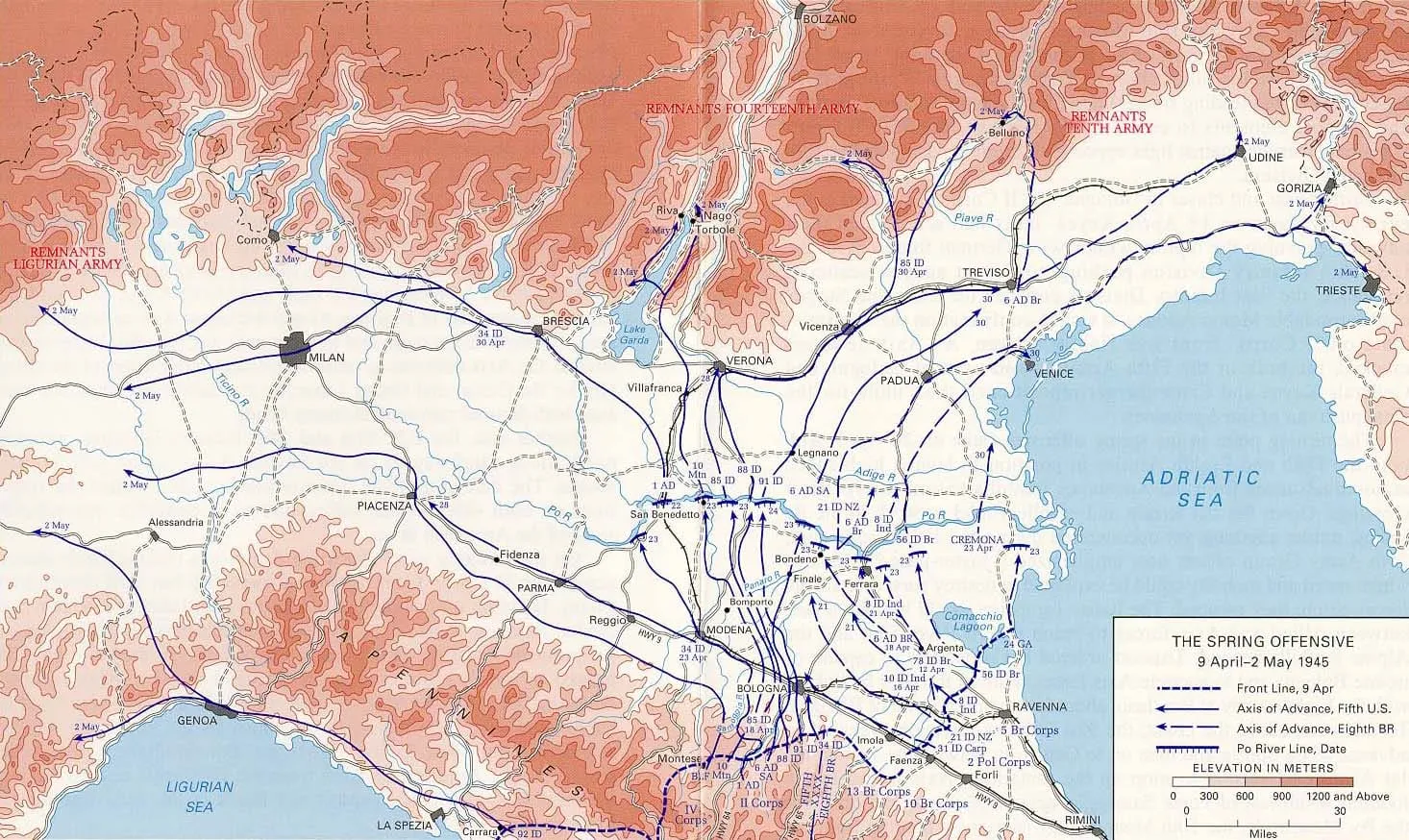
- Northern Italy – the Romagna along the Senio, Santerno and Reno rivers, the Comacchio lagoon and the Argenta Gap, the Tuscan-Emilian Apennines south of Bologna (Highways 64 and 65), the Ligurian coast near Massa and Carrara, the Po Valley with its crossings over the Po, and the roads towards Verona, Milan, Venice and the AlpsOn the battle map →
- Sides:
- Allies (United Kingdom, United States, Poland, New Zealand, India, Brazil, South Africa, Italy)Harold Alexander, Mark Wayne Clark, Richard McCreery, Lucian Truscott, Władysław AndersNazi Germany and the Italian Social RepublicHeinrich von Vietinghoff, Traugott Herr, Joachim Lemelsen
- Result:
- Allied victory. Army Group C was destroyed south of the Po and in the river valley, and on 29 April 1945 at Caserta its plenipotentiaries signed the unconditional surrender of all German and Fascist forces in Italy, which took effect on 2 May. Allied losses from 9 April amounted, according to figures cited in the literature, to some 16,000 killed, wounded and missing (including about 2,900 killed); German combat losses were estimated at 30,000–32,000, and – including the surrender – close to a million German and Italian soldiers were taken prisoner.
- Author:
- Natalia
Name and dates
The spring offensive in Italy is the name given to the last great Allied operation of the Italian campaign, conducted from the beginning of April to 2 May 1945 by General Mark Clark’s 15th Army Group. The whole offensive bore the code name Grapeshot. The British Eighth Army’s attack across the rivers of the Romagna was called Operation Buckland, and the US Fifth Army’s advance through the Apennines towards Bologna and the Po Valley Operation Craftsman. In Polish tradition its most important part is the episode known as the Battle of Bologna (9–21 April), the last battle of the Polish II Corps.
The offensive can be dated from 5 April, when the US 92nd Infantry Division opened a diversionary attack on the Ligurian coast towards Massa. Before that, on 1–2 April, British commandos fought a preliminary action on the Comacchio lagoon, Operation Roast, to prepare the way for the main blow; for this reason different accounts date the offensive from 1, 5, 6 or 9 April. The Eighth Army’s main attack across the Senio began on the afternoon of 9 April, and the Fifth Army struck on 14 April. The fighting was ended by the surrender of Army Group C, signed on 29 April in the Royal Palace at Caserta and effective from noon on 2 May.
The offensive lasted less than four weeks, but it brought to an end a campaign that, since the landing in Sicily in July 1943, had cost both sides hundreds of thousands of dead and wounded. In those weeks the Allies advanced from the trenches on the Senio and the Apennine ridges, where they had stood since the autumn, all the way to the foothills of the Alps, and the German armies in Italy ceased to exist as a fighting force even before the Reich capitulated.
Background
In the autumn of 1944 the Allies broke through the Gothic Line and took Rimini, but failed to break out into the Po Valley. The drive on Bologna bogged down in the Apennines and in the mud of the Romagna, and at the turn of November and December the front froze for the winter – a stalemate that was to last until April. In the east, on the plain, after the capture of Ravenna and Faenza, the front line came to rest on the Senio, whose high artificial embankments the Germans had honeycombed with tunnels and firing positions. In the mountains the US Fifth Army stood some ten to fifteen kilometres south of Bologna. In February and March 1945 its western wing improved its positions in Operation Encore, in which the Brazilians took Monte Castello and the US 10th Mountain Division the neighbouring peaks.
Over the winter the command changed on both sides. Field Marshal Harold Alexander became Supreme Allied Commander Mediterranean in December 1944, and command of all ground forces in Italy – renamed the 15th Army Group – passed to Clark. General Lucian Truscott took over the Fifth Army, while the Eighth Army had been commanded since the autumn by General Richard McCreery. On the German side, Field Marshal Albert Kesselring left in March 1945 to become Commander-in-Chief West, and on 10 March General Heinrich von Vietinghoff again took over Army Group C. The Tenth Army in the east was commanded by General Traugott Herr, and the Fourteenth Army in the Apennines by General Joachim Lemelsen.
The Italian front lost many troops during this period. In the autumn the 4th Indian and British 4th Infantry Divisions, among others, left for Greece; in January the British 1st Division departed for Palestine, and in February and March the Canadian I Corps and the British 5th Division were transferred to north-west Europe. The Eighth Army shrank to seven divisions. Alexander and Clark knew that their task was above all to tie down German divisions – but also that Army Group C was growing ever weaker, short of reserves, fuel and air cover.
At the same time, secret talks on a surrender were under way. From early March 1945 the Supreme SS and Police Leader in Italy, General Karl Wolff, was in contact in Switzerland with the American intelligence representative Allen Dulles (Operation Sunrise, which the British called Crossword). The talks produced no agreement that spring, and the Soviet Union, excluded from them, accused the Western Allies of seeking a separate peace; this dispute, conducted in a sharp exchange of letters between Stalin and Roosevelt, is sometimes called the “Berne incident”. The armies in Italy were therefore left to settle the matter on the battlefield.
Forces and plans
Despite the loss of many units, in April 1945 the 15th Army Group enjoyed a clear superiority. According to the British official history, on which most accounts rely, it numbered 17 divisions and 8 independent brigades – the equivalent of almost 20 divisions in all. It was a more multinational army than any other in the western theatres of the war. The Eighth Army included the British 56th, 78th and 6th Armoured Divisions, the 2nd New Zealand Division under General Bernard Freyberg, the 8th and 10th Indian Infantry Divisions, the Polish II Corps, the Jewish Brigade, made up of volunteers from Palestine, and three Italian combat groups of the royal army – Cremona, Friuli and Folgore; a fourth, Legnano, fought alongside the Americans. The Fifth Army comprised American infantry divisions (the 34th, 85th, 88th, 91st and 92nd), the 1st Armored Division, the 10th Mountain Division, the South African 6th Armoured Division and the Brazilian 1st Infantry Division of the Brazilian Expeditionary Force, which had arrived in Italy in the summer of 1944. Allied air power ruled the skies unchallenged.
The Polish II Corps, weakened by its autumn losses, received some 11,000 replacements in the first months of 1945. Most were Poles from Silesia and Pomerania who had been forcibly conscripted into the Wehrmacht and taken prisoner by the Allies in France. The corps consisted of the 3rd Carpathian Rifle Division, the 5th Kresowa (Borderlands) Infantry Division and the 2nd Warsaw Armoured Brigade, and for the attack it was given British tanks, assault engineers, artillery and a Gurkha brigade. Major General Władysław Anders had been acting Commander-in-Chief in London since 26 February; according to Polish accounts, during the Battle of Bologna the corps was commanded by his deputy, Brigadier General Zygmunt Bohusz-Szyszko. The Polish divisions stood on the Senio on the main axis of attack – along Highway 9, the ancient Via Emilia, which led through Imola to Bologna.
Army Group C had 21 German divisions and 4 divisions of the Italian Social Republic, but most of them were understrength and poorly supplied. According to figures cited from the British history, on 9 April there were some 349,000 German and 45,000 Italian soldiers at the front, plus about 91,000 Germans in the rear and some 100,000 Italian police under German command. Three Italian divisions of Marshal Rodolfo Graziani guarded the French border as part of the Liguria Army. Hitler forbade any withdrawal to the line of the Po.
Clark’s plan of 18 March aimed to destroy as much of the German force as possible south of the Po. The Eighth Army was to strike first: across the Senio and the Santerno, and then along two axes – down Highway 9 towards Bologna, and north-west through the gap at Argenta between the Comacchio lagoon and the flooded marshes. A few days later the Fifth Army was to attack, cross the last ridges of the Apennines and debouch onto the plain west of Bologna. The two armies were to meet in the area of Bondeno and Finale on the Panaro, trapping the Germans in a pincer short of the Po. The capture of Bologna itself was regarded as a secondary objective.
Preliminary operations: Comacchio and Liguria
The offensive was preceded by attacks on both flanks of the front, intended to draw off German reserves. During the night of 1–2 April the British 2nd Commando Brigade crossed the shallow, silted Comacchio lagoon and in Operation Roast seized the narrow strip of land between the lagoon and the Adriatic as far as the canal leading to Porto Garibaldi. The commandos took several hundred prisoners and secured the Eighth Army’s right flank. In the following days special forces carried out further raids on the lagoon; in one of them, during the night of 8–9 April, Anders Lassen, a Danish officer of the British Special Boat Service, was killed and posthumously awarded the Victoria Cross.
At the opposite end of the front, by the Ligurian Sea, the US 92nd Infantry Division, reinforced by the 442nd Infantry Regiment of Japanese Americans, went into the attack on 5 April. The assault on the mountain positions above the coast opened the way to Massa, taken on 10 April, and to Carrara, which the Americans entered the next day together with Italian partisans. Planned as a diversion, the attack turned into a pursuit along the coast: by the end of April the 92nd Division had reached La Spezia and Genoa.
Meanwhile Allied aircraft destroyed the bridges over the Po and the Adige and strafed the roads, crossings and canals the Germans used to bring up supplies. From the beginning of April the Eighth Army’s artillery laid down ever heavier fire on the German positions on the Senio – from 6 April, according to some accounts.
The breakthrough on the Senio and the Santerno
The Eighth Army’s main attack began on 9 April. In the afternoon more than 800 heavy bombers flew over the German positions and dropped fragmentation bombs on the zone behind the Senio; they were followed by medium bombers and fighter-bombers. From 3.20 to 7.10 p.m. the artillery fired five half-hour barrages, interspersed with air attacks, so that the Germans would not know when the infantry would go in. At dusk three divisions crossed the river: the 8th Indian and 2nd New Zealand Divisions of the British V Corps, and the Polish 3rd Carpathian Rifle Division on Highway 9. The Senio embankments were burnt out with flamethrowers – Churchill Crocodile tanks and Wasp carriers.
From the very outset the Poles suffered painful losses from their own air support: one wave of bombers mistakenly dropped its load on units of the 3rd Carpathian Rifle Division, killing 34 soldiers and wounding 188, according to Polish figures. Even so, the division forced the Senio and, over the following days, supported by the 5th Kresowa Infantry Division and British tanks, broke through the German defences on one river and canal after another. The Poles reached the Santerno during the night of 11–12 April. The New Zealanders crossed the Santerno at dawn on 11 April, and the Indians established themselves on the far bank on the morning of 12 April; in the fighting on the Senio soldiers of the 8th Indian Division won two Victoria Crosses.
On a subsidiary axis along Highway 9 a Polish battle group under Colonel Klemens Rudnicki advanced. According to Polish accounts it took Castel Bolognese on 12 April and Imola on 14 April. On the Eighth Army’s northern flank, near Alfonsine, the Italian Cremona Group and the Jewish Brigade went into action; the brigade’s soldiers had been fighting on the Senio since March, and for many of them, Jews from Palestine, it was a fight against the army of the state that was at that very moment carrying out the Holocaust of their people.
The Argenta Gap and the Fifth Army’s attack
Beyond the Santerno the British 78th Division passed through the Indian and New Zealand bridgehead and turned towards Bastia and Argenta. The Argenta Gap – at its narrowest a strip of dry ground a few kilometres wide between the Comacchio lagoon and the land the Germans had flooded – was the key to the road to Ferrara and the Po. From 11 April the British 24th Guards Brigade of the 56th Division tried to outflank it from the lagoon side, crossing in amphibious vehicles, but was held up at the fortifications on the Fossa Marina canal. On 14 April the 78th Division was stopped on the Reno near Bastia. The Germans threw in their last reserves here, including the 29th Panzergrenadier Division, and the fighting lasted several days. Argenta was taken on 17–18 April, and by 19 April the gap had been forced. The British 6th Armoured Division drove through the breach, heading along the Reno towards Bondeno to meet the Americans.
The Fifth Army opened its attack on 14 April, two days late because bad weather had grounded the aircraft. On the left wing General Willis Crittenberger’s IV Corps attacked: the 10th Mountain Division, the 1st Armored Division and the Brazilians, who in four days of fighting, up to 17 April, took the small town of Montese. During the night of 15–16 April, after a massive bombardment, II Corps took up the attack with the South African 6th Armoured Division and the US 88th, 91st and 34th Infantry Divisions, advancing along Highways 64 and 65 towards Bologna. The Germans defended the last Apennine ridges fiercely, and the first days brought the Americans heavy losses for little gain. Superiority in artillery and air power, and above all the lack of German reserves, which the Eighth Army had tied down in the east, nevertheless decided the outcome.
On 20 April the 10th Mountain Division came down from the mountains onto the plain west of Bologna. Its leading units, organised as a mobile task force, bypassed the shattered German formations and on 22 April reached the Po near San Benedetto Po. On the same day, 20 April, Vietinghoff, faced with the threat of the encirclement of the entire army group, ordered a withdrawal behind the Po on his own responsibility – a few days earlier Hitler had rejected a similar proposal. The order came too late: the divisions that were to withdraw were already on the move under attack from two sides, and the bridges over the river had long since been reduced to rubble.
Bologna, 21 April
After taking Imola the Polish divisions pressed west along Highway 9. On 17 April they took Castel San Pietro, and on 20 April they forced the Gaiana and the Idice, the last obstacles before the city, fighting hard against German paratroopers. Threatened with encirclement by the Americans from the west and the Poles from the east, the Germans abandoned Bologna during the night of 20–21 April. In the morning – at 6.05 a.m., according to Polish accounts – the 9th Carpathian Rifle Battalion was the first to enter the city and hoisted the Polish flag over it. Soldiers of the Italian Friuli Combat Group entered along Highway 9 together with the Poles, and roughly two hours later units of the 34th Infantry Division of the US II Corps arrived from the south. Partisans were already active in the city itself, taking over public offices from the departing Germans and Fascists. The question of who had been first later became a matter of pride and dispute; in Bologna the memory of the Poles as the first liberators took root.
The inhabitants greeted the soldiers with flowers and cheers. The 9th Battalion was later given the honorific “Bologna”, seventeen Polish commanders were made honorary citizens of the city, and the city authorities had commemorative medals struck for the Polish soldiers, inscribed to the “liberators who were the first to enter Bologna on 21 April 1945”. On the orders of the Eighth Army commander, II Corps remained in the area of the city and took no further part in the pursuit.
The Battle of Bologna cost the Poles, according to various tallies, between about 230 and 300 killed and more than a thousand wounded – Gustaw Łowczowski gives 234 killed, 1,228 wounded and 7 missing, while other figures speak of 249 killed and 1,219 wounded. British tallies for the offensive as a whole give 1,622 Polish killed, wounded and missing. The Polish soldiers fought with a sense of bitterness: two months earlier the Yalta Conference had awarded eastern Poland, where many of them came from, to the Soviet Union. Anders even wanted to withdraw the corps from the front, but at the Allies’ request the soldiers stayed in the fight to the end. Bologna was their last battle; its name – “Bolonia 9–21 IV 1945” – is inscribed today on one of the plaques of the Tomb of the Unknown Soldier in Warsaw.
On the Po and the rising in the north
After the fall of Bologna the fighting turned into a pursuit. The British 6th Armoured Division took Bondeno and on 23 April met the South African 6th Armoured Division of the Fifth Army near Finale on the Panaro. The pincers had closed: south of the Po thousands of German soldiers were left behind, along with heavy equipment, guns and vehicles that could not be got across a river with no bridges. Those who escaped crossed by swimming, on ferries and in boats, abandoning everything heavier than a rifle. The Allies crossed the Po at many points: the British XIII Corps near Ficarolo on 22 April, the Americans of IV Corps near San Benedetto on 23 April, and the British V Corps by 25 April. On 26 April the US 88th Division entered Verona, and the 10th Mountain Division pushed along Lake Garda towards the Alps to cut the escape routes to Austria.
Behind the disintegrating front a rising broke out. The National Liberation Committee for Northern Italy (CLNAI), which directed the Italian resistance, called for a general insurrection on 25 April – a day now celebrated in Italy as Liberation Day. Fighting had already begun earlier: in Genoa the partisans rose on 23 April, and on 25 April General Günther Meinhold signed the surrender of his garrison to the local committee in the city; between several thousand and over ten thousand Germans were taken prisoner, according to various figures. In Milan and Turin the partisans took control of the cities before Allied troops arrived; the first American units reached Milan in the last days of April. Benito Mussolini tried to escape northwards with a German column; on 27 April partisans recognised him at Dongo on Lake Como, and on 28 April he was shot together with Clara Petacci. His body was put on display the following day in Milan’s Piazzale Loreto.
The last major action of the offensive was a Brazilian success. In the area of Collecchio and Fornovo di Taro, south of Parma, the Brazilian division blocked the road to the retreating German and Italian troops: on 28–29 April the German 148th Infantry Division of General Otto Fretter-Pico surrendered to it together with the remnants of the Italian Italia Division – some 14,000–15,000 men in all, according to Brazilian figures. On the right wing the Eighth Army crossed the Adige; on 28 April the New Zealanders entered Padua, where partisans had disarmed the German garrison, and Freyberg’s New Zealanders then drove on through Venice towards Trieste, which they reached on 2 May – a day after Yugoslav partisans had entered the city.
The surrender at Caserta
As Vietinghoff’s armies fell apart on the Po, the talks Wolff had been conducting since March finally bore fruit. On 28 April two German plenipotentiaries arrived at Alexander’s headquarters at Caserta: Lieutenant Colonel Viktor von Schweinitz, authorised by Vietinghoff, and SS-Sturmbannführer Eugen Wenner, acting on behalf of Wolff and, according to the documents, of Graziani as well. At 2 p.m. on 29 April, in the Royal Palace at Caserta, they signed the instrument of unconditional surrender of all land, sea and air forces under the command of Army Group C. The document was signed on Alexander’s behalf by his chief of staff, General William Morgan. The Soviet General Aleksei Kislenko, sent after Moscow’s protests against the secret negotiations, was present at the signing. The surrender was to take effect at 12 noon Greenwich Mean Time (2 p.m. local time) on 2 May.
The last days before that deadline brought confusion on the German side. Kesselring, to whom Hitler had also subordinated the Italian front, learned of the negotiations, dismissed Vietinghoff and his chief of staff and appointed General Friedrich Schulz of Army Group G in their place. For two days it was uncertain whether the German command would honour the signature of its plenipotentiaries. Only after news of Hitler’s death arrived did Kesselring give his consent; Vietinghoff – although he had not formally been reinstated – again acted as commander, and confirmation of the surrender reached the 15th Army Group’s headquarters on the morning of 2 May. On 1 May Graziani ordered the forces of the Italian Social Republic to lay down their arms. At noon on 2 May the guns fell silent along the whole Italian front. The Caserta surrender also covered the western regions of Austria under Army Group C’s command, and it was the first surrender of an entire German front in the war, preceding the capitulation of the Reich by several days.
Losses
According to tallies based on the Allied armies’ figures and cited in English-language literature, from 9 April to the end of the offensive the 15th Army Group lost about 16,300 men killed, wounded and missing, including about 2,900 killed. The Fifth Army accounted for nearly 8,000 of these losses (about 6,800 Americans, about 540 South Africans and about 600 Brazilians), and the Eighth Army for about 7,200 (more than 3,000 British, about 1,600 Poles, about 1,400 New Zealanders and about 1,100 Indians); the Italian units fighting alongside both armies lost about 1,100 men. These figures do not include the preliminary operations or partisan losses.
German combat losses were estimated at 30,000–32,000 killed and wounded – the first figure was given by the British, the second by a German staff officer. The number of prisoners was far greater: even before the surrender the Allies and the partisans had captured tens of thousands of soldiers, and the Caserta surrender covered, by contemporary Allied estimates, close to a million German and Italian soldiers including auxiliary personnel. Army Group C lost almost all its heavy equipment south of the Po.
The civilian population suffered heavily. The bombing of bridges, roads and towns in the Po Valley, street fighting and artillery fire claimed victims until the very last days. In the final weeks retreating German and Fascist units were still executing partisans and civilians, and after the liberation the north of the country saw a wave of summary killings of Fascists and people regarded as collaborators, the scale of which is still debated by historians in Italy; estimates of the victims vary widely, from about 8,000 according to post-war figures from the Italian Interior Ministry to more than 20,000 in later estimates.
Place in the history of the war
The spring offensive brought to an end the Italian campaign, the longest land campaign of the Western Allies in Europe, which had lasted since the landing in Sicily in July 1943. For most of that time Italy had been a secondary front on which the Allies tied down German divisions without being able to count on a decisive result. In April 1945, however, facing a weakened enemy and with overwhelming air superiority, they managed to carry out an operation that many historians regard as one of the best planned of the entire campaign: instead of pushing the Germans back from one defensive line to the next, they destroyed their armies short of the Po before they could withdraw.
For the Poles, the Battle of Bologna closed the combat trail of II Corps, which had led from Monte Cassino through Ancona and the Gothic Line. It was a victory won at a time when Poland’s fate was already being decided without any say from its soldiers in the West – after Yalta most of them could not return to homes now ruled by the Communists. For Italy, thanks to the rising and the liberation of the northern cities, those April days became the foundation of the memory of the resistance and of the post-war republic; 25 April is celebrated as Liberation Day.
The Caserta surrender, signed the day before Hitler’s death and carried out two days after it, heralded the further partial surrenders that preceded the unconditional surrender of the Third Reich in the first days of May. At the same time, Wolff’s secret talks with Dulles and Stalin’s sharp reaction to them became one of the first signs of the mistrust that would divide the anti-Hitler coalition after victory. At the north-eastern edge of Italy, in Trieste, as early as May 1945 the dispute over who would occupy the captured territory, and how, set yesterday’s allies against one another.