Poland
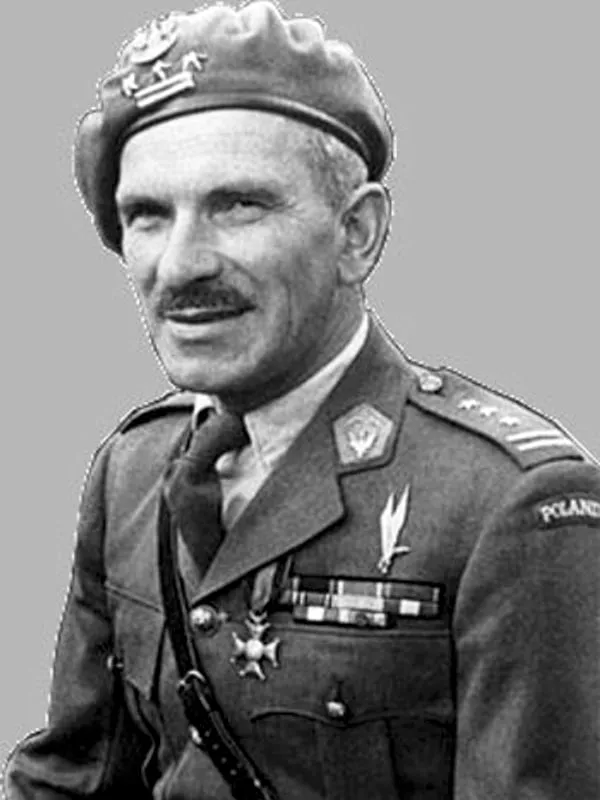
Stanisław Sosabowski
Commander of the 21st “Children of Warsaw” Infantry Regiment (1939), commander of the 1st Independent Parachute Brigade (1941–1944)
- Born:
- 8 May 1892, Stanisławów (Austria-Hungary)
- Died:
- 25 September 1967, London (United Kingdom)
- Author:
- Łukasz
- Photo:
- autor nieznany, domena publiczna, Wikimedia Commons

Stanisław Sosabowski was a staff officer and lecturer who, as a colonel approaching fifty, built the first Polish parachute unit from scratch. In 1939 his 21st “Children of Warsaw” Infantry Regiment defended Grochów, and in September 1944 his brigade jumped near the Dutch village of Driel to help the British troops surrounded on the Rhine. Operation Market Garden ended in failure, and Sosabowski, who had openly criticised the British plan beforehand, was afterwards removed from command. He spent the last two decades of his life working in London as a factory labourer. Full recognition came only after his death: first from the Dutch, and in 2025 from the British government as well.
A railwayman’s son from Stanisławów
He was born on 8 May 1892 in Stanisławów (Ivano-Frankivsk), in Austrian Galicia, the eldest of the three children of the railwayman Władysław Sosabowski and Franciszka, née Garbarska. His father died when Stanisław was eleven, and the family fell into poverty; the boy helped his mother by giving private lessons. From 1903 to 1910 he attended the Realschule in Stanisławów, where he led secret self-education circles, and in 1910 he passed his school-leaving examinations with distinction.
While still at school he joined the Galician youth independence movement. From 1909 he belonged to the Zarzewie Independence Youth Organisation and the Polish Army associated with it. He studied briefly at the Academy of Commerce in Kraków, but in 1912 returned to his home town and took command of the 24th Polish Rifle Squad with the rank of officer cadet, the highest the organisation conferred in peacetime. At the same time, from November 1911, he was founding scout troops in Stanisławów, and until 1913 he was the commander of the local scout district.
An NCO in the imperial army
Unlike many later generals from Galicia, Sosabowski did not join the Polish Legions. In October 1913 he was called up for compulsory service in the Austro-Hungarian army, and in August 1914 he was a corporal in the 58th Infantry Regiment from Stanisławów. He had his baptism of fire in October at the Przemyśl Fortress, fought in the Carpathians in the winter, and in the spring of 1915 advanced with the offensive that began with the breakthrough at Gorlice, through the Lublin region towards Brest. On 15 June 1915 he was seriously wounded in the knee on the Leśna river. He reached hospital as a staff sergeant, decorated with every medal for bravery open to NCOs; in his memoirs he wrote that of the roughly 250 soldiers with whom he had set out for the front, only three were still alive.
The wound left his right leg immobilised for years and closed off the front line to him. While recovering he married Maria Tokarska, and on 1 January 1916 he was promoted to second lieutenant. He served out the rest of the war in staffs and rear-area offices: in the military censorship at Złoczów, at corps headquarters in Mährisch Ostrau (Ostrava), in the archives at Bozen in the Tyrol, and from early 1918 in the Austro-Hungarian Military General Government in Lublin. There, by now a lieutenant, he made contact with the commander of the Lublin district of the Polish Military Organisation.
Staff officer and lecturer
In November 1918 he joined the Polish Army and, as a captain, worked on winding up the Austrian occupation administration, first in Lublin and from 1919 at the Ministry of Military Affairs in Warsaw. Because of his damaged knee he fought neither in the Polish–Ukrainian War nor in the Polish–Soviet War; in 1920–1921 he served in the supply and communications department of the ministry’s staff. In 1922 his rank was confirmed as major, and after a course at the Higher Military School he received his General Staff officer’s diploma in 1923; he was later transferred from the quartermaster corps to the infantry.
In 1927, by then a lieutenant colonel, he commanded battalions of the 75th Infantry Regiment at Królewska Huta and Rybnik, and from 1928 he was deputy commander of the 3rd Podhale Rifles Regiment at Bielsko. From December 1929 he lectured for several years at the Higher Military School, from 1930 as head of the department of staff service. In 1937 he took command of the 9th Legions Infantry Regiment at Zamość. A year later he was struck by a family tragedy: in October 1938 his younger son, sixteen-year-old Jacek, fatally shot himself with his father’s pistol. Sosabowski was relieved of command and sent to Zakopane to recover. On 21 February 1939 he was given the 21st “Children of Warsaw” Infantry Regiment (PL), stationed in the Citadel, and in March he was promoted to colonel.
Grochów 1939
In September 1939 the 21st Infantry Regiment fought as part of the 8th Infantry Division of the Modlin Army in northern Masovia during the September Campaign. When the division was shattered and scattered early in the month, Sosabowski kept his regiment in hand and, together with a battalion of the 8th Light Artillery Regiment, covered the retreat. The regiment reached the capital, and from 14 September Sosabowski commanded the Grochów sector on the right bank of the Vistula. It was there, along Grochowska Street, that his soldiers repulsed an attack by the Germans, who had hoped to take right-bank Warsaw on the march, and took prisoners in a night counter-attack. He fought in this sector until the end of the defence of Warsaw, through the encirclement and the bombardments until the capitulation.
On 29 September 1939 the commander of the Warsaw Army, Major General Juliusz Rómmel, in his farewell order to the 8th Infantry Division, singled out “the excellent regimental commander, Colonel Stanisław Sosabowski”, who on 2–6 September had “kept his regiment in hand” and covered the division’s retreat, and then defended the eastern bank of the Vistula. In the same order he awarded him the Silver Cross of the Virtuti Militari.
After the capitulation Sosabowski went with his son to Żyrardów, the first stage of captivity. Feigning illness, he escaped from the camp, returned to Warsaw in October and joined the underground Service for Poland’s Victory. He was given the task of making his way through Hungary to France with reports for the government-in-exile. On 21 December 1939, with papers in the name of “Emil Hełm”, he reached Paris.
France and Scotland
The Commander-in-Chief, General Władysław Sikorski, placed him at the disposal of Lieutenant General Kazimierz Sosnkowski. In February 1940 Sosabowski became infantry commander of the 1st Infantry Division (later the 1st Grenadier Division), and in April of the 4th Infantry Division, then forming in the camp at Parthenay. The division never managed to arm itself: when France was collapsing in June, only a small proportion of its soldiers had weapons. Its commander, Brigadier General Rudolf Dreszer, decided on 16 June to fight his way through to the Atlantic ports. Sosabowski led part of the division to La Pallice, from where some 6,000 of its soldiers sailed for Britain on 19 June.
In Scotland he was given command of the 4th Cadre Rifle Brigade – one of the units composed mainly of officers that were meant to be filled up with volunteers. The plan to bring it up to strength with Polish emigrants from Canada proved unrealistic, so Sosabowski decided to turn it into the first parachute unit in the history of the Polish Army. A ground-training centre was set up at Largo House, which the soldiers called the “monkey grove”; jumps were practised at Ringway airfield near Manchester. On 23 September 1941 Sikorski gave the unit the name 1st Independent Parachute Brigade and reserved it for his exclusive use. The brigade was intended to support a general rising in Poland; its motto became “By the shortest way!” – that is, by parachute, to Poland.
The brigade that did not fly to Warsaw
The British valued Sosabowski as a professional. In September 1943 General Frederick Browning, one of the founders of the British airborne forces, offered him, according to Polish sources, command of a mixed British–Polish parachute division with promotion to general; Sosabowski declined, because this would have meant abandoning the purpose for which the brigade had been created. On 15 June 1944 Sosabowski was promoted to brigadier general.
When the Warsaw Uprising broke out on 1 August 1944, the paratroopers were ready to fly to the capital, but the British judged the transfer of the brigade impracticable for military, technical and political reasons. Unrest grew in the brigade, and the general, as he himself recalled, had to quell it in person in several companies. He did not know that his son Stanisław Janusz, a doctor and Home Army lieutenant, had lost his sight in the fighting of the uprising. According to Polish accounts the British even threatened to disarm the brigade. In any case it had already been placed at the disposal of the Allied supreme command, under British pressure: by a decision of the Council of Ministers of 14 March 1944, formally from 6 June.
Driel
In the plan for Operation Market Garden the Polish brigade was to land on the south bank of the Rhine by the bridge at Arnhem and support the British 1st Airborne Division of Major General Roy Urquhart. According to his own account and his biographers, Sosabowski openly criticised the assumptions of the plan, especially the drop zones some ten kilometres from the bridge; his objections were not accepted. When the operation began on 17 September, the British were held up in the outskirts of Arnhem, and only small forces fought their way through to the bridge. Gliders carrying the Polish anti-tank battery landed on 19 September in the middle of the fighting, while the weather postponed the drop of the brigade’s main body two days running.
The Poles did not jump until 21 September, shortly after 5 p.m., under German fire – no longer by the bridge but on the polder near the village of Driel, opposite Oosterbeek, where the remnants of Urquhart’s division were holding out. Some of the aircraft were turned back because of the weather, and the ferry at Heveadorp, by which the brigade was to cross to the north bank, turned out to have been sunk. Without boats Sosabowski could do little: on the night of 22/23 September some 50 of his soldiers crossed in the few available boats, and the following night around 150. Yet the mere presence of the Poles on the south bank forced the Germans to shift part of their forces there to cover the road from Nijmegen. On 24 September, at a conference at Valburg, Lieutenant General Brian Horrocks and the commander of the 43rd Infantry Division decided to send a battalion of the Dorset Regiment and a Polish battalion across the river; Sosabowski, by his own account, protested against the choice of crossing point and the too small number of boats. In the end the Polish crossing did not take place, and the Dorsets suffered heavy losses.
On the night of 25/26 September some 2,400 soldiers were evacuated across the Rhine, including around 160 Poles; the British 1st Division lost about 1,500 killed, and more than 6,000 of its men were taken prisoner. The Polish brigade’s losses are given as ranging from about 340 to about 590 men, including more than 90 killed. After the battle Sosabowski received the Cross of Valour, and in October the brigade returned to Britain.
Scapegoat
The failure at Arnhem was soon being explained in part by the conduct of the Poles. In October 1944 Field Marshal Bernard Montgomery, in a letter to the Chief of the Imperial General Staff, General Alan Brooke, wrote that the Polish brigade had fought badly. Browning, who had been at odds with Sosabowski from the start of the preparations, portrayed him in a report and a letter to the War Office as a commander who was difficult to work with and unwilling to carry out orders, and then demanded his removal. The Polish authorities gave way: by an order of 27 December 1944 Sosabowski was stripped of the brigade and appointed inspector of lines-of-communication and guard units. Historians, British ones included, now regard these charges as unjust and attribute responsibility for the failure above all to the assumptions of the plan and its execution.
A labourer in London
The general was demobilised in July 1948. Like many soldiers of the Polish Armed Forces, he did not return to communist Poland. He brought his blind son and his son’s wife to England, while he himself, without a military pension, worked for some seventeen years as a storeman in factories making electric motors and later television sets. He later wrote of a “double life”: five days a week he was “Stan” at the factory, and outside work a Polish general, still “Sosab” to his paratroopers. He published two volumes of memoirs, Najkrótszą drogą (“By the Shortest Way”) and Droga wiodła ugorem (“The Road Led Through Fallow Land”). He died of a heart attack on 25 September 1967 in hospital in the London borough of Hillingdon, on the anniversary of the last days of the fighting on the Rhine. In 1969 his soldiers brought his ashes to Poland and, in accordance with his wishes, buried them at the Powązki Military Cemetery.
Place in the history of the war
Sosabowski is one of those commanders whose role outgrew their rank: he commanded only a brigade, but its story encapsulates the dilemma of the Polish army in the West – a unit created to fight for Poland was spent in an Allied operation that had nothing to do with Poland. The general became more widely known through Cornelius Ryan’s book A Bridge Too Far (1974) and its 1977 film adaptation, in which he was played by Gene Hackman. The Dutch were the first to make amends: on 31 May 2006 Queen Beatrix posthumously awarded the general the Bronze Lion, and the brigade’s colours the Military William Order. In 2018 he was posthumously awarded the Order of the White Eagle, and the 6th Airborne Brigade bears his name. On 18 June 2025, at a ceremony at Wilanów Palace, the British defence minister of state Vernon Coaker, on behalf of the United Kingdom, formally acknowledged the brigade’s heroism and Sosabowski’s leadership, which in Poland was received as his rehabilitation.
Sources
Commanded in battles
(01)Mentioned in battles
(02)Often appears with
People who appear in the same events.