Japan
Masaharu Homma
Commander of the 27th Division (1938–1940), the Taiwan Army (1940–1941) and the 14th Army in the Philippines (1941–1942), lieutenant general
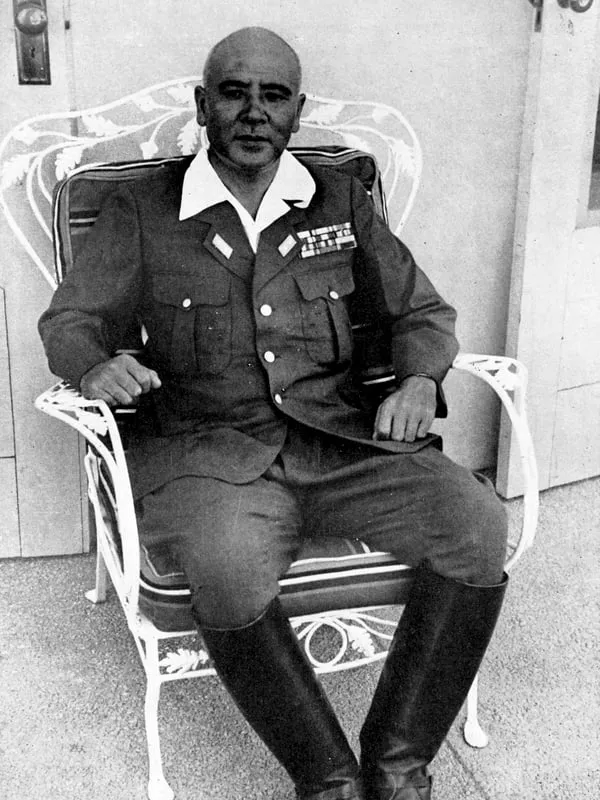
- Born:
- 27 November 1887, Hatano on Sado Island, Niigata Prefecture (Japan)
- Died:
- 3 April 1946, Los Baños, Luzon (Philippines)
- Author:
- Łukasz
- Photo:
- Hijima Dispatch Army Press Department, domena publiczna, Wikimedia Commons

Masaharu Homma was one of the most unusual generals in the Japanese army. He had served for years in Britain and India, spoke fluent English, wrote poetry and the lyrics of military songs, and was regarded as a moderate and an opponent of war with the West. Yet it was he who in December 1941 was given command of the 14th Army, which was to conquer the Philippines in fifty days. He took Manila, but failed to crush the defenders of the Bataan peninsula quickly, and for this he lost the confidence of Tokyo and his command. After the surrender on Bataan thousands of American and Filipino prisoners died on the death march conducted by his soldiers. After the war an American military commission in Manila held him responsible for these crimes and sentenced him to death. His trial remains controversial to this day.
Early life and career in Europe
He was born on 27 November 1887 in Hatano on Sado Island in the Sea of Japan, in Niigata Prefecture, the eldest son of Kenkichi Homma. Some accounts wrongly give the date as 28 January 1888. After secondary school on Sado he entered the Military Academy, graduating in 1907 second among the infantry cadets of his class and receiving the imperial prize. In the same class, the nineteenth, was Hitoshi Imamura, later the conqueror of Java, who remained Homma’s friend for life. He served in the 16th Infantry Regiment, and in 1915 graduated third from the Army War College, again receiving an honorary sword from the emperor.
In 1913 he married Toshiko, daughter of General Iyozō Tamura, Deputy Chief of the General Staff. The marriage proved unhappy. His wife led a free life, appeared on the stage and had affairs, and when Homma, then abroad, learned that the marriage had broken down, he wanted, according to his Japanese biographers, to throw himself out of a window and was stopped by Imamura. He later married Fujiko, who stayed by his side to the end.
In 1918 the General Staff sent him to Britain. He was attached to the East Lancashire Regiment and accompanied the British Expeditionary Force in France as an observer during the final months of the First World War. On his return he lectured at the Army War College, and in the 1920s he was military attaché in British India. In 1927 he became aide-de-camp to Prince Chichibu, younger brother of Emperor Hirohito. Tall, handsome and worldly, he was said to be an ornament of Tokyo’s drawing rooms. In 1930–1932 he served in London again, this time as military attaché at the embassy; in 1932 he was a member of the Japanese delegation to the disarmament conference in Geneva, and afterwards he headed the press section of the Army Ministry.
The years spent in the West shaped his views. In an army in which careers were made by advocates of expansion and of an alliance with Germany, Homma was seen as an Anglophile and as a man who knew the industrial strength of Britain and the United States. At the same time he had almost no experience of commanding troops. Only in 1933 did he take up his first line command, the 1st Infantry Regiment in Tokyo, followed in 1935, by then a major general, by the 32nd Infantry Brigade.
China
In December 1936 he travelled to Europe, and in May 1937 he accompanied Prince Chichibu to the coronation of George VI in London. On 21 July 1937, two weeks after the Marco Polo Bridge Incident, he became head of the Second Bureau – the intelligence bureau – of the General Staff. He was one of the officers who considered the war in China a mistake and warned that without a quick peace Japan would be bogged down in it for years. In July 1938 he was promoted to lieutenant general and given command of the 27th Division, which he led in the Battle of Wuhan.
The division was then stationed in Tianjin, where the Tientsin Incident broke out in June 1939. When the British refused to hand over Chinese suspected of murdering a collaborationist official, Homma issued a proclamation on 13 June, and the next day his soldiers surrounded the British and French concessions with barbed wire. The blockade, during which the Japanese publicly humiliated Britons at the checkpoints, was the work of hardliners on the staff of the North China Area Army, whose chief of staff was General Tomoyuki Yamashita. Homma, who knew the British well, was regarded as a moderate in the affair. The crisis ended in the summer with a compromise favourable to Japan. In December 1940 Homma became commander of the Taiwan Army. On Taiwan he wrote the words of the “Song of the Taiwan Army”, one of several military songs he composed.
The conquest of the Philippines
On 6 November 1941, a month before the outbreak of the Pacific War, Homma took command of the 14th Army, which was to capture the Philippines. He had some 43,000 men in two divisions, the 16th and the 48th, supported by the army’s 5th Air Group and the navy’s 11th Air Fleet. The plan called for the destruction of the American air force, the capture of Manila and the occupation of Luzon within fifty days, after which the 48th Division and the aircraft were to leave for Java.
The first part went according to plan. The attack on Clark Field on 8 December 1941 destroyed half of the American air force on the ground, and preliminary landings gave the Japanese airfields in northern Luzon. Homma directed the operation from Taiwan until he sailed with the invasion convoy. On 22 December his main force landed in Lingayen Gulf, and on 24 December the 16th Division landed in Lamon Bay. Homma himself regarded the Lingayen landing, in heavy seas and without communication with the troops ashore, as the first of three critical moments of the campaign. General Douglas MacArthur then abandoned the defence of the beaches and ordered a withdrawal to the Bataan peninsula.
At this point Homma made the mistake that decided the whole campaign. Convinced that the Americans would defend Manila, he sent both divisions towards the capital instead of cutting the road to Bataan. As he occupied the capital on 2 January 1942, the American and Filipino forces were completing their withdrawal into the peninsula. According to Japanese accounts, before entering Manila he assembled several hundred officers and lectured them for an hour: no arson, no rape, no looting. He ordered that Filipinos be treated as friends and that their faith and customs be respected. This policy aroused the hostility of his superior, the commander of the Southern Army, Field Marshal Hisaichi Terauchi, who sent unflattering reports to Tokyo. At the same time the 14th Army staff included officers under the influence of Colonel Masanobu Tsuji who, according to post-war accounts, issued orders in Homma’s name that contradicted his policy. One of them was the order to shoot the Chief Justice of the Supreme Court of the Commonwealth of the Philippines, José Abad Santos, who was killed in May 1942. Homma managed to stop the execution of Manuel Roxas.
Bataan and downfall
At the beginning of January 1942 the Southern Army took the 48th Division and most of the aircraft away from Homma, giving him instead the 65th Brigade, a garrison unit of poorly trained conscripts. His staff estimated the defenders on Bataan at 25,000 men; in reality there were more than three times as many. The offensive launched on 9 January forced the defenders off their first line, but on the second, running from Orion to Bagac, the Japanese stalled. Landings on the west coast of the peninsula ended in the destruction of two battalions. By 1 March the 14th Army had lost almost 7,000 killed and wounded, and 10,000–12,000 soldiers lay sick with malaria and dysentery. On 8 February Homma halted the offensive and asked for reinforcements. Rather than throw his men into further frontal attacks, he tried to outflank the enemy positions, which some of his superiors took as a sign of softness and of a Western “infection” – concern for soldiers’ lives. Emperor Hirohito, worried by the stalemate, twice pressed the Chief of the General Staff, Hajime Sugiyama, in January. There were rumours that Homma would be recalled, and the American press even reported that he had committed suicide.
In March he received reinforcements: the 4th Division, heavy artillery and bombers. On 3 April 1942, the feast of Emperor Jimmu, he attacked the starving, disease-ravaged defenders of Bataan, and on 9 April General Edward King surrendered. Some 76,000 men went into captivity. The Japanese, who had expected 25,000 prisoners at most, had prepared neither transport nor food for them. Homma entrusted the prisoners to Major General Yoshikata Kawane and approved his plan for a march to Camp O’Donnell, while he himself concentrated on preparing the assault on Corregidor. On the Bataan Death March the guards beat the prisoners, denied them water and killed those who could not keep up. According to the cautious estimates of the historian Stanley Falk, 600–650 Americans and 5,000–10,000 Filipinos died; other estimates are higher. On 6 May Corregidor surrendered. Homma refused to accept from General Jonathan Wainwright the surrender of the island alone and demanded the capitulation of all forces in the Philippines. Fearing for the fate of some 11,000 prisoners from Corregidor, Wainwright gave way and that night announced the surrender of the entire archipelago.
Victory had come four months later than the plan envisaged, and Homma could not explain the delay. In August 1942 he was recalled to the General Staff, and on 31 August he was placed on the reserve list. That is the date given in Japanese personnel records; some English-language literature gives 1943. Some accounts claim that he became a minister in 1943, which is likewise not borne out. He spent the rest of the war without an appointment, as president of the Philippine Society. According to his family and biographers, he spoke with respect of MacArthur, his opponent, as an outstanding leader both on the battlefield and in politics.
Trial and execution
After Japan’s surrender Homma was arrested by the Americans in September 1945. On 12 December he was taken from Sugamo Prison to Manila. His trial before an American military commission of five generals lasted from 3 January to 11 February 1946 and was held in the High Commissioner’s residence in Manila. The indictment contained 48 counts. The first was the violation of Manila’s status as an open city; the most important concerned the crimes committed against prisoners on the death march and at Camp O’Donnell. Homma maintained that, busy preparing the assault on Corregidor, he had not known what was happening to the prisoners and learned of it only in the courtroom: “I am ashamed of myself should these atrocities have happened.” The prosecution replied that his headquarters had stood beside the route of the march and that as commander he must have known. His wife Fujiko testified before the commission. According to reports of the trial, she said she was proud of her husband and would wish their daughter to marry a man like him.
On 11 February 1946, Japan’s National Foundation Day, the commission found him guilty on all counts and sentenced him to death by firing squad, a punishment considered more honourable than hanging. Fujiko Homma went to Tokyo to ask MacArthur for clemency. MacArthur received her and in his memoirs called the meeting one of the most trying of his life, but he confirmed the sentence, writing that if this defendant did not deserve his fate, then no one in the history of the law ever had. The defence appealed to the Supreme Court of the United States, which declined to hear the case. In his dissent Justice Frank Murphy warned that either such trials must be conducted in the spirit of the Constitution, or all pretence of justice should be abandoned and the country should descend to the level of “vengeful blood purges”.
On 3 April 1946, exactly four years after the start of the final offensive on Bataan, Homma was shot by an American firing squad at Los Baños on Luzon. He was allowed to go to his death in uniform rather than prison clothes. He was 58 years old. Some accounts wrongly state that he died in Manila. Six weeks earlier General Yamashita had been hanged at the same place.
Significance
Homma is one of the most controversial figures of the Japanese army. To American and Filipino veterans he was the “Beast of Bataan”, responsible for the deaths of thousands of defenceless prisoners. Many historians, however, see him as a man who did not order the atrocities but was unable to control his subordinates, took no interest in logistics and neglected the duty a commander owes to prisoners. The trial, conducted in haste by the subordinates of MacArthur, whom Homma had defeated in the Philippines, raised doubts from the very beginning. His defence counsel John Skeen called it “highly irregular”, and General Arthur Trudeau, a member of the commission, admitted in 1971 that he had opposed the death sentence and had managed only to have hanging replaced by shooting. To this day the Japanese describe his trial as MacArthur’s revenge for his defeat in the Philippines.
The Homma case, together with the Yamashita trial, established the principle of command responsibility: a commander is answerable for war crimes committed by his soldiers if he knew or should have known of them and failed to prevent them. The principle became a permanent part of the law of armed conflict. The fate of Homma – an Anglophile sent to fight the Anglo-Saxons, a moderate general executed for the atrocities of his subordinates – shows how little the personal views of officers counted against the machinery of the war Japan was waging.
Sources
Commanded in battles
(01)Often appears with
People who appear in the same events.
On the timeline
(15)1939
1941
1942
January
February
March
April
- 09
- Key eventThe fall of BataanOn 9 April 1942 General Edward King surrendered the forces on Bataan against orders. Some 75,000 men went into captivity; only Corregidor still held out.
- The Bataan Death MarchAfter Bataan fell on 9 April 1942 the Japanese drove some 76,000 prisoners north on foot to Camp O'Donnell. Thousands of men died on the way.