United States
Jonathan Wainwright
Commander of United States Forces in the Philippines (1942), Lieutenant General, General from 1945
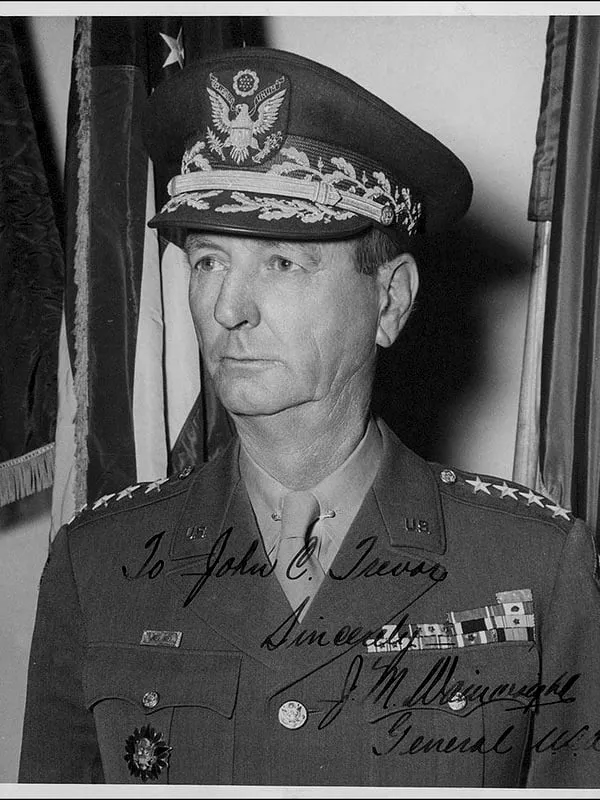
- Born:
- 23 August 1883, Fort Walla Walla, Washington Territory (United States)
- Died:
- 2 September 1953, San Antonio, Texas (United States)
- Author:
- Natalia
- Photo:
- Unknow Military photographer, domena publiczna, Wikimedia Commons

Jonathan Mayhew Wainwright, the fourth of that name in his family, was the general who was given the hardest task entrusted to any American commander in the Second World War. In March 1942, when Douglas MacArthur left the Philippines for Australia on the President’s orders, Wainwright took command of a starving, malaria-ravaged army on the Bataan peninsula and the island of Corregidor, with no hope of relief. After the fall of Bataan and the Japanese landing on Corregidor, on 6 May 1942 he surrendered to General Masaharu Homma and, under Homma’s pressure, ordered the capitulation of all American and Filipino forces on the archipelago. He was the highest-ranking American in Japanese captivity. Through three years in camps in the Philippines, Taiwan and Manchuria he was convinced that at home he was regarded as a coward. On his liberation he was welcomed as a hero, stood behind MacArthur at the surrender of Japan and received the Medal of Honor.
A family of soldiers
He was born on 23 August 1883 at Fort Walla Walla in Washington Territory, where his father, Robert Powell Page Wainwright, a cavalry officer, was stationed. The family had a long tradition of service. His great-grandfather, Jonathan Mayhew Wainwright, was an Episcopal bishop of New York; his grandfather, a naval lieutenant of the same name, was killed in 1863 at the Battle of Galveston during the Civil War. His father commanded a squadron of the 5th Cavalry in the fighting at Santiago in Cuba during the Spanish–American War, and died in 1902 in the Philippines, where the US Army was suppressing resistance after the occupation of the archipelago. At home the son was called by his middle name, Mayhew.
In 1901 Wainwright graduated from high school in Highland Park, Illinois, and entered the Military Academy at West Point. He stood about 188 centimetres tall but weighed little more than 55 kilograms, and it was then that he acquired the nickname “Skinny”, which stayed with him for the rest of his life. In his final year he was First Captain of the Corps of Cadets, the highest rank a cadet could attain. He graduated in 1906.
Cavalryman
He was posted to the 1st Cavalry Regiment, in which his father had been commissioned in 1875. He served with it in Texas, and in 1908 the regiment was moved to the Philippines, where on the island of Jolo the young lieutenant saw action for the first time, against the Muslim Moros who were resisting American rule. In 1911 he married Adele Holley, known as Kitty. Their only son, Jonathan Mayhew Wainwright V, was born in 1913. His studies at the Mounted Service School at Fort Riley were interrupted when a horse kicked him and broke his leg, and he did not complete the course until 1916. That same year, by then a captain, he patrolled the Mexican border with his regiment.
When the United States entered the First World War he taught at the first officers’ training camp at Plattsburgh; in August 1917 he was promoted to major, and in February 1918 he left for France. From June he was assistant chief of staff of the 82nd Division, with which he fought in the Battle of Saint-Mihiel and the Meuse-Argonne Offensive. A shell burst permanently damaged his hearing. In October 1918 he received the temporary rank of lieutenant colonel, and after the war he served with the Third Army’s occupation forces in Koblenz.
The interwar years
On his return, like thousands of other officers, he lost his wartime promotion. He was an instructor at the Cavalry School at Fort Riley, worked on the General Staff from 1921 to 1923, and from 1923 to 1925 served with the 3rd Cavalry Regiment at Fort Myer near Washington, the capital’s ceremonial unit. His career moved slowly. He did not become a permanent lieutenant colonel until 1929, more than ten years after he had first worn that rank in France. He completed the Command and General Staff School at Fort Leavenworth and, in 1934, the Army War College. On that course, which Omar Bradley and William Halsey also attended, he worked several times on War Plan Orange, which envisaged a war with Japan and the defence of the Philippines on the Bataan peninsula.
In 1935 he became a colonel and took command of the 3rd Cavalry Regiment, and in 1938, as a brigadier general, of the 1st Cavalry Brigade at Fort Clark, Texas. He was a typical cavalry officer of the old army: a superb horseman, a polo player, sociable and popular with his men. It seemed that he would end his career as a brigadier general at a time when the horse was giving way to the tank.
The Philippines 1941–1942
In September 1940, just as the US Army was beginning to expand rapidly, Wainwright was posted to the Philippines as commander of the Philippine Division, made up of Americans and Filipino soldiers of the Philippine Scouts. On the way, just after passing through the Panama Canal, he learned of his promotion to major general. In the autumn of 1941, as MacArthur, commander of United States Army Forces in the Far East (USAFFE), prepared to defend the whole archipelago, Wainwright took over the North Luzon Force, which in the event of war was to defend the most important sector, Lingayen Gulf. It consisted of three newly mobilised divisions of the Philippine Army, poorly trained and armed, and the 26th Cavalry Regiment of the Philippine Scouts.
On the morning of 8 December 1941 he was at Fort Stotsenburg, next to Clark Field, a few hours before Japanese aircraft destroyed the American bombers there. On 22 December Homma’s 14th Army landed in Lingayen Gulf. The Filipino divisions could not withstand the blow, and the 26th Cavalry covered the retreat in a series of engagements. When on 23 December MacArthur reverted to War Plan Orange, Wainwright fought delaying actions on successive lines in central Luzon that allowed both the northern forces and the South Luzon Force to withdraw to Bataan. The manoeuvre succeeded, although Manila had to be given up and huge stocks of supplies were left behind on the plain.
On Bataan he commanded I Corps on the western half of the peninsula. After Homma’s January offensive his corps, cut off on the Mauban line, had to fall back to the second line of defence. In February his men wiped out the Japanese landings on the west coast and the units that had infiltrated the front. Wainwright was often seen in the front line, which earned him the respect of his soldiers, and his cavalry, when the food ran out, ate their horses.
Commander in the Philippines
On 11 March 1942 MacArthur left Corregidor. He left behind four separate commands in the Philippines and intended to direct them from Australia, but Washington recognised Wainwright, the senior officer, as commander of all the forces. On 19 March President Franklin Delano Roosevelt nominated him for promotion to lieutenant general, and on 21 March Wainwright moved to Corregidor and took command of United States Forces in the Philippines (USFIP). Rations on Bataan fell to about a thousand calories a day, while Washington reiterated its ban on surrender. On 9 April, after Homma’s final offensive, General Edward King surrendered Bataan without the knowledge of Wainwright, who had pressed for a counter-attack to the end. The prisoners were driven off on the Death March. Wainwright never condemned King.
Over the following month Japanese artillery on Bataan pounded Corregidor to pieces. On the night of 5–6 May Japanese infantry landed on the island, and in the morning tanks joined the fighting. Fearing a massacre of the wounded in the Malinta Tunnel, Wainwright decided to surrender. He tried to save the forces in the south by handing them over to General William Sharp, but at their meeting at Cabcaben Homma refused to accept a surrender that did not include all the forces in the Philippines. Wainwright gave way, and on the night of 6–7 May he signed the document of surrender of Corregidor and of the entire archipelago; on 7 May, over the radio in Manila, he called on the troops to lay down their arms. MacArthur cabled Washington that Wainwright had “temporarily become unbalanced” and ordered Sharp to fight on, but Sharp, convinced that the prisoners from Corregidor faced a massacre, surrendered on 10 May. The last units gave up on 9 June. The whole Philippines campaign lasted five months, not the fifty days the Japanese had planned for.
Captivity
Wainwright was the highest-ranking American prisoner of the war. The Japanese held him first in Manila and from 9 June 1942 in a camp for senior officers at Tarlac on Luzon. In August he was taken to Taiwan, to the camp at Karenko, where he met captured British and Dutch generals, among them Arthur Percival, who had surrendered Singapore. The senior officers were beaten, forced to work and starved. In his diary Wainwright recorded his loss of weight and went over his decision to surrender again and again. Later he was moved to other camps on Taiwan, and in the autumn of 1944, when American bombers began to reach the Japanese home islands, to Manchuria. He spent the last months of the war in a freezing camp near Xi’an, today’s Liaoyuan, north-east of Mukden.
At home his fate was a national cause. In 1942 he was put forward for the Medal of Honor, but MacArthur formally objected, citing among other things the surrender itself, and the Chief of Staff, General George Marshall, shelved the matter so as not to antagonise the commander in the South West Pacific. In May 1944 Time magazine put a portrait of Wainwright behind barbed wire on its cover.
On 19 August 1945, a few days after Japan’s surrender had been announced, two agents of the American Office of Strategic Services, who had been parachuted near Mukden, reached the camp. At the end of August, while the Red Army was occupying Manchuria, Wainwright, Percival and the other prisoners returned to Mukden and flew out from there. The first question Wainwright asked was what Americans thought of him. He was astonished to hear that he was a hero.
On the Missouri and at Baguio
On 31 August he met MacArthur in Yokohama. According to those present, MacArthur was shaken by the appearance of his emaciated, grey-haired former subordinate. On 2 September 1945, aboard the battleship Missouri in Tokyo Bay, Wainwright and Percival stood just behind MacArthur as he accepted the surrender of Japan. MacArthur signed the document with several pens and handed the first of them to Wainwright. The next day both men were present at Baguio on Luzon when General Tomoyuki Yamashita signed the surrender of the Japanese forces in the Philippines.
After his return home, Secretary of War Henry Stimson ruled MacArthur’s objection to the Medal of Honor groundless. On 10 September 1945 President Harry Truman unexpectedly presented him with the medal in the White House Rose Garden. The citation stressed that Wainwright had repeatedly gone into the line of fire at the risk of his life and that his conduct on Corregidor had won the admiration of the Allies. He was promoted to full, four-star general, and on 13 September New York gave him a parade on Broadway. Among his many later foreign decorations, the Polish Virtuti Militari is also listed.
Last years
He took over Eastern Defense Command on Governors Island in New York, and in January 1946 the Fourth Army at Fort Sam Houston, Texas. In 1946 he testified on the terms of the surrender before the American military commission trying Homma in Manila. With the journalist Robert Considine he also published his memoirs, General Wainwright’s Story, which became a bestseller. On 31 August 1947, having reached retirement age, he reluctantly retired. He sat on the boards of several companies, was national commander of the Disabled American Veterans and often spoke at veterans’ reunions. He never showed any public resentment towards MacArthur, and in 1948 he was ready to deliver the speech nominating him as the Republican presidential candidate.
He died of a stroke on 2 September 1953 in San Antonio, on the eighth anniversary of the ceremony aboard the Missouri. He was buried in Arlington National Cemetery, beside his parents. Bradley, Marshall and Edward King attended the funeral.
Significance
Wainwright was not an outstanding strategist and had no influence on the plan that doomed the defenders of the Philippines to defeat. It was MacArthur who decided to defend the whole archipelago and dispersed the supplies, and Washington knew from the outset that there would be no relief. Wainwright was given command of an army that had already lost, and held out with it for as long as he could. His decision to surrender all the forces in the Philippines, extracted by a threat against the defenceless garrison of Corregidor, was to MacArthur proof of weakness, and to historians rather an example of a commander with no cards left trying to save his men. Louis Morton, author of the US Army’s official history, pointed out that the dilemma would never have arisen had the command arrangements MacArthur left behind been kept, because the Japanese would have had no one from whom to demand the surrender of the entire archipelago.
For Americans Wainwright became a symbol of the soldiers left behind in the Philippines, of Bataan, of Corregidor and of the thousands of prisoners who never returned from captivity. Fort Wainwright in Alaska bears his name, and the veterans’ hospital in Walla Walla, his home town, was named after him. On Corregidor, among the ruins of the fortress, stands his memorial.
Sources
Commanded in battles
(01)Mentioned in battles
(02)Often appears with
People who appear in the same events.
On the timeline
(18)1941
1942
January
February
March
April
- 09
- Key eventThe fall of BataanOn 9 April 1942 General Edward King surrendered the forces on Bataan against orders. Some 75,000 men went into captivity; only Corregidor still held out.
- The Bataan Death MarchAfter Bataan fell on 9 April 1942 the Japanese drove some 76,000 prisoners north on foot to Camp O'Donnell. Thousands of men died on the way.
May
1944
1945
February
July
August
September
- 02
- Key eventThe Japanese surrender on the “Missouri”On 2 September 1945, in Tokyo Bay, Japan signed the instrument of unconditional surrender aboard USS Missouri. The Second World War was over.
- The surrender of YamashitaOn 2 September 1945 General Tomoyuki Yamashita came down from the mountains near Kiangan and surrendered; on 3 September he signed the surrender at Baguio.