United States
Henry L. Stimson
US Secretary of War (1911–1913, 1940–1945), Governor-General of the Philippines (1927–1929), US Secretary of State (1929–1933)
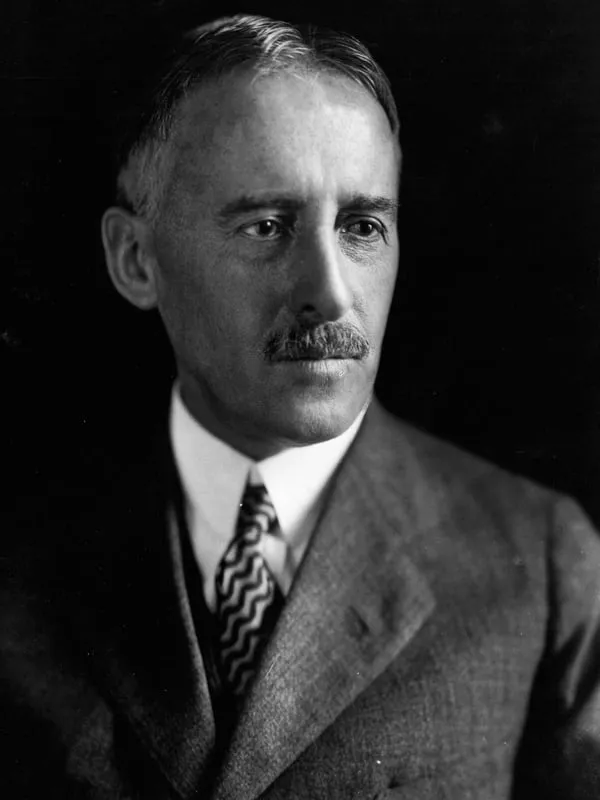
- Born:
- 21 September 1867, New York City (United States)
- Died:
- 20 October 1950, Huntington (New York State, United States)
- Author:
- Natalia
- Photo:
- Harris & Ewing, domena publiczna, Wikimedia Commons

Henry Lewis Stimson served six presidents, Republican and Democratic, over almost forty years. He was Secretary of War under William Taft before the First World War and under Franklin Roosevelt and Harry Truman during the Second, and in between he was Herbert Hoover’s Secretary of State. For the history of that era two moments of his life matter most. In January 1932, when Japan occupied Manchuria, he announced that the United States would not recognise gains achieved in violation of treaties. This Stimson Doctrine did not stop the aggressor, but it became a principle of international law. Ten years later, as Secretary of War, he built the army that defeated Germany and Japan, oversaw the building of the atomic bomb and advised on its use.
A New York lawyer
He was born on 21 September 1867 in New York City into a wealthy family. His father, Lewis Atterbury Stimson, was a well-known surgeon. His mother died when he was nine, and he was brought up in boarding schools. He graduated from Phillips Academy, Andover, then from Yale University in 1888, where he belonged to the secret society Skull and Bones, and from Harvard Law School in 1890. In 1891 he joined the Wall Street law firm of Root and Clark. Its head, Elihu Root, later Secretary of War and Secretary of State, became his mentor and model. In 1893 Stimson married Mabel White. They had no children. All his life he was a keen hunter and hiker, and as a young man he roamed the mountains of Montana, where one of the peaks of Glacier National Park now bears his name.
In 1906 President Theodore Roosevelt appointed him US Attorney in New York. Stimson made his name with prosecutions of trusts and customs frauds. In 1910 he ran as the Republican candidate for Governor of New York and lost.
Secretary of War and colonel
In 1911 President William Taft entrusted him with the War Department. Stimson continued Root’s reforms, which were meant to turn an army scattered among frontier forts into a modern fighting force, and pushed through a new organisation of the troops at home. He left in 1913, when the Democrat Woodrow Wilson took office. After war broke out in Europe he belonged to the Preparedness Movement, which called for the expansion of the army and trained volunteers as officers. When the United States entered the war in 1917, the fifty-year-old Stimson volunteered for the army. He served in France as a field artillery officer and in August 1918 was promoted to colonel. For the rest of his life his friends called him “the Colonel”.
After the war he returned to the law. In 1927 President Calvin Coolidge sent him to Nicaragua, where he negotiated an end to the civil war. From the end of 1927 to the beginning of 1929 he was Governor-General of the Philippines. Like many American politicians of his generation, he believed that the Filipinos were not yet ready for independence, nor the Nicaraguans for self-government. These paternalistic views went hand in hand with the conviction that America had obligations towards the world and could not wall itself off from it.
Secretary of State
In March 1929 Herbert Hoover appointed him Secretary of State. Stimson began with a decision he later regretted: he closed the code-breaking bureau funded by the State Department, the so-called Black Chamber, which read the cables of foreign governments. He was credited with the words “Gentlemen do not read each other’s mail.” In 1930 he led the American delegation to the conference that ended with the signing of the London Naval Treaty, and in 1931 he supported the Hoover Moratorium on payments of war debts and reparations.
The hardest test of his tenure was the Mukden Incident of 18 September 1931 and the Japanese invasion of Manchuria. At first Stimson hoped that the civilian government in Tokyo would rein in the army, and he did not want to make its task harder. He sent an observer to the meetings of the Council of the League of Nations, even though the United States was not a member, and invoked the Kellogg–Briand Pact. When at the beginning of January 1932 the Japanese took Jinzhou, the last seat of Chinese authority in southern Manchuria, he himself was ready to consider economic sanctions. Hoover refused, believing that sanctions lead to war. On 7 January 1932, therefore, Stimson sent Japan and China a note announcing that the United States would not recognise any situation, treaty or agreement brought about in violation of the Pact of Paris or of America’s rights in China.
Britain and France did not associate themselves with the note, and Japan replied ironically that China was in such a state that treaties had to be applied with due regard to the facts. After the Japanese attack on Shanghai, Stimson published on 23 February 1932 a letter to Senator William Borah in which he warned that Japan’s breach of its obligations towards China might release America from the limits on naval armaments agreed in Washington. On 11 March 1932 the Assembly of the League of Nations adopted his principle of non-recognition as an obligation on all members. Japan nevertheless proclaimed Manchukuo, recognised it in September 1932, and in 1933 left the League. In August 1932, in New York, Stimson argued that after the Pact of Paris war had ceased to be the private affair of the parties and that the world could not be neutral towards it. The Japanese press received the speech with indignation.
In January 1933, before the end of his term, Stimson met President-elect Franklin Delano Roosevelt at his estate at Hyde Park and persuaded him to maintain the policy of non-recognition. Roosevelt never recognised Manchukuo. On 4 March 1933 Stimson left office.
A voice of warning
In the 1930s Stimson, as a lawyer and president of the New York City Bar Association, remained one of the most influential critics of Japanese expansion and American isolationism. After the outbreak of the Sino-Japanese War in 1937 he called, in a widely noticed letter to The New York Times, for a halt to shipments of American war materials to Japan, and later sponsored a committee that campaigned for an embargo. He also supported aid to the states threatened by Adolf Hitler and criticised the Neutrality Acts. After the fall of France, on 18 June 1940, he called in a radio address for the introduction of universal conscription and for American ports to be opened to the British fleet.
Roosevelt’s Secretary of War
A few days later Roosevelt offered him, a seventy-two-year-old Republican, the War Department once again. At the same time another Republican, Frank Knox, took over the Navy Department. In this way the President wanted to win both parties over to preparations for war. The Senate confirmed Stimson on 9 July 1940 over the votes of isolationists, who regarded him as too pro-British. Stimson secured the passage in September 1940 of the first peacetime conscription in the history of the United States, and supported Lend-Lease, aid to Britain and a firm line towards Japan. Together with the Army Chief of Staff, General George Marshall, he built an army and air force that at their peak numbered more than eight million men.
At the end of November 1941 he noted in his diary that Roosevelt expected a Japanese attack and was considering how to “maneuver” the Japanese into firing the first shot. Proponents of the theory that Washington knew in advance of the attack on Pearl Harbor quote this entry to this day. Most historians read it as evidence of fears of an attack on British or Dutch possessions rather than of knowledge of a strike on Hawaii. When the Japanese attacked the Pacific Fleet on 7 December 1941, Stimson noted that his first feeling was one of relief that the indecision was over and that the crisis would unite the nation.
In the war Stimson took decisions that are judged very differently. After initial hesitation, in February 1942 he backed the removal of more than a hundred thousand Americans of Japanese descent from the West Coast and their incarceration in camps, although he himself wrote that it would make “a tremendous hole” in the country’s constitutional system. He was an advocate of a landing in France at the earliest possible date. He opposed the plan of the Treasury Secretary, Henry Morgenthau, to turn defeated Germany into an agricultural country, and ensured that it did not become official policy. It was he, the lawyer, who insisted, against Churchill, that the leaders of the Third Reich be brought to trial rather than shot without one. From these proposals grew the Nuremberg trials, in which they were also charged with crimes against peace, based on the very pact that Stimson had invoked in 1932.
The bomb
Stimson exercised political oversight over the Manhattan Project. He obtained money and priority for it, and in May 1945 he became chairman of the committee that advised President Truman on the use of the bomb. He struck Kyoto, Japan’s former capital, off the list of targets, fearing that its destruction would alienate the Japanese from America for generations. The popular story that he had spent his honeymoon there is a legend. In July 1945 he advised Truman to assure the Japanese, in the call for their surrender, that the monarchy would be preserved, which might have made it easier for them to give in. This assurance was not included in the Potsdam Declaration. Stimson supported the dropping of the bombs on Hiroshima and Nagasaki. After the war he argued that without it Japan would not have surrendered quickly and that an invasion would have cost more than a million American casualties. Historians regard these estimates as inflated, and the dispute over whether the bomb was necessary continues to this day.
In the autumn of 1945 Stimson proposed that the United States offer the Soviet Union joint control of atomic weapons before an arms race broke out. His advice was not taken. On 21 September 1945, his seventy-eighth birthday, he retired.
Last years and significance
In 1947 he published in Harper’s Magazine an article on the decision to use the atomic bomb that long shaped its official interpretation, and in 1948, together with McGeorge Bundy, his memoirs, On Active Service in Peace and War. He died on 20 October 1950 at Highhold, his estate in Huntington on Long Island.
Stimson was the embodiment of the American elite that convinced America it could not wall itself off from the world. In 1932 his words did not stop Japan, and critics accused him of merely provoking Tokyo without the force to back it up. The principle he formulated, however, outlived that failure: the United States recognised neither Manchukuo, nor the annexation of Ethiopia, nor the Soviet occupation of the Baltic states, and after 1945 the non-recognition of gains won by force became part of international law. Ten years after his note on Manchuria, Stimson stood at the head of the war machine that answered Japan with force. His record from 1940–1945, including the removal of Japanese Americans and the decision on the atomic bomb, remains contested.
Sources
Mentioned in battles
(02)Often appears with
People who appear in the same events.
On the timeline
(48)The 40 most important of 48 events. All tagged “Henry L. Stimson” (11) →
1929
1930
1932
1940
1941
January
February
March
June
July
September
November
- 26
- Key eventThe Kidō Butai sails for HawaiiOn 26 November 1941 Vice-Admiral Chūichi Nagumo’s six carriers left Hitokappu Bay in the Kurils, sailing under radio silence to strike Pearl Harbor.
- The Hull noteOn 26 November 1941 Cordell Hull handed the Japanese a note demanding withdrawal from China and Indochina. It set no deadline, but Tokyo saw it as an ultimatum.
December
1942
February
March
May
June
- 18
- The Manhattan Project beginsOn 18 June 1942 Colonel James C. Marshall was ordered to organise the military side of the American atomic programme. So the Manhattan Project was born.
- Churchill in WashingtonOn 18 June 1942 Churchill flew to Washington for talks with Roosevelt. Before leaving he named Anthony Eden to the King as his successor.