Saar Offensive
- Dates:
- 7 September – 16 October 1939
- Front:
- Western Front
- Location:
- The Franco-German borderland between the Moselle and the Palatinate Forest – the Warndt forest, the area around Saarbrücken and the valleys of the Saar and the Blies (Saarland and the Palatinate, Germany), together with the adjoining part of Lorraine (Moselle department, France)On the battle map →
- Sides:
- FranceMaurice Gamelin, André-Gaston PrételatNazi GermanyErwin von Witzleben
- Result:
- Inconclusive. The French occupied a strip of ground in front of the Siegfried Line up to about 8 km deep, but on 12 September halted the advance and by 17 October had withdrawn to their own territory. The offensive drew no German forces away from Poland.
- Author:
- Łukasz
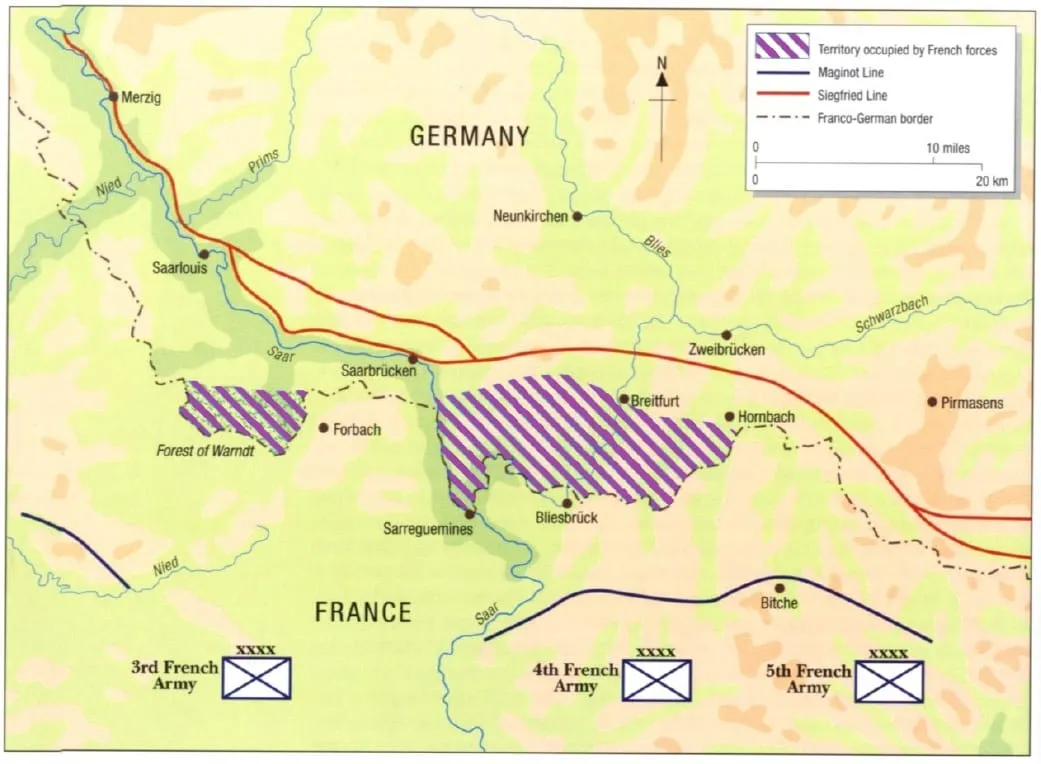
The Saar Offensive was the only attack the French army made on German territory while the Wehrmacht was fighting in Poland. From 7 September 1939 troops of General André-Gaston Prételat’s French 2nd Army Group crossed the border between the Moselle and the Palatinate Forest and advanced slowly through deserted villages and mined woods in the forefield of the German Siegfried Line. At their furthest point they were some eight kilometres inside the Reich. On 12 September the Commander-in-Chief, General Maurice Gamelin, halted the advance, and he later ordered the troops back to their start line. On 16 October the German 1st Army, by then rebuilt in the west, went over to a counter-attack, and on 17 October the last French outposts left German soil. The offensive that the Allies had promised Poland for the fifteenth day of mobilisation never began. What was supposed to herald it turned out to be a reconnaissance in force, which did not draw a single German division away from the Vistula.
Name and dates
Polish historians speak of the “offensive in the Saar” or the “Saar offensive”, French ones of the “offensive de la Sarre” or “opération de la Sarre”, and German ones of the “Saar-Offensive”. The name somewhat overstates the case: only part of the forces that French plans had earmarked for a great offensive took part, and Gamelin and his staff themselves regarded the operation as a strong reconnaissance of the ground in front of the Siegfried Line, not as an attempt to break through it.
The operation is generally taken to have begun on 7 September 1939. During the night of 6–7 September reconnaissance units of the French 3rd Army pushed deeper into German territory and reached the first villages beyond the border, although small patrol raids a few hundred metres across the frontier had been taking place since 3 and 4 September. The main attack by the 4th Army began at dawn on 9 September. Historians give different end dates: 12 September (when the advance was halted), 21 September (the order to prepare the withdrawal), the beginning of October (the withdrawal of the main forces) or 16–17 October, when the German counter-attack pushed the French covering units back across the border. The end of the offensive can be taken as 16 October, the day of the German counter-attack. On 17 October the last French outposts left German territory.
Background
France was bound to Poland by an alliance of 1921, and in March 1939 it had joined the British guarantee. On 19 May 1939 Generals Gamelin and Tadeusz Kasprzycki signed a protocol of staff talks in Paris. In it the French army undertook that, should Germany launch its main attack against Poland, it would immediately begin air operations, open limited offensive operations from the third day of mobilisation, and launch an offensive “with its main forces” no later than the fifteenth day of mobilisation. The protocol did not formally enter into force until the political agreement that accompanied it had been signed, and that happened only on 4 September 1939, when the war was already under way. The Polish high command nevertheless built its calculations on it: the Polish defence plan assumed that the Polish Army would hold out for a few weeks, until an attack in the west forced the Germans to transfer forces there.
The French commitment was burdened from the outset by a contradiction. France’s military doctrine was defensive. The army, built around the Maginot Line, was meant to survive the first shock and wait until the naval blockade and British rearmament had changed the balance of forces, going over to a great offensive in 1941 at the earliest. The Anglo-French staff talks in the spring of 1939 adopted the same strategy of a long war. Apart from the Saar and the Palatinate, the routes into Germany ran through neutral Belgium and Luxembourg, and France had no intention of violating their borders. That left the narrow sector between the Moselle and the Rhine, where since 1936, after the remilitarisation of the Rhineland, the Germans had been building the Siegfried Line (the Westwall). In 1938 and 1939 the work was carried out on an enormous scale. French intelligence overestimated its progress, just as it overestimated the strength of the German garrison.
French mobilisation began on 2 September, and its fifteenth day fell on 16 September. The French mobilised army, unwieldy and based on reservists, needed about two weeks to concentrate its units, above all its heavy artillery, which had to be brought out of storage and moved by rail. The French high command also feared German air raids on the towns and industrial centres of eastern France. When Britain and France declared war on Germany on 3 September, Gamelin told the government that operations would be cautious and gradual.
On the other side of the border stood General Wilhelm von Leeb’s Army Group C, and in the Saar and Palatinate sector its 1st Army under General Erwin von Witzleben. Almost all the Wehrmacht’s field forces, its air force and its armour were fighting in Poland. What remained in the west were mainly reserve and Landwehr divisions, poorly equipped, without tanks and with little air support. Estimates of their number vary according to what is counted: General Alfred Jodl spoke at Nuremberg of 23 divisions, while other tallies, which include units in the rear and those formed during the campaign, give 30–40 divisions. In his directive of 31 August Hitler ordered that in the west the responsibility for opening hostilities should be left to the enemy, and that the land frontier was not to be crossed without his permission. The border strip in front of the Siegfried Line, the so-called Red Zone, had already been evacuated in September: the civilian population was moved out of the villages in front of the fortifications, and the roads, bridges, houses and fields were thickly sown with mines.
Forces and plans
French plans envisaged two stages. First the troops were to occupy the strip of land between the border and the Siegfried Line, clear it of German outposts and mines, bring up heavy artillery and reconnoitre the fortifications. Only then, if the situation allowed, was the real attack on the German positions to follow. Staff studies of the 1930s spoke of several dozen divisions, many regiments of heavy artillery and battalions of tanks. In September 1939, however, only part of these forces was committed to the first stage, and no decision on the second was ever taken.
The numerical advantage lay with the French, and it was a great one. Most of the German divisions in the west lacked full equipment and the necessary numbers of heavy and anti-tank guns, and their ammunition would have lasted a few days of intensive fighting. The fighter and bomber arms were fighting in Poland. In the Saar and Palatinate sector the Siegfried Line was unfinished: alongside dense belts of bunkers and anti-tank obstacles it had gaps whose existence the French did not suspect. Working from incomplete intelligence, however, the French high command rated German strength and fortifications far higher than they really were. It also assumed that an attack on fortifications without heavy artillery and special ammunition would end in a slaughter like those of 1914–1918.
The German command reckoned with a French attack and had prepared a plan to meet it. The 1st Army was to give up the forefield, confine itself to minor skirmishes and the demolition of bridges, and stop the enemy only on the main line of fortifications. It did not have the strength for counter-attacks on any larger scale. In the event of a strong French attack the only remedy would have been to bring troops back from Poland, which Hitler and the Army High Command wanted to avoid at all costs.
Course: the advance into the Saar (7–12 September)
The operation was entrusted to General Prételat’s 2nd Army Group, made up of the 3rd, 4th and 5th Armies, which held the front from Luxembourg to the Rhine. The attack was carried out chiefly by the 3rd Army on the left wing, in the Warndt forest west of Saarbrücken, and the 4th Army in the centre, between Saarbrücken and the valley of the Blies. The 5th Army covered the attack from the east, on the side of the Palatinate Forest. Polish studies list in the first wave the 11th, 21st and 23rd Infantry Divisions, the 4th North African Division and the 9th Motorised Division, supported by several tank battalions. Sources differ on the number of divisions that took part in the operation as a whole, usually giving between nine and twelve. Only a few of them went into action at full strength. At the same time more than 80 divisions had been mobilised in France.
During the night of 6–7 September reconnaissance units of the 3rd Army crossed the border and reached the first deserted villages on the German side. There were minor clashes with German outposts. The following days showed what the whole operation would look like. The Germans did not defend the forefield, but they left thousands of anti-personnel and anti-tank mines in it. The mines took their toll of patrols, destroyed tanks and forced the infantry to advance step by step behind the sappers. German sappers blew up the bridges over the Saar and the Blies.
The main attack by the 4th Army began at dawn on 9 September. The weather was bad, and the air force gave the troops little support. Most of the soldiers were newly called-up reservists, the divisions were short of some of their equipment, and the infantry did not know how to cooperate with tanks. The French took one village after another in the Blies valley and on the hills south of Saarbrücken: according to the records, Gersheim, Medelsheim, Niedergailbach, Bliesmengen, Brenschelbach, Auersmacher, Sitterswald, Kleinblittersdorf and several others, about a dozen places in all, usually without a fight. North of Bliesbrück several Renault R35 tanks were destroyed on mines. By 9 September the 3rd Army had occupied most of the Warndt forest. On 10 September a German counter-attack briefly retook the village of Apach near the Luxembourg border, which the French recovered a few hours later. The bridge at Schengen, where the French, German and Luxembourg borders meet, was blown up. The French got furthest, to a depth of about eight kilometres, in the area south-east of Saarbrücken. According to various sources the occupied strip had a frontage of 25–32 kilometres.
The advance halted
On 12 September Gamelin ordered a halt to any further advance. The troops were to hold the ground they had taken but not to approach the main line of German fortifications. That same day the Anglo-French Supreme War Council met for the first time at Abbeville. The prime ministers, Neville Chamberlain and Édouard Daladier, concluded that the campaign in Poland had in practice been decided and that no effective help could be given to her. It was resolved not to undertake a great land offensive and not to begin bombing targets in Germany, so as not to provoke German retaliation against France and Britain, but instead to build up forces for a decision at a later stage of the war.
Poland, the ally, was not informed of this. Gamelin assured Marshal Edward Rydz-Śmigły that more than half of his active divisions on the north-eastern front were engaged in combat and that the Germans had been forced to move part of their forces to the west. This was not true. A few days later the head of the French military mission in Poland, General Louis Faury, informed the Chief of Staff of the Commander-in-Chief, General Wacław Stachiewicz, that the offensive in the west had been postponed. The Polish ambassadors in Paris and London demanded in vain that the obligations of the alliance be honoured.
After 12 September the French units in the Saar dug in on the positions they had taken, carried out reconnaissance and here and there improved their line. Until mid-September they were reinforced with heavy artillery, needed for any bombardment of the Siegfried Line. The news of the Soviet invasion of Poland on 17 September finally removed any point in further operations. Some French generals, among them General Henri Giraud, believed that an opportunity had been thrown away. Others, such as the commander of the 5th Army, General Victor Bourret, thought that without heavy artillery and ammunition capable of breaching fortifications an assault on the Siegfried Line would have been unrealistic.
Withdrawal and the German counter-attack
On 21 September Gamelin ordered preparations for the withdrawal of the main forces to French territory, to positions in front of the Maginot Line. The troops were to pull back gradually, by night, leaving only covering outposts on the occupied ground. The main forces left the Saar at the turn of September and October. On 28 September the French repelled one more local German counter-attack near Bischmisheim and Ommersheim.
After the capitulation of Warsaw and the end of the main fighting in Poland the Germans began moving divisions to the west, and Luftwaffe fighters reappeared over the French border. On 16 October Witzleben’s 1st Army launched a counter-attack along the whole sector previously occupied by the French. The French covering units withdrew according to plan, and on 17 October the last of them left German territory. In some sectors the Germans advanced onto a few square kilometres of French soil. Local skirmishes went on until 24 October. After that the front fell silent until May 1940.
Losses
According to French figures the operation cost the French army about 2,000 men killed, wounded, missing and sick. Polish studies give 1,750 soldiers and 98 officers killed, wounded and missing up to 16 October. The 21st Infantry Division, for example, lost 76 killed, 4 missing and 241 wounded by 15 September. A large proportion of the losses was caused by mines. The dead of the 11th Infantry Division, the so-called Iron Division, were buried in the cemetery at Sarreguemines. German reports for the period up to 17 October spoke of 196 killed, 356 wounded and 114 missing, and of 11 aircraft lost. These figures also include the fighting during the counter-attack.
Significance
The Saar Offensive had no effect on the course of the campaign in Poland. It did not force the Germans to move a single division or a single aircraft to the west. The Polish commanders, who had based their defence plan on the assumption that a great offensive would begin in the west by mid-September, were in fact fighting alone. Leszek Moczulski called the Allies’ conduct a classic act of felony, the betrayal of an ally on the field of battle. French historians more often stress that the French army, mobilised according to outdated plans and lacking the means to break through fortifications, was incapable of a rapid offensive, and that the high command did not want to undertake one. After the war German generals claimed that a determined attack in September 1939 would have put the Wehrmacht in a very difficult position. General Siegfried Westphal wrote that the western front would then have held out for only a week or two. These statements, however, came from men who after the war were glad to emphasise their opponents’ mistakes.
The withdrawal from the Saar opened the period in the west that the French called the drôle de guerre and the Poles the “strange war”, known in English as the Phoney War: eight months in which the armies faced each other from behind their fortifications, exchanging patrols, artillery fire and propaganda. The apparent ease of the advance into the Saar strengthened the French high command’s conviction that time was on the Allies’ side. In reality it gave the Germans the chance to move their entire army to the west. On 10 May 1940 the Wehrmacht struck through Belgium, the Netherlands and the Ardennes, bypassing the Maginot Line, and defeated France in six weeks. Gamelin, who had halted the advance in the Saar in September 1939, lost his command on 19 May 1940, in the midst of the defeat.