Poland
Edward Rydz-Śmigły
Commandant of the POW (1917–1918), commander of the 3rd Army and the Central Front (1920), Inspector General of the Armed Forces (1935–1939), Marshal of Poland (from 1936), Commander-in-Chief (1939)
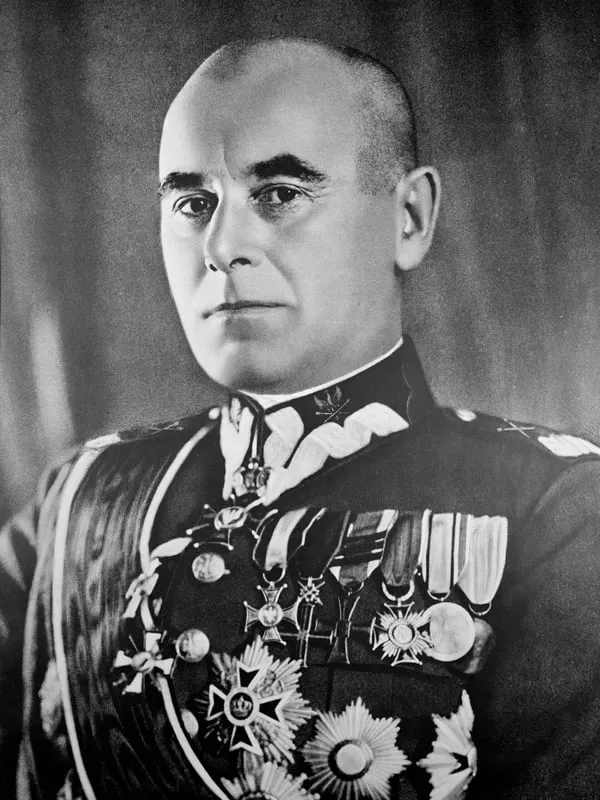
- Born:
- 11 March 1886, Brzeżany (Austria-Hungary)
- Died:
- 2 December 1941, Warsaw
- Author:
- Natalia
- Photo:
- Harris & Ewing, domena publiczna, Wikimedia Commons

Edward Rydz-Śmigły was one of Józef Piłsudski’s ablest field commanders and his successor at the head of the army. A painter by training, he rose to the rank of colonel in the Legions, and in the war with Soviet Russia of 1919–1920 he took Wilno, Dyneburg (Daugavpils) and Kiev and commanded one of the fronts in the Battle of Warsaw. After Piłsudski’s death in 1935 he became Inspector General of the Armed Forces, and in 1936 Marshal of Poland and, officially, the “second person in the state” after the president. In the last years before the war he was responsible for rearmament and defence planning, and in September 1939, as Commander-in-Chief, he led the Polish Army in a hopeless war against Germany and the Soviet Union. The defeat, followed by his crossing into Romania, weighed on his reputation for decades.
Painter and rifleman
He was born on 11 March 1886 in Brzeżany in Eastern Galicia, the son of Tomasz Rydz, a non-commissioned officer in the Austrian army, and Maria, née Babiak. He lost both parents early and was brought up by his grandparents and then by the family of a local doctor, Uranowicz. After his school-leaving examinations at the Brzeżany gymnasium he went to Kraków, where he studied painting at the Academy of Fine Arts as well as philosophy and art history at the Jagiellonian University. He also studied in Munich and Vienna. He was a gifted painter of landscapes and portraits, and he did not give up painting even in wartime.
In 1910–1911 he did his one-year service in the Austro-Hungarian army, in the 4th Infantry Regiment in Vienna, and completed the reserve officers’ school. At the same time he became involved in Piłsudski’s pro-independence rifle movement, and from 1912 he was one of the commanders of the Riflemen’s Association in Galicia, a lecturer on officers’ courses and the author of a pamphlet on bayonet fighting.
The Legions and the POW
In August 1914 he went to war with Piłsudski. In the First Brigade of the Legions he commanded a battalion and, from December 1914, the 1st Infantry Regiment. He was regarded as one of the bravest officers in the brigade and one of the calmest under fire. He was made lieutenant colonel in 1915 and colonel in 1916. The Commandant rated him more highly than most of the Legion commanders, and he never lost the trust he won in those years.
In 1917, when Piłsudski was imprisoned by the Germans and the legionaries who refused to swear an oath of brotherhood in arms with the Central Powers were interned, Rydz took over the clandestine Polish Military Organisation (POW) as its commandant. It was then that he adopted the pseudonym “Śmigły” (“Swift”), which in time became part of his surname. Under his direction the POW trained the cadres of the future army, and in the autumn of 1918 it took over power from the withdrawing Austrians. On the night of 6–7 November 1918 he joined Ignacy Daszyński’s Provisional People’s Government in Lublin as minister of war, stressing that he held the office on Piłsudski’s behalf. When Józef Piłsudski returned from Magdeburg a few days later, the government handed power over to him, and Rydz became a general of the Polish Army and commander of a military district, first in Lublin and then in Warsaw.
The war with the Bolsheviks
In the Polish–Soviet War Rydz-Śmigły was one of the commanders on whom Piłsudski relied most. When, after the first clashes of February 1919, the Chief of State decided to strike at Wilno, Rydz led the legionary infantry, which on the night of 20–21 April 1919 reached the city, already partly held by Polish cavalry, and forced the Bolsheviks to withdraw. He then beat off Soviet attempts to retake Wilno at the turn of April and May. On 3 January 1920 Polish troops under his command, together with Latvian units, attacked Dyneburg on the Daugava and took it for Latvia. The Latvians later repaid him with their highest decorations.
In the spring of 1920, during the Kiev offensive, he commanded the 3rd Army, which entered Kiev on 7 May. When Semyon Budyonny’s Soviet 1st Cavalry Army broke through the front in Ukraine at the beginning of June, he was ordered to retreat. He hesitated, demanded confirmation from Piłsudski and did not withdraw until 10 June, but he managed to lead his army out of a dangerous encirclement. On 6 August 1920 he took command of the new Central Front, whose troops on the Wieprz river delivered the decisive counter-offensive in the Battle of Warsaw. Piłsudski directed the blow in person, but Rydz was responsible for the front and for the pursuit of Mikhail Tukhachevsky’s shattered armies. In September, in the Battle of the Niemen, he commanded the 2nd Army. He emerged from the war as one of the best-known generals of reborn Poland.
In the Marshal’s shadow
After the war he was an army inspector based in Wilno. He kept out of politics, but in military disputes he always sided with Piłsudski and his legionaries. In May 1926, during the May Coup, he seized control in Wilno and sent regiments from the north-eastern districts to Piłsudski’s aid. After the coup he became an army inspector in Warsaw and one of the Marshal’s closest military associates. Piłsudski thought highly of his abilities as a commander, although in an assessment from 1922 he is said to have written that Rydz would make an excellent army commander but that he was not sure he would be equal to the role of commander-in-chief in a war between two states.
The successor
After Piłsudski’s death, and in accordance with his wishes, President Ignacy Mościcki appointed Rydz-Śmigły Inspector General of the Armed Forces on 12 May 1935 – the post designated to become Commander-in-Chief in time of war. In the struggle for the Marshal’s legacy the Sanacja camp split into supporters of the president, of the general and of the former prime minister Walery Sławek. Mościcki and Rydz came to terms at Sławek’s expense and shared power until 1939. In July 1936 a circular from Prime Minister Felicjan Sławoj Składkowski ordered that the general be regarded as the first person in the state after the president, and on 10 November 1936 Rydz received the baton of a Marshal of Poland. In 1937, on his initiative, the Camp of National Unity was founded; it was meant to rally society around the army and its leader, but it increasingly adopted the slogans of the nationalist right, including towards the Jews. The cult built around the Marshal offended even many of Piłsudski’s followers, and the system of those years was called, not without reason, “a dictatorship without a dictator”.
The army was Rydz’s most important task. He took over a military that had been starved of investment under Piłsudski, just as Hitler’s Germany was embarking on large-scale rearmament. In 1936 a six-year plan for expanding and modernising the armed forces was adopted and the National Defence Fund was set up, and in September of that year, after Rydz’s visit to France, Poland obtained French credits for armaments worth two billion francs at Rambouillet. Many of these plans had no time to bear fruit, because Poland could not afford rapid modernisation and its arms industry was only just being built, among other places in the Central Industrial Region. Until 1938 the general staff worked mainly on a plan for war with the Soviet Union, and the plan for defence against Germany was drawn up in haste only at the beginning of 1939. Rydz also backed the ultimatum with which, in September 1938, after the Munich Agreement, Poland forced Czechoslovakia to cede Zaolzie.
In the spring of 1939, when Hitler demanded Gdańsk and an extraterritorial motorway across Pomerania, Rydz stood behind the refusal. In August, during the military talks in Moscow, he rejected the demand that Poland agree to let the Red Army march across its territory. According to accounts, he argued that there was no guarantee the Soviets would actually fight, and that once they came in they would never leave. A few days later Stalin signed his pact with Hitler.
September 1939
On 1 September 1939 the president appointed him Commander-in-Chief. The Polish Army, deployed along the long border with Germany to defend the industrial districts and prevent a swift seizure of Pomerania or Silesia, was broken within a week by the German armoured groupings. On the night of 6–7 September the Commander-in-Chief left Warsaw and moved his headquarters to Brest, and then further south-east. Communications with the armies kept breaking down, and command was slipping out of his hands. Rydz was counting on the defence of Warsaw and Modlin and on the creation of the Romanian bridgehead, where the army could hold out until the promised offensive by France and Britain.
The offensive in the west never came, and on 17 September the Red Army entered Poland. That day the Commander-in-Chief issued a directive whose most famous words read: “The Soviets have invaded. I order a general withdrawal to Romania and Hungary by the shortest routes. Do not fight the Bolsheviks unless they attack or attempt to disarm our units.” The order never reached many units, and historians still argue about its consequences. On 18 September Rydz-Śmigły and his staff crossed the Romanian border and were interned, as the president and the government had been before them. At the end of October he resigned as Commander-in-Chief, and the post was taken over by Władysław Sikorski.
The last months
In Romania the Marshal was closely guarded, and the new authorities in exile, led by Sikorski, blamed him for the defeat and wanted him neither in France nor in Poland. On 10 December 1940 he escaped from internment to Hungary. When rumours spread that he wished to return to Poland, Sikorski cabled the commander of the underground at home, General Stefan Rowecki, that the government would regard his presence in Poland as sabotage of its work. Rydz nevertheless made his way through Slovakia to occupied Warsaw in October 1941, intending to fight in the underground as a private soldier. He died there suddenly of heart failure on 2 December 1941, a few weeks after his arrival. He was buried in Powązki Cemetery under an assumed name, Adam Zawisza. His real name appeared on his grave only after the fall of communism.
Assessment
Few Polish leaders have been judged as contradictorily as Rydz-Śmigły. In 1919–1920 he was one of Poland’s best commanders, brave and independent-minded, and it was those years that made his standing. After 1935, however, he was raised to a post for which, as Piłsudski himself had feared, he was not prepared, and the cult with which he was surrounded made him ridiculous in the eyes of many contemporaries. His critics blame him for the poor deployment of the army in September 1939, for losing control of the battle, for leaving Warsaw and for crossing into Romania, which to most people looked like a commander’s flight. His defenders point out that no commander could have saved the Polish Army, weaker and worse armed, once it was attacked simultaneously by Germany and the Soviet Union and its allies failed to keep their promises. In communist Poland he was portrayed as the symbol of the Sanacja regime’s defeat, while in exile Sikorski’s camp blamed him for September. Only in recent decades have historians begun to judge him more calmly, as a soldier whose greatest victories came in 1920 and whose greatest defeat came in a war Poland could not win.
Sources
Commanded in battles
(03)Mentioned in battles
(06)Often appears with
People who appear in the same events.
On the timeline
(30)1919
1936
1939
March
April
July
August
September
- 03
- Key eventBritain and France declare war on GermanyOn 3 September 1939 Britain at 11 a.m. and France at 5 p.m. found themselves at war with Germany. Warsaw cheered, but no real help arrived.
- The sinking of Wicher and GryfOn 3 September 1939 German dive bombers sank the destroyer Wicher and the minelayer Gryf in the naval port of Hel, Poland’s largest warships in the Baltic.
- The Legion of Czechs and SlovaksOn 3 September 1939 President Mościcki decreed a Legion of Czechs and Slovaks. Some 1,000 refugees from Czechoslovakia were to fight Germany beside the Poles.
- 06
- The Germans take KrakówOn 6 September 1939 the German 14th Army entered undefended Kraków. The Kraków Army was retreating to the Nida and Dunajec; the Wawel treasures had left.
- Romania declares neutralityOn 6 September 1939 the Crown Council backed Romanian neutrality. Poland's ally stayed out of the war but agreed to let aid for Poland pass through.
- 28
- The capitulation of WarsawOn 28 September 1939 Generals Kutrzeba and Blaskowitz signed the capitulation of Warsaw at Rakowiec, after its heaviest air raid and a general assault.
- The Soviet–Estonian Mutual Assistance PactOn 28 September 1939, under threat of war, Estonia signed a mutual assistance pact in Moscow, giving the USSR bases and the right to station 25,000 troops.