United Kingdom
Neville Chamberlain
Minister of Health (1923, 1924–1929, 1931), Chancellor of the Exchequer (1923–1924, 1931–1937), Prime Minister of the United Kingdom (1937–1940), Lord President of the Council (1940)
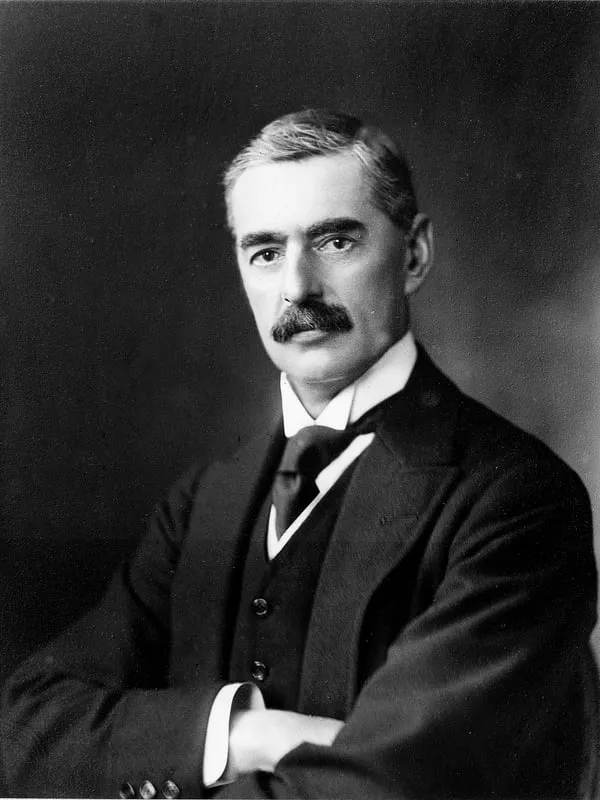
- Born:
- 18 March 1869, Birmingham (England)
- Died:
- 9 November 1940, Highfield Park, Heckfield, near Reading (Hampshire, England)
- Author:
- Łukasz
- Photo:
- Lafayette Ltd, domena publiczna, Wikimedia Commons

Arthur Neville Chamberlain was Prime Minister of the United Kingdom in the last three years before the Second World War and in the first months of the war. His name became a byword for appeasement – the attempt to preserve peace through concessions to Hitler and Mussolini – which reached its height in the Munich Agreement of September 1938. Yet the same Chamberlain gave Poland a guarantee six months later and declared war on Germany on 3 September 1939. Before he became a symbol, he had been a capable businessman, a reformer of local government and social welfare, and one of the most effective Chancellors of the Exchequer in the country’s history. His foreign policy has divided historians for more than eighty years.
Son of a great father
He was born on 18 March 1869 in Edgbaston, a district of Birmingham, the only son of the second marriage of Joseph Chamberlain, a manufacturer, mayor of Birmingham and later one of the most important ministers of the Victorian era. His mother died when he was a small boy. His elder half-brother, Austen Chamberlain, was groomed for politics from the start; Neville was meant for business. He was educated at Rugby School and Mason College in Birmingham and then served an apprenticeship with a firm of accountants.
In 1890 his father, hoping to restore the family fortune, sent him to the island of Andros in the Bahamas to set up a sisal plantation. Neville spent six years on the island and worked hard, but the venture ended in failure and a loss of about £50,000. After his return he ran Hoskins, a firm making metal ships’ berths, with success, and served on the boards of hospitals and societies in Birmingham. In 1911 he married Anne Cole. They had two children, Dorothy and Francis.
Birmingham and the First World War
In 1911 Chamberlain was elected to Birmingham city council and chaired its town planning committee. In 1915 he became Lord Mayor of the city, as his father and several of his uncles had been before him. During the war he founded a municipal savings bank for working people. In December 1916 Prime Minister David Lloyd George gave him the new post of Director of National Service, responsible for allocating manpower between the forces and industry. Without clear powers or the Prime Minister’s backing, Chamberlain could achieve little, and he resigned in August 1917. From then on he and Lloyd George cordially loathed each other.
At the general election of December 1918, aged 49, he was elected Member of Parliament for Birmingham Ladywood. Years later he remarked that he had come to national politics too late to become Prime Minister. It turned out otherwise.
Minister of Health and Chancellor of the Exchequer
When the Conservatives broke off their coalition with Lloyd George in October 1922, many of the party’s leading figures, Austen among them, refused to serve in the new government. Neville profited from this: within a few months he rose from the back benches to Postmaster General, then Minister of Health and, in August 1923, Chancellor of the Exchequer in Stanley Baldwin’s government. He lost the office in January 1924 after the Conservatives’ defeat. At the election of October 1924 he held his seat by a majority of just 77 votes over the Labour candidate Oswald Mosley, the future leader of the British fascists, and from 1929 he sat for the safer seat of Edgbaston.
In Baldwin’s second government, from 1924 to 1929, Chamberlain was Minister of Health, with responsibility also for housing, local government and poor relief. He presented the cabinet with a list of 25 bills and saw 21 of them enacted. He introduced pensions for widows and orphans and contributory pensions for workers, supported house-building, and with the Local Government Act of 1929 abolished the old Boards of Guardians responsible for relief of the poor. In those years he proved one of the most capable ministers in the government. Labour, however, could not stand him: he treated them with undisguised condescension, and Clement Attlee recalled that Chamberlain always treated them like dirt.
In 1930 he became Chairman of the Conservative Party, responsible for its organisation and campaigns, and in August 1931, when Ramsay MacDonald’s National Government was formed, Minister of Health once again. After the election of October 1931 he became Chancellor of the Exchequer and held the post until 1937. In February 1932 he carried the Import Duties Act, thereby fulfilling his father’s programme. At the Ottawa conference of 1932 imperial preference was introduced. Chamberlain reduced the interest on the war debt, kept credit cheap, which stimulated house-building, and in 1934 announced a budget surplus. From the mid-1930s he was, after Baldwin, the most important man in the government.
A Chancellor facing Hitler
In the early 1930s Chamberlain, like the whole government, cut military spending. From 1934, however, he was among the ministers who saw the German danger most clearly. He regarded Germany as the main adversary and proposed seeking an understanding with Japan so as not to have enemies at both ends of the world, as the story of Japan’s renunciation of the naval treaties shows. He argued for giving priority to the air force, since in the age of the bomber the Channel no longer protected the British Isles, and for limiting the army’s commitments on the Continent. Before the general election of November 1935 he wanted an open campaign for rearmament, but Baldwin chose caution. In June 1936 he called the continuation of sanctions against Italy, which had just conquered Ethiopia, “the very midsummer of madness”, which hastened their lifting. In the autumn of 1936 he supported Baldwin in the conflict with Edward VIII.
Prime Minister
On 28 May 1937, after Baldwin stood down, Chamberlain became Prime Minister, and on 31 May leader of the Conservative Party. He was 68. At home his government passed the Factories Act, the Holidays with Pay Act and a programme of slum clearance. The Prime Minister’s real passion, however, was foreign policy, which he resolved to conduct personally. Chamberlain believed that war would be a catastrophe for civilisation and for the Empire, which Britain could not defend simultaneously against Germany, Italy and Japan. He believed that Germany’s legitimate demands could be satisfied and a general settlement obtained in return. At the same time he rearmed the country, above all in fighter aircraft and air defence.
In November 1937, with the Prime Minister’s approval, Lord Halifax held talks with Hitler in Germany. In January 1938 Chamberlain gave a cool reception to President Franklin Delano Roosevelt’s proposal to convene an international conference, and in February, in a dispute over talks with Italy, he brought about the resignation of the Foreign Secretary, Anthony Eden, who was replaced by Halifax. He acquiesced in the Anschluss of Austria in March 1938, and in April he concluded an agreement with Italy recognising the Italian conquest of Ethiopia in return for a promise to withdraw some Italian troops from Spain.
Munich
In the summer of 1938 Hitler began threatening Czechoslovakia with war over the Sudeten Germans. Chamberlain, convinced that neither Britain nor France could effectively defend Czechoslovakia, decided to act on his own. On 15 September 1938, aged 69, he flew for the first time in his life and met Hitler at Berchtesgaden. He agreed to the transfer to Germany of the areas with a German majority and, together with the French, pressed Edvard Beneš’s government to accept it. When Hitler raised his demands at Bad Godesberg on 22 September, war loomed. On 27 September Chamberlain said in a broadcast that it was horrible and incredible that the British should be digging trenches because of “a quarrel in a far-away country between people of whom we know nothing”.
At Chamberlain’s request Mussolini proposed a conference. On 29–30 September 1938 in Munich, Chamberlain, Édouard Daladier, Hitler and Mussolini signed the Munich Agreement, which handed the Sudetenland to Germany. Czechoslovakia’s representatives were not admitted to the talks. The next morning Chamberlain persuaded Hitler to sign a short declaration in which both men announced that their peoples would never go to war with one another again. Greeted by crowds in London, he spoke from a window in Downing Street of “peace for our time”. The minister Duff Cooper resigned, and Churchill called Munich a total and unmitigated defeat. Most Britons, however, welcomed the Prime Minister with relief and gratitude.
From guarantee to war
After Munich Chamberlain accelerated rearmament but still hoped for a settlement. He condemned Kristallnacht but did not break off talks with Germany. On 15 March 1939 Germany occupied Prague and the rest of Bohemia and Moravia. Two days later, in a speech in Birmingham, Chamberlain asked whether this was not a step in an attempt to dominate the world by force. On 31 March he announced in the House of Commons that Britain and France would lend Poland all support in their power if its independence were threatened and Poland considered it vital to resist. At the beginning of April it was agreed with Foreign Minister Józef Beck that the guarantee would be mutual. The government doubled the size of the Territorial Army and at the end of April introduced conscription in peacetime, for the first time in the country’s history. After Italy occupied Albania, guarantees were also given to Greece and Romania.
Chamberlain entered into talks on an alliance with the Soviet Union reluctantly. He distrusted Stalin, doubted the worth of the Red Army after the purges and knew that Poland would not agree to Soviet troops crossing its territory. The talks dragged on through the summer without result, and on 23 August 1939 Vyacheslav Molotov and Joachim von Ribbentrop signed a non-aggression pact in Moscow. On 25 August Britain concluded a treaty of alliance with Poland. When Germany attacked Poland on 1 September, the British government delayed for two days, waiting for the French and for an Italian proposal for a conference, which caused uproar in the House of Commons and a revolt by some ministers. At 9 a.m. on 3 September the ambassador in Berlin delivered an ultimatum, and at 11.15 a.m. Chamberlain announced on the radio that Britain was at war with Germany. A few hours later he told the House of Commons that everything he had worked for and believed in during his public life had crashed into ruins.
War leader
Chamberlain formed a War Cabinet, which Churchill joined as First Lord of the Admiralty. Britain and France gave no effective military help to Poland, which fought alone. Through the winter the Phoney War went on: the Prime Minister hoped that the naval blockade and rearmament would force Germany into concessions or bring about Hitler’s fall without a great offensive. On 4 April 1940 he said that Hitler had “missed the bus”. Five days later Germany attacked Denmark and Norway. After the failure of the Norwegian campaign, the House of Commons debated the conduct of the war on 7–8 May. The Conservative Leo Amery hurled Cromwell’s words at the Prime Minister: “In the name of God, go!” In the division the government’s majority fell from over two hundred to 81, as many Conservatives voted against it or abstained. On 10 May, the day of the German offensive in the west, Chamberlain resigned and Churchill became Prime Minister.
The last months
Chamberlain remained party leader and joined the War Cabinet as Lord President of the Council. He supported Churchill loyally, ran domestic affairs and, at the end of May 1940, during the dispute in the War Cabinet, backed Churchill against Halifax, who wanted to explore the possibility of negotiations through Italy. In July the pamphlet Guilty Men appeared, blaming him for the country’s unpreparedness for war. In the same month doctors found that he had inoperable bowel cancer. On 22 September he offered Churchill his resignation, and at the beginning of October 1940 he left the government and the party leadership. He declined the Order of the Garter, saying that he preferred to die plain Mr Chamberlain, like his father. He died on 9 November 1940 at Highfield Park in Heckfield, near Reading. His ashes were interred in Westminster Abbey. Paying tribute to him in the House of Commons, Churchill said that the only guide to a man is his conscience, and that Chamberlain had acted in accordance with his, striving to save the world from a terrible war.
The Chamberlain debate
For decades after the war the dominant image was of Chamberlain as a naive man with an umbrella who believed Hitler, sacrificed Czechoslovakia and encouraged Germany to make further demands. This verdict was fixed by Guilty Men and by Churchill’s memoirs. After the archives were opened in the 1960s, revisionist historians drew attention to the constraints under which he acted: the country’s military weakness in 1938, an empire scattered across the globe, the Dominions’ reluctance to go to war in Europe, the resistance of the Chiefs of Staff, pacifist public opinion and the need to buy time for rearmament. The year between Munich and the outbreak of war made it possible to expand the fighter force and the radar network that saved Britain in 1940.
Critics reply that in 1938 Germany was not ready for a major war either, that Czechoslovakia had a strong army and fortifications, and that Munich handed them to Hitler without a fight and convinced him that the Western democracies would always give way. They also point out that Chamberlain disregarded the possibility of cooperation with the Soviet Union and the United States and trusted his own diplomacy more than the warnings of experts. For Poland he is a figure with two faces: it was he who in March 1939 gave Poland the guarantee that brought Britain into the war, and it was his government that in September 1939 gave Poland no real help.
Sources
Mentioned in battles
(05)Often appears with
People who appear in the same events.
On the timeline
(84)The 40 most important of 84 events. All tagged “Neville Chamberlain” (15) →
1924
1934
1935
1936
1937
1938
1939
January
March
- 31
- Key eventThe British guarantee to PolandOn 31 March 1939 Chamberlain told the Commons that Britain and France would aid Poland if its independence were threatened. Appeasement was over.
- The end of the Slovak–Hungarian WarBy late March 1939 the Hungarian–Slovak fighting had died down. A ceasefire came under German pressure on 24 March, but skirmishes went on until 31 March.
April
May
June
July
August
- 25
- Key eventThe Anglo-Polish allianceOn 25 August 1939 Raczyński and Halifax signed a mutual assistance agreement in London. A secret protocol stated that the “European Power” meant Germany.
- Hitler halts the attack on PolandOn 25 August 1939 Hitler ordered an attack on Poland for the next dawn, but that evening revoked it after news of the London alliance and Mussolini's refusal.
September
- 01
- Britain prepares for warOn 1 September 1939 Britain ordered mobilisation, the blackout and the evacuation of its cities. A population register and a Ministry of Food followed.
- Britain and France demand a German withdrawal from PolandOn the evening of 1 September 1939 Henderson and Coulondre demanded that Germany withdraw from Poland. The notes were a warning, not an ultimatum.
- Roosevelt’s appeal to spare civiliansOn 1 September 1939 Roosevelt urged the belligerents not to bomb civilians. Hitler gave his pledge on the very day the Luftwaffe destroyed Wieluń.
1940
March
April
May
- 10
- Key eventGermany attacks in the WestOn 10 May 1940 the Wehrmacht struck the Netherlands, Belgium and Luxembourg. The Allies advanced into Belgium as Kleist's tanks entered the Ardennes.
- Key eventChurchill becomes Prime MinisterOn 10 May 1940, the day of the German offensive in the West, Chamberlain resigned and the King asked Churchill to form a coalition government.