- Category:
- Diplomacy
- Date:
- 3 September 1939
- Author:
- Natalia
- Tags:
- United Kingdom, France, Poland, Neville Chamberlain
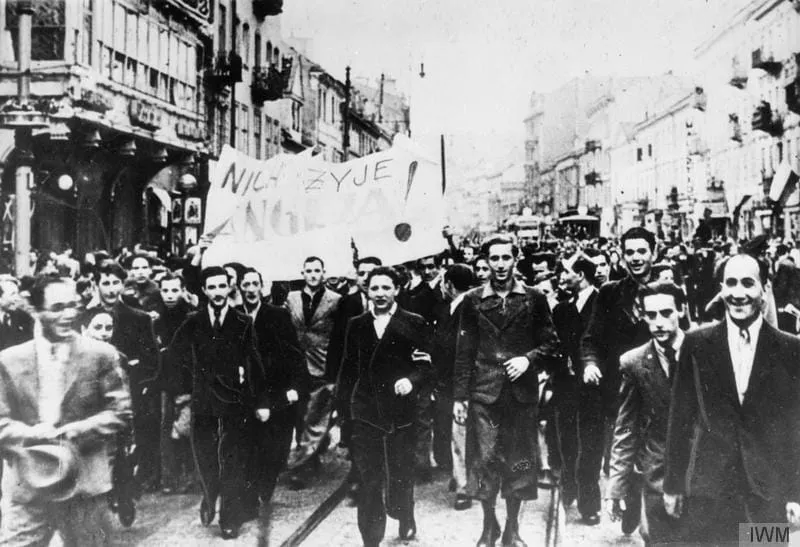
On Sunday 3 September 1939, the third day after Germany invaded Poland, Great Britain and France found themselves at war with the Third Reich. At 9 a.m. the British ambassador in Berlin, Nevile Henderson, delivered at the German Foreign Office an ultimatum that expired at 11 a.m. The Germans did not reply, and at 11.15 a.m. the Prime Minister, Neville Chamberlain, announced on the radio that his country was at war with Germany. At noon the French ambassador, Robert Coulondre, appeared in the same building on the Wilhelmstraße, and at around 12.30 p.m. he handed the Foreign Minister, Joachim von Ribbentrop, a French note with a deadline of 5 p.m. At that hour France entered the war. In Warsaw crowds cheered outside the embassies of both allies, convinced that Poland was no longer fighting alone. The German attack on Poland had become a European war, although for Poland as it fought, the Western declarations of war proved above all a political gesture.
Two days of delay
Neither London nor Paris declared war on 1 September. On the evening of that day Henderson and Coulondre handed Ribbentrop notes in which both governments demanded the cessation of operations against Poland and the withdrawal of German troops, threatening otherwise to fulfil their obligations as allies. The notes, however, set no deadline, and both capitals afterwards assured the Italians that they were not ultimatums. The British were bound by the alliance of 25 August, the French by the alliance of 1921, and both governments since March by their guarantee of Poland’s independence. Even so, for almost two days they went on looking for a way out.
The main obstacle was French reluctance to hurry. The Foreign Minister, Georges Bonnet, clung to the proposal of Benito Mussolini, who on 31 August had suggested convening a conference of the powers and on the morning of 2 September renewed it in Berlin as a plan for an armistice and five-power talks. Hitler did not reject it outright: through the Italian ambassador, Bernardo Attolico, he asked whether the notes of 1 September were ultimatums and requested a day to think it over. The French high command, headed by General Maurice Gamelin, meanwhile wanted to gain as much time as possible for the first days of mobilisation and for the evacuation of the cities before the expected German bombs fell on France. The British government made its participation in a conference conditional on the withdrawal of German troops from Poland, but it wanted to act together with France and waited for it.
In Warsaw every hour of delay caused alarm. On 2 September the Foreign Minister, Józef Beck, summoned the British and French ambassadors, Howard Kennard and Léon Noël, and pointed out that the Luftwaffe might throw its whole strength against Poland, that it was bombing more than military targets, and that a diversion in the west was needed as soon as possible. He asked to be told immediately that the two states had entered the war. Kennard supported him in a telegram to London. In London and Paris the ambassadors Edward Raczyński and Juliusz Łukasiewicz pressed for the same thing, Łukasiewicz in stormy exchanges with Bonnet.
Revolt in the cabinet
On the afternoon of 2 September the British cabinet agreed that Germany must be presented with an ultimatum, which according to one minister was to expire that very night, at midnight. The French, however, asked for a longer deadline. Chamberlain, who had spoken by telephone during the day with the French Prime Minister, Édouard Daladier, kept the House of Commons waiting almost two hours for his statement. When at last he spoke, at 7.44 p.m., he made no mention of any deadline. He reported the Italian proposal, repeated that Great Britain would not sit down to talks while Poland was being invaded and her towns bombed, and added that the government was in communication with France about the time within which Germany must reply. If German troops were withdrawn, the position could be regarded as the same as before the Polish frontier was crossed.
Members received this with indignation. When the deputy Labour leader, Arthur Greenwood, rose to reply to the Prime Minister, the Conservative Leo Amery called out from the Conservative benches: “Speak for England, Arthur!” Greenwood said that every minute of delay cost human lives and imperilled national interests. Chamberlain explained that allies communicating by telephone found it hard to synchronise their actions as quickly as if they were sitting in the same room, and assured the House that he would have a definite answer for it the next day. Many members took this as the herald of a new Munich.
The ministers rebelled too. Immediately after the debate ten members of the cabinet who sat in the House of Commons met in the room of the Chancellor of the Exchequer, John Simon. Among them was the Secretary of State for War, Leslie Hore-Belisha. Simon, hitherto one of the Prime Minister’s most loyal men, went to Chamberlain and declared that unless the ultimatum was presented before the House next sat, the government would fall. The Prime Minister and the Foreign Secretary, Lord Halifax, spoke to Paris once more, but the French were still asking for a delay. At around midnight, during a violent thunderstorm, Chamberlain’s last peacetime cabinet met. It was decided that Great Britain would wait no longer for France: the ultimatum would be delivered in Berlin at 9 a.m. and expire at 11 a.m., before parliament met at noon. According to those present, the Prime Minister closed the meeting with the words: “Right, gentlemen, this means war.”
The ultimatum in Berlin
At 5 a.m. on 3 September Halifax sent Henderson his instructions. The ambassador was to ask to see Ribbentrop at 9 a.m. and, if the minister could not receive him, to hand the text to another representative of the Reich government. The note recalled the warning of 1 September and stated that since then German attacks on Poland had continued and indeed intensified. If by 11 a.m. British time at the latest satisfactory assurances had not reached London that Germany had suspended its aggression and was prepared promptly to withdraw its troops, a state of war would exist between the two countries “as from that hour”.
Ribbentrop did not receive Henderson. The note was accepted at 9 a.m. in the minister’s office by the chief interpreter of the Auswärtiges Amt, Paul Schmidt, who by his own account had nearly overslept and reached the Wilhelmstraße at the last moment. He took it to the Reich Chancellery and translated it for Hitler in Ribbentrop’s presence. Schmidt later described how Hitler sat motionless and then, after a while, turned to Ribbentrop with the question: “What now?” In the anteroom Hermann Göring is said to have remarked: “If we lose this war, may Heaven have mercy on us”, while Joseph Goebbels stood dejected in a corner. Whatever the precise accuracy of these words, the account captures the mood well: for months Ribbentrop had been assuring Hitler that once the pact with the USSR was concluded, the West would not fight.
The deadline passed without a reply. Only at 11.20 a.m. did Ribbentrop receive Henderson and hand him a memorandum in which the Reich government refused “to receive, let alone to fulfil” demands in the nature of an ultimatum. It laid the blame for the war on Great Britain, which had supposedly given Poland “full powers” for any action against Germany, repeated the propaganda charges of Polish terror against Germans and announced that Germany would answer any English aggression with the same weapons. That same day Hitler issued proclamations to the German people, to the army in the west and to the party, presenting Great Britain as a warmonger, and in the evening he left by special train for the front in Poland.
“This country is at war with Germany”
At 11.15 a.m. Chamberlain spoke on BBC radio from the Cabinet Room at 10 Downing Street. He recalled that the ambassador in Berlin had that morning handed the German government a final note, and said: “I have to tell you now that no such undertaking has been received, and that consequently this country is at war with Germany.” He spoke of his bitterness at the failure of his efforts for peace and of how Hitler would never have given up his intention of using force, and he ended by declaring that the British would be fighting against “evil things”: brute force, bad faith, injustice, oppression and persecution. A few minutes after the broadcast the air-raid sirens wailed over London. The alarm proved false, but it showed what was expected: the city was bracing itself for mass air raids.
At noon, for the first time in its history on a Sunday, the House of Commons met. Chamberlain read out the text of the ultimatum and announced that the French ambassador in Berlin was at that moment presenting a similar note with a fixed time limit. “This is a sad day for all of us, and to none is it sadder than to me,” he said. “Everything that I have worked for, everything that I have hoped for, everything that I have believed in during my public life, has crashed into ruins.” He expressed the hope that he would live to see the day when Hitlerism had been destroyed and a liberated Europe re-established. After him spoke the opposition leaders and Winston Churchill, who that same day returned to government as First Lord of the Admiralty. In the evening King George VI broadcast to the nation and the empire.
The French note
France acted more slowly and cautiously. Until late in the evening of 2 September Bonnet was still counting on Italian mediation, and the high command was pressing for the latest possible deadline. According to British accounts, the French initially wanted the ultimatum to expire only on the morning of 4 September. At midnight Bonnet told Coulondre to expect a new step at noon the next day, and he sent the final instruction at 10.20 a.m. on 3 September, after the British note had already been delivered. Under pressure from London the deadline was brought forward to 5 p.m.
Coulondre arrived at the Wilhelmstraße at noon. The State Secretary, Ernst von Weizsäcker, stated that he could not say whether a reply would be given to the note of 1 September and referred him to the minister. At 12.30 p.m. Ribbentrop received him. He said that Germany had already rejected the British ultimatum, and that if France, because of its obligations to Poland, entered the conflict, he would regret it, since Germany felt no hostility towards France. Asked directly whether the reply to the note of 1 September was negative, he answered: “Yes.” Then, as the ambassador reported, at about 12.40 p.m. Coulondre declared that from 5 p.m. on 3 September the French government would be obliged to fulfil its obligations towards Poland, “which are known to the German government”. Ribbentrop replied that in that case it would be France that was the aggressor. “History will judge,” Coulondre answered, and asked for his passports.
Chronologies sometimes state that the French delivered their ultimatum at noon. The documents of the French “Yellow Book” show that the ambassador reached the ministry at noon but presented the note itself to Ribbentrop some thirty or forty minutes later. The French text, moreover, did not contain the word “war”. Bonnet sent the formal notification that a state of war existed between France and Germany from 5 p.m. to the representatives of foreign states under the Third Hague Convention of 1907. In the evening Daladier addressed the nation on the radio: “We are waging war because it has been forced upon us.”
Cheers in Warsaw
Polish Radio broadcast the news from London before noon, playing the allies’ anthems. The people of Warsaw poured into the streets. According to eyewitnesses, a crowd of more than ten thousand gathered outside the British embassy at the corner of Nowy Świat and Smolna Streets. They shouted “Long live England!”, “Long live the English King!” and “Down with Hitler!”, raised two fingers in the victory sign and brought flowers. Beck drove to the embassy and appeared on the balcony with Ambassador Kennard. He said that he had come to the King’s representative at the moment when two chivalrous nations had joined hands in a common struggle in defence of freedom. In the afternoon and evening similar scenes took place outside the French embassy, where the crowd sang the “Marseillaise”. The demonstration then moved on to Castle Square, where people cheered the President and the Commander-in-Chief, Marshal Edward Rydz-Śmigły.
The joy was understandable. For three days Poland had been fighting off alone the attack of a neighbour with superiority in numbers and equipment and command of the air, and every Polish war plan assumed that the Polish Army had to hold out for the first weeks until the allies moved in the west. The declaration of war seemed to confirm that this scenario would come true. Yet by then the news from the front was already bad: German troops were cutting through Pomerania, and in the south they were breaking through the Polish frontier positions.
Why help did not come
The war declared on 3 September did not change the course of the campaign in Poland. France, whose army was the only force capable of striking quickly at Germany, had no intention of mounting a great offensive. The protocol signed in May 1939 by Generals Tadeusz Kasprzycki and Gamelin promised an offensive with the main forces no later than the fifteenth day of mobilisation, but French doctrine envisaged defence behind the Maginot Line and a long war in which victory would come from the naval blockade and the Allies’ material superiority. In the west Germany had left a few dozen divisions, largely reserve formations, without armour and with little air support, yet the French high command overestimated both their strength and the fortifications of the Siegfried Line.
Great Britain had no land army that it could send quickly to the Continent. The first units of the expeditionary force began arriving in France only after several days, and divisions ready for battle only in the following weeks. Bomber Command was ordered to attack strictly military targets only, because both governments feared German retaliation against their own cities and had pledged to President Roosevelt to spare the civilian population. As early as the night of 3–4 September British aircraft were dropping not bombs over Germany but leaflets.
A few days later French divisions advanced a few kilometres into Germany during the Saar Offensive, and on 12 September Daladier and Chamberlain, at the Abbeville conference, concluded that no effective help could be given to Poland. This decision was not communicated to the Polish government. The Phoney War had begun – a state of war without fighting on land, which in the west lasted until the spring of 1940.
Place in the history of the war
On 3 September 1939 the German–Polish war became a European war, and with it a war of empires. On the same day British India, Australia and New Zealand declared themselves at war, followed in the next few days by South Africa and Canada. Hitler, who had counted on a repeat of Munich, now had to wage the war against the great powers that his generals had warned him against. At sea the fighting began at once: on the evening of 3 September a German submarine sank the British passenger liner Athenia.
For Poland the balance was bitter. The declaration of war brought no immediate relief at the front, and on 17 September the Red Army entered Poland, to which Great Britain and France responded only with a protest. At the same time, without the decision of 3 September there would have been no Polish government and army in exile, later fighting alongside the Allies in France, in Great Britain, at sea, in Africa and in Italy. The passivity of the allies in September 1939 became one of the most enduring Polish experiences of the war, and historians still ask whether a determined attack in the west could have changed its course. Many of them believe that, given the weakness of the German forces in the west, a French offensive in September stood a real chance; others stress that the French army was prepared for it neither materially nor psychologically. For France the postponement of the fight ended in defeat in June 1940, and Great Britain fought Germany alone for a year.
Places·Warsaw
Sources
Meanwhile
(04)Elsewhere, within a week.
- 3 September 1939 · AtlanticThe sinking of the AtheniaOn the evening of 3 September 1939 U-30 torpedoed the British liner Athenia without warning, with over 1,400 people aboard. Between 112 and 117 died.
- 3 September 1939 · PolandBloody Sunday in BydgoszczOn 3 September 1939 shooting broke out in Bydgoszcz amid retreating troops. Several hundred Germans died, and propaganda turned it into “Bloody Sunday”.
- 3 September 1939 · PolandThe sinking of Wicher and GryfOn 3 September 1939 German dive bombers sank the destroyer Wicher and the minelayer Gryf in the naval port of Hel, Poland’s largest warships in the Baltic.
- 3 September 1939 · PolandThe Legion of Czechs and SlovaksOn 3 September 1939 President Mościcki decreed a Legion of Czechs and Slovaks. Some 1,000 refugees from Czechoslovakia were to fight Germany beside the Poles.
Related events
(04)The same battle, people or subject.
- 25 August 1939 · DiplomacyThe Anglo-Polish allianceOn 25 August 1939 Raczyński and Halifax signed a mutual assistance agreement in London. A secret protocol stated that the “European Power” meant Germany.
- 25 August 1939 · MilitaryHitler halts the attack on PolandOn 25 August 1939 Hitler ordered an attack on Poland for the next dawn, but that evening revoked it after news of the London alliance and Mussolini's refusal.
- 1 September 1939 · DiplomacyBritain and France demand a German withdrawal from PolandOn the evening of 1 September 1939 Henderson and Coulondre demanded that Germany withdraw from Poland. The notes were a warning, not an ultimatum.
- 10 July 1939 · DiplomacyChamberlain on DanzigOn 10 July 1939 Chamberlain told the House of Commons that an attempt to seize Danzig threatening Polish independence would trigger the British guarantee.