France
Maurice Gamelin
Chief of the General Staff (1931–1935), Vice-President of the Supreme War Council (1935–1940), Chief of the General Staff of National Defence (1938–1940), Commander-in-Chief (1939–1940)
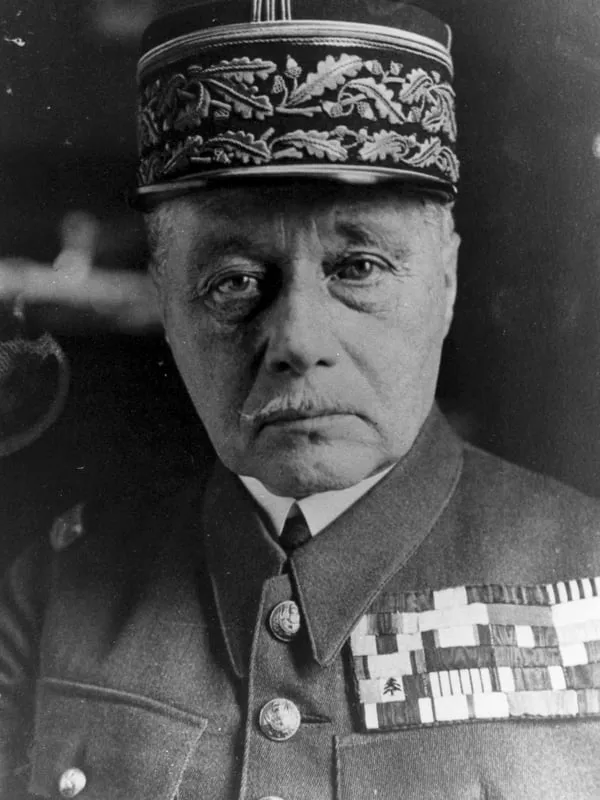
- Born:
- 20 September 1872, Paris
- Died:
- 18 April 1958, Paris
- Author:
- Łukasz
- Photo:
- autor nieznany, domena publiczna, Wikimedia Commons

For the last five years of peace and the first months of the war, Maurice Gamelin stood at the head of the French Army, then regarded as the strongest in Europe. A pupil of Foch and Joffre’s closest aide in 1914, he was considered one of the most intelligent generals of his generation. It was he who advised the government to remain passive in the face of the remilitarisation of the Rhineland in 1936; he who in May 1939 signed France’s commitments to Poland, and he who in September fulfilled them so meagrely; and in May 1940 it was his war plan that collapsed within a week. After the defeat he became one of the chief accused for the fall of France. Historians sometimes call his career “the Gamelin enigma”: how could a man with so brilliant a reputation lead an army into such a catastrophe?
Youth and Joffre
Maurice Gustave Gamelin was born in Paris on 20 September 1872 into a military family. His father, a controller-general of the army, had been wounded at Solferino, and his mother’s family came from Alsace. The boy had a talent for drawing and painting, but he chose the army. In 1891 he entered the military academy of Saint-Cyr and graduated top of his class in 1893. He served first in North Africa, with a regiment of Algerian tirailleurs and with a topographical brigade in Tunisia, and then completed the École de Guerre, where he caught the eye of one of his instructors, the future Marshal Ferdinand Foch. In 1906 he published a study of the philosophy of the art of war that earned him a reputation as one of the army’s ablest theorists.
That same year, on Foch’s recommendation, he became aide-de-camp to General Joseph Joffre. From then on his career was tied to that of Joffre, who in 1911 was appointed Chief of the General Staff and Commander-in-Chief designate in the event of war. In his reports Joffre wrote that Gamelin carried out every task entrusted to him, however difficult, in such a way that nothing needed correcting.
The First World War
In August 1914 Gamelin was one of Joffre’s closest advisers at General Headquarters. He took part in preparing the counter-offensive that brought victory in the First Battle of the Marne. He later claimed authorship of the plan, although it was the collective work of the staff. In 1915 he headed the operations section and prepared the autumn offensives in Artois and Champagne, and then commanded a brigade of chasseurs in the Vosges and on the Somme. In December 1916 he was promoted to brigadier general, and in 1917 he became chief of staff of the Reserve Army Group during the failed Nivelle Offensive. From May 1917 until the end of the war he commanded the 11th Infantry Division. In the spring of 1918, during the German Spring Offensive, his division held up the advance of much stronger German forces near Noyon; in the summer it repulsed the Germans in the Tardenois, and in the autumn it took part in the final offensives. Gamelin came out of the war with a reputation as a commander who was sparing of his men’s lives and as a brilliant staff officer.
Brazil, Syria and the road to the top
From 1919 to 1924 he headed the French military mission in Brazil, advising successive Brazilian governments on the reorganisation of their army. In 1925, when a Druze revolt broke out in Syria and grew into the Great Syrian Revolt, he was sent to the Levant as deputy to the High Commissioner, General Maurice Sarrail. He soon took command of the French forces in the region and by the middle of 1926 had crushed the rising. French reprisals, including the shelling of Damascus in October 1925, caused an outcry around the world. Gamelin returned to France in 1928, commanded a corps at Nancy, and in 1930 became First Deputy Chief of the General Staff.
In 1931, when Maxime Weygand succeeded Philippe Pétain as vice-president of the Supreme War Council – the designated commander-in-chief in time of war – Gamelin succeeded Weygand as Chief of the General Staff. Unlike the conservative Weygand, he was regarded as a general loyal to the Republic and close to the Radicals, which won him the support of the left, and especially of Édouard Daladier. In January 1935, when Weygand retired, Gamelin combined both posts. Not since Joffre had anyone held so much power over the army. In January 1938 he also became the first Chief of the General Staff of National Defence, responsible for coordinating the army, the air force and the navy.
Head of the army in the years of crisis
Gamelin believed in a long war fought on the model of 1918: France would defend itself behind the Maginot Line, while the blockade and the Allies’ superior resources gradually wore Germany down until a decisive offensive in 1941 or 1942. The doctrine he approved in 1936 rested on the methodical battle fought under the cover of artillery. He supported the motorisation of the infantry and, with some hesitation, the creation of armoured divisions, but he restricted public debate on new ideas such as those put forward by Colonel Charles de Gaulle. In 1935 he met Marshal Pietro Badoglio and Benito Mussolini in Rome, hoping for an alliance with Italy against Germany. Those hopes were dashed by the war in Ethiopia.
The first great test came on 7 March 1936, when German troops marched into the Rhineland. Gamelin presented the government with inflated figures for the German forces and declared that any action would require at least partial, and most probably general, mobilisation. The government, a few weeks before an election, would not decide on mobilisation. After the victory of the Popular Front, Gamelin assured Prime Minister Léon Blum that he would keep the army out of politics, and he worked well with Daladier as Minister of Defence. In the summer of 1936 he visited Poland and held talks with Edward Rydz-Śmigły, and in September, after Rydz’s return visit to France, an agreement on a French loan for Polish rearmament was signed at Rambouillet. Gamelin failed, however, to persuade Poland to draw closer to Czechoslovakia, and during the Sudeten crisis he concluded that Rydz-Śmigły had broken his word not to take part in a war against Czechoslovakia. In September 1938 he warned that an offensive in defence of Czechoslovakia would be “a modernised Battle of the Somme”, and he did not oppose the Munich Agreement.
In the spring of 1939, after the occupation of Prague, Gamelin concluded that there could be no eastern front without Poland, and that Polish resistance would give France time to prepare. On 19 May 1939 he signed a protocol with the Polish Minister of Military Affairs, General Tadeusz Kasprzycki, in which France promised, in the event of a German attack, air operations, actions with limited objectives from the third day of mobilisation and an offensive “with the main forces” no later than the fifteenth day. According to the Polish historian Wojciech Mazur, Gamelin himself made sure that the wording was general enough for him to interpret it flexibly later. The Polish high command, which in August, at the time of the alliance with Britain, was counting on a swift French attack, based its defence plan on this protocol. When on 23 August Daladier asked the military whether France could allow Poland to be wiped off the map, Gamelin replied that France could not abandon an ally without dishonour, and assured him that the army was ready.
September 1939
After the outbreak of war and the start of mobilisation, Gamelin became Commander-in-Chief of the French land forces and, in practice, the chief strategist of the alliance. He set up his command post in the Château de Vincennes outside Paris, far from the headquarters of the commander of the North-Eastern Front, General Alphonse Georges. He assured the Poles that help would come, while telling the British that he had no intention of squandering his forces merely for effect. The Saar Offensive, launched on 7 September, was a cautious demonstration from the start. On 10 September Gamelin assured Rydz-Śmigły that more than half of his active divisions were engaged in the fighting, which was untrue, and on 12 September he halted the advance. That same day at Abbeville he persuaded the Prime Ministers, Daladier and Neville Chamberlain, that the Siegfried Line should not be attacked and that prolonged Polish resistance would only give the Allies more time to prepare. On 21 September he ordered his troops to withdraw to their starting positions. His image in Poland was settled for decades: Polish historians count him among the chief authors of the “betrayal” of an ally, while others see him rather as the executor of a strategy that Paris and London had adopted before the war.
The Phoney War and the catastrophe of 1940
The Phoney War lasted through the winter of 1939–1940. Gamelin assumed that the Germans would strike across the plains of Belgium, as in 1914, and prepared the Dyle Plan: in the event of an attack, the best French armies and Lord Gort’s British Expeditionary Force were to advance into Belgium and take up positions on the line of the River Dyle. In March 1940 he extended it with the Breda variant, sending the Seventh Army as far as the Netherlands and thereby depriving himself of almost all of his strategic reserve. He considered the Ardennes unsuitable for operations by large formations. He also reorganised the high command in such a way that responsibility became blurred between Vincennes, Georges’s headquarters and a new staff at Montry. Prime Minister Paul Reynaud, who had replaced Daladier in March 1940, said of him that he was “a prefect, a bishop, but not a leader”, and on 9 May decided to dismiss him. The next day the Germans launched their offensive.
On 10 May 1940 Gamelin set the Dyle–Breda Plan in motion, and the Allies entered Belgium, just as the German high command had expected. The main German blow came through the Ardennes. On 13 May the Germans forced the Meuse at Sedan, and over the following days they tore the front apart. On 16 May, at a meeting in Paris, when Winston Churchill asked him about the strategic reserve, Gamelin replied that there was none. On 19 May he issued his first and only order of the battle, providing for an attack on the flanks of the German wedge, and that evening Reynaud dismissed him and handed command to Weygand. The details of the French campaign showed that he was not the only member of the high command who failed to understand the new way of waging war, but it was he who was responsible for the plan that collapsed.
Riom and captivity
After the defeat Gamelin settled in the provinces. On 6 September 1940 the Vichy government had him arrested together with Blum, Daladier, Reynaud and Georges Mandel. In February 1942 he went on trial with Blum and Daladier at the Riom Trial, which was meant to lay the blame for the defeat on the Third Republic. Unlike the politicians, Gamelin refused to give evidence, explaining that he owed loyalty to his subordinates. The accused turned the trial into an indictment of the high command, Marshal Pétain included, and in April 1942, under German pressure, the proceedings were suspended.
After the Germans occupied southern France, Gamelin fell into their hands. In April 1943 he was taken to the vicinity of the Buchenwald camp, and in May to Itter Castle in the Tyrol, where the Germans held prominent Frenchmen: Daladier, Reynaud, Weygand, Léon Jouhaux and others. There he was reconciled with Reynaud, but he did not speak to Weygand. On 5 May 1945 the prisoners were freed after the Battle for Castle Itter, in which American soldiers and Wehrmacht soldiers who had gone over to the Allies beat off an attack by SS troops.
Last years and assessment
After the war Gamelin published his three-volume memoirs, Servir (1946–1947), in which he defended his decisions and shifted the blame onto his subordinates and the politicians. They were received very critically. He lived in seclusion, writing articles on the lessons of the world wars and a book on the Battle of the Marne. He died on 18 April 1958 at the Val-de-Grâce military hospital in Paris after a fall down the stairs, and was buried in Passy Cemetery. The government refused him a funeral mass at the church of Les Invalides and a guard of honour at his coffin.
Historians judge him harshly, though less and less often do they make him the sole culprit. His biographer Max Schiavon writes of “the gulf between what he should have been and what he was”, and stresses that it was the politicians, above all Daladier, who raised him up and kept him in post. The British historian Julian Jackson notes the irony: so cautious and rational a man was defeated because he could not imagine that the Germans would risk a thrust through the Ardennes. To Poles he remains above all the general who in September 1939 promised an offensive and delivered only the semblance of one. To the French he is the symbol of an army prepared to refight the previous war.
Sources
Commanded in battles
(02)Mentioned in battles
(04)Often appears with
People who appear in the same events.