Germany
Alfred Jodl
Head of the National Defence Department (1935–1938), Chief of the Wehrmacht Operations Staff at the OKW (1939–1945), Colonel General (1944)
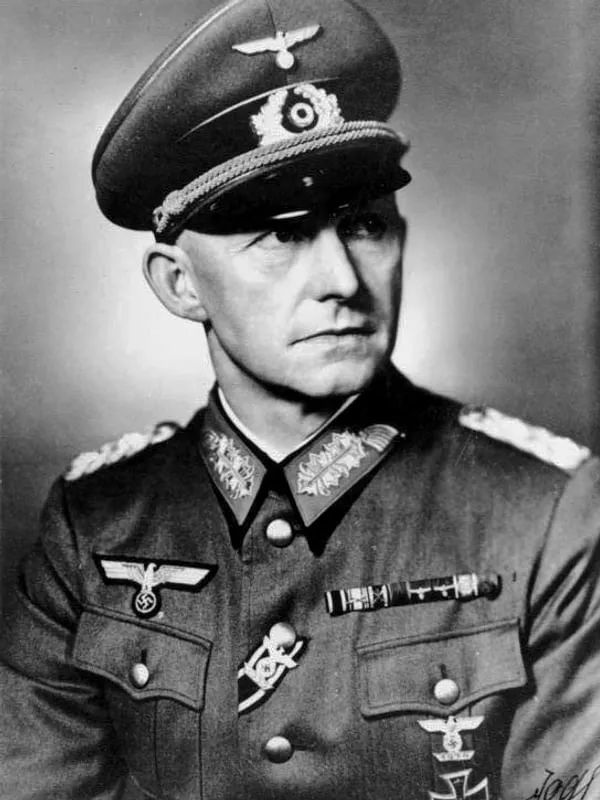
- Born:
- 10 May 1890, Würzburg (Kingdom of Bavaria, German Empire)
- Died:
- 16 October 1946, Nuremberg
- Author:
- Łukasz
- Photo:
- autor nieznany, CC BY-SA 3.0 DE, Wikimedia Commons

Throughout the Second World War Alfred Jodl was chief of the operations staff of the Wehrmacht High Command (OKW), and every day, almost without a break, he stood at the map table beside Adolf Hitler. He commanded no army, but his staff produced the plans for the invasion of Norway, the Barbarossa directive and the orders for the fronts that Hitler regarded as “his own” theatres of war – from France to Africa and Italy. Efficient and ambitious, he passed on orders that violated the laws of war and publicly credited Hitler with military genius. On 7 May 1945 it was he who signed, at Reims, the unconditional surrender of the German armed forces. A year and a half later, sentenced by the International Military Tribunal, he went to the gallows at Nuremberg.
Würzburg, the cadet corps and the First World War
He was born on 10 May 1890 in Würzburg in Bavaria. His father was an officer in the Bavarian artillery; his mother, Therese Baumgärtler, was considered by the regiment an unsuitable match for an officer. His parents lived together unmarried for years and wed only in 1899, when his father left the army; only then did the boy, registered at birth as Alfred Baumgärtler, take the surname Jodl. His younger brother, Ferdinand Jodl, also became a professional officer and during the Second World War commanded a mountain corps in the far north, in Finland and Norway.
In 1903, at the age of thirteen, Alfred entered the Bavarian Cadet Corps in Munich, which he completed in 1910, and in July of that year he began service as a Fähnrich (officer cadet) in the 4th Bavarian Field Artillery Regiment in Augsburg. After the war school in Munich he was commissioned Leutnant in October 1912. In September 1913 he married Countess Irma von Bullion; both his marriages were childless.
At the start of the First World War he fought in Lorraine, at the Battle of Sarrebourg, and on 24 August 1914 he was wounded in the thigh. He returned to the front in the spring of 1915. At the end of 1916 he was sent to the Eastern Front, where in 1917 he commanded a battery in an Austro-Hungarian artillery regiment, and at the beginning of 1918 – by now as a staff officer – he returned to the west. He ended the war with both classes of the Iron Cross and with experience both at the front and on the staff.
The Reichswehr and the National Defence Department
After the armistice of Compiègne Jodl stayed in the army. In the 100,000-strong Reichswehr of General Hans von Seeckt he was among the most able candidates for staff officer. In 1921, already a Hauptmann (captain), he completed the secret course for “commander’s assistants” (Führergehilfen) – the general staff, banned by the Treaty of Versailles, was then operating in disguise – and finished among the top ten. He then served as a staff officer of the 7th (Bavarian) Division in Munich and as a tactics instructor. In February 1932 he was promoted to major, and in June of that year he joined the Operations Department of the Troop Office (Truppenamt) in the Reichswehr Ministry in Berlin – the heart of the camouflaged general staff.
He was not then a member of the NSDAP and, like most officers, regarded the party with reserve. He nevertheless welcomed Hitler’s seizure of power in 1933 and the programme of expanding the army. On 20 June 1935 he became head of the National Defence Department (Abteilung Landesverteidigung) in the Wehrmacht Office, and on 1 August he was promoted to Oberst (colonel). This was the planning staff of the War Minister, Werner von Blomberg.
At the beginning of 1938, after the affair that removed Blomberg and the commander of the army, General Werner von Fritsch, Hitler himself took command of the Wehrmacht, and the former ministry was transformed into the Wehrmacht High Command (OKW) under General Wilhelm Keitel. Jodl moved into the new structure as head of the Wehrmacht Operations Office and took part in planning the Anschluss of Austria and the operation against Czechoslovakia. In the autumn of 1938, in accordance with the rotation principle, he went to Vienna as artillery commander of the 44th Infantry Division; his duties were taken over by his deputy, Colonel Walter Warlimont. On 1 April 1939 Jodl was promoted to Generalmajor and was due to take over the 4th Mountain Division in the autumn. It never came to that: on 23 August 1939, a week before the attack on Poland, he was recalled to Berlin and once again put at the head of the office, which in 1940 was renamed the Wehrmacht Operations Staff (Wehrmachtführungsstab).
At Hitler’s side: Norway, France, Barbarossa
The September Campaign was planned and conducted by the Army High Command (OKH) of General Franz Halder and General Walther von Brauchitsch; Jodl toured the front in Poland with Hitler aboard his special train, and it was then that their daily collaboration began. He quickly won the dictator’s trust – he was matter-of-fact and, unlike many generals of the old school, did not treat him with condescension – while he himself, after one victory after another, mistook Hitler’s self-confidence for strategic talent.
The first major undertaking of Jodl’s staff was the invasion of Denmark and Norway. Because the OKH, absorbed in preparations for the offensive in the west, was sceptical about it, on 27 January 1940 Hitler ordered it to be prepared within the OKW. The directive of 1 March 1940 and the plan for Operation Weserübung, commanded by General Nikolaus von Falkenhorst, were drawn up under Jodl’s direction. During the Norwegian campaign, when the German position at Narvik became critical, it was he who calmed Hitler, who was ready to withdraw General Dietl’s troops into Sweden.
In the French campaign, during which Hitler several times halted the advancing panzer divisions – most famously outside Dunkirk – Jodl sided with the dictator in disputes with the OKH. After the armistice at Compiègne, on 19 July 1940, he was promoted to General der Artillerie, skipping the rank of Generalleutnant. On 29 July 1940 at Bad Reichenhall Jodl informed the astonished officers of his staff that Hitler had decided to attack the Soviet Union. The final text of Directive No. 21 “Barbarossa” of 18 December 1940 was drawn up by Jodl’s staff on the basis of OKH plans. In June 1941 Operation Barbarossa began.
Criminal orders
From the outset the war against the Soviet Union was meant to be, in Hitler’s words, a “struggle between two world views”, and the OKW translated this into orders for the troops. According to the findings of the International Military Tribunal and of historians, Jodl took part in drafting the so-called Commissar Order of 6 June 1941, which required captured Soviet political commissars to be shot; on a draft from May 1941 he noted that it should be presented as retaliation for anticipated Soviet lawlessness. On 7 October 1941 he signed Hitler’s instruction, passed on to the troops, that the surrender of Leningrad, and later of Moscow, was not to be accepted even if offered – a document linked to the plan to starve the besieged city.
The most frequently cited example became the Commando Order of 18 October 1942. Hitler signed it, but the draft was prepared at the OKW by Warlimont on Jodl’s instructions, and on 19 October Jodl sent the order out to commanders together with an additional explanation from the dictator; it required captured soldiers of Allied special forces, even in uniform, to be killed instead of being treated as prisoners of war. In the autumn of 1943, when the commander of German troops in Denmark objected to the state of emergency being used to deport Danish Jews, Jodl dismissed his letter with the marginal comment “twaddle” and a note about “reasons of state”. On 28 October 1944 he signed the order for the forced evacuation of the population and the destruction of all buildings east of the Lyngenfjord in northern Norway; most of the towns and villages of Finnmark were burned, and tens of thousands of people were left homeless. The Nuremberg tribunal listed this order among the crimes for which Jodl was responsible.
Disputes with Hitler
Jodl had the reputation of an officer who could tell Hitler the truth, and on a few occasions he actually did. In the summer of 1942, during Operation Blue, he criticised the splitting of Army Group South along two axes – towards the Caucasus and towards Stalingrad – as a dispersal of forces. At the beginning of September, when the advance in the Caucasus had stalled, Hitler sent him to the headquarters of Field Marshal Wilhelm List. Jodl returned convinced that the halt was due to weakness of forces, and told Hitler so bluntly. After a furious row at headquarters near Vinnytsia, List lost his post, while Hitler refused to shake Jodl’s hand for many weeks and from then on had stenographers record the briefings. The dictator planned to replace Jodl with General Friedrich Paulus once the latter had taken Stalingrad – the encirclement of the Sixth Army put an end to that intention.
Jodl remained in his post but drew the lesson from the crisis that there was no point in arguing. Outwardly he showed Hitler complete loyalty. On 7 November 1943, in a lecture to the Gauleiters in Munich, he said that surrender would mean the end of the nation and that faith in victory was justified by the “genius” at the head of the state. On 30 January 1944 he was promoted to Colonel General. On 18 April 1944 his wife Irma died in Königsberg.
In the 20 July plot of 1944 at the Wolf’s Lair, Jodl was slightly wounded. He sharply condemned the conspirators, among them Colonel Claus von Stauffenberg, in a speech to the officers of his staff. In the autumn of 1944 his staff prepared the plan for Hitler’s last great offensive in the west – the Ardennes offensive – and when Field Marshals Gerd von Rundstedt and Walter Model, regarding Antwerp as an unattainable objective, proposed a “small solution”, he defended Hitler’s version.
The end of the war: Reims and Flensburg
On 7 April 1945 Jodl married Luise von Benda, a friend of his late wife who worked as a secretary at the army high command. On 22 April he witnessed Hitler’s breakdown – the dictator admitted for the first time that the war was lost and announced that he would stay in Berlin. Jodl and Keitel left the capital that night; from successive command posts in the north they still tried to direct armies to the relief of the encircled city, although there were no longer any forces capable of carrying it out.
After Hitler’s death Jodl placed himself under his successor, Grand Admiral Karl Dönitz, who through partial surrenders in the west wanted to give as many soldiers and refugees as possible time to escape from the Red Army. When General Dwight Eisenhower rejected Admiral von Friedeburg’s bargaining, Dönitz sent Jodl to Reims, where he arrived on the evening of 6 May. Faced with an ultimatum – complete surrender, or the front would be closed to those coming from the east – he cabled Flensburg that the choice was simple: chaos or signature. At 2.41 a.m. on 7 May he signed the instrument of unconditional surrender of all German armed forces, which came into force at 11.01 p.m. Central European Time on 8 May. At Moscow’s demand the act was repeated at Karlshorst on the night of 8–9 May, where it was signed by Keitel.
When the British arrested Keitel on 13 May, Jodl took over the duties of chief of the OKW. He worked at Mürwik alongside the rump “Flensburg government”; on 15 May, in a memorandum, he presented the attack on the USSR as a preventive war – a claim he later repeated at Nuremberg. On 23 May 1945, on Eisenhower’s orders, he was arrested together with Dönitz and the ministers. He was taken to the camp for the highest-ranking prisoners at Mondorf-les-Bains in Luxembourg, and from there to the prison in Nuremberg.
Nuremberg
Before the International Military Tribunal (PL) Jodl was charged on all four counts of the indictment: conspiracy, crimes against peace, war crimes and crimes against humanity. He was defended by the law professors Franz Exner and Hermann Jahrreiß. He pleaded not guilty “before God, before history and before my people”. He argued that as a soldier he had carried out orders and had tried to soften Hitler’s worst instructions.
On 1 October 1946 the tribunal found him guilty on all four counts and sentenced him to death. In its judgment it stated that participation in such crimes had never been required of any soldier and that Jodl could not shield himself behind a supposed duty of absolute obedience. The verdict raised doubts on the Allied side too – the French judge Henri Donnedieu de Vabres considered it mistaken. His request to be shot rather than hanged was rejected, as were those of Keitel and Hermann Göring. Jodl was executed on the night of 15–16 October 1946 in the Nuremberg prison together with nine other condemned men; his last words are said to have been a salute to “eternal Germany”. His body was cremated in Munich and the ashes were scattered in a stream flowing into the Isar.
Dispute after death
In 1953 the Bavarian authorities opened denazification proceedings before a tribunal in Munich concerning Jodl’s estate – the law allowed the confiscation of the estate of a person who would have been classed among the “major offenders”. By a ruling of 28 February 1953 the tribunal declined to confiscate it, finding that had he been alive Jodl would have been classed neither as a major offender nor as an incriminated person. The ruling provoked objections from the American High Commissioner, since it called into question the verdict of the International Tribunal. In May 1953 the Bavarian minister Otto Weinkamm ordered the proceedings to be reopened, and the case was closed by a settlement under which the widow kept the estate and her right to benefits, while the Nuremberg verdict remained untouched. In the cemetery on the island of Frauenchiemsee, above the graves of both his wives, the family erected a cross bearing Jodl’s name, which in recent years has been a site of protests.
Jodl is remembered as the epitome of the technocrat general who worked for Hitler to the end without asking what his plans served, and who – as the tribunal ruled – bore personal responsibility for the orders he passed on. His trial became one of the most frequently cited examples of the principle that a superior’s order does not absolve anyone of responsibility for a crime.
Sources
Mentioned in battles
(06)Often appears with
People who appear in the same events.
On the timeline
(53)1939
1940
1941
1942
1943
1944
1945
March
April
May
- 07
- Key eventThe surrender at ReimsAt 2.41 a.m. on 7 May 1945, at Eisenhower's headquarters in Reims, General Alfred Jodl signed the unconditional surrender of all German armed forces.
- Göring taken prisonerOn 7 May 1945 Hermann Göring, freed from SS arrest, surrendered to the Americans in Austria. He hoped to meet Eisenhower but ended up in prison and in the dock.
- 08
- Key eventVictory in Europe DayOn 8 May 1945 the West celebrated Germany's surrender in London, Paris and New York. The guns fell silent at 11.01 p.m.; in Poland, joy was clouded by doubt.
- Key eventThe surrender at KarlshorstOn 8 May 1945 in Berlin-Karlshorst, Keitel, Friedeburg and Stumpff signed Germany's final act of unconditional surrender before Zhukov and Tedder.