France
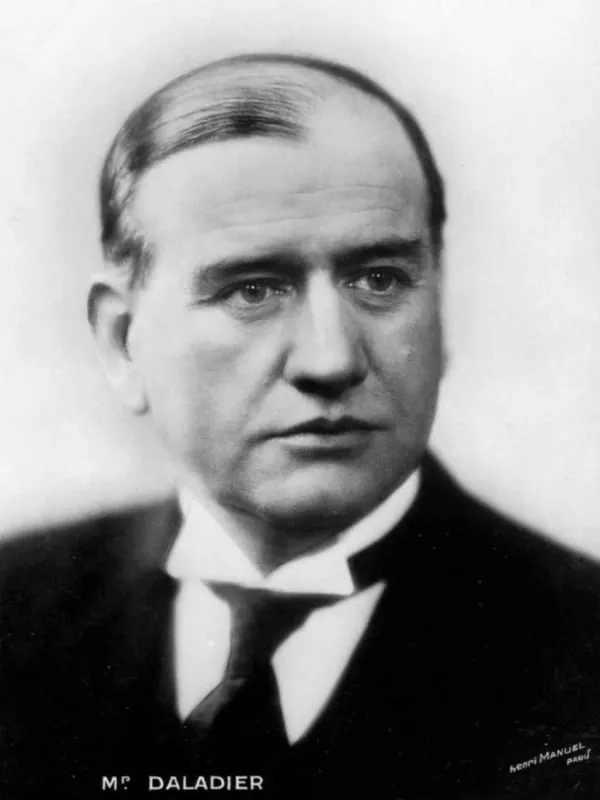
Édouard Daladier
Prime Minister of France (1933, 1934, 1938–1940), Minister of War and National Defence (1933–1934, 1936–1940), president of the Radical Party
- Born:
- 18 June 1884, Carpentras (France)
- Died:
- 10 October 1970, Paris
- Author:
- Natalia
- Photo:
- Henri Manuel, domena publiczna, Wikimedia Commons

Édouard Daladier was Prime Minister of France in the last two years of peace and the first months of the Second World War. Together with Neville Chamberlain he signed the agreement in Munich that handed Czechoslovakia’s Sudetenland to Hitler, and together with him he declared war on Germany on 3 September 1939. Unlike his British partner, he had no illusions about Hitler’s intentions, yet he gave way all the same, because he did not believe France could fight without Britain. A veteran of Verdun, the son of a Provençal baker and leader of the Radicals, he travelled the road from the Popular Front to government by decree, and from Munich to a fortress cell in which the Vichy regime locked him up. He survived the war in German captivity and sat in parliament for another thirteen years.
The teacher from Carpentras
He was born on 18 June 1884 in Carpentras in the Vaucluse department, the son of a baker, Claude Daladier. He was a gifted pupil. At the lycée in Lyon one of his teachers was Édouard Herriot, later leader of the Radicals and Prime Minister, with whom Daladier first worked closely and then for years competed for the party leadership. In 1909 he came first in the agrégation in history and geography and taught at lycées in Nîmes and Marseille. In 1912, aged 28, he became mayor of his home town. Two years later he stood unsuccessfully for parliament.
The war
When war broke out in 1914 he went to the front as a sergeant in an infantry regiment of the Foreign Legion, and in 1916 he transferred to the 209th Infantry Regiment. He fought at Verdun, was commissioned in April 1916 and ended the war as a lieutenant with three mentions in divisional dispatches and the Croix de Guerre. He was later promoted to captain in the reserve and awarded the Legion of Honour. The experience of the trenches, in which hundreds of thousands of his contemporaries died, shaped him for life. Like many Frenchmen of his generation, he was prepared to go to great lengths to prevent a repetition of that slaughter, while knowing full well what the German army was.
The Radical
In 1919 he was elected deputy for Vaucluse and sat in the Chamber of Deputies without a break until the end of the Third Republic. He belonged to the Radical Party, a centre-left party of the petty bourgeoisie, peasants and civil servants that was the pivot of almost every coalition of the period. He led its left wing and favoured cooperation with the Socialists. Burly, stubborn and taciturn, he earned the nickname “the bull of Vaucluse”. The malicious added that he had the horns of a snail. In the governments of the Cartel des Gauches he was Minister of the Colonies (1924–1925), briefly Minister of War and then of Education, and in 1930–1932 three times Minister of Public Works. From 1927 to 1930 he was president of the party.
On 31 January 1933, the day after Hitler took power in Berlin, Daladier became head of government for the first time, keeping the War Ministry for himself. His cabinet accepted the Four-Power Pact proposed by Mussolini, which was meant to bind Italy, Germany, France and Britain in a kind of directorate of the great powers. The pact, watered down at Paris’s insistence and signed in Rome in July 1933, never came into force, but it caused outrage in Poland and in the states of the Little Entente, which feared that the great powers would decide their borders without them. In the autumn of 1933 Germany left the League of Nations, and Daladier’s government fell on 24 October in a dispute over budget cuts.
He became Prime Minister for the second time on 30 January 1934, amid the scandal of the Stavisky affair, which had compromised a number of Radicals. When he dismissed the Paris prefect of police, Jean Chiappe, who enjoyed the sympathy of the right, the far-right leagues and veterans’ organisations took to the streets on 6 February. The demonstration outside the Palais Bourbon turned into bloody clashes with the police in which more than a dozen people were killed and over a thousand injured. Although the Chamber gave him a vote of confidence, Daladier resigned the next day. Part of the left regarded the 6 February crisis as an attempted fascist coup, and fear of one drew the Radicals, Socialists and Communists together.
The Popular Front and rearmament
Daladier was one of the architects of this rapprochement. On 14 July 1935 he marched in the great Popular Front procession alongside the Socialist Léon Blum and the Communist Maurice Thorez, and in 1936, once again as president of the Radical Party, he brought the Radicals into the victorious coalition. In June 1936 he became Deputy Prime Minister and Minister of National Defence in Blum’s government. He kept this post in successive cabinets until May 1940. Convinced that Germany was winning the arms race, in September 1936 he pushed through a 14-billion-franc programme to modernise the army – the largest such peacetime programme in French history – and brought part of the arms industry under state ownership. At the same time the government supported the policy of non-intervention in the Spanish Civil War. Rearmament, however, gathered pace slowly, and the air force remained the weakest link.
Prime Minister in the Munich years
After the fall of Blum’s second government, Daladier became Prime Minister for the third time on 10 April 1938. His government moved towards the centre and in effect brought the era of the Popular Front to an end. He had to rescue the public finances, devalued the franc and governed largely by decree-laws. From his first weeks in office he grappled with the crisis over Czechoslovakia, to which France was bound by an alliance of 1924. In London in April 1938 he told the British that Hitler was aiming at a domination of the Continent beside which Napoleon’s ambitions had been modest, and that after Czechoslovakia it would be the turn of Poland and Romania. He knew, however, that France could not win a war against Germany without Britain, and Maurice Gamelin’s general staff had no plans for an offensive that could actually help Prague. The Foreign Minister, Georges Bonnet, sought concessions at any price.
In September 1938 Daladier agreed to the Anglo-French plan to cede the Sudetenland to Germany and, together with the British, forced President Edvard Beneš to accept it. When Hitler raised his demands at Godesberg, the French Prime Minister said he preferred war to such humiliation and called up reservists. But when Chamberlain accepted the invitation to Munich, Daladier went too. On 29 and 30 September he signed the Munich Agreement. On his return, greeted by a cheering crowd at Le Bourget airport, he reportedly muttered, according to witnesses: “Ah, the fools! If only they knew…” In his memoirs he wrote more calmly that he had expected tomatoes and got flowers. The Chamber of Deputies approved his policy by 535 votes to 75. A few weeks later Daladier said that if he had had three or four thousand aircraft, there would have been no Munich.
After Munich the Prime Minister chose a “hard line”. In November 1938 the new Finance Minister, Paul Reynaud, used decrees to abolish the 40-hour working week in practice, raise taxes and increase spending on armaments. The government broke the general strike of 30 November with the help of the army and mass dismissals. The finances improved and aircraft production rose rapidly, helped by orders for aircraft in the United States. At the same time the government issued decrees on the control of foreigners that allowed “undesirable” aliens to be interned. They struck at refugees from Germany and Central Europe, many of them Jews, and from February 1939 at hundreds of thousands of Spanish Republicans, who were confined in camps on the beaches of southern France. When, in November 1938, Fascist deputies in Rome began clamouring for Tunisia, Corsica and Nice, Daladier replied with a firm refusal and in January 1939 paid demonstrative visits to Corsica and Tunisia.
The war
After Germany occupied Prague in March 1939, France joined the British guarantees to Poland and Romania. Daladier, more than Chamberlain, wanted to bring the Soviet Union into the alliance and was irritated by Poland’s refusal to allow the Red Army to pass through its territory. The Molotov–Ribbentrop Pact of 23 August put an end to these plans. The government banned the communist press and in September dissolved the French Communist Party, which had backed Stalin’s policy. On the afternoon of 3 September 1939, a few hours after Britain, France declared war on Germany.
Contrary to its commitments to Poland, the French army undertook no serious offensive. After a brief and cautious advance into the Saar it withdrew behind the Maginot Line, and the Phoney War began. When Hitler made his “peace offer” at the beginning of October, Daladier rejected it, saying that France would not lay down its arms until it had obtained guarantees of security that would not be threatened every six months. When the Soviet Union attacked Finland, the government promised help but did not manage to provide it before Finland capitulated in March 1940. On 20 March, in a vote of confidence, most deputies abstained, and Daladier resigned. Reynaud became Prime Minister, while Daladier remained Minister of National Defence. He defended Gamelin, whom Reynaud wanted to dismiss. After the German breakthrough at Sedan in May 1940 he swapped portfolios with Reynaud and for two weeks was Foreign Minister, while Gamelin was replaced by General Maxime Weygand. On 5 June Daladier left the government.
In prison
After the defeat, on 21 June 1940, Daladier and a group of parliamentarians, among them Pierre Mendès France and Jean Zay, sailed from near Bordeaux for Morocco aboard the Massilia, believing that the government would continue the fight in North Africa. Marshal Philippe Pétain, however, concluded an armistice, and the passengers of the Massilia were portrayed as deserters. Daladier was arrested and sent back to France. The Vichy regime made him, together with Blum and Gamelin, one of the chief defendants at the Riom Trial, which from February 1942 was meant to prove that the politicians of the Third Republic were to blame for the defeat. Daladier and Blum defended themselves so effectively, pointing to the responsibility of the military high command, including Pétain himself, that in April 1942 the trial was suspended, officially so that the investigation could be completed.
Daladier was held at the Château de Chazeron and in the Fort du Portalet in the Pyrenees. After the Germans occupied southern France he was handed over to them. In April 1943 he was taken to the Weimar area, where he was held near the Buchenwald concentration camp, and in May 1943 to Schloss Itter in the Tyrol, where the Germans kept prominent Frenchmen: Reynaud, Gamelin, Weygand, the trade unionist Léon Jouhaux and others. The prisoners, divided by old quarrels, barely spoke to one another. On 5 May 1945 they were freed after the Battle for Castle Itter, in which American soldiers, a group of Wehrmacht soldiers who had gone over to the Allies, and the prisoners themselves beat off an attack by Waffen-SS troops.
After the war
On his return Daladier faced the hostility of the Communists and part of the Resistance, who blamed him for Munich and for dissolving the Communist Party. In 1946 he returned to parliament and sat there until 1958, supporting the Radicals’ young reformer Pierre Mendès France. From 1953 to 1958 he was mayor of Avignon. In 1958 he voted against entrusting power to General Charles de Gaulle, lost his seat in the election that autumn and withdrew from politics. He died in Paris on 10 October 1970 and was buried in Père Lachaise Cemetery.
Assessment
In collective memory Daladier stands in Chamberlain’s shadow, as his weaker and more passive partner at Munich. Historians, especially French ones, stress, however, that it was he, not Chamberlain, who understood Hitler, and that he gave way not out of illusion but out of a sense of powerlessness: in the face of a weak air force, an empty treasury, the army’s defensive doctrine, the pacifism of the electorate and, above all, France’s dependence on Britain. In the year after Munich his government restored the public finances and accelerated rearmament, and in September 1939 France kept its word and went to war. Critics reply that it was France, bound by an alliance with Czechoslovakia, that let its ally down most of all, and that in September 1939 it gave Poland no real help, even though Germany had only weak forces in the west. For the Czechs his signature on the Munich Agreement remained the symbol of betrayal by the ally they had trusted most.
Sources
Mentioned in battles
(04)Often appears with
People who appear in the same events.
On the timeline
(39)1937
1938
1939
March
April
June
August
- 25
- Key eventThe Anglo-Polish allianceOn 25 August 1939 Raczyński and Halifax signed a mutual assistance agreement in London. A secret protocol stated that the “European Power” meant Germany.
- Hitler halts the attack on PolandOn 25 August 1939 Hitler ordered an attack on Poland for the next dawn, but that evening revoked it after news of the London alliance and Mussolini's refusal.